
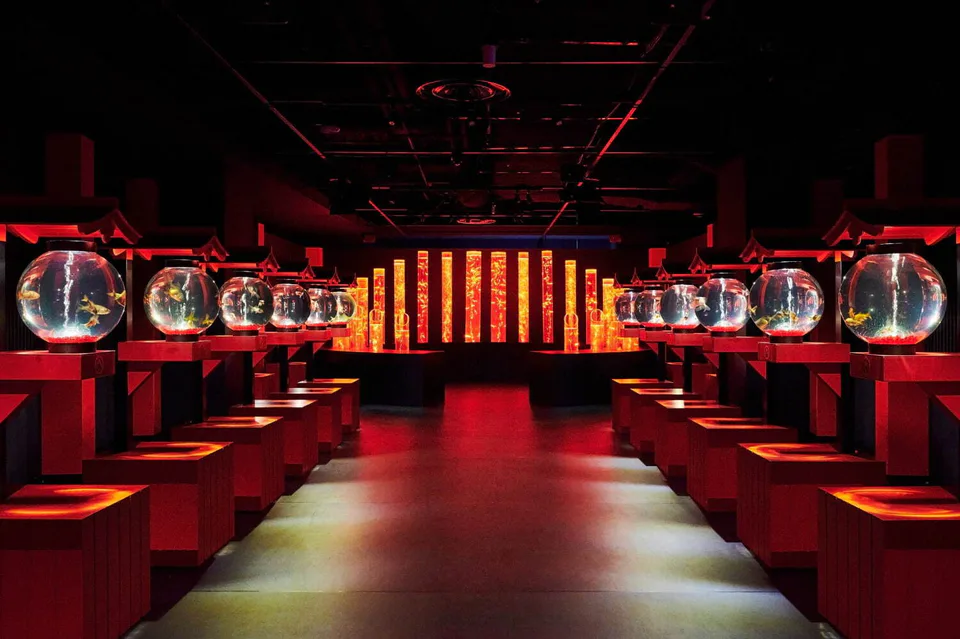
Art Aquarium Museum GINZA is worth the current JPY 2,500 (about US$16) web price when Ginza is already part of your day, you want a compact visual attraction rather than a conventional aquarium, and you are personally comfortable with live goldfish being used as part of the artistic medium. I would skip it if any of those three conditions fails. It is strongest as a 60–90 minute Ginza add-on, not as a cross-Tokyo destination that displaces a higher-priority museum or teamLab visit.
There is also an important late-summer 2026 correction. Summer Art Aquarium 2026 continues through September 30, but the special after-4 p.m. “Mystical Goldfish Museum” / yokai-style evening programme ran only from July 21 through August 12. If you visit now, do not buy a normal late-afternoon ticket expecting the venue to switch into that expired evening version because you saw older social posts or an old ticket page.
Ticket and event information rechecked August 27, 2026. Approximate USD conversions use JPY 1,000 ≈ US$6.28 only for orientation; exchange rates move.
↔ Scroll table left or right
Your real question | Verdict | Why |
Ginza is already on the route and you want a compact visual stop | Strong fit | The venue is inside Ginza Mitsukoshi and does not need to consume a half-day |
You want a normal aquarium with species variety and education | Skip | This is a goldfish-based living-art installation, not a conventional aquarium |
Live animals used as art are an ethical veto for you | Skip | The operator explains the concept, but its own pages are not independent animal-welfare verification |
You only have one major immersive-art slot in Tokyo | Compare teamLab first | Art Aquarium wins on compactness and Ginza geography; teamLab is more naturally an anchor attraction |
Family with young children | Potentially strong value | One paying general/student visitor can currently bring up to two elementary-school-age-or-younger children free |
Stroller or suitcase on a hotel-transfer day | Solve storage before booking | Strollers and suitcases are not allowed inside the museum |
You are visiting after August 12 expecting the yokai evening version | Do not buy for that reason | That limited evening programme has ended even though Summer Art Aquarium continues |
ValueNavi Attraction Score: 9/10 route fit in Ginza can become a 5/10 detour across Tokyo
This score separates two travellers because geography changes the recommendation more than the ticket price does. The first is already spending part of the day in Ginza / Yurakucho / Tokyo Station. The second is crossing Tokyo mainly for Art Aquarium and then leaving the area again. Ten means more traveller-friendly for that dimension. This is editorial analysis, not an official attraction rating.
Decision dimension | Already in Ginza | Dedicated cross-Tokyo trip | Why |
|---|---|---|---|
Route fit | The attraction becomes a building-level add-on in Ginza but a separate transport assignment when it is the only reason for the district | ||
Time efficiency | A 60–90 minute visit is efficient only when the approach and exit do not consume another large block | ||
Weather resilience | The museum itself is indoors; rain changes surrounding plans more than the core visit | ||
Booking flexibility | Official web tickets are date-and-time specified, capacity can still create a wait, and re-entry is not allowed | ||
Luggage / stroller resilience | Strollers and suitcases cannot enter, so a transfer-day visit adds a separate storage problem | ||
Family price efficiency | One paying general/student visitor can bring up to two elementary-school-age-or-younger children free under the current policy | ||
Experience distinctiveness | The goldfish, sculptural tanks, lighting and Japanese visual language form a product that is not simply a small conventional aquarium |
Ethical fit is intentionally not scored. If using live animals as an artistic medium is a personal veto, a 9.5 route-fit score cannot “average it away.” The same logic applies to luggage: on a transfer day with a suitcase you cannot store cleanly, the hard routing constraint matters more than the average of the other dimensions.
This is why I would not publish one overall 7.8/10. The useful proprietary data is conditional: Art Aquarium is highly efficient when the Ginza route is already solved, but its actual experience does not become better merely because you spend another hour crossing Tokyo to reach it.
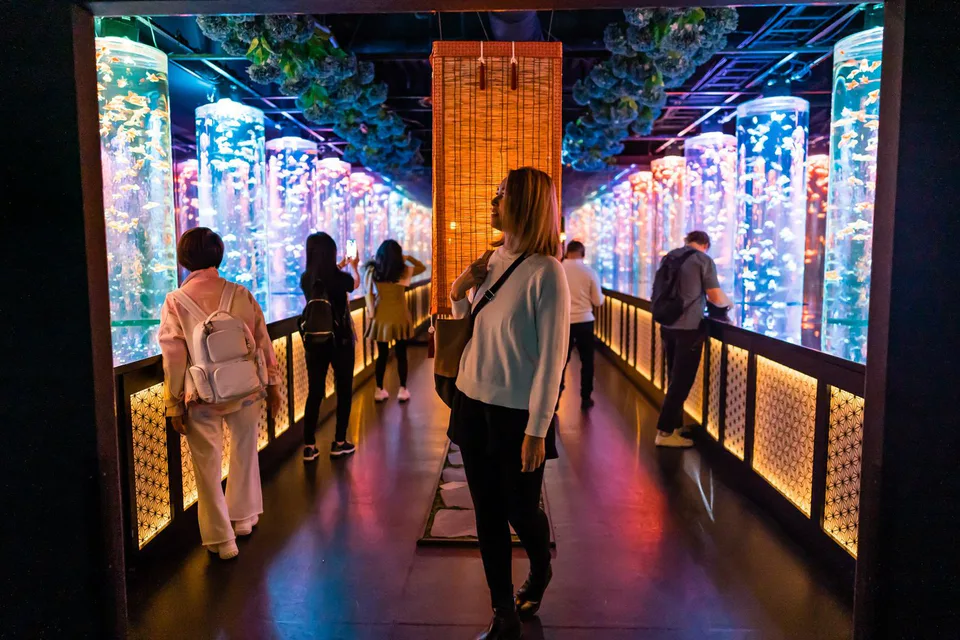
First decide whether “living art” is a product you want to support
The operator describes Art Aquarium as a combination of goldfish, sculptural tanks, light, sound, fragrance and Japanese aesthetics. That means living animals are part of the visual medium rather than incidental to it.
This should be a first-order decision, not a footnote near the end of the review. Some travellers are comfortable with ornamental goldfish as part of a contemporary interpretation of Japanese goldfish culture. Others are not comfortable supporting an attraction that uses live fish in decorative installations.
The public operator pages explain the concept and the fish on display, but they are not an independent husbandry or animal-welfare audit. If you require independent welfare evidence before supporting this kind of attraction, the rational answer is to choose a non-animal art venue rather than buying the ticket and hoping the word “museum” resolves the concern.
The current ticket is really a geography-and-time purchase
The current official general web ticket is JPY 2,500 (about US$16), while the same-day ticket is JPY 2,700 (about US$17). Standard hours are currently 10:00–19:00 with last admission at 18:00, subject to Mitsukoshi closing days, maintenance and special events.
The ticket price is not the main cost. The stronger cost is the Tokyo time slot. I would reserve about 60–90 minutes for a normal visit, with more time only if photography or watching individual fish is a major part of the experience. That is ValueNavi planning guidance rather than an official visit-time guarantee.
If you are already shopping in Ginza, eating nearby or moving between Yurakucho and Tokyo Station, the geographic cost is low. If you are crossing from Shinjuku, Asakusa or another part of Tokyo solely for this attraction and then travelling back across the city, the same JPY 2,500 ticket has a much larger opportunity cost.
My decision rule: Art Aquarium should normally fit into an existing Ginza day. It should need a stronger personal reason before it becomes the destination that the rest of the day is built around.
ValueNavi Total Commitment: add the detour before judging a JPY 2,500 ticket
A useful attraction-cost equation is:
Total commitment = museum time + district detour + timed-entry buffer + luggage/stroller handling
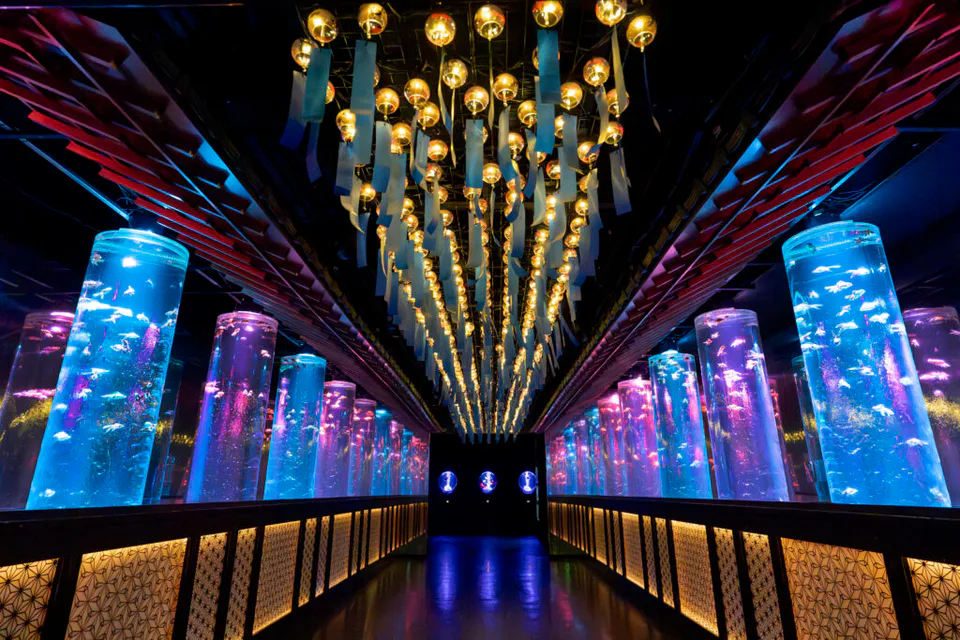
For someone already in Ginza, the detour term can approach zero. For someone coming from west or east Tokyo only for this ticket, transport becomes a large share of the experience. On a hotel-transfer day, storage becomes another hard term. This is why the same JPY 2,500 purchase can be excellent value in one itinerary and weak value in another without the museum itself changing at all.
ValueNavi Route-Conflict Matrix: when a 60–90 minute visit stays compact
The museum’s strongest advantage is not simply that the exhibition itself is short. It is that the visit can stay short when the rest of the day is already in the same travel corridor. Once luggage storage, a separate cross-city transfer or another major immersive attraction is added, the 60–90 minute museum block stops describing the real commitment.
↔ Scroll table left or right
Day pattern | Fit | Why | What can break the plan |
Ginza shopping or meal day | Strong | The museum becomes one contained indoor block rather than a separate district assignment | Timed entry reduces spontaneity, so solve the sequence before going upstairs |
Wet central-Tokyo afternoon | Strong | The indoor visit can replace an outdoor block without needing the whole day to move around it | Rain does not remove the stroller, suitcase or timed-entry constraints |
Tokyo Station / Yurakucho day with bags already stored | Good conditional fit | The attraction can sit inside an already-central day rather than creating a dedicated outing | A suitcase that is not already stored turns a compact visit into a separate logistics task |
Hotel-transfer day with a suitcase or stroller dependence | Weak | Storage and child-carry logistics can consume more planning energy than the museum visit itself | Move the attraction to a normal sightseeing day unless storage is solved before the ticket time |
Only one major immersive-art slot in Tokyo | Compare teamLab first | Art Aquarium’s comparative strength is compactness; it does not need to replace the trip’s anchor immersive experience | Choose Art Aquarium as the anchor only when its specific living-art format is the priority |
Conventional aquarium goal | Skip | The product category is wrong for travellers prioritising species variety, large habitats or educational interpretation | Choose a conventional aquarium instead of trying to make the name “Aquarium” fit the wrong expectation |
Decision rule: if Art Aquarium can be inserted without creating a new transport, storage or experience conflict, keep it on the shortlist. If the museum needs the rest of the day to bend around it, its main advantage—compactness—has already been spent.
Do not confuse Summer Art Aquarium with the expired after-4 p.m. programme
The main Summer Art Aquarium 2026 exhibition runs from June 26 through September 30. The operator’s detailed launch notice lists new or newly presented spaces including the Goldfish Folding Screen Room, Super Oiran – Yui and Edo Kiriko-related displays.
Separately, the official ticket system advertised a limited “Mystical Goldfish Museum: A Hauntingly Beautiful World of Sound and Light” programme from July 21 through August 12, with the special version beginning from 16:00. That programme is now over.
This matters because old ticket pages and social posts can survive after a limited programme ends. For a late-August or September visit, the useful question is whether the regular Summer Art Aquarium appeals to you. Do not treat an expired evening overlay as part of the product you are currently buying.
There is also a small first-party source mismatch worth knowing: the operator homepage currently contains a visible year typo beside the Summer Art Aquarium end date, while the detailed June 25 announcement clearly states September 30, 2026. When first-party pages conflict, use the detailed current-year event notice and live ticket flow rather than silently averaging the two.
Use the correct substitute: aquarium, museum or immersive-art anchor
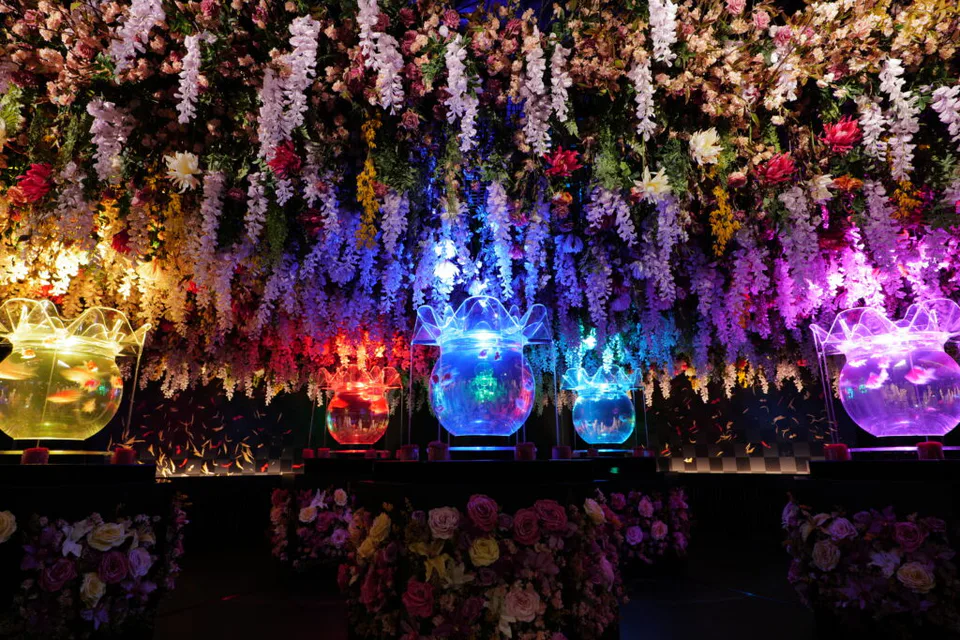
Art Aquarium is easy to compare badly because its name contains both “art” and “aquarium.” A conventional aquarium is normally judged by species variety, habitat interpretation, large tanks and educational content. Art Aquarium is better understood as a designed visual installation centred on ornamental goldfish.
If what you want is a conventional aquarium, skip this comparison and choose a real aquarium. If you want collection-led art without live animals, compare a central museum such as Artizon Museum. If you have only one major immersive-art slot in Tokyo, compare teamLab before booking.
The distinction is itinerary scale. Art Aquarium is good at being small enough to add. A larger immersive attraction is better when the immersive experience itself deserves to anchor the day. Saving money on a shorter attraction is not value if it causes you to miss the experience you actually wanted.
Strollers and suitcases are hard routing constraints
The official visitor rules state that strollers and suitcases cannot enter the museum. The ticket system also says the museum itself does not provide luggage lockers. Strollers can be left at the designated Mitsukoshi area, while luggage needs to be solved elsewhere in the building or before arrival.
This makes Art Aquarium a weaker choice between hotel checkout and an airport or Shinkansen departure. The venue may be geographically central, but a timed ticket plus luggage storage creates more hard edges than the same attraction has on a normal Ginza afternoon.
For a family, the free-child policy does not remove the stroller problem. If a young child normally relies on a stroller through a shopping day, factor in whether the child can walk the exhibition or needs to be carried.
The family price can be excellent without making the attraction automatically family-friendly
Under the current official pricing, one paying general or student visitor can bring up to two elementary-school-age-or-younger children free. That can produce a very low effective family admission price.
But “free child admission” should not decide the itinerary. A child who enjoys colour, fish and visual environments may get a lot from the visit. A child who needs hands-on play, large animals or a long activity block may not. The right question is whether this format fits the child, not whether the child ticket is cheap.
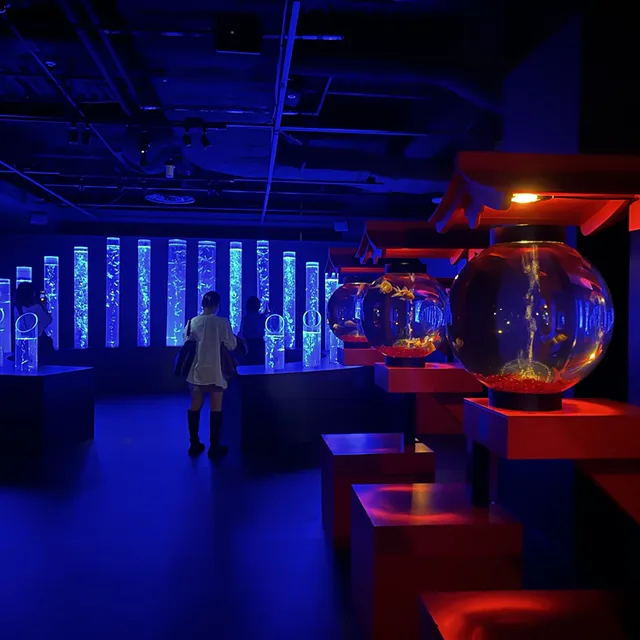
Photography is a benefit, not a guaranteed outcome
The official FAQ permits personal photography and video, but flash, external lighting, tripods and monopods are prohibited. That makes the venue friendly to phones and handheld cameras rather than controlled shooting.
If photography is the main reason for visiting, budget extra time rather than extra equipment. Other visitors, reflections and moving fish are part of the environment. A useful red-team test is whether you would still enjoy the visit if you never get the empty, perfectly framed shot you saw online. If not, the ticket is depending too heavily on an outcome it does not guarantee.
Timed entry means the Ginza sequence should be solved before you go upstairs
Official web tickets are date-and-time specified, and capacity controls can still create a wait. Re-entry is not permitted after you leave.
The efficient sequence is therefore: solve luggage and stroller storage → eat or use the toilet if needed → enter → finish the museum in one continuous block → continue with Ginza, Yurakucho or Tokyo Station. Do not use the ticket as a flexible bookmark between unrelated errands.
This is why the museum is particularly useful on a wet Ginza day. It creates an indoor visual block without forcing a cross-city transfer, while still leaving room for shopping, cafés or another central museum.
Final verdict
Art Aquarium Museum GINZA is worth it when four conditions line up: Ginza is already useful to your day, you want a compact visual attraction, the live-goldfish medium is acceptable to you, and the ticket is not displacing a higher-priority immersive or museum experience.
Skip it when the animal-medium issue is a veto, when you are crossing Tokyo solely for it, when you want a conventional aquarium, or when suitcases/stroller logistics turn a simple 60–90 minute stop into a transfer-day problem.
For late summer 2026, also separate two products that are easy to confuse: Summer Art Aquarium continues through September 30; the special 16:00-after-dark yokai programme ended on August 12. Buy the ticket for the exhibition that exists on your date, not the version that appeared in an older post.
References
Art Aquarium Museum GINZA — official site · official Summer Art Aquarium 2026 announcement · official ticket store · official 2026 limited evening-programme ticket page · official visitor rules and opening hours. Checked August 27, 2026. Operator pages are used for prices, rules and the operator’s own description; they are not presented as independent animal-welfare verification.