Kanmon Strait Museum is worth the ¥500 adult ticket when the strait itself is part of the reason you came to Mojiko—not when you only need a retro-photo stop. The free Retro Lane, promenade deck, observation deck and fourth-floor cafe space already give short-stay visitors a useful indoor break. The paid zone becomes the better use of time for families, rainy or very hot days, and travellers interested in ships, ports, transport systems or the history connecting Mojiko with Shimonoseki.
The price is unusually low: ¥500 is roughly USD 3.15 / TWD 100 at late-August 2026 exchange rates. That makes the cash decision easy, but the time decision is more important. A rushed 25-minute paid visit is worse value than a free 25-minute stop; a deliberate 60–90-minute visit can materially improve the rest of a Mojiko day because the traffic and geography of the Kanmon Strait become easier to read outside.
If you are still deciding whether Kitakyushu belongs in your Fukuoka trip at all, start with where to base yourself in Fukuoka for day trips. This guide starts one decision later: Mojiko is already in the itinerary, and the question is how much museum time it deserves.
↔ Scroll table left or right
Your situation | Best choice | Why | Main risk |
20–40 minutes before a ferry, train or meal | Free areas only | You still get Retro Lane, views and an indoor break | Paid admission creates clock-watching rather than value |
60–90 minutes, adult interested in ships/history | Paid zone | Enough time for the large-screen sequence, models and interactive displays | Arriving between scheduled presentations can weaken the visit |
Family with children | Paid zone + consider Children’s Square | More active than a label-heavy local museum | Weekend/holiday play sessions can be time-limited |
Clear-weather, photo-first Mojiko visit | Start free | Waterfront, ferry and heritage streets compete strongly for daylight | Paying simply because ¥500 feels cheap can waste the better outdoor hour |
Rain, heat or outdoor fatigue | Paid zone becomes stronger | The museum can absorb a weak outdoor period without breaking the day | Do not push it too late; last admission is not a full-visit guarantee |
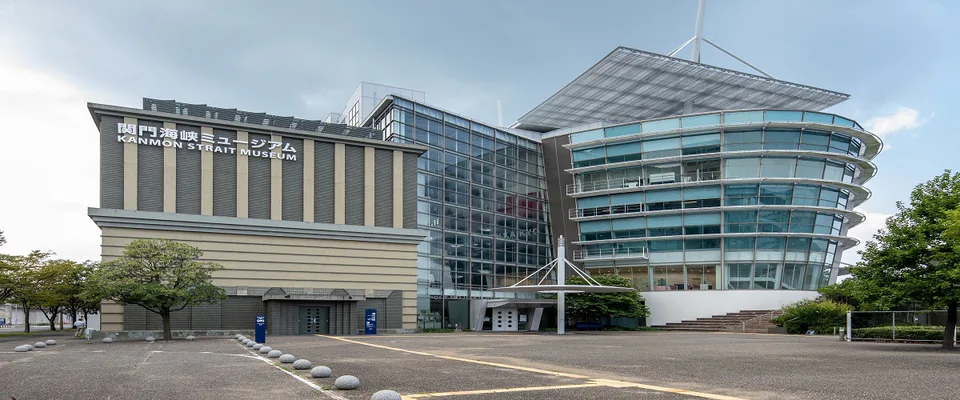
The ¥500 question is really a time-allocation question
Current official admission is ¥500 for adults and ¥200 for elementary and junior-high students—approximately USD 3.15 / TWD 100 and USD 1.25 / TWD 40. The separate Kaikyo Children’s Square costs ¥100 for visitors aged one and older, about USD 0.65 / TWD 20. JPY remains the price to use when budgeting; the converted figures are only scale references.
At these prices, a traditional “does the ticket pay back?” calculation is not very useful. The better question is what the same hour could do elsewhere. Mojiko has a ferry connection, heritage buildings, waterfront walking, yaki curry, the observation room and views whose quality changes with weather and daylight. The museum therefore earns its slot by protecting or improving the route—not by being cheap.
ValueNavi time rule: under 40 minutes, stay free; around 60–90 minutes, the paid zone has room to work; with children, allow roughly 90–120 minutes if interactive stations and the play area matter. Treat these as planning ranges rather than official duration promises.
The free areas are a real alternative, not a teaser
The museum’s official information lists the promenade deck, observation deck, cafe and Kanmon Strait Retro Lane as free areas. That means a traveller can enter, get out of rain or heat, see the retro streetscape and look toward the strait without automatically buying museum admission.
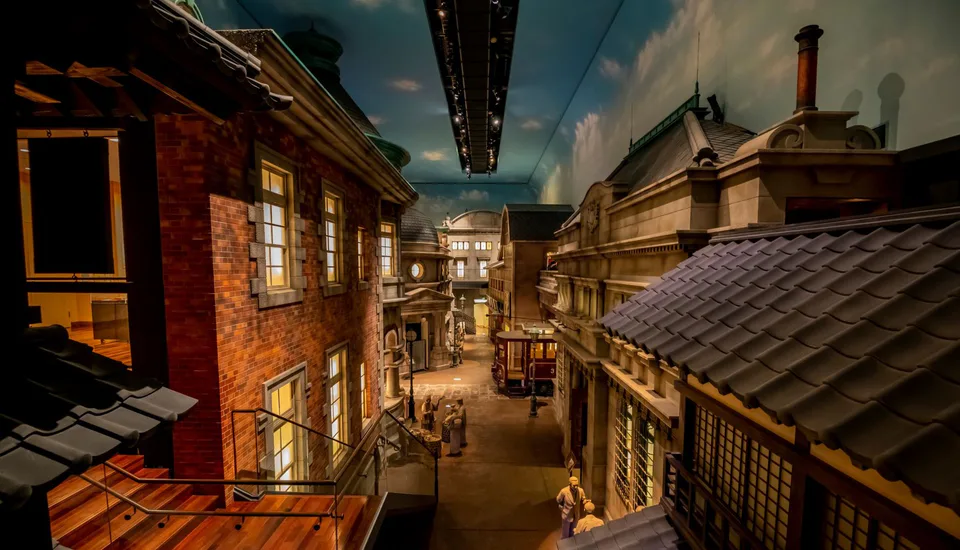
The Retro Lane recreates the atmosphere of Mojiko’s trading-port era through period shopfronts and transport scenes. For a visitor whose Mojiko priorities are architecture, photography, curry and the waterfront, that can be enough context. The decision should not be “I came all the way here, so I may as well pay.” It should be “Will another hour indoors make the rest of the strait more interesting?”
There is also an important correction to older information: Cruise Cafe Canal ended operations on April 14, 2026, but the fourth-floor cafe space did not remain empty. The official site announced KUU COFFEE from April 25, with its grand opening from May 1 and planned hours of 9:00–17:00. So the free fourth-floor stop is again more useful than an outdated guide may suggest.
The paid zone is strongest when you catch the visual programme, not when you drift through it
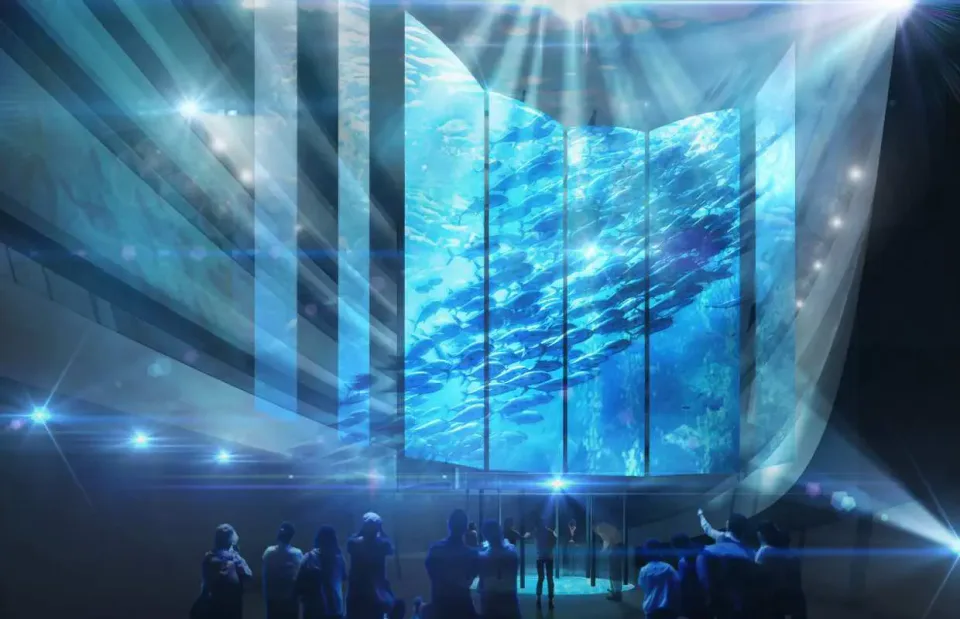
The paid experience works best as an explanation of the waterway outside. Large-scale visual presentations, historical models and interactive exhibits frame the Kanmon Strait as a narrow transport route with currents, traffic, geography and strategic history—not simply the water between Mojiko and Shimonoseki.
The official museum page currently publishes presentation times, which creates a useful planning advantage. “A Day in the Strait” is scheduled at 10:30, 12:30, 14:30 and 16:30. History-themed visual programmes are listed at 10:00, 12:00, 14:00 and 16:00 for “The Story of Mojiko,” and 11:00, 13:00 and 15:00 for another Kanmon history sequence.
That schedule changes the best arrival strategy. If a main presentation is 10–15 minutes away, starting with nearby displays and then catching it can create a more coherent visit. Arriving just after one and leaving before the next can make the same ¥500 ticket feel more like a conventional small local museum.
History fans should use the models as anchors instead of trying to read everything
The Kanmon Strait connects several layers of Japanese history, including the Battle of Dan-no-ura, Ganryujima stories, shipping, military activity and the growth of Mojiko as a port. The practical way to use the museum is not to read every panel in sequence. Start with the visual or three-dimensional displays that connect a historical episode to a place you can still see outside, then go deeper only where the subject matters to you.
This selective approach matters for English-language visitors because local museums can vary in how much non-Japanese explanation is available from display to display. The museum includes multilingual support across parts of the experience, but the strongest information gain comes from understanding the physical relationship between port, strait and opposite shore rather than trying to translate every date.
Families get a different product from the same ticket
For adults, interest in maritime systems is the main value driver. For families, the interaction itself adds value: operating, identifying, watching and moving between displays creates a different pace from a museum built mostly around text panels.
The separate Kaikyo Children’s Square deserves its own planning decision. Official guidance says it is for ages one through elementary-school age, while the play equipment itself is aimed at ages three and older. On weekends, national holidays and long school breaks, use can be limited to 40-minute sessions. The museum also asks users to wear athletic shoes.
That means a family should not automatically add “museum + play area” to a tight ferry itinerary. If the child mainly needs active play, the ¥100 add-on can be excellent value. If a 40-minute session would push the family past lunch, ferry or train timing, the low price is irrelevant—the schedule cost is higher than the cash cost.
Weather changes the museum’s opportunity cost more than its admission value
On a clear, comfortable day, Mojiko’s outdoor assets are difficult competition. The heritage station area, Blue Wing Moji, waterfront views and ferry all benefit from being outside. Using the first bright hour inside simply because the museum is nearby can be poor sequencing.
In rain, strong summer heat or after a long walking block, the calculation flips. The museum is one of the few Mojiko stops where bad weather can actually increase relative value: the paid exhibits remain usable while the opportunity cost of skipping outdoor sightseeing falls.
This creates a useful weather-resilience strategy: do not necessarily lock the museum to a fixed morning hour. On uncertain weather days, keep it as the indoor block that can expand from free-only to a full paid visit if conditions deteriorate.
16:30 last admission is a hard operational boundary, not a recommended arrival time
Official hours are currently 9:00–17:00, with last admission at 16:30. A traveller entering at 16:25 may technically be admitted, but that does not create the 60–90 minutes needed for a relaxed paid visit. It can also leave almost no flexibility around the scheduled visual programme.
A better rule is to protect the museum’s last full hour. If arrival slips past about 16:00 and the paid zone is not the day’s priority, use the free areas and preserve the remaining time for the waterfront or onward transport.
The official 2026 calendar currently lists irregular closure dates including September 8 and November 10, 2026, followed by January 12, 2027. A separate August 13 maintenance closure has already passed. Recheck the official page for your exact date because these facility-specific closures matter more than generic “open daily” summaries.
Put the museum between transport commitments, not in front of them
The official access information places the museum about a nine-minute walk from JR Mojiko Station. That makes it easy to use as a middle block in a Mojiko route rather than the first or last thing at any cost.
↔ Scroll table left or right
What else is fixed today? | Museum role | Why |
Ferry departure / Karato Market connection | Buffer activity | Use free areas if the ferry clock becomes tight; do not force a paid visit |
Observation-room sunset | Earlier indoor block | Do not let a flexible museum hour consume the weather-dependent view |
Rainy afternoon | Anchor activity | Outdoor opportunity cost is lower, so 60–90 paid minutes become easier to justify |
Return train to Hakata | Cuttable block | The museum ticket is cheap; missing the planned train connection is not |
If you are travelling from Hakata, the expensive part of the day is transport rather than museum admission. Check whether the JR Kyushu Northern Kyushu Rail Pass actually pays back for your route before optimizing around a ¥500 entrance fee. If sunset, dinner and the return to Fukuoka make Mojiko feel compressed, BEB5 Mojiko changes the calculation by turning the strait into an overnight stop.
ValueNavi decision score: paid zone vs free-only visit
↔ Scroll table left or right
Decision factor | Paid zone | Free-only |
Cash cost | 5/5 — ¥500 is low | 5/5 — no admission |
Time efficiency under 40 min | 2/5 | 5/5 |
Rain / heat resilience | 5/5 | 3/5 |
Value for ship / port / history interest | 5/5 | 2/5 |
Photo-first Mojiko itinerary | 2/5 | 4/5 |
Family interaction | 4/5 | 2/5 |
The score is deliberately not one universal number. The museum changes value by trip type. For a maritime-history fan on a rainy day, the paid zone is an easy yes. For a traveller with 30 minutes before the ferry, the free spaces can be the better product even though the ticket costs only a few dollars.
Should you buy the ticket in advance?
Advance purchase is not the first decision to solve. First confirm that Mojiko is staying in the route, that the museum is open on your date, and that you will have enough time for the paid zone. Then compare the exact e-ticket’s redemption and cancellation terms.
Klook | Check the Kanmon Strait Museum e-ticket for your date
KKday | Compare redemption and cancellation terms for the same admission
Use either booking option as a final verification step rather than a reason to force the museum into the itinerary. This article may contain affiliate links; ValueNavi may earn a commission from a qualifying booking at no additional cost to you.
Final verdict: pay for context, not because ¥500 feels cheap
The Kanmon Strait Museum’s unusual strength is that the free and paid products solve different needs. Free areas are enough for a short indoor reset, retro atmosphere and strait views. The paid zone is for understanding why the water outside mattered—and still matters—as a transport corridor.
Choose the paid zone if you have at least an hour, bad weather has weakened the outdoor plan, children want interactive content, or ships and local history are already genuine interests. Stay free if your visit is photo-first, the ferry or sunset is the real priority, or you have less than about 40 minutes.
The cheapest ticket can still be the wrong use of time. Here, the best decision is not “¥500 is inexpensive, so go in.” It is “does this hour make Mojiko better than the hour it replaces?”
Current facts to recheck before you go
Fact check: August 26, 2026. The official Mojiko Retro site currently lists Kanmon Strait Museum at 9:00–17:00, last admission 16:30; adults ¥500, elementary and junior-high students ¥200; Kaikyo Children’s Square ¥100 for ages one and older. The promenade deck, observation deck, cafe and Kanmon Strait Retro Lane are free. KUU COFFEE was announced for the fourth-floor cafe space from April 25, with grand opening from May 1. JR Mojiko Station is about a nine-minute walk. Upcoming irregular closures currently include September 8 and November 10, 2026, followed by January 12, 2027. Presentation times, closures, admission and e-ticket terms can change, so recheck before travel and payment.
Currency guide: ¥1 ≈ USD 0.00628 / TWD 0.200 in late August 2026. JPY prices are authoritative; USD/TWD figures above are rounded planning references.
Official sources: Mojiko Retro official Kanmon Strait Museum page · official KUU COFFEE opening notice · Mojiko Retro English facility guide.