
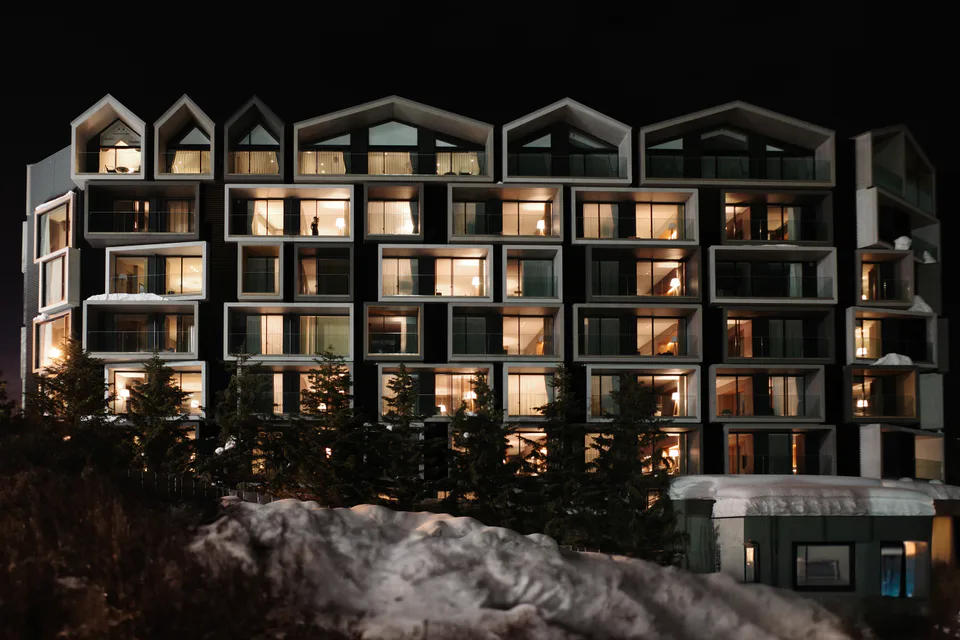
MUWA Niseko is easiest to justify when you are a family or group staying several nights and skiing Grand Hirafu repeatedly. The premium is not just buying a luxury label. It can buy three things you use every day: direct slope access toward King Gondola, residence-scale living space, and a kitchen that reduces the friction of feeding a group. If you are a couple staying one or two nights, will not cook, and only ski once, much of that value disappears.
↔ Scroll table left or right
Your trip | My call | Why |
Family/group, 4–7 nights, Grand Hirafu most days | Strong fit | Ski access, shared living space and kitchen can be used repeatedly |
Two adults, 1–2 nights, one ski day | Price carefully | The residence features have little time to repay a high nightly premium |
Group needs 2–4 real bedrooms and common space | Strong fit | The official project lineup scales from 1.5 to 4 bedrooms with substantial floor area |
Beginner skier | Conditional | Direct slope access is useful, but the easiest return route still depends on snow, open runs and ability |
Non-skier who wants HANAZONO | Wrong base | MUWA is Upper Hirafu beside Grand Hirafu, not HANAZONO |
Mount Yotei view is the main reason to upgrade | Only book a named view category | Weather can erase the mountain even when the room category is correct |
Start with ski days: the room premium should be divided by how often you use the ski edge
The official MUWA project page says the property sits beside Niseko Tokyu Grand Hirafu and lets guests ski directly from the hotel toward King Gondola. That is a meaningful location benefit when it repeats.
A useful ValueNavi calculation is:
ski-access premium per useful ski edge =
(extra hotel cost versus your realistic alternative)
÷ (morning ski departures + end-of-day ski returns you will actually use)
A five-night stay with four ski days can create eight useful ski-edge moments: four mornings and four returns. A one-night stay with one ski day may create only one or two. The same nightly premium therefore buys very different amounts of practical value.
This is also why “ski-in/ski-out” should not end the analysis. The return route can change with snow cover, open runs, grooming and skier ability. For the weakest skier in the group, ask the hotel or ski school how the current return works and whether an easy alternative exists. A direct exit is valuable only if the whole party can use it safely.
MUWA is in Upper Hirafu, not HANAZONO
This sounds obvious, but it prevents a costly booking mistake. MUWA is aligned with Grand Hirafu and King Gondola. Park Hyatt Niseko is in HANAZONO, a different base within Niseko United.
Choose MUWA when Hirafu is where your ski lessons, restaurants, friends and daily slope flow are concentrated. Do not choose it because “Niseko is all connected” if the trip is actually built around HANAZONO. The mountains connect ski areas; your hotel evenings, lesson meeting points and non-skiing companions still live on the ground.
If the base itself is undecided, use Where to Stay in Niseko: Hirafu, HANAZONO, Annupuri or Niseko Village before comparing individual hotels.
The residence space is the strongest non-ski reason to pay more
The current official project page highlights four representative residence sizes:
↔ Scroll table left or right
Residence | Published interior area | What the space is best used for |
1.5 Bedroom | 65.18 m² | Couple or small family wanting a real living area rather than a conventional hotel room |
2 Bedroom | 91.58 m² | Family of four or two couples when the exact bedding works |
3 Bedroom | 139.79 m² | Larger family/group that will use shared living and dining space |
4 Bedroom | 217.40 m² | Multigenerational or multi-couple group where one residence replaces several hotel rooms |
Those figures create the hotel’s clearest value proposition for groups. The 2-bedroom example works out to about 22.9 m² of gross published interior area per person if four people share it; the 3-bedroom example is about 23.3 m² per person for six; the 4-bedroom example about 27.2 m² per person for eight. These are not usable-floor measurements, but they show why MUWA should be compared with multiple hotel rooms plus the loss of common space, not only with one standard room at another luxury hotel.
The reverse is just as important. Two adults can end up paying for a kitchen, dining table and living room they barely use. Residence scale is not automatically better value; it is better value when the group actually lives together inside it.
Kitchen value starts to matter around the third or fourth day
MUWA’s official project material presents the accommodation as residential living, and the current public room descriptions support kitchen-equipped units. A kitchen has almost no value if you eat every meal out. It becomes useful when the group can remove one or more daily food decisions: breakfast before skiing, children’s snacks, reheating takeaway, a simple dinner after a storm day, or keeping drinks and groceries for a week.
Use this test:
1–2 nights: kitchen value is usually low unless dietary needs make it essential.
3–4 nights: it can start replacing restaurant decisions and expensive group breakfasts.
5–7 nights: kitchen and living space can become core infrastructure rather than amenities.
This is an editorial framework, not a hotel rule. The point is to stop paying for residential features merely because they look luxurious in photographs.
For four, six or eight guests, start with bedrooms and bathrooms—not maximum occupancy
The project lineup gives a stable residence framework, but individual booking channels can use more detailed labels such as 2.5-bedroom, signature ski-in/out or penthouse categories. Do not choose from the largest headline occupancy alone.
For a group booking, confirm in this order:
How many closed bedrooms are there?
How many guests sleep on permanent beds versus Murphy/sofa/extra bedding?
How many bathrooms and toilets are usable by the group in the morning?
Does the kitchen/living area remain usable after all sleeping arrangements are deployed?
Does the exact room category include the view, bath or ski-access feature you are paying for?
A nominally larger unit can still be the wrong purchase if person five or six gets a sleeping arrangement the group would not accept. The correct unit is the smallest one that comfortably solves the actual bed-and-bathroom problem.
Mount Yotei is a view premium, not a weather guarantee
Do not upgrade only because a request box lets you type “Mount Yotei view.” If the mountain matters, book a named category that explicitly sells that outlook.
Then red-team the premium: would you still be satisfied if cloud or heavy snow hid Mount Yotei for most of the stay? If the answer is no, the view premium is carrying too much of the booking decision. In winter, the most reliable benefits are the room layout and ski geometry; the mountain is the variable bonus.
Onsen is another feature that must be separated by category
MUWA publicly promotes hot-spring facilities, and selected higher-end accommodation is marketed with private or in-room bathing. Do not collapse public onsen, an open-air bath and an in-room onsen into one feature.
If private bathing is essential for children, privacy or tattoo-related reasons, verify the exact room and the current written policy before paying. An ordinary private bathroom is not automatically natural hot-spring water, and a hotel-wide onsen does not mean every residence has one inside.
The hotel’s onsen can add real value after skiing, but it should not be counted twice. If your room already carries a large premium for an in-room onsen, ask whether the private bath changes how you will actually use the stay compared with the public facilities.
Breakfast and restaurants matter more when the village is difficult to move through
The current official project page identifies HITO by TACUBO and Sukiyaki Hiyama as the two signature restaurants. Restaurant operation and reservation conditions can vary by season, so do not assume every venue solves every dinner.
In deep winter, a residence kitchen and on-site dining become more valuable because every external dinner has a transport cost: winter walking, steep streets, snow, taxis or reservation timing. In spring or summer, that penalty can be much smaller.
This is another reason the same MUWA room can be worth more in January than in a shoulder season even before the nightly price changes: the hotel can remove more external movement. That is ValueNavi analysis, not a hotel claim.
Airport transfer should be booked as a separate logistics product
Do not assume an airport coach stops at MUWA’s door because a booking page says “airport shuttle.” Winter buses may terminate at Hirafu Welcome Center or another designated point, while private transfers use a different chain.
For New Chitose Airport, choose the transfer only after fixing your flight time, number of ski bags, children and check-in date. Ask where the vehicle actually drops you, what happens after a delayed flight and whether the booking is tied to a particular service.
The hotel premium does not protect a poorly designed arrival day. A luxury residence reached after a missed final transfer is still a bad itinerary.
The 2026–27 Grand Hirafu dates correct an important old assumption
Niseko Tokyu Grand Hirafu currently lists the 2026–27 ski season as November 28, 2026 to May 5, 2027, subject to snow. The current provisional night-skiing period is December 12, 2026 to March 22, 2027.
This matters because an old MUWA comparison can easily carry last season’s dates into a new booking. If night skiing is one reason you want a ski-edge hotel, the premium has less value outside the operating period. Always recheck the live lift calendar before locking a non-refundable residence.
Use public room specifications—not staff anecdotes—to judge residential complexity
Large ski residences are more complex than a conventional hotel bedroom because the booking can involve multiple bedrooms, bathrooms, kitchen equipment, living areas, extra bedding and category-specific bath or view features. That is exactly why the safest prepayment check is the public specification for the exact room category, followed by written confirmation from the hotel for anything the published page leaves unclear.
Do not infer current maintenance quality, internal inspection procedures or appliance condition from an anecdote or an old review. The decision here is built only from current public room specifications, resort operating information and the practical consequences of the layout you are buying.
Who should choose MUWA?
A family or group staying at least several nights and skiing Grand Hirafu on multiple days.
Two couples or a larger family that values a shared living room more than separate hotel rooms.
A group that will use a kitchen for breakfasts, snacks or some dinners.
Skiers who value reducing the repeated morning/evening equipment transfer.
Travellers who book an exact view/bath category rather than relying on a request.
Who should choose somewhere else?
A one-night couple that only needs a luxury bed.
A traveller whose trip is centred on HANAZONO rather than Hirafu.
A group that will eat every meal out and never use the residence common space.
A beginner who assumes “ski-in/ski-out” guarantees an easy return without checking the current route.
A price-sensitive traveller whose premium depends almost entirely on seeing Mount Yotei.
Final verdict: pay for repeated friction removal, not prestige
MUWA Niseko is most defensible when the premium is spread across many useful moments: several ski mornings, several ski returns, group meals, shared evenings and enough nights for the residence layout to matter. That is where its location and room format become operational advantages rather than luxury decoration.
For a couple staying one or two nights, reopen the comparison. If you will not cook, will not use the living area, ski only once and could tolerate a short slope transfer elsewhere, MUWA can still be an excellent hotel without being the best-value purchase for that trip.
Use the true Niseko ski-in/ski-out comparison if slope access is the first priority, or the Niseko family/group apartment guide if bedroom count, kitchens and group living matter more.
Compare MUWA rooms for the same dates and group
References
MUWA NISEKO official project page — ski access, residence lineup and restaurants · Niseko Tokyu Grand Hirafu — 2026–27 operating dates. Current accommodation inventory, bath policies, restaurant operation and airport transfers remain date-specific; confirm the exact room and stay conditions before payment.