

For a first Niseko trip, I would choose Ki Niseko for a beginner or lesson-heavy family, Skye Niseko for a mixed group that will repeatedly use ski valet, rentals and midday returns, AYA Niseko for true lower-Hirafu slope access when its minimum-stay rules fit, MUWA Niseko for a luxury residence-style Hirafu stay, and Park Hyatt Niseko Hanazono only when HANAZONO itself is the resort experience you want. The best ski-in/ski-out hotel is not the one with the strongest marketing label. It is the one whose slope door, lesson point, gear storage, return route and evening geography are all useful to the weakest skier in the group.
The premium should be judged by how many slope-door transitions you will actually use. Two ski days with one morning departure and one final return create only four high-value transitions. Four days with children, lessons, a midday reset, equipment swaps and night skiing can create 12–16. The same hotel premium can therefore be weak value for one couple and excellent value for a family in the room next door.
↔ Scroll table left or right
Your trip | Start with | Why | Main reason to reject it |
Beginners / children using GoSnow around King Gondola | Ki Niseko | Officially 0 m to slopes, about 50 m to GoSnow and 100 m to the high-speed gondola; ski entrance opens beside lesson meeting areas | You want a large apartment rather than a boutique hotel routine |
Mixed group, 3–5 ski days, repeated gear swaps or midday returns | Skye Niseko | In-house valet/rentals plus direct access toward both King and Ace gondola sides | The group will barely use the residence space or premium services |
Central Hirafu + Ace Family area + apartment space | AYA Niseko | Official ski-in/ski-out position beside Grand Hirafu lifts and a staffed ski valet | 2026–27 minimum-stay rules can require 3 or 5 nights across much of winter |
Luxury Hirafu residence + direct King Gondola access | MUWA Niseko | Official property material describes slope-direct access and skiing from the hotel toward King Gondola | You are paying for luxury residence/onsen value that the group will not use |
HANAZONO-focused ski + non-skier resort stay | Park Hyatt Niseko Hanazono | Ski-in/ski-out, ski valet, large rooms, pool, onsen and resort dining support mixed ski/non-ski groups | You expect a Hirafu restaurant/bar routine every night, or your trip is after HANAZONO closes |
Count slope-door transitions, not the advertised walk time
A normal hotel-location comparison asks how many minutes you save. Ski-in/ski-out works differently because the same access can be used several times in one day.
Count one transition whenever direct slope access deletes a booted walk, shuttle, ski-bag move or awkward change of transport. A typical adult couple might use only two: ski out in the morning and ski back at the end of the day. A family may use four: lesson departure, lunchtime return, afternoon restart and final return. Night skiing can add another useful cycle during the official operating period.
ValueNavi rule: I would pay a meaningful ski-in/ski-out premium only when the stay is likely to create at least eight useful slope-door transitions across the trip, or when one transition is unusually expensive because of very young children, limited mobility, several sets of equipment or a lesson schedule. Eight is an editorial planning threshold, not a resort rule.
This is why one or two ski days rarely justify an unlimited premium. The hotel may still be worth it for room quality, onsen or dining, but those should be priced as separate benefits rather than hidden inside the phrase “ski-in/ski-out.”
The weakest skier should control the access decision
A route that is effortless for an advanced skier can be a poor group route. A snowboarder may dislike a flat return; a beginner may not be comfortable on the ski-back terrain; a child may finish a lesson exhausted and need the shortest possible gear-to-room chain.
Before booking, ask four questions:
Can the weakest skier safely use the normal return route?
Is the lesson meeting point on the same side of the resort as the hotel exit?
Can rented equipment be stored or serviced without carrying it through the village?
If the relevant lift or run closes, what is the fallback—walk, shuttle, taxi or another lift?
If one family member cannot use the direct route, the group does not truly have ski-in/ski-out in the way the booking decision needs it. That member’s fallback becomes part of everyone’s daily logistics.
Ki Niseko is the cleanest beginner-and-lessons choice
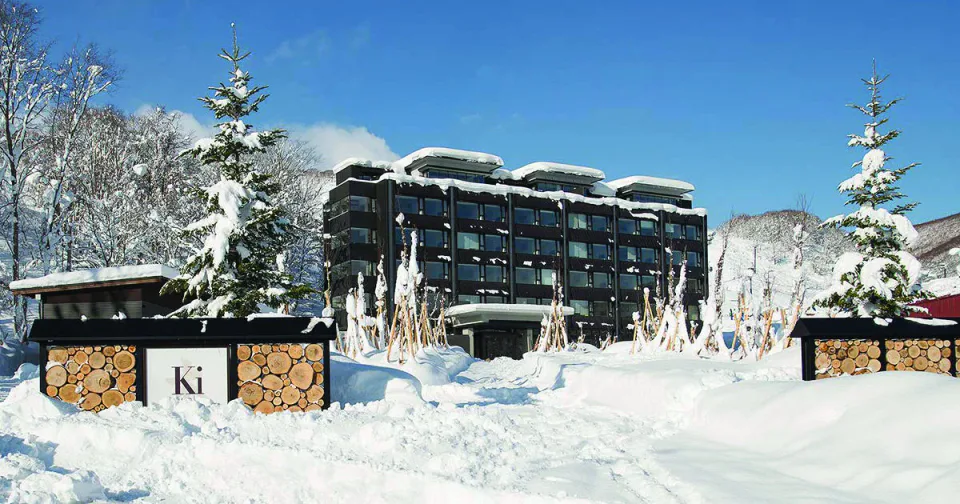
Ki Niseko has the strongest documented lesson geometry in this comparison. Its official ski-valet page says the second-floor ski entrance opens straight onto the snow beside the King Holiday Pair, King Gondola and GoSnow group/private lesson meeting areas. Ki currently describes itself as 0 metres to the slopes, about 50 metres from GoSnow and 100 metres from the high-speed gondola.
That colocation matters more than a generic “doorstep skiing” badge. A beginner family can store equipment in the valet, meet the instructor on the same side of the mountain and return to the hotel for food or an onsen without rebuilding the transport chain. Ki also states that YamaSport can deliver rental equipment to the hotel valet after fitting.
The strongest use case is therefore not an expert powder group that can manage any village route. It is a family or mixed-ability group for whom lesson meeting + lift + gear storage + room need to function as one system.
The recommendation reverses when the group wants a large multi-bedroom residence or spends most days skiing away from the King area. In that case, Ki’s compact operational advantage may matter less than apartment space or a different mountain side.
Compare Ki Niseko rates and cancellation terms
Skye Niseko is strongest when the group keeps coming back to the hotel
Skye’s official ski-valet material says guests can step directly onto the Upper Hirafu slopes, ski from the valet toward King Gondola, or use the main-lobby side for Ace Gondola. It also operates in-house equipment rental and allows free gear swaps within its rental programme.
That makes Skye particularly valuable for a mixed group whose day is not one uninterrupted eight-hour ski block. One skier can change gear, a child can return for lunch, another person can stop early, and the group can restart without handling skis through the village each time. Skye itself promotes the property as a midday pit stop as well as a morning start.
The hidden trade-off is that the residence-style premium is easiest to justify when the group uses the residence. A large apartment, kitchen and living space add real value for four to eight people staying several nights; they add less when two adults are out from first lift until dinner and use the room mainly for sleep.
Best for: 3–5 ski days, mixed abilities, families/groups, repeated midday returns, travellers who want both King and Ace-side access options.
Avoid overpaying when: it is a one- or two-day ski stop, nobody will use the larger living space, or a cheaper Hirafu room gives the same lesson and evening geography you need.
Compare Skye Niseko rates and cancellation terms
AYA Niseko is true slope access, but the booking rules can be the real constraint
AYA’s current official pages describe the property as ski-in/ski-out at the base of Grand Hirafu beside the Ace Family lift area. Its ski-valet page says guests can ski down to the hotel doors, with secure equipment storage and drying racks.
The useful catch for 2026–27 is not slope access—it is minimum stay. AYA’s current winter reservation policy requires three-night minimums across several periods and five nights over Christmas/New Year and the February peak holiday window; one-night stays are mainly available in narrower shoulder periods under the currently released schedule. If you only need one night around two ski days, AYA can therefore be the wrong product before price is even compared.
There is also a small night-skiing operational detail. AYA currently lists ski-valet winter hours as 07:00–20:00, but 07:00–18:00 during night skiing. The hotel can still be physically ski-in/ski-out while the valet is no longer a late-night service. Do not count “night ski + staffed valet on return” as one guaranteed benefit.
Best for: multi-night Hirafu stays where apartment space, Ace Family-area access and village convenience all matter.
Avoid if: your trip is only one or two nights during a 3–5-night minimum-stay period, or your lesson/rental setup sits more naturally on the King side.
Compare AYA Niseko rates and cancellation terms
MUWA Niseko is a luxury residence decision, not merely another ski-door hotel
Current official MUWA material describes the property as adjacent to Grand Hirafu with direct slope access: guests can step outside onto the snow and ski from the hotel toward King Gondola. Property materials also list ski valet/rental facilities and onsen amenities.
That puts MUWA in the same general Hirafu convenience category as Ki and Skye, but the buying logic is different. MUWA becomes most rational when the room and wellness side are also part of the trip—larger residence layouts, onsen time, private-room features in selected categories and a luxury hotel routine.
Do not double-count the premium. If you are already paying extra for residence space and an onsen-led stay, direct slope access can complete the product. If you only need a bed and the fastest lesson meeting point, a simpler Hirafu hotel may deliver more of the value you actually use.
Best for: couples or families who want luxury residence/wellness value and direct Hirafu access in the same booking.
Avoid if: the group will spend nearly every waking hour outside and none of the room/onsen premium changes the ski day.
Compare MUWA Niseko rates and cancellation terms
Park Hyatt works when HANAZONO is the whole resort, not a hotel beside a Hirafu trip
Park Hyatt’s current fact sheet lists ski-in/ski-out, ski valet, onsen, a 25 m indoor pool and 65 m² standard guestrooms. This is why it can beat a Hirafu hotel for a mixed ski/non-ski family: the non-skier is not simply waiting in a small ski room while everyone else is on the mountain.
The key trade-off is evening geography. A Park Hyatt stay is strongest when you are happy to eat, relax and spend a large share of the trip within the HANAZONO/Park Hyatt ecosystem. If the group’s social life is built around walking to a different Hirafu restaurant or bar every night, that freedom is no longer included in the room location; transport back and forth becomes a separate planning problem.
There is also a hard season boundary. Niseko United currently lists HANAZONO’s 2026–27 ski season as November 28, 2026 to April 11, 2027, while Grand Hirafu is scheduled to continue until May 5. A late-April or early-May skier should not pay a HANAZONO ski-in/ski-out premium as though the connected resort were still operating. The hotel may remain attractive for luxury or wellness, but the ski-access product has changed.
Best for: multi-generation groups, non-ski partners, families using HANAZONO lessons/rentals, travellers who want the hotel and resort to be one self-contained holiday.
Avoid if: the real trip is “Hirafu every day and Hirafu every night,” or the ski dates fall after HANAZONO’s operating season.
Compare Park Hyatt Niseko rates and cancellation terms
Night skiing increases the access premium only inside the night-ski window
Niseko United currently schedules night skiing from December 12, 2026 to March 22, 2027. During that window, a well-positioned hotel can add a genuinely different use case: ski during the day, return for food/rest, then go out again without a shuttle or equipment move.
After March 22, do not keep pricing that benefit into the room. The physical hotel has not moved, but one of the recurring transitions that justified the premium has disappeared.
This is a useful way to prevent seasonal overpayment. A January family that plans two night-ski sessions can use slope access more times than an April couple staying the same number of nights. The correct premium is therefore itinerary-specific even when the room rate is identical.
Ski-in/ski-out is conditional on the mountain being open
Niseko United explicitly states that operating dates and hours are subject to change and publishes live lift/weather status. That matters because a hotel’s direct route is not independent infrastructure: it relies on the connected terrain and lifts being usable.
The failure mode is assuming “ski-in/ski-out” means “never need a fallback.” Wind holds, weather, low visibility, maintenance or seasonal terrain closures can remove the route you expected to use. In that situation the relevant question becomes: is the hotel still easy by road, shuttle or foot, and can the weakest skier manage the alternative?
ValueNavi red-team: before paying a large premium, ask whether you would still choose the hotel on a day when the direct ski-back route is unavailable. If the answer is no, the room is highly dependent on one operational benefit and the premium should be treated more cautiously.
Late-season trips expose the biggest marketing trap
For 2026–27, Niseko United currently lists different closing dates across the four resorts: Niseko Village to April 4, HANAZONO to April 11, and Grand Hirafu and Annupuri to May 5. “Niseko ski-in/ski-out” therefore stops being one category as spring progresses.
A hotel can remain open while its connected ski operation has ended. If your dates are April 12–May 5, a Grand Hirafu property may still provide genuine slope access while a HANAZONO property cannot provide the same ski product. Check the resort operating period first, then the hotel.
This is one of the strongest reasons to avoid booking from an evergreen “best Niseko hotels” list without dates.
How many ski days make the premium worth it?
I would use this hierarchy:
1 ski day: ski-in/ski-out is a convenience, not a reason to accept a major room premium. Choose it only if lessons, children or equipment make the single day unusually difficult.
2 ski days: useful for families, but compare against a well-located village hotel. Four basic slope transitions may not justify a large price gap.
3–5 ski days: this is where the premium can compound. Gear storage, lesson starts, lunch returns, child resets and weather-driven gear swaps repeat enough times to matter.
6+ days: access remains valuable, but room space, laundry, kitchen, recovery facilities and evening life become equally important because you are living in the property for a week.
Longer stays do not automatically mean “buy the most expensive slope hotel.” They mean more hotel features have enough time to become real or to become irritating.
Final decision: buy the access system, not the hotel label
Choose Ki Niseko when beginners, children or GoSnow lessons make King-area colocation the highest-value feature. Choose Skye Niseko when a mixed group will repeatedly use valet, rentals, two gondola-side options and midday returns. Choose AYA Niseko when lower-Hirafu ski access plus apartment space fits a multi-night booking and the 2026–27 minimum-stay rules work. Choose MUWA Niseko when luxury residence and onsen value are being used alongside direct Hirafu access. Choose Park Hyatt Niseko Hanazono when HANAZONO and the hotel’s non-ski facilities are the resort experience—not when you are trying to recreate a walkable Hirafu holiday from another base.
Then run one final veto: can the weakest skier use the normal route, are the lessons/rentals on the same side, are the connected lifts operating for your dates, and would the hotel still work if weather removes the direct ski-back? If any answer is no, “ski-in/ski-out” is not the complete solution the room rate suggests.
Lake Kawaguchi vs Lake Yamanaka for Autumn Leaves: Views, Access and Hotels
Edogawa Fireworks 2026: The Best Free Side to Watch, When to Arrive and How to Get Out
Niseko Food Guide: Restaurants, Ski Lunches, Dinner Bookings and Groceries
Niseko vs Furano vs Rusutsu: Which Hokkaido Ski Resort Should You Choose?
Big Tamagotchi Exhibition Osaka Guide: Sold-Out Tickets, Timed Entry and Umeda Access

References
Niseko United — 2026–27 operating dates and night-ski period · Skye Niseko — ski valet and slope access · Ki Niseko — ski valet, GoSnow and King-area access · AYA Niseko — ski valet · AYA Niseko — 2026–27 minimum-stay policy · MUWA NISEKO — official slope-direct access · Park Hyatt Niseko Hanazono. Checked August 25, 2026. Lift operations, snow conditions, lesson locations, ski-back routes and hotel services can change; confirm the exact dates before booking.