
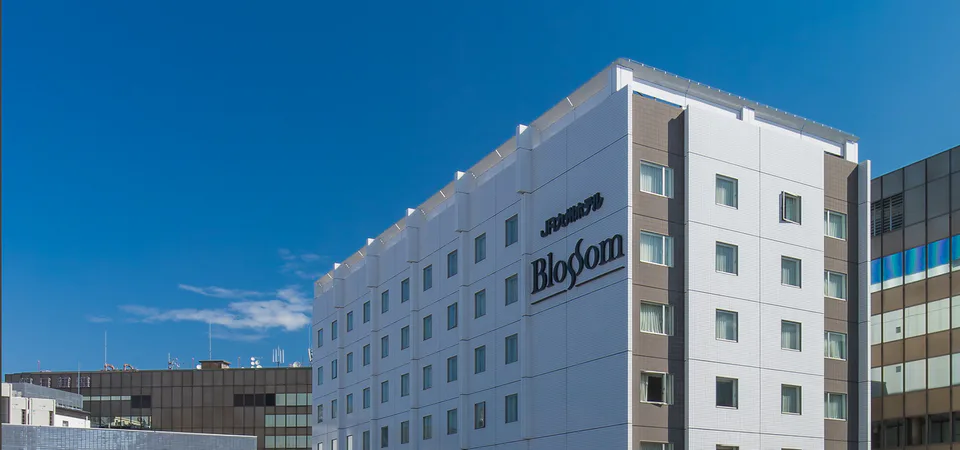
JR KYUSHU HOTEL Blossom Hakata Chuo: 2-Minute Hakata Access and 25m² Twin
If two people are each carrying a large suitcase and using Hakata Station as a Kyushu transport base, JR KYUSHU HOTEL Blossom Hakata Chuo is more interesting than the generic claim that it is “near the station.” The hotel currently lists roughly a two-minute walk from Hakata Station’s Hakata Exit, all rooms exceed 19m², and the 25m² Superior Twin is specifically described as having enough room to open luggage. That gives it a different decision profile from station-area hotels that win on distance but make the entry room the main compromise.
The one big decision is whether that short final walk matters enough on a late arrival or early JR/Shinkansen departure, and whether two large suitcases make the 25m² Superior Twin the sensible starting room instead of chasing the lowest visible rate. The answer is not “always upgrade.” I first ask how often the trip reuses both advantages: the short station walk and the extra room space. A two-minute walk used once is convenience; a two-minute walk used on a late arrival, an early rail departure and repeated day trips can become part of the itinerary design.
For another direct-station benchmark, compare Miyako Hotel Hakata, where the decision shifts toward true station connection, larger rooms and a spa. If most of your Fukuoka time is actually spent around Tenjin, the Fukuoka three-day itinerary is a better first check than assuming Hakata is automatically the right base.
JR KYUSHU HOTEL Blossom Hakata Chuo: 30-second verdict
I would book it when arrival is late, the next morning involves JR or Shinkansen, and both travellers have large luggage. The short walk reduces friction on both arrival and departure, while the 25m² Superior Twin gives a more practical place to unpack and repack. This is the strongest version of the hotel’s value because both the location and room layout are used repeatedly within a short window.
I would compare again for a daytime arrival, one cabin-size bag and only one night. In that case the 19–20m² Standard Double may be enough; the real price gap should decide whether 25m² is worth paying for. Paying for space you will barely use is no more rational than paying for a station premium when you only enter Hakata Station once.
I would skip it when a large public bath, sauna or a hotel-based evening experience is the main priority. The current facility list focuses on the restaurant, coin laundry, vending and practical services rather than a large public-bath product. Its core value is Hakata access plus understandable room space, not resort-style facilities. If the hotel itself needs to become the night’s activity, choose a different product rather than pretending the two-minute location answers that preference.
↔ Scroll table left or right
Item | Verified hotel information | Trip impact |
Hakata Station | About 2 minutes on foot from Hakata Exit | Most valuable for late arrival, rain and early departure |
Standard Double | 19–20m², 2 guests, 160cm bed | Compare first for 1–2 nights and lighter luggage |
Superior Twin | 25m², 2 guests; hotel mentions enough room to open luggage | Main candidate for two travellers with large suitcases |
Breakfast | 06:30–10:00, last entry 09:30; adult JPY 2,200 | Work backward from the first train before adding it |
Coin laundry | Floors 5, 11 and 12; 24 hours | More useful for longer stays and onward Kyushu travel |
Arrival reality: the two minutes save the last segment, not the whole airport-to-room journey
The official two-minute figure is the final walk from the Hakata Exit side to the hotel. It does not include the walk from a subway or JR platform, finding elevators, crossing station crowds or completing check-in. From Fukuoka Airport you still arrive at Hakata Station, navigate the station, find the Hakata Exit and only then enter the short hotel segment. That is why I would never turn “two minutes” into a promise that the airport-to-room journey takes a fixed number of minutes.
The real arrival advantage appears when the traveller is already tired. A 22:00 arrival with two large cases is not the same as a 15:00 arrival carrying one backpack. Rain, children, older family members and the need to find a working elevator can all increase the effort inside the station. The hotel cannot remove those variables, but it stops the final outdoor or street-level walk from continuing for another seven or eight minutes after you finally reach the correct exit.
At 15:00 with no large luggage, I would not pay a large premium solely for a two-minute walk. At 22:30 with two suitcases and a 07:30 departure the next morning, the short final leg gets used twice in less than ten hours. Location value rises with arrival time, luggage and the first transport the next day. The Fukuoka transport guide helps separate station-level movement from the hotel’s final two-minute walk.
Room decision: why 25m² Superior Twin matters for two large suitcases
The room ladder is straightforward enough to make a real decision. Standard Double is 19–20m² for two guests with a 160cm-wide bed. Superior Twin is 25m² with two 120cm beds. Deluxe Twin is 29m² for two to three guests. These numbers are not here to build a room catalogue; they answer a practical question about how much operating space two travellers need while unpacking, repacking and moving around the room.
The Superior Twin description is unusually helpful because the hotel explicitly mentions enough room to open luggage. That is stronger evidence than area alone. Two rooms can share the same square-metre figure and still feel different because beds, desks and bathrooms divide the floor differently. Even so, I would not stretch the hotel’s wording into a guarantee that two specific 28-inch cases can both remain fully open with a fixed-width aisle. The useful claim is narrower: the 25m² Twin is deliberately presented as a comfortable two-person room with luggage-opening space.
↔ Scroll table left or right
Room | Official area / occupancy | Decision |
Standard Double | 19–20m² / 2 guests | Start here for 1–2 nights and light luggage when the upgrade gap is large |
Superior Twin | 25m² / 2 guests | First choice for two large suitcases; hotel explicitly mentions luggage-opening space |
Deluxe Twin | 29m² / 2–3 guests | Compare for three guests, a small price gap or a genuine need for more buffer |
For two travellers with one medium suitcase on a one- or two-night stay, compare Standard Double and Superior Twin by the real price difference. If the upgrade gap is substantial, 19–20m² does not deserve automatic rejection just because 25m² is larger. For two hard-shell large cases, shopping and three or more nights, use Superior Twin as the default starting point. The extra space pays back every time you reopen and reorganise luggage, not only when you first enter the room.
Deluxe Twin adds another four square metres and can accommodate up to three guests, but two people should not keep upgrading simply because it is larger. If Superior Twin already solves the room-and-luggage problem, Deluxe becomes rational only when the price gap is modest, three people are sharing the room or the trip genuinely needs more buffer. “Bigger” is not a booking strategy unless you can identify what the extra space fixes.
A late arrival and early departure change the value of the same room
Imagine arriving at Hakata Station around 22:10. After completing the station walk, you exit on the Hakata side and finish the official two-minute final segment. Both travellers open luggage, take out clothes for the next morning and organise purchases. This is a scenario test rather than a personal-stay claim. At that hour the useful hotel functions are a short last leg and an easy place to reorganise, not a long list of public facilities.
If you still want a late dinner around Nakasu, the Fukuoka yatai guide is a useful counter-test. Every extra activity after arrival reduces the time you spend benefiting from the room itself, while the station location remains useful when you return. That is why I separate location value from hotel-facility value rather than scoring everything under one vague idea of convenience.
If the next train is around 07:30, breakfast needs to be calculated backward. Current hotel information lists 06:30–10:00, last entry 09:30 and an adult guest price of JPY 2,200. Breakfast, returning to the room, taking luggage, checking out, walking back to Hakata Station and finding the platform all sit between 06:30 and departure. A 06:30 breakfast opening does not automatically make a very early train comfortable.
If the city day starts after 09:00, breakfast becomes much easier to use. Its value is convenience inside the same building rather than a claim that it always beats breakfast around Hakata Station on price. Compare the real departure with the Fukuoka breakfast guide and choose based on time, not simply on whether the hotel sells breakfast.
Breakfast and 24-hour laundry: useful only when the itinerary can use them
The laundry logic is even simpler. The hotel lists coin-operated machines on floors 5, 11 and 12 with 24-hour access. On a one-night stay this is mostly a backup. Across three to five nights, in summer or before moving onward through Kyushu, it can reduce the amount of clothing you carry. Returning at 23:00 does not automatically make laundry easy, but a 24-hour operating window at least prevents the facility from being ruled out by a 22:00 closing time.
The hotel does not publish live machine availability, exact evening queue levels or a guarantee that a washer will be free whenever you return. The verified value is access to laundry on three floors around the clock. That is useful for a multi-city Kyushu trip because the option can change how much clothing you pack; it is not evidence that laundry will be frictionless every night.
↔ Scroll table left or right
Facility | Verified information | When it matters |
Breakfast | 06:30–10:00; last entry 09:30; adult JPY 2,200 | You are not leaving extremely early and want the morning completed inside the hotel |
Coin laundry | Floors 5, 11 and 12; 24 hours | 3–5 nights, summer travel or onward Kyushu itinerary |
If the next leg is Yufuin, use the Fukuoka to Yufuin transport guide; for Aso, use the Fukuoka to Aso day-trip guide. Both help you work backward from real departure times before deciding how much breakfast or late-night laundry value the hotel can deliver.
Location × itinerary: which trips use the two-minute Hakata position repeatedly?
The strongest scenarios are late-flight arrival, one or more early JR/Shinkansen/highway-bus departures, and Fukuoka functioning as the front or back end of a wider Kyushu trip. Those patterns repeatedly cash in the short Hakata Exit walk. For Yufuin, Beppu or Aso, the value is not that the attractions are close to the hotel; it is that the morning begins near the transport node, with less city walking before you join the longer intercity leg.
For a route linking Fukuoka, Hita, Yufuin and Beppu, the three-day two-night hotel route shows why Hakata can function as a transport base. The decision becomes more valuable with reserved seats, early trains and large luggage, because every extra city segment adds another place where delay or physical effort can accumulate.
If all three days are concentrated around Tenjin, Daimyo and Nakasu and evenings also end there, a two-minute Hakata position is less valuable. In that pattern, compare a Tenjin-centred stay such as ONE FUKUOKA HOTEL instead of forcing Hakata to be the default. The airport transfer happens once; the evening return can happen every day.
Across three to five nights, location and room size start paying back at different moments. The short walk is reused every day you return late or depart by JR. The 25m² room is reused every time both travellers unpack, drop shopping, repack or prepare for the next city. That repeated room behaviour is why I lean toward Superior Twin when two large suitcases are part of the trip rather than treating room size as a one-night comfort bonus.
↔ Scroll table left or right
Itinerary pattern | Value of staying here | Main friction still left |
Late flight into Fukuoka | About 2 minutes for the final Hakata Exit segment | Airport arrival and station navigation still take time |
Next-day JR / Shinkansen | The short walk is reused on checkout day | Platform finding, crowds and train-specific buffer still matter |
Yufuin / Beppu / Aso | Hakata works as the Kyushu transport base | Frequent early departures can reduce breakfast use |
Tenjin / Daimyo focused | Hakata proximity may not be the main advantage | Nightly return should be compared with a Tenjin-area base |
If weather disrupts the outdoor plan, the Fukuoka rainy-day route helps decide whether staying close to Hakata still serves the revised day. For food-led evenings, the Fukuoka mentaiko guide and Fukuoka coffee and dessert walk are useful counterweights to a purely transport-led hotel choice.
What are you giving up by staying here?
The first trade-off is that the accommodation budget is not buying a large public-bath or sauna experience. If your normal travel rhythm is to return to the hotel, soak for an hour and make the property part of the night, that requirement belongs above a two-minute station walk. Do not choose a transit hotel and then resent it for not behaving like an onsen resort.
The second trade-off is that short walking distance does not make every room friendly to large luggage. Standard Double is still 19–20m². Travellers who need luggage space should lock the 25m² Superior Twin before comparing OTA prices; otherwise the lowest rate in a search result may belong to a room solving a different problem. “This hotel has rooms over 19m²” is not enough information for a four-night stay with two large cases.
The third trade-off is the conflict between breakfast and very early transport. A 06:30 start sounds early, but a traveller who needs to be on a platform around 07:00 can still squeeze the schedule too tightly. The hotel can shorten the final walk; it cannot remove checkout, waiting for elevators, station navigation, ticket gates or an unexpected crowd. If breakfast forces you to spend all of the saved station buffer, you are using the location advantage in the wrong way.
Compare the same 25m² room before choosing a booking platform
Keep the exact room, bed type, guest count, breakfast, taxes and cancellation deadline aligned before comparing Booking.com, Trip.com and Agoda. The core decision in this guide is the 25m² Superior Twin. Comparing one platform’s Standard Double headline price with another platform’s Superior Twin answers the wrong question and can make a cheaper room look like a cheaper hotel.
Booking.com — compare JR KYUSHU HOTEL Blossom Hakata Chuo rooms
Trip.com — compare JR KYUSHU HOTEL Blossom Hakata Chuo rooms
Agoda — compare JR KYUSHU HOTEL Blossom Hakata Chuo rooms
Final decision: would I book it?
↔ Scroll table left or right
Decision | Best-fit condition / trade-off |
I would book | Late arrival or early departure, two large suitcases and repeated Hakata Station use; start by pricing the 25m² Superior Twin. |
I would compare again | Daytime/light-luggage 1–2 night stay; compare the actual Standard Double versus Superior Twin price gap. |
I would skip | A large public bath, sauna or hotel-based night experience is the top priority; the two-minute location does not answer that need. |
My final view is simple: this is not a resort-facility hotel. It is a clean answer to two practical travel problems—reducing the last segment around Hakata Station and giving two travellers a room category that is easier to use with luggage. For a transit-heavy Fukuoka trip, less friction can be more valuable than another facility you never use. If Hakata Station is not central to the itinerary, there is no reason to overpay for that positioning.
JR KYUSHU HOTEL Blossom Hakata Chuo FAQ
Is Hakata Station really about two minutes away?
The hotel lists about two minutes on foot from the Hakata Exit side. That does not mean two minutes from a subway or Shinkansen platform to the room; station walking, elevators, crowds and check-in must be added.
Which room would I choose for two large suitcases?
I would prioritise the 25m² Superior Twin because the hotel’s room description explicitly mentions enough room to open luggage. I would not turn that into an exact guarantee for two specific 28-inch cases.
What time is breakfast and how much is it?
Current hotel information lists breakfast from 06:30–10:00, last entry 09:30 and an adult guest price of JPY 2,200. For a very early JR or Shinkansen departure, preserve station buffer before adding breakfast.
Does the hotel have coin laundry?
Yes. The hotel lists coin-operated laundry on floors 5, 11 and 12, available 24 hours. It does not publish live queue or machine-availability data.
What are the check-in and checkout times?
The hotel currently lists check-in at 14:00 and checkout at 11:00. For a late flight, follow the booking conditions and provide the expected arrival time where required.
Miyako Hotel Hakata: direct station connection, larger rooms and spa
THE BASICS FUKUOKA: when hotel time matters more than the shortest walk
Fukuoka transport: JR, subway and Nishitetsu
Hita Sennen Akari Festival Guide: Access, Viewing Spots and Photo Tips
Lake Kawaguchi vs Lake Yamanaka for Autumn Leaves: Views, Access and Hotels
Japan Autumn Leaves in Mid-November: Kyoto, Tokyo, Fuji, Miyajima and Kyushu
The Naha Terrace: Are 35m² Rooms and 12:00 Check-Out Worth a 15–20 Minute Station Walk?


Sources
JR KYUSHU HOTEL Blossom Hakata Chuo official website
Official guest-room information
Official facilities and services
Official restaurant and breakfast information
Room types, rates, availability and cancellation terms can change by date. This article may contain affiliate links; ValueNavi may earn a commission from qualifying bookings at no additional cost to you.