
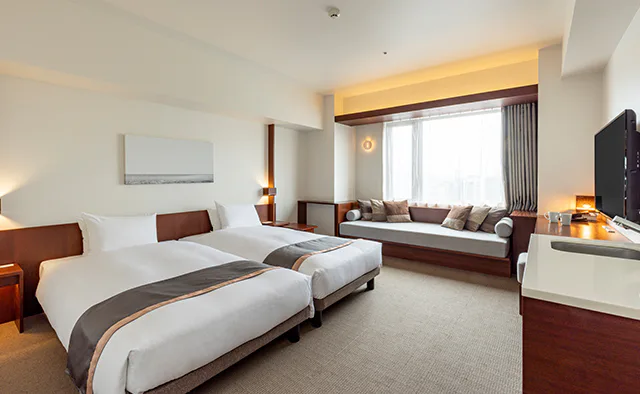
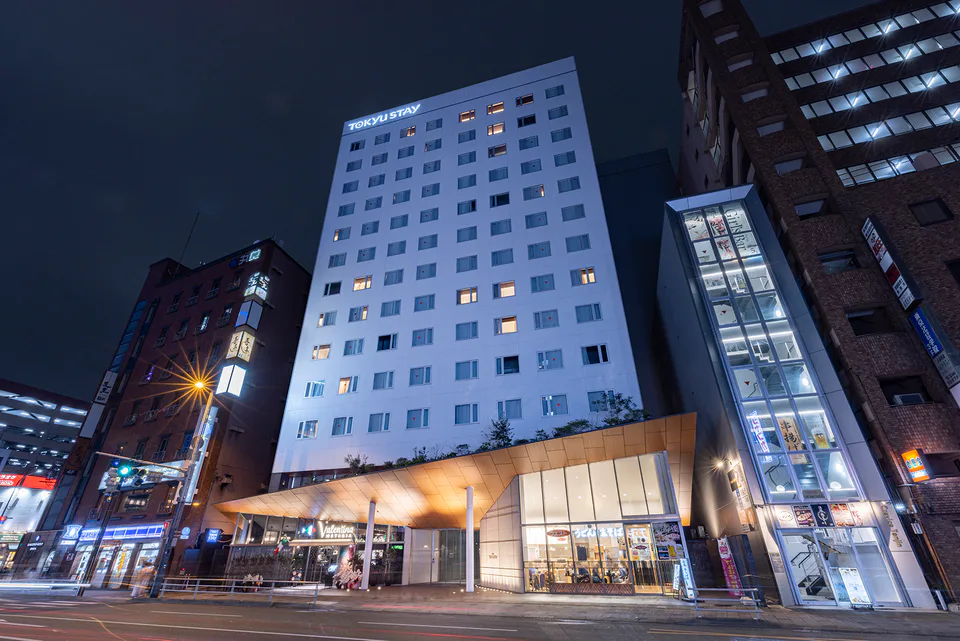
For a one-night Fukuoka stay, the washer-dryer inside a Tokyu Stay Fukuoka Tenjin room can look more useful on the facilities list than it feels in real life. Stretch the same stay to four or five nights and the calculation changes. The hotel’s current room table lists an in-room washer-dryer and microwave in the main Moderate, Residential, Comfort Twin, Residential Twin, Deluxe and Connecting categories, while selected Residential and Deluxe rooms add a kitchenette. That changes how much clothing you need to pack, when dirty clothes are dealt with, and whether simple food has to be bought and eaten outside every single time.
The convenience is not free. The hotel is in Haruyoshi, with current access information listing about three minutes on foot from Tenjin-minami Station Exit 6 and about seven minutes from Tenjin Station Exit 16. That works naturally when evenings end around Tenjin, Haruyoshi or Nakasu. If several mornings begin with JR, Shinkansen or regional trains at Hakata Station, however, you exchange some of the station-front convenience for a better long-stay room routine. This guide answers one question: on a four-to-five-night stay, is the in-room washer-dryer valuable enough to move your base away from Hakata Station?
Tokyu Stay Fukuoka Tenjin: the 30-second answer
I would book it for four or five nights when most evenings finish in Tenjin, Nakasu or Haruyoshi and I expect to shop, rewear clothing or deliberately pack lighter. In that pattern, the washer-dryer is not something used once on the final night. It can spread laundry across the trip and remove a recurring household task from the rest of the itinerary.
I would compare other hotels for a two- or three-night stay when the room is mostly used to shower and sleep. Even the 18–22m² room tiers can already include the washer-dryer and microwave, but there may not be enough nights to turn those features into a meaningful rate advantage. If a Hakata Station hotel is materially cheaper on the same dates, first calculate how many mornings actually require Hakata.
I would skip it when the core itinerary is repeated early JR or Shinkansen travel from Hakata Station. Tokyu Stay Fukuoka Tenjin sells a way to move laundry, reheating and—in selected rooms—simple cooking inside the room. It does not sell the shortest route to a JR platform. When the trip has no long-stay household needs, that exchange becomes much harder to justify.
Hotel snapshot: the conditions that change the stay
Current official information lists check-in from 15:00 and checkout by 11:00. Breakfast at Osteria Valentina on the first floor is currently 06:30–10:00 with last order at 09:30, and the hotel’s English page lists JPY 2,200 including tax. Those details matter, but they do not explain why this hotel is different. The main differentiators are what happens inside the room: in-room laundry, a microwave in the major room types, and a kitchenette only in selected categories.
Housekeeping is another long-stay detail that deserves more attention than it usually gets. The current Tokyu Stay room information says simplified cleaning can be requested during multi-night stays, mainly covering towel, bath towel, bath mat and sleepwear replacement plus rubbish collection. A full room cleaning is added weekly for stays of seven nights or more. For a four- or five-night stay, that does not mean the room is ignored; it means you should not expect the same default full daily cleaning rhythm as a conventional hotel. Some travellers prefer the reduced interruption. Others care about a fully reset room every day. That preference can matter more than the washer-dryer.
↔ Scroll table left or right
Item | Current hotel information | Why it matters |
In-room laundry | Main room types list a washer-dryer | Much easier to use repeatedly over four or five nights than on a one-night stay |
Microwave | Listed in the main room categories | Adds flexibility for late returns and some breakfast / snack decisions |
Kitchenette | Residential Double, Residential Twin, Deluxe and selected Connecting categories | Upgrade for simple cooking only if you will actually use it |
Room size | Main ladder includes 18, 19, 22, 30 and 40m² | Long-stay equipment and luggage space should be judged separately |
Subway access | Tenjin-minami Exit 6 ~3 min; Tenjin Exit 16 ~7 min | Strong for the western city centre, but not a JR-platform hotel |
Breakfast | 06:30–10:00; last order 09:30; currently JPY 2,200 | Easy for normal city mornings; early JR days still need a transport buffer |
Multi-night cleaning | Simplified cleaning on request; 7+ nights add weekly full cleaning | Four- or five-night guests should be comfortable with a long-stay cleaning rhythm |
Arrival reality: simple from the airport, but you are not sleeping beside a JR platform
From Fukuoka Airport, the most straightforward route is the Airport Line to Tenjin Station. Current hotel access information puts the subway ride from the airport to Tenjin at roughly ten minutes and the walk from Tenjin Station Exit 16 at around seven minutes. The advantage is that you do not need to travel to Hakata first and then reverse direction. The cost is the final street segment, which feels very different in dry weather with one carry-on than in rain with two large suitcases.
If you are already at Hakata Station, the Nanakuma Line changes the equation. Ride to Tenjin-minami and the hotel currently lists about three minutes from Exit 6. That proves Hakata is not difficult to reach from the hotel, but it also proves this is not a Hakata Station-front product. On a morning that begins with JR, you still leave the room, walk to Tenjin-minami, ride back to Hakata, navigate the station and only then reach the platform. One or two mornings like that may be trivial. Three consecutive early departures turn it into repeated friction.
My baseline is to decide the area before the hotel. The existing Fukuoka Hakata vs Tenjin Hotels guide is the best first filter if you have not decided which side should absorb the daily transport cost. Then use the Fukuoka 3 Day Itinerary to see where the actual days begin and end before adding more hotel-specific features.
Tenjin and Haruyoshi hotels solve the same area in different ways
Tokyu Stay is not the only way to base yourself on this side of Fukuoka. Solaria Nishitetsu Hotel Fukuoka makes a stronger station-centred Tenjin argument, while Hotel Mei Fukuoka Tenjin pushes farther into the Haruyoshi lifestyle trade-off. If you want a hotel that turns common areas and hotel time into more of the product, ONE FUKUOKA HOTEL is another useful counter-example. Tokyu Stay’s advantage is much less theatrical: it moves practical chores into the room.
Room decision: the 18m² room already has laundry, so upgrade for space or a kitchen
The first rule when choosing a room here is not to upgrade merely to obtain a washer-dryer. Moderate Double 18m², Residential Double 19m², Comfort Twin 22m², Residential Twin 30m² and Deluxe Room 40m² are all currently listed with an in-room washer-dryer and microwave. The core long-stay feature is already present at the lower end of the room ladder. Paying more should buy something else you actually need: more floor area, separate beds, a kitchenette, a separate bath and toilet, or higher occupancy.
Moderate Double at 18m² is the efficiency-first option. It can make sense for one person or two light packers who prioritise the laundry convenience and location. For two travellers staying four or five nights with two large cases, the main risk is not whether the room can technically sleep two. It is what happens after clothes, shopping and luggage all remain inside the same 18m². The hotel does not publish enough exact floor-clearance detail to guarantee that two 28-inch suitcases can remain fully open, so I would not write that as a certainty.
Residential Double at 19m² adds only a small amount of published floor area, but it adds a kitchenette. That is a functional upgrade, not a space upgrade. If your only goal is to wash clothes, there is little reason to pay more just for the Residential name. If a five-night stay includes simple breakfasts, reheating, or the occasional late dinner inside the room, the kitchenette starts to change the use case.
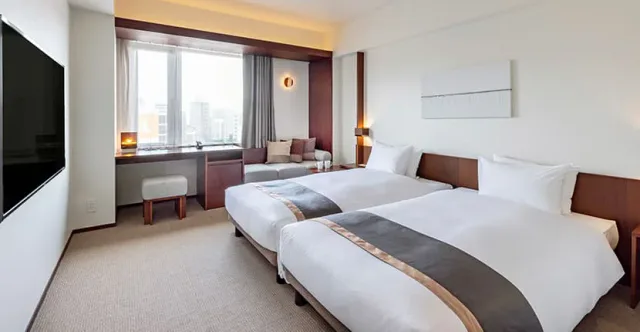
Comfort Twin at 22m² uses two 1100×2000mm beds and is currently listed with a washer-dryer and microwave, but the official equipment table does not list a kitchenette. For two friends or travellers who refuse to share one bed, it may be the natural middle tier. For a couple who specifically wants light cooking, the smaller 19m² Residential Double may actually offer the more relevant long-stay function despite having less area. Room names do not form a simple ladder where every feature appears automatically as the price rises.
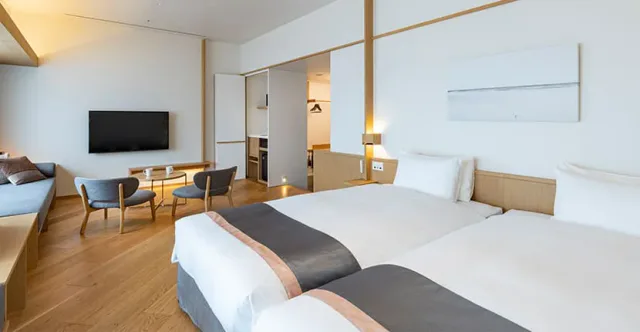
Residential Twin at 30m² is the room I would examine most closely for two travellers with large luggage staying four or five nights. The current room table lists twin beds, a kitchenette, microwave, washer-dryer and separate bath/toilet, with occupancy up to three people. At that point, the room is not merely giving you a washing machine. It is creating a more usable daily living sequence: bags have more margin, clothes can be processed inside the room, and simple food does not require another trip outside.
Deluxe Room reaches 40m² and can accommodate up to five guests. It also includes the kitchenette and separate bath/toilet arrangement. That makes the higher rate easier to divide across a family or group. For two people, however, the argument should be stronger than “we want laundry.” You already had laundry in the smaller categories. Pay for 40m² when the group size or room-centred use needs it.
↔ Scroll table left or right
Room | Official area | Key equipment difference | Best use |
Moderate Double | 18m² | Washer-dryer + microwave | Shorter stay or light packing; assess luggage pressure separately for two people |
Residential Double | 19m² | Washer-dryer + microwave + kitchenette | Choose when simple cooking matters more than an extra bed or large room |
Comfort Twin | 22m² | Washer-dryer + microwave; no kitchenette listed | Twin-bed priority rather than kitchen priority |
Residential Twin | 30m² | Twin beds + kitchenette + microwave + washer-dryer + separate bath/toilet | Strongest two-person long-stay option when large luggage is also present |
Deluxe Room | 40m² | Kitchenette + separate bath/toilet; occupancy up to 5 | Family or group use where the space premium is divided across more people |
If room size itself is the priority, compare how other Fukuoka hotels solve the problem. HOTEL GREAT MORNING Fukuoka gives its main Single, Double and Twin rooms 27m² and makes room environment the product. THE BLOSSOM HAKATA Premier moves the trade-off toward 30–37m² twin rooms and a guest public bath. Tokyu Stay is different: its lower room tiers already contain the household equipment, and the upgrade question is how much private space and kitchen function you need.
How much is the in-room washer-dryer really worth over four or five nights?
The washer-dryer is easiest to value as a timeline rather than a checklist. Imagine five days and four nights. Wash the first two days of tops and inner layers on the second evening, then do another load on the fourth evening. That can reduce how much clean clothing needs to leave home with you and prevents every dirty item from building into one bag until the final night. Tokyu Stay’s current FAQ also says detergent is provided in rooms equipped with the washer-dryer, so buying detergent after arrival does not have to become another task.
This becomes particularly easy to use in summer, rainy weather, family travel or a multi-city Kyushu trip. Clothing that was worn today can potentially be dealt with tonight instead of being carried forward for several days. But I would not exaggerate it into a universal necessity. On a one-night stay or the night before flying home, the washer-dryer may be nothing more than a large appliance inside the room. Feature value comes from expected use frequency, not from whether the equipment list contains a check mark.
There is also a less visible advantage: laundry becomes a parallel task. Start a cycle after returning to the room, then shower, organise shopping, recharge devices or plan the next day. You are not travelling to a shared laundry room and repeatedly checking whether a machine is free. I would not claim a fixed number of minutes saved because cycle length and personal behaviour vary. The verified difference is that the machine is inside the room, so the movement and waiting pattern changes fundamentally.
That long-stay logic is the opposite of a nightlife-first hotel such as HOTEL IL PALAZZO Fukuoka or HOTEL RESOL TRINITY HAKATA. Those hotels earn more of their value from where you end the night or how you recover after it. Tokyu Stay earns more of its value from chores and routines repeated across several days.
Breakfast and the microwave: long stay does not mean eating every meal in the room
Breakfast begins at 06:30, which is early enough for many city days. It does not automatically make sense before every regional departure. If one morning requires an early JR train from Hakata, I would not let a prepaid breakfast erase the subway and station buffer. A four- or five-night stay also does not need to include hotel breakfast every morning. The microwave in the main room categories gives more flexibility for a convenience-store breakfast, leftovers or a late snack without requiring a full kitchenette.
The kitchenette should be treated as another level of flexibility, not an invitation to cook three meals a day in Fukuoka. Tenjin, Nakasu and Haruyoshi are food-dense areas. The more natural use is a simple breakfast, reheating, drinks or a backup meal when the weather is bad or the group is tired. A traveller who wants a 24-hour hotel-adjacent lifestyle rather than a kitchen may find LAMP LIGHT BOOKS HOTEL Fukuoka more relevant. A traveller who wants Nakasu nightlife right outside the door should compare THE LIVELY FUKUOKA HAKATA. Tokyu Stay is for people who value quiet practical control inside the room more than an always-on hotel social environment.
For an evening that does end at food stalls, the Fukuoka Yatai Guide is useful because it helps determine whether Nakasu and Tenjin are repeated evening destinations or just one night. That distinction matters: the more often the trip ends on this side of the city, the more valuable the Tenjin base becomes.
Location × itinerary: Tenjin and Nakasu fit; repeated JR mornings need a recalculation
Put the hotel back into a real itinerary and the answer becomes clearer. On days built around Tenjin shopping, Haruyoshi dinner, Nakasu yatai or central Fukuoka cafés, the evening ends close to the hotel and the room equipment continues the same low-friction routine: return, start laundry, shower, eat or reheat something, and prepare for the next day. The location and the room features work in the same direction.
On Yufuin, Aso, Kumamoto or other regional days that require Hakata Station, the equation reverses. It is not that Tenjin cannot reach Hakata. It can, and the Nanakuma Line connection is straightforward. The issue is repetition. One suburban day creates a small extra segment. Three early JR days create three pre-departure segments. That is why airport convenience should never be used as proof that a hotel is automatically convenient for every Kyushu route. Airport Line arrival and Hakata JR departure are two different transport problems.
If your trip is roughly half city and half regional, I would look at where the last two or three evenings end. If they repeatedly finish around Tenjin and Nakasu, staying here avoids a return to Hakata every night and makes the in-room routine more useful. If the mornings repeatedly begin at Hakata, you accept the reverse: the easy evenings are paid for with an extra subway segment after waking up. That morning-versus-evening trade cannot be reduced to one station-distance number.
↔ Scroll table left or right
Trip pattern | What the hotel gives you | Main friction | Fit |
Tenjin shopping / Nakasu dinner | Evening return stays inside the main activity zone | JR proximity is not being used | High |
Fukuoka Airport arrival / departure | Airport Line reaches Tenjin directly | Final walk is still about 7 minutes from Exit 16 | Medium-high |
Yufuin / Aso regional day | After returning, evenings can still use Tenjin / Nakasu | Morning pre-transfer to Hakata | Depends on number of regional days |
Several JR / Shinkansen intercity days | In-room laundry remains useful | Every morning begins with a trip to Hakata | Low |
Long stay / remote work | Washer, microwave and selected kitchenettes are used repeatedly | Small room tiers are still physically small | High |
The important thing is that you can choose another hotel on the same side of the city if Tokyu Stay’s room model does not fit. ONE FUKUOKA HOTEL is much more hotel-time driven. LAMP LIGHT BOOKS HOTEL Fukuoka exchanges private-room scale for the 24-hour bookstore concept. Tokyu Stay becomes the better answer when practical private-room equipment is the feature you expect to use most often.
What are you giving up by staying here?
The first exchange is room functions versus JR directness. You get the washer-dryer, microwave and—on selected room types—a kitchenette. You give up the ability to walk out of the hotel and be beside JR or Shinkansen platforms within a few minutes. On a five-night city stay, the room functions may be used every day. On a three-day intercity route, direct Hakata access may be used every morning.
The second exchange is that a complete equipment list does not make an 18m² room spacious. Moderate Double already contains the washer and microwave, so it looks extremely complete on paper. Two travellers with large cases still occupy an 18m² floor area. If you are also carrying baby equipment or expect heavy shopping, solve the space question independently. The washer-dryer can reduce the amount of clothing you pack, but it cannot create more floor area once you arrive.
The third exchange is housekeeping style. Four- and five-night stays use simplified cleaning on request rather than assuming a full traditional room reset every day. Some travellers actively prefer that. Others want daily bed making and comprehensive cleaning. This is not automatically good or bad; it is part of choosing a long-stay hotel format rather than a conventional full-service rhythm.
If the main priority is simply being near Hakata without giving up larger room options, revisit THE BLOSSOM HAKATA Premier or the broader Hakata-versus-Tenjin area guide. If the real priority is returning from Nakasu late at night, HOTEL IL PALAZZO Fukuoka may be more aligned with the trip. The most useful hotel is the one that reduces the friction you actually repeat.
Compare the same room before choosing a booking platform
Before comparing Booking.com, Trip.com and Agoda, fix the same room category, bed configuration, guest count, breakfast inclusion, taxes and cancellation deadline. This hotel is particularly easy to miscompare because equipment changes do not line up neatly with area. Residential Double at 19m² has a kitchenette; Comfort Twin at 22m² is larger and has two beds, but the official room table does not list a kitchenette. A platform’s cheapest headline rate may therefore refer to a different functional product.
Booking.com: compare Tokyu Stay Fukuoka Tenjin rooms
Trip.com: compare Tokyu Stay Fukuoka Tenjin rooms
Agoda: compare Tokyu Stay Fukuoka Tenjin rooms
Final verdict: would I book Tokyu Stay Fukuoka Tenjin?
↔ Scroll table left or right
Decision | Core conditions |
I would book | Four or five nights, most evenings around Tenjin / Nakasu, and I expect to use the washer-dryer and microwave repeatedly. The room equipment can break travel chores into smaller daily tasks instead of saving them for the final night. |
I would compare | Two travellers have large luggage, or some mornings require early JR from Hakata. Compare the 30m² Residential Twin rate and the repeated transport cost at the same time. |
I would skip | Only one or two nights, repeated early JR / Shinkansen departures, or a strong expectation of full daily housekeeping. The hotel’s most distinctive long-stay features do not match the trip rhythm. |
My positioning is simple: Tokyu Stay Fukuoka Tenjin is not “the closest Tenjin hotel” and it is not trying to be a Hakata Station transfer hotel. It is a city-centre base that moves laundry, reheating and selected kitchen functions into the room. The longer you stay and the more often you use those functions, the more reasonable it becomes to trade some Hakata convenience for the Tenjin lifestyle zone.
Tokyu Stay Fukuoka Tenjin FAQ
Does every main room type really have a washer-dryer?
The hotel’s current room table lists washer-dryers and microwaves in the main Moderate, Residential, Comfort Twin, Residential Twin, Deluxe and Connecting categories. The official hotel FAQ also confirms in-room washer-dryer use. Always check the equipment list for the exact room category you are booking.
Which room types have a kitchenette?
The current room table explicitly lists a kitchenette for Residential Double, Residential Twin, Deluxe Room and Connecting Room. Moderate Double and Comfort Twin are not listed with one. If simple cooking is the reason for upgrading, check the equipment column rather than the room name or floor area.
Is Tenjin-minami Station really about three minutes away?
Current official access information lists about three minutes on foot from Tenjin-minami Station Exit 6, about seven minutes from Tenjin Station Exit 16 and about eight minutes from Nakasu-Kawabata Station Exit 1. Choose the route based on the line you are actually using rather than mixing all three station times into one number.
How do I get there from Fukuoka Airport?
Take the Fukuoka City Subway Airport Line to Tenjin Station. The hotel currently lists the airport-to-Tenjin subway ride at about ten minutes, followed by about seven minutes on foot from Exit 16. With large luggage or rain, add time for station navigation and the final street walk rather than treating the train time as the full door-to-door journey.
What time is breakfast and how much is it?
The hotel’s current English page lists breakfast at Osteria Valentina from 06:30–10:00, with last order at 09:30, at JPY 2,200 including tax. Breakfast prices and plans can change, so check the latest hotel page or the exact rate plan before travel.
Can I leave luggage before check-in and after checkout?
Yes. Tokyu Stay’s current FAQ says the front desk can store luggage before check-in and until the same day after checkout. Valuables and fragile items are excluded. This is particularly useful on a final day that stays around Tenjin rather than moving immediately to the airport or Hakata Station.
Miyako Hotel Hakata: Is a Direct Hakata Station Connection Worth the Premium?
Mitsui Garden Hotel Fukuoka Gion: Is the 26.6 m² Triple Room Worth It for 3 Adults?
Lake Biwa Otsu Prince Hotel: Is the 36.2m² Lake View Worth the Shuttle?
La Vista Furano Hills: Is a Small Room Worth It for a One-Night Furano Stay?
Hotel Sonia Otaru: Is a Canal-View Room and Rooftop Onsen Worth the 8-Minute Station Walk?
Sources
Tokyu Stay Fukuoka Tenjin official hotel page
Tokyu Stay Fukuoka Tenjin official room information
Booking.com: Tokyu Stay Fukuoka Tenjin property page
Trip.com: Tokyu Stay Fukuoka Tenjin property page
Agoda: Tokyu Stay Fukuoka Tenjin property page
Room types, rates, availability and cancellation terms can change by date. This article may contain affiliate links; ValueNavi may earn a commission from qualifying bookings at no additional cost to you.