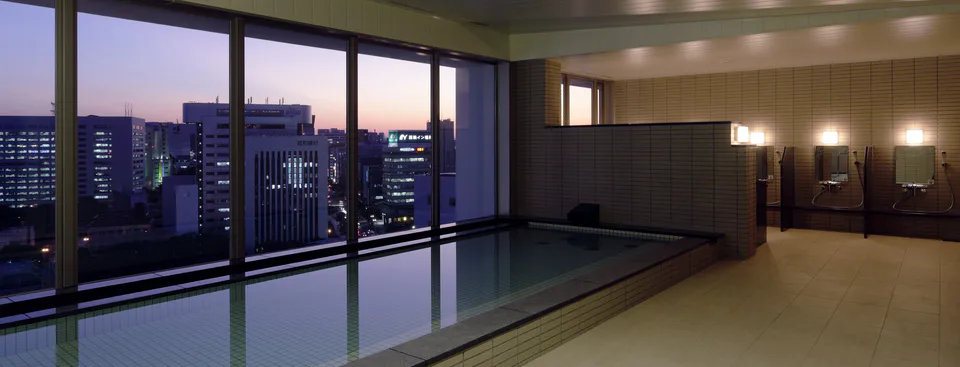
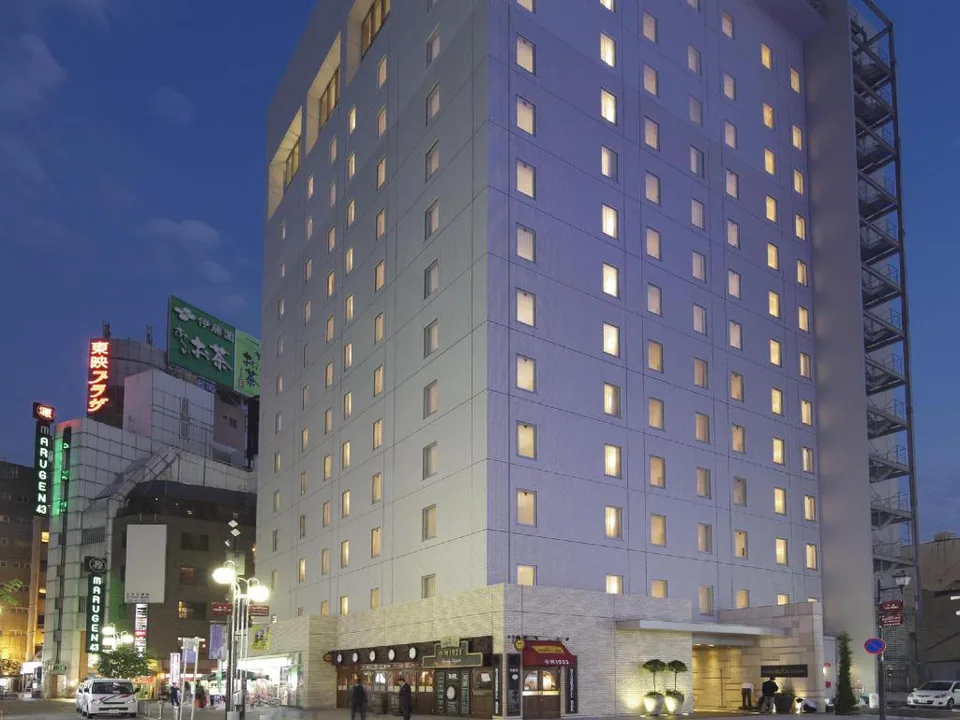
HOTEL RESOL TRINITY HAKATA is strongest when your Fukuoka nights finish in Nakasu and you want the hotel day to keep working after 23:00. The property is about one minute from Nakasu-Kawabata Station Exit 1, and the guest public bath runs until 02:00 before reopening from 06:00–09:00. That combination can delete a late walk and preserve a bath after yatai, dinner or drinks. The trade-off is room space: the common 16–19 m² categories are compact, so nightlife convenience should not automatically decide a four- or five-night stay.
For two travellers, my baseline comparison is the 19 m² Standard Twin versus the 24 m² Deluxe Twin. The Deluxe adds 5 m²—about 26% more published floor area. That does not guarantee a perfect suitcase layout, but it is large enough to treat as a meaningful daily-space difference rather than cosmetic upselling. If your trip instead begins with repeated early JR departures from Hakata Station, compare Hakata vs Tenjin hotels before paying for a Nakasu advantage that mostly helps at night.
The 30-second decision
↔ Scroll table left or right
Trip pattern | My call | Why |
1–2 nights, Nakasu evenings, bath after 23:00 | Book | The short return and late bath solve the same after-dark problem. |
3–5 nights, two large suitcases | Price 19 m² and 24 m² together | Room friction repeats long after the first convenient night. |
Repeated early JR departures from Hakata | Compare a Hakata base | The hotel moves friction from the late evening to the early morning. |
No public-bath use and little Nakasu nightlife | Skip or compare again | Two of the hotel’s most distinctive advantages contribute very little. |
The ValueNavi Nakasu-night payback test
“One minute from the subway” is not valuable in isolation. Count how many nights the location actually deletes a tiring final segment.
↔ Scroll table left or right
Stay pattern | Nakasu location value | What can reverse the answer |
One late Nakasu night in a 4-night stay | Low–medium | A larger room or Hakata Station base may matter more for the other three days. |
2–3 Nakasu/Tenjin evenings | High | Only if the mornings are not dominated by very early JR departures. |
Late dinner + public bath after 23:00 | Very high for that night | Value disappears if you do not use communal baths. |
City stay with little nightlife | Medium at best | Room size, breakfast and daytime transport should take priority. |
This is why I would not describe the hotel as universally “more convenient than Hakata.” It is convenient for a specific sequence: Nakasu evening → short return → late bath → sleep. A rail-heavy Kyushu itinerary creates a different sequence: wake early → subway to Hakata → navigate JR platform → board. Decide which sequence repeats more often.
The one-minute walk removes only the final surface segment
The hotel is about one minute from Nakasu-Kawabata Station Exit 1, and the Airport Line gives direct subway access from Fukuoka Airport. That is genuinely useful with luggage or rain. It does not mean the airport is one minute away: baggage claim, waiting, platform movement, elevators and the subway ride remain.
The same distinction matters after a late night. The short surface walk is the part the location removes. If dinner already ends in Tenjin or Nakasu, that can be a meaningful reduction in friction. If every evening finishes somewhere else and every morning begins at Hakata Station, the one-minute statistic has much less power.
Use the Fukuoka yatai guide and the Fukuoka three-day itinerary to decide where the trip actually spends its evenings before choosing the hotel around a station name.
Room-space trade-off: 19 m² versus 24 m² is the useful breakpoint
The current room ladder includes Moderate at 16 m², Double at 18 m², Standard Twin at 19 m² and Deluxe Twin at 24 m². For a solo traveller or a very short couple stay, the smaller categories can be efficient. For two travellers with full-size cases, I would not let the cheapest rate hide the space decision.
↔ Scroll table left or right
Room | Published area | My use case |
Moderate | 16 m² | Solo or very short couple stay with little luggage. |
Double | 18 m² | Short couple stay prioritising one wider bed. |
Standard Twin | 19 m² | My short-stay two-person baseline. |
Deluxe Twin | 24 m² | Longer stay, more luggage or more time spent inside the room. |
The 19-to-24 m² jump is roughly 26% in published area. I would calculate the total upgrade premium over the entire stay and divide it by nights and travellers. If the extra cost is modest per person per night, the additional area can pay back every time both people open luggage, dress or reorganise shopping. If the stay is one night and both cases remain mostly closed, the same upgrade can be unnecessary.
The hotel does not publish enough clear-floor measurements to promise that two specific 28-inch suitcases can remain fully open in every room. Floor area is a planning proxy, not a suitcase guarantee.
The public bath until 02:00 is valuable because of timing, not because of the amenity count
The 14F guest public bath currently operates 15:00–02:00 and 06:00–09:00 with no separate bathing fee for staying guests. That window is unusually compatible with late Nakasu evenings. A traveller returning at 23:30 still has time to bathe without treating the hotel like a curfew.
The boundary condition is simple: if you prefer the private room bath or never use communal bathing, this feature should contribute almost nothing to the room premium. Do not count facilities you will not use. The hotel is more compelling when both location and bath timing solve the same real itinerary problem.
Laundry can support a longer Kyushu trip
The hotel’s current FAQ lists two washing machines and two dryers in each 14F public-bath area during bath hours, plus two washer-dryers on 2F operating 24 hours. That makes the laundry setup more flexible than relying only on the bath area.
For one night, this should barely influence the booking. For four or five nights before continuing to another Kyushu base, it can reduce clothing volume and make luggage forwarding more useful. If bags are the recurring problem, use the Japan luggage-forwarding guide rather than buying a larger hotel room at every stop.
Breakfast: JPY 2,300 in advance or JPY 2,500 on the day
Il Chianti currently serves breakfast from 07:00–10:00, with last entry at 09:30. The hotel lists JPY 2,300 per person when added by the previous day (about US$14.40 at a recent exchange rate) and JPY 2,500 on the day (about US$15.70). Keep the JPY amount as the planning reference because exchange rates move.
I would add breakfast on slower Fukuoka mornings, not automatically. If the first fixed event is an early JR train from Hakata Station, breakfast competes with the subway ride, station navigation and boarding buffer. Choose the departure first; then decide whether the buffet still fits.
A late-night timeline shows when the hotel works best
↔ Scroll table left or right
Time | Possible routine | Why the hotel helps |
22:30 | Finish yatai or dinner in Nakasu | Short final return reduces after-dark walking. |
23:00–00:30 | Organise luggage and use the public bath | The 02:00 close preserves a real late bathing window. |
After 00:30 | Use 2F laundry if needed | The 24-hour machines are not tied to bath hours. |
06:00–09:00 | Optional morning bath | Useful only if it does not conflict with an early departure. |
This is a planning simulation, not a record of a personal stay. Its purpose is to show that the hotel’s most valuable features overlap in time. A traveller who returns at 18:00 and never uses the bath may get far less value from the same property.
When Hakata Station becomes the better base
Nakasu wins the evening. Hakata can win the morning. If three or four days begin with JR or Shinkansen departures toward Yufuin, Beppu, Kumamoto or elsewhere in Kyushu, the extra subway segment to Hakata repeats. At that point I would compare a Hakata hotel rather than treating one late-night advantage as decisive for the entire stay.
The JR KYUSHU HOTEL Blossom Hakata Chuo guide is useful when direct station access matters more. For a Tenjin-centred stay with in-room laundry, compare Tokyu Stay Fukuoka Tenjin. The correct base is the one aligned with the hardest repeated movement.
Driving has a separate failure mode
The hotel currently lists parking at JPY 1,600 per night (about US$10.00), first come first served. More importantly, the open-air parking approach is on a road that becomes pedestrian-only from 19:00–02:00, preventing entry and exit during that window. That is a concrete reason not to reduce the self-drive decision to “parking available.”
For subway-and-walking travellers this issue largely disappears. For drivers planning a late Nakasu return, check the current parking approach and restrictions before arrival.
Compare the same room before booking
Fix the same dates, guest count, exact room category, bed setup, breakfast, taxes and cancellation deadline. Decide first whether 19 m² is genuinely acceptable or whether 24 m² is the room you would actually choose. Comparing a non-refundable Standard Twin against a flexible Deluxe Twin does not answer which platform is cheaper.
Booking.com — compare HOTEL RESOL TRINITY HAKATA rooms
Expedia — compare HOTEL RESOL TRINITY HAKATA rates
Final verdict
I would book HOTEL RESOL TRINITY HAKATA for one or two nights when evenings genuinely centre on Nakasu/Tenjin and I expect to use the public bath after 23:00. For two travellers staying three to five nights with large luggage, I would make the 24 m² Deluxe Twin part of the first price comparison. I would switch the whole base decision back toward Hakata when repeated early JR departures matter more than the late-night return. The hotel wins by compressing a specific evening routine—not by making its compact rooms disappear.
THE BLOSSOM HAKATA Premier: Is the 7-Minute Walk Worth a 30m² Twin and Public Bath?
Hotel Gracery Sapporo: Is a 1-Minute Station Walk Worth a 15 m² Room?
HOTEL FORZA Hakata Station Chikushi-Guchi I Review: 1-Minute Access and 18m² Rooms
Kinosaki Ryokan Dinner Included or Room Only: Which Is Worth It?
Hotel WBF Grande Asahikawa: Is a 2-Minute Station Walk Worth It for a Northern Hokkaido Base?


Sources
HOTEL RESOL TRINITY HAKATA — official website
HOTEL RESOL TRINITY HAKATA — official guest rooms
HOTEL RESOL TRINITY HAKATA — official public bath
HOTEL RESOL TRINITY HAKATA — official breakfast
HOTEL RESOL TRINITY HAKATA — official FAQ and laundry information
HOTEL RESOL TRINITY HAKATA — official access and parking information
Room types, rates, operating hours and parking conditions can change. USD equivalents are approximate and exchange rates move. This article may contain affiliate links; ValueNavi may earn a commission from qualifying bookings at no additional cost to you.