
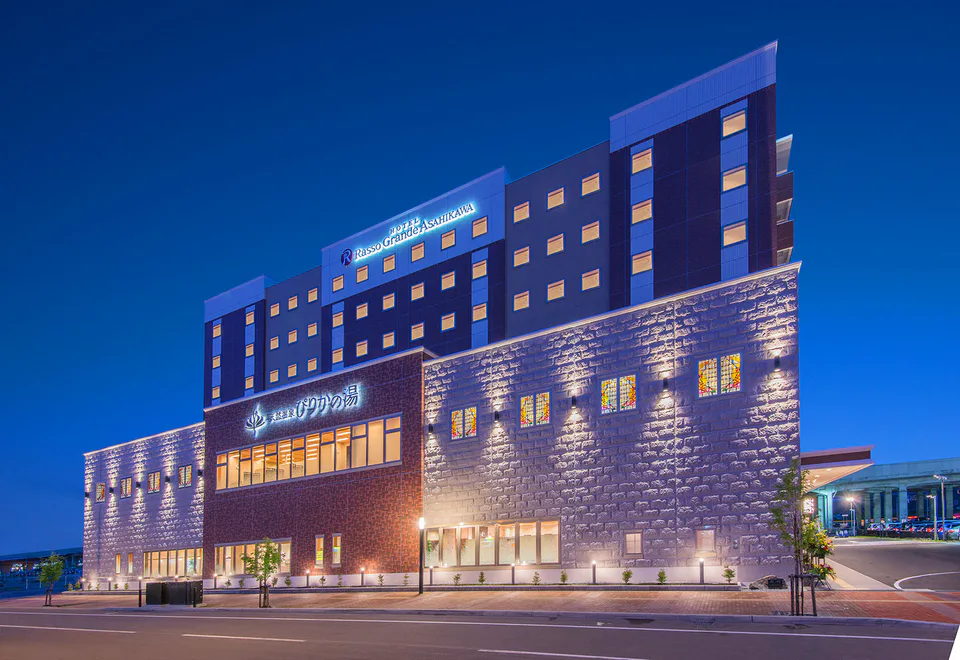

Hotel WBF Grande Asahikawa makes the most sense when Asahikawa is a real two- or three-night base and you will use both halves of its proposition: the short walk from JR Asahikawa Station and the natural-hot-spring bath after returning from day trips. If you are driving out before breakfast and returning late only to sleep, the hotel’s strongest advantages shrink. If your priority is a completely indoor station route in winter, the two-minute walk is still not the same product as a station-connected hotel.
The key decision is not whether “2 minutes from the station” sounds convenient. It is whether those two minutes remain acceptable with snow, luggage and repeated daily returns—and whether the hot spring, room size and breakfast are actually usable on your timetable.
30-second decision: when WBF is the right Asahikawa base
↔ Scroll table left or right
Trip pattern | ValueNavi verdict | Why | Main trade-off |
2–3 nights, rail-led Biei/Furano/Asahikawa days | Strong fit | The short station return repeats and the bath can become a nightly recovery routine. | The final segment is still outdoors. |
Winter trip with heavy luggage, indoor route essential | Compare JR Inn first | WBF is close, but proximity does not remove snow, slush or crossings. | You may prefer a station-connected route even if WBF has the stronger bath product. |
Two travellers, 3 nights, two large cases | Good fit in 25 m² tier | The 25 m² Twin/Double gives more working room for winter clothing and luggage. | It can cost more than the 17 m² entry room. |
Self-drive, leave before 06:30, return after 22:00 | Conditional | Station proximity and breakfast are less useful when the car controls the day. | Parking availability and road conditions become more important. |
One-night transit sleep | Compare on exact rate | You may not have enough hotel time to justify paying extra for bath and room features. | A simpler station-first hotel can be more efficient. |
ValueNavi Hotel Fit Score: strong base utility, but weather changes the meaning of “2 minutes”
This is a ValueNavi editorial model, not an official star rating. The score separates base utility from hotel marketing so the same property can be strong for one itinerary and weak for another.
↔ Scroll table left or right
Dimension | Score / 10 | Reason |
Location fit for a rail-led northern Hokkaido base | 9.0 | Officially about 2 minutes from JR Asahikawa Station East Exit. |
Transit resilience | 8.0 | Very short final leg, but it is not a fully indoor connection. |
Room/luggage resilience | 8.2 in 25 m² Twin / 5.8 in 17 m² Semi-Double | The room tier changes the answer more than the hotel name alone. |
Included-feature usability | 8.6 when you return early enough to bathe | The natural hot spring and sauna can add value every night rather than once per stay. |
Weather/final-walk resilience | 7.0 | Short distance limits exposure, but winter surfaces still matter with wheels and mobility constraints. |
Uniqueness for a station-area business hotel | 7.8 | Natural hot spring plus a genuinely short station approach is a useful combination. |
The 2-minute winter test: door-to-door friction is not measured in metres alone
The hotel’s current official site states about a two-minute walk from Asahikawa Station East Exit. In dry weather with a backpack, that is close enough to treat as a minor final leg. In Hokkaido winter, however, luggage wheels, packed snow, slush and icy crossings can turn a tiny map distance into the most annoying part of arrival.
I would use a simple rule: if everyone in the group can comfortably pull luggage over winter pavement and the stay is long enough to use the onsen, WBF’s location is strong. If one traveller has limited mobility, you have several large cases, or avoiding outdoor pavement is a hard requirement, compare JR Inn Asahikawa before deciding. The point is not that two minutes is “far”; it is that indoor and outdoor minutes are not equivalent in winter.
17 m² vs 25 m² vs 35 m²: the room tier can reverse the hotel verdict
The current official hotel information lists a 17 m² Semi-Double with a 140 cm bed, 25 m² Double with a 160 cm bed, 25 m² Twin with two 120 cm beds, and a 35 m² Japanese-Western room with two 120 cm beds plus two futons. That room ladder is more useful than a generic “spacious rooms” claim.
For one person or a one-night couple with light luggage, 17 m² can be a rational value choice. For two travellers carrying winter coats, shopping and two large cases for three nights, I would price the 25 m² Twin first. You are not simply buying eight more square metres; you are buying fewer repeated packing decisions every morning and evening.
For a family, 35 m² becomes more interesting because it changes sleeping and floor-use patterns, not because bigger is automatically better. The important check is whether the exact bedding arrangement works for the group. Maximum occupancy is a legal booking fact; it is not a promise that every family member will prefer the sleeping setup.
Natural hot spring: value it by nights used, not by the word “onsen”
The hotel currently promotes a natural-hot-spring bathing facility and sauna. That is meaningful because it can be used as a recovery routine after Biei, Furano, skiing or a long transfer day. But an amenity only creates value when the timetable allows it.
I would mentally divide any room premium by the number of nights I realistically expect to use the bath. If a three-night stay includes two returns around 19:00–21:00, the feature has repeated utility. If every day ends very late or the group does not use public baths, the value is close to zero even though the facility still exists.
If the bath window is the main reason for choosing a hotel, compare Premier Hotel -CABIN- Asahikawa. If the hotel itself is meant to be part of the evening rather than simply a base, compare OMO7 Asahikawa.
Hidden fixed costs: breakfast and parking should be priced into the same stay
As of August 27, 2026, the official hotel site lists breakfast at ¥1,980 per adult (about US$12.40) and ¥900 per elementary-school child (about US$5.70), with preschool children free. Breakfast runs 06:30–09:30 with final entry at 09:00. The USD figures are approximate, using a late-August 2026 mid-market rate of roughly ¥159 per US$1; card and cash conversion rates will differ.
That makes breakfast an itinerary decision rather than a default add-on. If you leave at 06:15 for a mountain or long transfer day, breakfast has zero usable value that morning. If you have two such mornings, compare a room-only rate before assuming the buffet package is better value.
The official FAQ currently lists outdoor parking at ¥1,000 per passenger car per night (about US$6.30), first come, first served, with nearby alternatives used when the hotel lot is full. For a three-night self-drive stay, that is ¥3,000 (about US$18.80) before any overflow-parking difference. A “station hotel with parking” is not the same as free, guaranteed parking.
The northern-Hokkaido base test: is Asahikawa itself the right place to sleep?
Before optimising the hotel, make sure Asahikawa is the correct base. WBF can reduce friction around JR Asahikawa Station, but it cannot make a geographically inefficient itinerary efficient.
↔ Scroll table left or right
Route pattern | How WBF fits | What can overturn the choice |
Asahikawa + Biei with rail/bus days | Very strong | If most sightseeing is actually around Furano, sleeping farther south may reduce daily backtracking. |
Asahidake / Sounkyo mixed with city time | Good as a transport base | Early mountain transport and weather buffers may make departure time more important than hotel facilities. |
Furano-heavy summer itinerary | Conditional | A Furano-area base can remove repeated southbound travel. |
Self-drive loop with one Asahikawa night | Rate-dependent | Station proximity may add little if the car is used for every segment. |
Use the Furano vs Asahikawa accommodation-base guide before paying more for a better room in the wrong city. For winter, the Hokkaido winter driving guide should outrank hotel amenities if the car is the main transport system.
Failure modes that make a “convenient” stay less convenient
Failure mode 1: choosing the 17 m² room because the hotel itself looked spacious. Public areas and bath facilities do not create suitcase floor area in the room. Compare the exact category.
Failure mode 2: treating a two-minute walk as weather-proof. In winter, the relevant question is whether your group can comfortably manage the outdoor surface, not whether Google Maps labels it two minutes.
Failure mode 3: paying for breakfast you cannot use. A 06:30 opening is convenient for many city days but not every early mountain or transfer departure.
Failure mode 4: assuming parking is guaranteed. The hotel’s lot is first come, first served. A late return by car needs a fallback, especially when weather makes an extra walk unpleasant.
What would make me choose JR Inn, OMO7 or Premier Hotel -CABIN- instead?
I would move to JR Inn Asahikawa if an indoor station connection is more valuable than a stronger hot-spring routine. I would move toward OMO7 Asahikawa if the hotel itself is part of the trip and I am willing to accept a less direct station relationship. I would compare Premier Hotel -CABIN- Asahikawa when bath timing is more important than room scale or the exact two-minute station position.
Final verdict
Choose Hotel WBF Grande Asahikawa when you will use Asahikawa as a genuine rail-led base for at least two nights, the short outdoor station walk is acceptable for your group, and the natural hot spring will be used after day trips. For two travellers with large luggage, I would price the 25 m² Twin/Double tier before defaulting to the 17 m² entry room.
Do not pay for “station + onsen” as two abstract advantages. If you drive every day, miss breakfast, return too late to care about the bath, or require a fully indoor winter route, the hotel’s headline strengths stop solving your actual trip.
Hotel Sosei Sapporo Review: Is a 39 m² Twin-Queen Room Worth a 15-Minute Walk from Sapporo Station?
Solaria Nishitetsu Hotel Sapporo: Is the Five-Minute Walk Worth It?
ONSEN RYOKAN YUEN SHINJUKU: Is Hakone Onsen Worth a 16-Minute JR Walk?
Zentis Osaka: Is Room 001 Worth the Walk from Osaka Station?
Lake Biwa Otsu Prince Hotel: Is the 36.2m² Lake View Worth the Shuttle?


Sources
Facts and fixed fees rechecked on August 27, 2026. Approximate USD conversions use a late-August 2026 mid-market rate of about ¥159 per US$1 and are provided only for scale.
Hotel WBF Grande Asahikawa — current official website
Hotel WBF Grande Asahikawa — official FAQ, parking and access information