
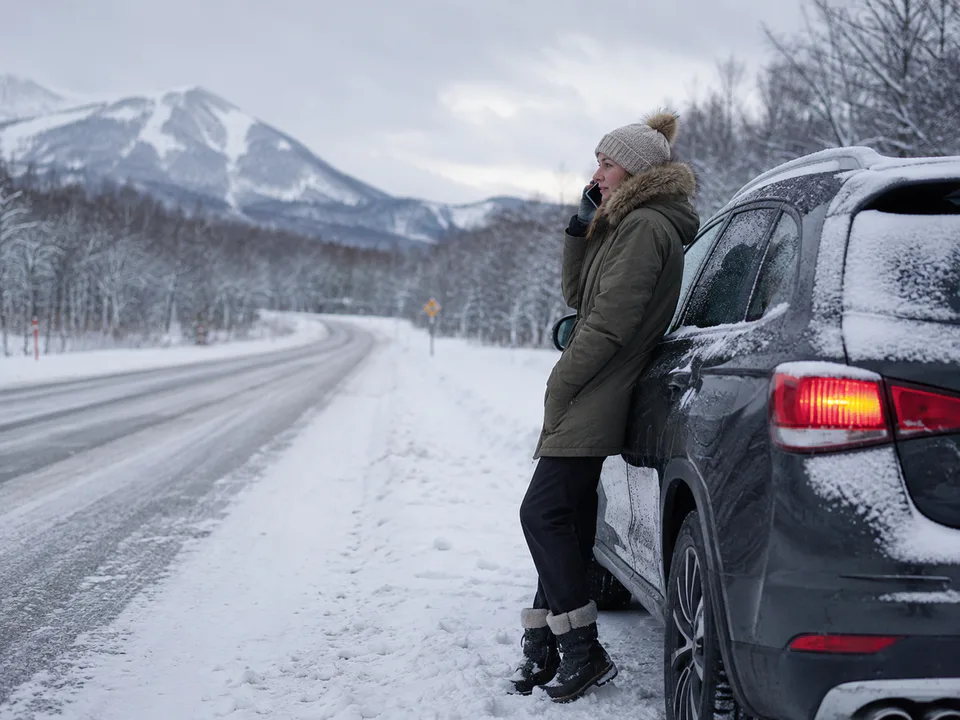
The safest Hokkaido winter-driving decision is made before you start the engine. I would rent a car only when the driver already has genuine snow-and-ice experience, the route can be completed mainly in daylight on maintained roads, official weather and road information are acceptable, and the itinerary can be cancelled or shortened without breaking the trip. Winter tyres and 4WD are useful equipment; they are not permission to drive into a blizzard, whiteout or official closure.
If this would be your first experience driving on snow, use Hokkaido’s trains, buses or private transfers instead. Hokkaido Government guidance currently tells drivers to check weather and road information before departure, avoid nonessential travel when bad weather is forecast, and consider changing departure time or using public transport when heavy snow or poor visibility is expected. That is the correct baseline for a tourist itinerary too.
↔ Scroll table left or right
Your situation today | ValueNavi decision | Why |
No real snow/ice driving experience | Do not self-drive | Hokkaido is the wrong place to learn while also adapting to left-side traffic and an unfamiliar rental car |
Experienced winter driver, daylight, maintained main roads, normal official conditions | Conditional GO | The trip has several safety margins and the vehicle setup can support the route |
Heavy snow / blizzard / poor visibility forecast | NO-GO or delay | Current Hokkaido guidance explicitly recommends avoiding nonessential travel and considering public transport |
Official road closure or traffic suspension affects the route | NO-GO on that route | A navigation detour does not overrule an official closure |
Late flight + long drive to Niseko, Furano or Tomamu | Sleep first; drive in daylight | Airport rental pickup already includes a shuttle to the rental office before the winter drive begins |
Trip stays in one ski resort and the car would sit parked | Bus / transfer often wins | You remove winter-road exposure, parking and snow-clearing work without losing much itinerary freedom |
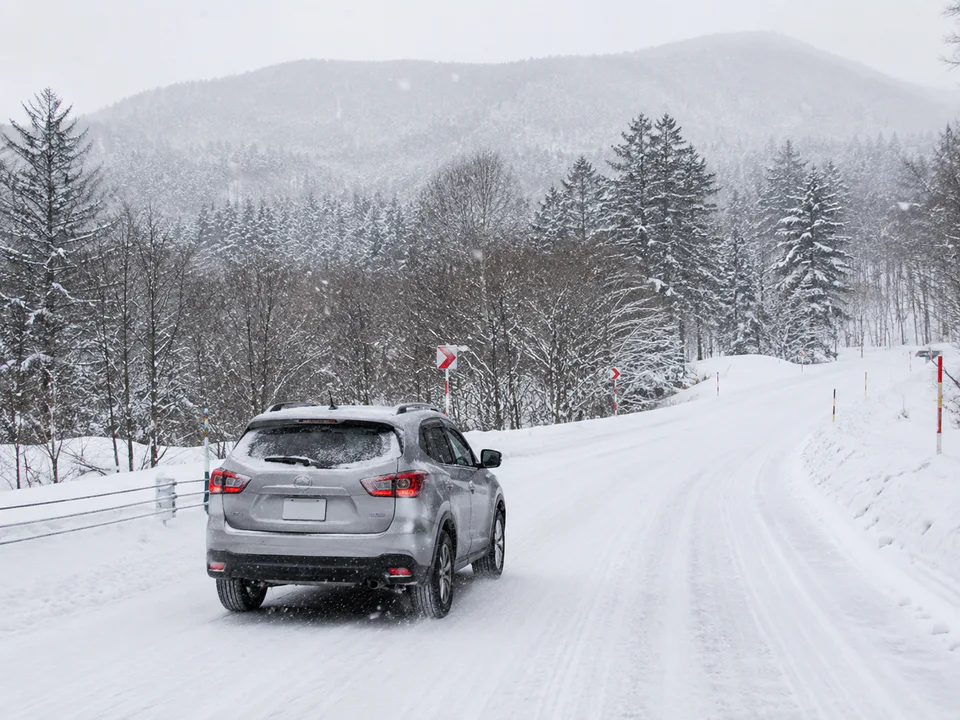
Use a five-step go/no-go test every driving day
A prepaid rental car should not decide whether you drive. Run this sequence again each morning and before a major mountain or intercity leg.
Driver: Is the person driving genuinely comfortable controlling a vehicle on snow and ice? If not, stop here and use another mode.
Weather: Do official forecasts show heavy snow, blizzard conditions or poor visibility along the route? If yes, delay, reroute onto public transport or cancel the drive.
Road: Are the intended roads open, and is the route based on maintained main roads rather than a navigation app’s minor-road shortcut?
Daylight and fatigue: Can the difficult section be completed with a large daylight margin and a rested driver? Hokkaido Government currently recommends planning to arrive while it is still light.
Recovery: If conditions deteriorate, is there a realistic safe place to stop, a bus/train alternative, an extra hotel night or a route you are willing to abandon?
If the trip passes only because “the forecast might improve” or “Google Maps has another road,” it has failed the test. Winter resilience comes from having a boring alternative, not from having a more ambitious itinerary.
Winter tyres are the baseline; 4WD is not a braking upgrade
Hokkaido Government’s current winter-driving guidance says roads that look black can already be frozen and advises changing to winter tyres early. It also recommends carrying winter equipment such as chains, a shovel, extra traction aids, jumper cables and tow ropes. For a rental car, confirm the exact winter-tyre and 4WD specification on the reservation and again at pickup rather than assuming every class is identical.
Four-wheel drive can help a vehicle move away from a stop or maintain traction on some climbs, but it does not make ice disappear under braking. The editorial rule is simple: 4WD can improve the vehicle; it must never upgrade a NO-GO weather decision into GO.
Hokkaido’s current official guidance says icy road surfaces can be approximately ten times as slippery as dry summer roads and recommends maintaining more than three times the normal summer following distance. Treat those figures as a warning about the scale of the margin you need, not as a formula that guarantees a safe stopping distance.
Black ice is dangerous precisely because the road can look normal
Black ice can look like wet, dark asphalt. Hokkaido and JAF both flag bridges, shaded areas and tunnel entrances or exits as places where freezing can be especially deceptive; intersections and areas around crossings also deserve extra caution.
This is why a dry-looking road at the hotel cannot be used to infer the next 100 km. Temperature, shade, elevation, wind and refreezing can change within the same route. Reduce speed early, leave more room than you think you need and avoid sudden steering, acceleration or braking inputs.
The most important behavioural boundary is not a particular speed number. It is whether you can still drive smoothly while preserving a large margin. If the road repeatedly surprises you, the correct response is to shorten or end the drive.
A whiteout is not a “drive slower and continue” condition
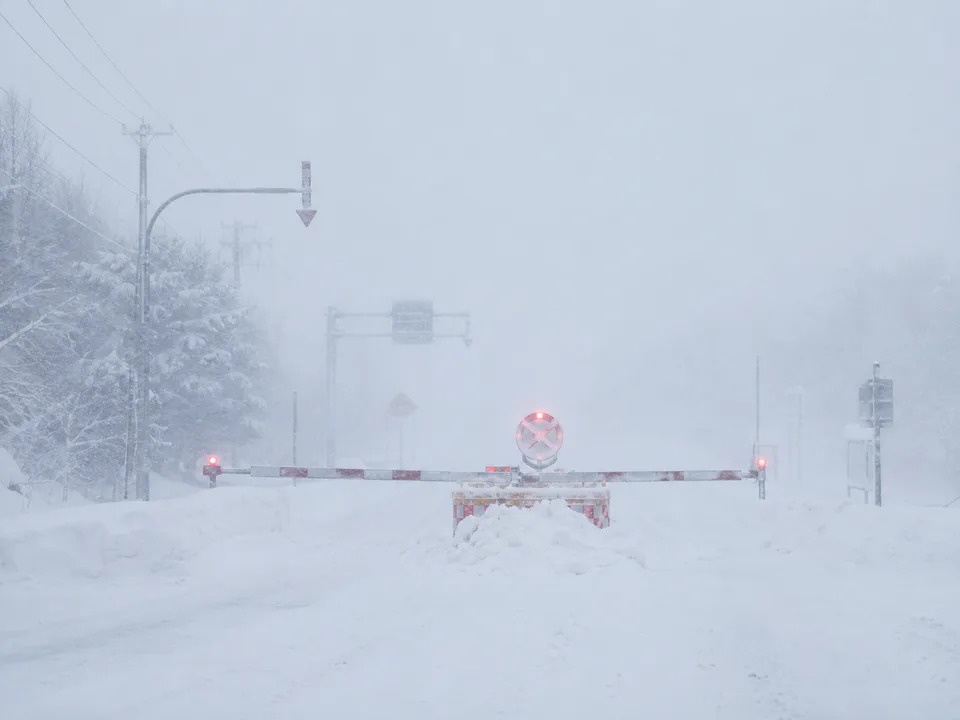
Whiteouts remove the contrast between the road, roadside and sky. If you can no longer identify the lane or road edge reliably, continuing to “make progress” is the wrong objective. JAF’s current snow guidance says that in a whiteout or heavy snowfall, drivers should use hazard lamps and stop at a safe place when they cannot proceed.
Do not stop suddenly in a live traffic lane if a safer place can be reached. Do not follow an unofficial detour onto an unploughed side road to get around a closure. And do not let a hotel cancellation penalty, ski lesson or restaurant reservation become the reason you continue.
Useful live sources include the Japan Meteorological Agency, official Hokkaido road information, NEXCO East and JARTIC. A saved route plan from the night before is not current road information.
New Chitose Airport adds a hidden hand-off before the first winter drive
New Chitose Airport currently states that rental cars are not handed over in the lane in front of the terminal. Staffed rental companies transport customers by bus to their business locations in Chitose City, and the return trip works the same way.
That changes the late-arrival calculation. A flight landing at 17:00 does not mean a rental car is driving away at 17:15. You still have baggage, the rental counter or meeting procedure, the shuttle, paperwork, vehicle inspection and winter setup before the road trip begins. In December or January, that can also move a large part of the first drive into darkness.
For a long transfer to Niseko, Furano or Tomamu after a flight, I would normally buy sleep rather than distance: stay in Chitose or Sapporo, or use a bus/private transfer. If you still want a car later, collect it in daylight. The New Chitose Airport to Niseko comparison is the right place to compare bus, private transfer, train and rental-car sequencing.
Full-trip rental is often worse than partial rental
A rental car does not need to cover every day just because one part of the itinerary benefits from driving. If the first two nights are in Sapporo and the next three are in a well-connected ski resort, a full-trip car can add winter exposure, hotel parking and snow clearing without adding much freedom.
Partial rental becomes especially strong when the driver is experienced but wants to limit exposure to daylight scenic or rural legs. For example, trains or transfers can handle the airport and city legs while a shorter rental handles one region where public transport genuinely constrains the itinerary.
Use Hokkaido Winter Rental Car: Full Trip or Partial Rental? once the safety decision is “yes, this driver can reasonably drive.” The guide should not be used to talk a first-time snow driver into renting for fewer days; if experience is missing, the safer answer is still not to drive.
Route density matters more than how many famous places fit on a map
Winter driving risk rises when the itinerary depends on long daily transitions, not merely because a destination is rural. A single-driver plan that changes region every day has less recovery margin than a two-night base with one optional day trip.
I would penalise a winter itinerary for each of these:
arrival-day long-distance driving after a flight;
mountain or rural sections scheduled after sunset;
two or more long intercity moves on consecutive days;
an activity booking that makes the driver unwilling to wait out bad weather;
a route whose only alternative is another winter road rather than rail, bus or an extra hotel night.
The point is not to avoid rural Hokkaido. It is to keep enough unused time that weather can change the itinerary without turning the day into a race.
Parking is part of winter driving, not an afterthought
A hotel with a parking space does not automatically offer an easy winter parking experience. Confirm whether the lot is outdoors or covered, whether reservations are required, what happens during heavy snowfall, any height limits and whether overnight clearing can temporarily move or bury the vehicle.
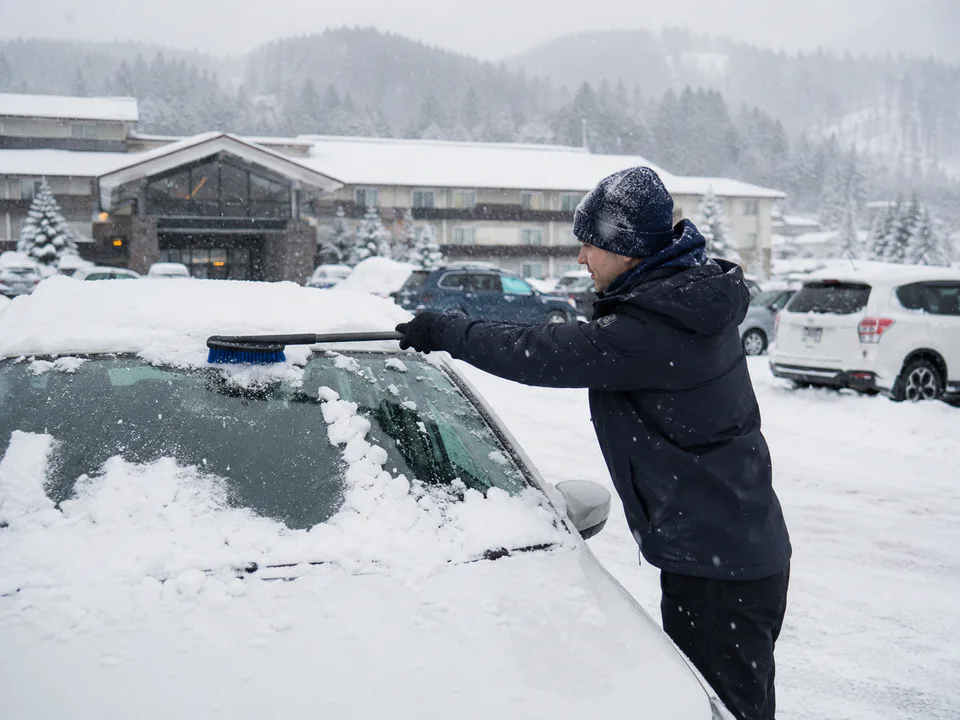
Before driving, clear snow from the roof, windows, mirrors, lights, number plate and sensors. Snow left on the roof can slide forward under braking or blow onto following traffic. Also make sure the exhaust area is not blocked before running the engine.
For ski trips, verify luggage geometry at booking. A nominal five-seat car can become a two-person car once ski bags, boots and two large suitcases are inside. An AWD badge does not tell you whether the equipment physically fits.
Rental insurance should be judged by the failure you cannot afford
Do not stop at “CDW included.” A deductible waiver and the Non-Operation Charge can be separate, and winter incidents can add towing, snow recovery, tyre, wheel, glass or underbody costs depending on the contract. The useful questions are:
What deductible remains after the selected waiver?
Is NOC waived, reduced or still payable?
How much towing or roadside assistance is included?
Does snow recovery have a separate limit or exclusion?
What happens if the driver ignores a closure, uses an unregistered driver or fails to obtain a police report?
A more expensive protection package can be rational when it removes a loss you could not comfortably absorb. It does not make unsafe driving acceptable and it may not cover an incident caused by violating the rental agreement.
If you get stuck, the engine can become part of the danger
JAF warns that when a vehicle is buried in heavy snow, a blocked exhaust can allow carbon monoxide to enter the cabin. While waiting for rescue, keep the exhaust outlet clear of snow. JAF also advises turning the engine off as much as practical during heavy snowfall and keeping winter emergency equipment such as a shovel, warm clothing and blankets in the car.
The emergency sequence is:
Protect people from a secondary collision and move to a safer position if that can be done without creating more risk.
Call 119 for injury/fire/urgent medical help and 110 when police accident assistance is required.
Notify the rental company and use the towing/rescue provider required by the contract.
Keep the exhaust area clear if the engine must run while waiting.
Do not walk a long distance through a whiteout or try an unfamiliar tow/recovery manoeuvre in live traffic.
JAF roadside assistance can be reached at #8139 or 0570-00-8139.
When does a bus or private transfer beat the car even for an experienced driver?
Snow-driving experience is necessary for self-driving; it does not mean driving is always the best product. A transfer can still win when:
the only important journey is New Chitose Airport ↔ one ski resort;
everyone plans to ski all day and the car would remain parked;
the group has several ski bags and luggage that force an expensive large vehicle;
the arrival or departure leg would otherwise be in darkness after a long flight;
weather uncertainty is high enough that transferring the operational risk to a professional service is worth the premium.
The car wins when it buys repeated freedom that public transport cannot: several rural stops, multiple bases with poor connections, or flexible day trips on days when the official conditions are good. It loses when it mostly sits under snow outside the hotel.
The decision should be allowed to change every morning
The strongest winter itinerary is not one that predicts the weather perfectly months in advance. It is one that survives a different answer on the day.
Before bed, identify tomorrow’s Plan B. In the morning, recheck JMA, official road information and any operator notices. If the forecast or road status moves the day from GO to NO-GO, use the alternative without trying to “recover” the prepaid drive later that night.
This is also why two-night bases are often stronger than daily hotel changes. They create somewhere to stay when one road day disappears.
Final verdict
Drive in winter Hokkaido only when four conditions are simultaneously true: the driver already has snow-and-ice experience, the route is mainly maintained road in daylight, current official weather/road information is acceptable, and cancelling the day will not break the trip.
Winter tyres are mandatory planning equipment; 4WD can improve traction but does not shorten an icy-road stopping problem enough to make bad weather safe. A late arrival should not launch directly into a long winter transfer simply because the rental desk is open. A ski-resort stay does not need a car merely because the destination is snowy. And an official closure or poor-visibility forecast should be allowed to erase a prepaid day.
The right question is therefore not “Can this car drive through Hokkaido in winter?” It is “Does this driver, on this route, in today’s conditions, still have enough margin to choose not to drive?” If the answer is no, use the bus, train or transfer.
What to Wear for Japan Autumn Leaves: Cities, Mountains, Rain and Snow
Hokkaido Autumn Leaves 2026: Daisetsuzan, Sapporo and Hakodate Routes
Niseko Powder Snow Guide: Why Hokkaido “Japow” Feels Different
Japan Autumn Leaves Early October: Hokkaido, Tohoku and Kamikochi
Sapporo Winter Horseback Riding: 50 vs 80 Minutes — Direct Booking, Pickup and Winter Access
References
Hokkaido Government — Driving on winter roads · Hokkaido Government — Winter traffic accident prevention · JAF — Snow-covered and icy roads · New Chitose Airport — Rental cars · Japan National Police Agency — Traffic information. Checked August 25, 2026. Weather, road closures, rental equipment, branch hours, insurance and rescue conditions can change; recheck the exact day, route and operator before driving.