
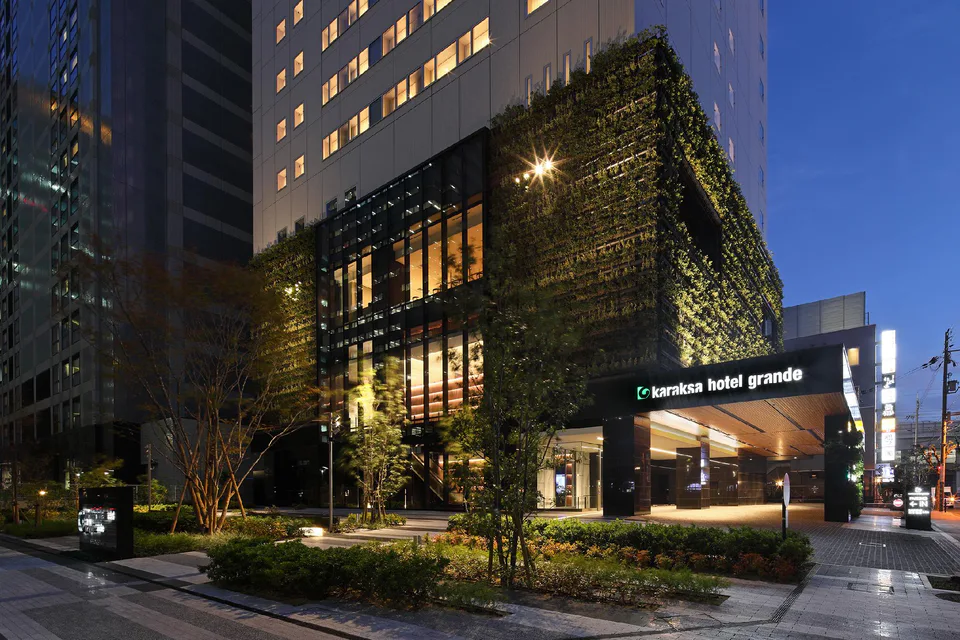
karaksa hotel grande Shin-Osaka Tower is worth moving to before an early Shinkansen when the move shifts uncertainty out of the departure morning. The hotel is about five minutes on foot from Shin-Osaka Station Exit 4. That does not magically turn a 07:00 train into a five-minute hotel-to-platform trip, but it can remove one local-train leg, one transfer and one piece of morning wayfinding from a hard-deadline day.
This is the ValueNavi distinction that matters: the hotel does not necessarily save the most minutes; it can save the most risky minutes. Moving from Namba or Umeda the night before turns a time-sensitive morning transfer into a more flexible evening transfer. If your Osaka nights are built around Namba, Shinsaibashi or USJ and the Shinkansen is not early, that trade is often unnecessary.
Fact-checked August 26, 2026. JPY remains the primary currency; approximate USD figures use about ¥159 = US$1 as a working reference. Shinkansen schedules, room availability and hotel operating hours can change.
ValueNavi relocation test: move the night before only when risk shifts in your favour
A hotel change is not free. You pack, check out, ride to Shin-Osaka, find the hotel and unpack again. The reason to do it is not “Shin-Osaka is convenient.” The reason is that an evening move usually has more recovery time than a departure-morning move.
↔ Scroll table left or right
Factor | Stay near Shin-Osaka the night before | Keep your existing Osaka base |
Train is genuinely early or connection-sensitive | Strong reason: remove a local-train dependency from the morning. | Better only if your existing base already gives a very simple direct route and you have plenty of buffer. |
Two large suitcases / family luggage | Stronger reason: shift luggage handling to the flexible evening. | Reasonable if the morning transfer is simple and lifts/routes are familiar. |
Four to six travellers | Stronger reason: connecting rooms and two bathroom zones reduce the group’s fixed-morning bottleneck. | Better if your current apartment/family room already solves bathroom and luggage friction. |
Late Namba/Shinsaibashi/USJ final night | Weak reason: you may create an awkward late relocation just to simplify the morning. | Usually better unless the departure deadline is unusually tight. |
Train is mid-morning or later | Convenience only. | Usually keep the better Osaka base. |
My editorial rule: I would consider a one-night Shin-Osaka relocation when at least two things are true: the train is early, the group has meaningful luggage, several people must get ready on one deadline, or the next leg is important enough that missing it would materially damage the itinerary. If none of those apply, I would rather avoid the hotel move.
This threshold is ValueNavi analysis, not a hotel rule.
The real saving is a smaller morning failure chain
From another Osaka base, the departure chain may look like this:
room → hotel checkout → local station → local train/subway → Shin-Osaka → Shinkansen gates → platform.
From karaksa, the chain becomes:
room → hotel checkout → about five-minute walk from Exit 4 area → Shin-Osaka interior → Shinkansen gates → platform.
Both still require station navigation and a boarding buffer. The difference is that one chain contains an extra public-transport leg whose delay, wrong direction, lift search or luggage boarding problem happens on the morning of a fixed train. The other shifts that local transfer to the previous evening, when a 10-minute mistake is usually annoying rather than trip-breaking.
That is why I would describe this as a deadline-risk hotel rather than simply a station hotel.
The 30-second verdict by itinerary
↔ Scroll table left or right
Itinerary | My call | Reason / trade-off |
Early Shinkansen next morning | Book / strong fit | You buy a shorter, more resilient morning chain at the cost of a hotel move the night before. |
KIX arrival, next day continues by Shinkansen | Strong fit | The hotel lists about 50 minutes by HARUKA to Shin-Osaka plus the final walk, making it a coherent transfer-night base. |
Four to six travellers using connecting rooms | Strong fit | Two rooms, internal connection and two bathroom zones can reduce the group morning bottleneck. |
Three or four Osaka sightseeing nights | Compare | Shin-Osaka remains connected by Midosuji Line, but every late city evening ends with a return north. |
Repeated late USJ / Namba nights, no early train | Skip for location | You pay the nightly return cost without using the deadline-risk benefit. |
Five minutes from Exit 4 is not five minutes from bed to Shinkansen
The hotel’s current official access information says approximately five minutes on foot from Shin-Osaka Station Exit 4. That is useful, but it is a last-segment figure. It excludes checkout, elevators, walking back into the station, finding the Shinkansen gates, ticket issues and the boarding buffer you choose.
JR Central’s 2026 timetable confirms that Shin-Osaka has early-morning Shinkansen departures in both directions. The correct planning order is therefore train departure → desired platform buffer → station interior time → hotel walk → room departure. Do not start with “hotel is five minutes away” and subtract five minutes from the train time.
If your real alternative is Umeda rather than Namba, compare the Osaka Station hotel comparison and Hotel Granvia Osaka. The question is whether you need Osaka Station repeatedly or Shin-Osaka once under a hard deadline.
ValueNavi room-space test: station proximity should not force you into the 15m²-class Double
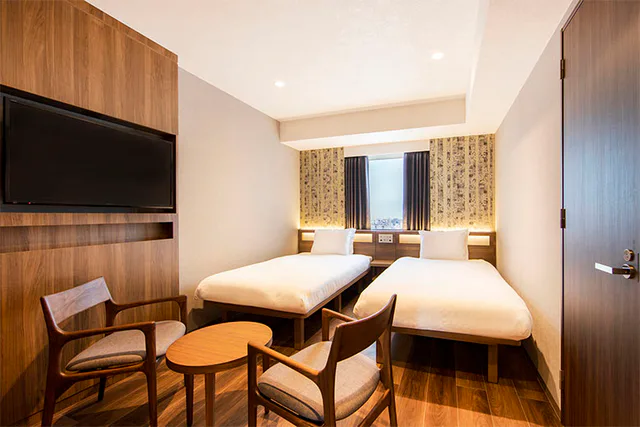
Room size varies enough to change the decision. Standard Double is 15.2–16.4m². Standard Twin is 21.0–26.3m². That means even the smallest Standard Twin gives at least 4.6m² more floor area than the largest Standard Double, before considering the Twin’s separated shower, washbasin and toilet layout.
For a solo traveller with light luggage, the Double can make sense. For two travellers with large bags and a fixed morning, I would price the Twin first because the value of extra floor area is highest exactly when both people are packing and getting ready at the same time.
↔ Scroll table left or right
Room | Published size | ValueNavi use case |
Standard Double | 15.2–16.4m² / 140cm bed | Solo or light-luggage one-night transfer stay. |
Standard Twin | 21.0–26.3m² / two 110cm beds | My two-person baseline when luggage and a fixed departure matter. |
King Double | 21.0–26.3m² / 220cm bed | Couples prioritising one large bed while keeping Twin-class floor area. |
High Floor Superior Twin | 23.2–25.2m² / 15F+ | Upgrade for layout/high floor, not simply “more premium.” |
High Floor Superior Twin with Sofa Bed | 25m² / up to 3 | Works for three, but the third bed and three people’s luggage share the same space. |
High Floor Grande with Tatami | 42.5m² / up to 4 | A genuinely different family-space product rather than a minor upgrade. |
The hotel does not guarantee how many 28- or 29-inch suitcases can remain fully open in each layout, so this is a floor-area and bathroom-layout comparison—not a fabricated suitcase test.
For a purpose-built family apartment instead of two hotel rooms, compare MIMARU Osaka Shinsaibashi Central.
Connecting rooms: ValueNavi’s “morning throughput” advantage
The hotel currently lists 160 connecting rooms, with paired rooms accommodating up to six guests depending on the combination. The important benefit is not just privacy. It is parallel morning throughput: two bathroom zones, two room entrances and two separate spaces for packing.
For a group of four to six with one fixed train, that can matter more than a slightly larger single family room. One person can shower while another uses the second wash area; one room can finish packing while the other is already ready. I would not assign a fake number of minutes saved, because group routines vary. The structural advantage is simply that more tasks can happen at once.
The trade-off is cost: connecting means two rooms. Compare the combined rate against an apartment or a true family room. If two bathrooms are the actual need, use Hotel Keihan Namba Grande family-room guide as another benchmark.
Public bath versus breakfast: on a very early train, choose the buffer first
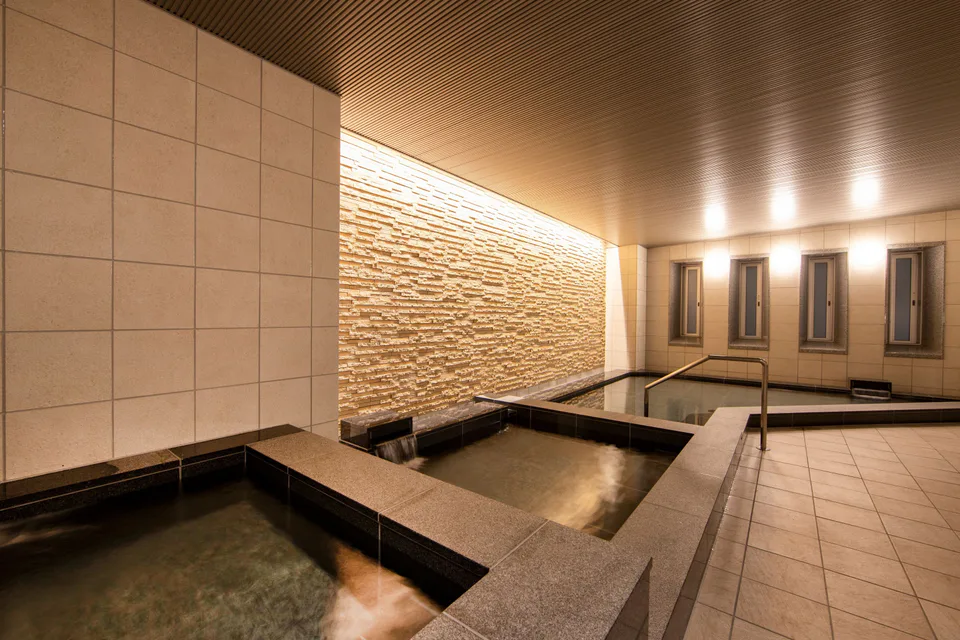
The public baths and saunas currently run 15:00–25:00 and 05:00–10:00, free for hotel guests. Breakfast runs 06:30–10:30 with last entry at 10:00 and costs ¥2,750 (about US$17.30) per adult.
Those hours create a classic early-train conflict. The 05:00 bath opening makes a morning soak possible, and the 06:30 breakfast opening makes a buffet possible—but using both before a very early departure can destroy the very buffer you paid Shin-Osaka prices to protect.
ValueNavi priority order: platform buffer first, essential packing/check-out second, then either bath or breakfast if the remaining time is genuinely comfortable. Amenities should consume spare time; they should not consume resilience.
The hotel also states that towels are not provided in the bath area, so bring them from the room. Tattoos are generally restricted, with an exception possible when the tattoo can be fully covered by the hotel’s cover sticker; confirm the current rule with the front desk.
Breakfast break-even: two adults create a ¥5,500 reference ceiling
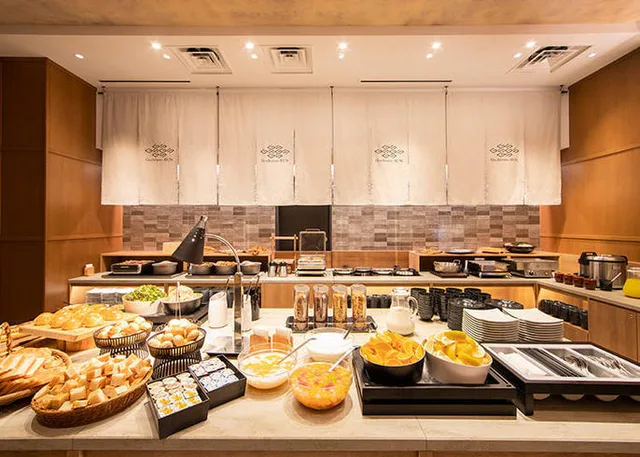
At the current ¥2,750 adult price, two adults would pay ¥5,500 (about US$34.60) for breakfast separately. That gives you a clean booking reference.
If the same room, cancellation terms and taxes cost ¥4,000 more with breakfast for two adults, the package is financially competitive if both people will actually eat. If the breakfast package costs ¥7,000 more, breakfast alone does not explain the difference. And if the train forces you out before breakfast is usable, the breakfast value is effectively zero for that morning regardless of how good the buffet looks.
This is why I would never book breakfast first and then choose the Shinkansen. The train sets the morning; the meal plan follows.
Free drinks and laundry are useful only on the correct transfer night
The hotel currently offers free drinks in part of Gochisou-SUN from 14:00 to 22:00. The fourth floor also has a self-service laundromat; the FAQ confirms there is no valet laundry service.
For a city-hopping itinerary, laundry can be more valuable than the public bath because it can reduce what you carry onto the next train. But machine availability at a specific late hour is not guaranteed. Treat it as a useful facility, not a scheduled service you can depend on at 23:30.
The same rule applies to free drinks: if your final Osaka evening keeps you in Namba until after 22:00, the amenity exists but your itinerary cannot use it. This is a recurring ValueNavi test: count usable hours, not amenity bullets.
Route-conflict matrix: where one Shin-Osaka night helps and where it hurts
↔ Scroll table left or right
Previous / next move | Conflict | ValueNavi call |
KIX arrival → next-day Shinkansen | Low conflict: official hotel access lists HARUKA to Shin-Osaka in about 50 minutes. | Excellent transfer-night shape. |
Namba dinner → early Shinkansen | Moderate: you must choose whether to relocate after dinner or give the morning the transfer. | Relocate only if the morning deadline matters more than the evening inconvenience. |
USJ late finish → early Shinkansen | High: both the late return and next morning are time-sensitive. | Do not assume Shin-Osaka solves both; decide which deadline is more important. |
Umeda evening → mid-morning Shinkansen | Low morning pressure. | Often keep the Umeda hotel and transfer in the morning. |
Repeated intercity rail days | Low: the hub is used more than once. | Shin-Osaka becomes a genuine base rather than a one-night insurance move. |
For late USJ nights, use the USJ late-night transport guide and Where to Stay for USJ Halloween before assuming an early-train hotel is the right final night.
What you give up by moving to Shin-Osaka
You move the inconvenience; you do not erase it. A night-before relocation means packing earlier, ending your final Osaka evening nearer a transport hub, and potentially giving up the ease of walking back to a Namba or Shinsaibashi hotel.
You also risk overpaying for proximity while choosing the wrong room. The smallest Double is 15.2–16.4m², so two travellers with large luggage can solve the station problem and create a room-space problem at the same time.
Finally, an early train can make several hotel benefits unusable. Breakfast starts at 06:30. Free drinks end at 22:00. The bath reopens at 05:00, but using it may consume your departure buffer. The hotel works best when you buy the transfer function first and treat amenities as secondary.
Five failure modes before an early Shinkansen
1. You read “five minutes” as room-to-platform time. Station interior and buffer still exist.
2. You move hotels even though the train is not early. You pay a relocation cost without buying meaningful resilience.
3. You keep a late Namba or USJ plan and then relocate at the end of an already exhausting night. The “safer morning” can be purchased with a worse evening.
4. You book breakfast because it sounds convenient, then leave before 06:30. Two adults can strand ¥5,500 of theoretical breakfast value.
5. You book the smallest Double solely because the hotel is close to the station. For two travellers, the 21m²-plus Twin may be the better transfer-night product.
Booking check: compare the same room, bedding and breakfast rules
Align the exact room type, guest count, bed setup, breakfast inclusion, taxes and cancellation deadline. For connecting rooms, confirm that the rate actually sells two adjacent rooms with an internal connecting door for your dates. Do not assume every paired-room rate is automatically a connecting-room product.
Booking.com: check karaksa hotel grande Shin-Osaka Tower rooms
Trip.com: check karaksa hotel grande Shin-Osaka Tower rooms
Agoda: check karaksa hotel grande Shin-Osaka Tower rooms
Final verdict: pay for risk relocation, not for the phrase “five-minute walk”
I would book karaksa hotel grande Shin-Osaka Tower for an early or connection-sensitive Shinkansen when moving the night before removes a local-train dependency from the fixed morning. I would also give it serious weight for four to six travellers who can use connecting rooms and two bathroom zones.
I would not automatically move here for a normal mid-morning train. If your final Osaka evening is the part of the trip you care about most, staying in Namba, Shinsaibashi, Umeda or Universal City and transferring in the morning may be the better trade.
The ValueNavi red-team question is: if tomorrow’s train were moved two hours later, would you still change hotels? If the answer is no, you are buying departure-risk reduction—and that is a perfectly valid reason. If the answer is yes, then Shin-Osaka is probably functioning as a wider rail base in your itinerary, not just one-night insurance.
FAQ
Is the hotel really about five minutes from Shin-Osaka Station?
The hotel currently states about five minutes on foot from JR / Osaka Metro Shin-Osaka Station Exit 4. This does not include room checkout, station navigation, Shinkansen gates or your boarding buffer.
For two travellers with large luggage, Standard Double or Standard Twin?
Standard Double is 15.2–16.4m²; Standard Twin is 21.0–26.3m². I would price the Twin first when both travellers have large luggage or need to get ready simultaneously.
What time does the public bath open?
Current hours are 15:00–25:00 and 05:00–10:00. Towels are not provided in the bath area, so bring them from the room.
When does breakfast start?
Breakfast currently runs 06:30–10:30, last entry 10:00, at ¥2,750 per adult. Two adults therefore create a ¥5,500 breakfast-price reference when comparing room packages.
How many people can connecting rooms accommodate?
The hotel lists 160 connecting rooms; paired-room combinations can accommodate up to six guests depending on the room type and availability.
Early Shinkansen from Osaka: Should You Stay in Shin-Osaka or Move Only for the Last Night?
Hotel Gracery Sapporo: Is a 1-Minute Station Walk Worth a 15 m² Room?
Hotel Sonia Otaru: Is a Canal-View Room and Rooftop Onsen Worth the 8-Minute Station Walk?
Mitsui Garden Hotel Ueno: Is the 6-Minute Walk from the Skyliner Worth It?
Sources
karaksa hotel grande Shin-Osaka Tower — official access information
karaksa hotel grande Shin-Osaka Tower — official room information
karaksa hotel grande Shin-Osaka Tower — official facilities, bath and breakfast
karaksa hotel grande Shin-Osaka Tower — official FAQ and connecting-room details
JR Central — Tokaido/Sanyo/Kyushu Shinkansen timetable
Room types, rates, operating hours, train schedules, availability and cancellation terms can change by date. This article may contain affiliate links; ValueNavi may earn a commission from qualifying bookings at no additional cost to you.