
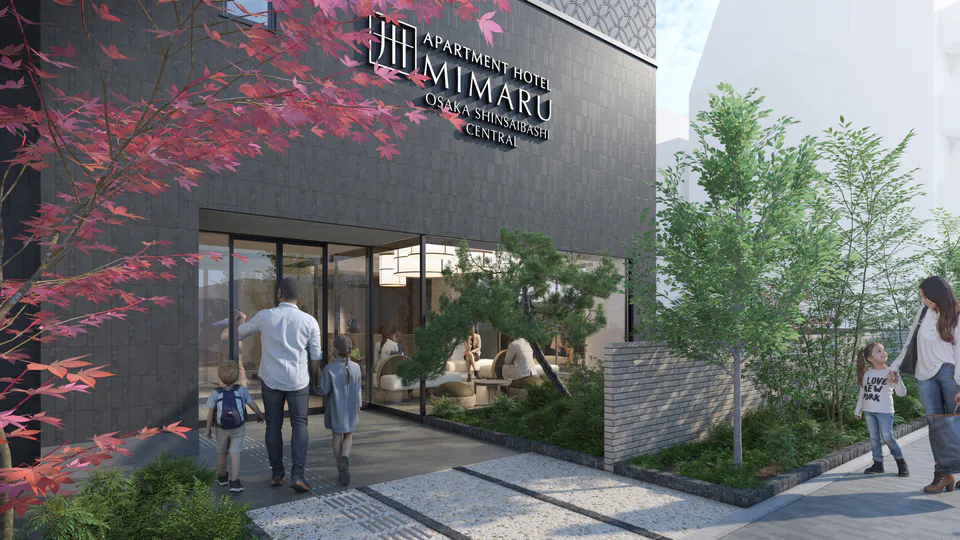

MIMARU Osaka Shinsaibashi Central is most compelling when one apartment solves a group problem that two ordinary hotel rooms would solve badly: everyone wants a shared living space, the kitchen and in-room washer-dryer will actually be used, and the bed plan matches the people travelling. It is not automatically the best four- or six-person hotel simply because everyone can sleep under one booking.
For four adults, the unusual 40 m² Two-Bunkbed Apartment is a bathroom-throughput product: two showers and two washbasins let two people get ready at once, but there is still only one toilet and every guest sleeps in a bunk. For a family of four, the 40–42 m² One-Bedroom Family Apartment is usually the safer default because it keeps a bathtub and two conventional single beds. For six, I would pay more attention to bedroom separation and bed type than to the small difference in floor area: the 60–61 m² Two-Bedroom Family Apartment has four single beds plus one bunk bed, while the 57 m² Superior One-Bedroom Family Apartment uses two singles, two loft beds and two futons.
Important: as of August 25, 2026, this property has not opened yet. The scheduled opening is September 1, 2026. This is therefore a pre-opening room-selection and location analysis based on current official specifications, not a stay review. The hotel itself says room images are for reference and layouts may change.
The 30-second room decision
↔ Scroll table left or right
Your group | Start with | Why | Main catch |
4 adult friends, all happy with bunk beds | Two-Bunkbed Apartment | 40 m², two showers and two washbasins reduce the shower bottleneck | Only one toilet; no bathtub; everyone sleeps in a bunk |
Family of 4 or group with an older traveller | One-Bedroom Family Apartment | Two single beds + one bunk bed, bathtub and clearer conventional-bed option | One bathroom and one toilet create more serial morning use |
6 guests who need real bedroom separation | Two-Bedroom Family Apartment | 60–61 m², four single beds + one bunk, two toilets, bath + separate shower | Two guests still use bunk beds; it is not six equal conventional beds |
6 guests who value one large shared sleeping setup and flexible bedding | Superior One-Bedroom Family Apartment for 6 | 57 m² with two singles, two loft beds and two futons; same two-toilet + bath/shower count | Less bedroom separation and fewer conventional beds |
4 adults who want privacy and two fully independent bathrooms | Compare two ordinary hotel rooms | Two rooms can provide two toilets, two bathrooms and two private sleep zones | You lose the large shared table, kitchen, single-group living space and one-apartment convenience |
1-night Osaka stop | Do not assume MIMARU wins | Kitchen and washer-dryer have little time to repay an apartment premium | Location or room price may still make it worthwhile |
3–5 nights with children, groceries or laundry | MIMARU gets stronger | Shared living space, kitchen and in-room washer-dryer are used repeatedly | Apartment-style housekeeping and no breakfast restaurant may not suit everyone |
Four adults: two showers solve one queue, not every bathroom queue
The Two-Bunkbed Apartment is the room that makes this property unusual. The current official specification is 40 m² with two bunk beds, two washbasins, two shower rooms, one toilet and an in-room washer-dryer, for four guests.
The useful way to value it is not “two showers sounds luxurious.” Think about the morning sequence. In a conventional four-person room with one bathroom, showering is largely serial: one person occupies the wet area while the others wait or improvise. Two independent showers create two parallel lanes, so a group of four can split into pairs. Two washbasins help with teeth, skincare and hair at the same time.
But the room does not become a two-bathroom apartment. The official layout still lists one toilet. If all four guests need the toilet at the same time before an early USJ day or train departure, that bottleneck remains. The room removes the shower queue; it does not remove every bathroom queue.
There is also a sleeping trade-off. Every guest must accept bunk-bed sleeping. For four friends in their twenties or thirties who value shared time and a fast morning, that can be exactly the point. For older parents, travellers with mobility concerns, or adults who simply dislike climbing into a bunk, two showers are solving the wrong problem.
For a family of four, the bathtub and bed mix can matter more than the second shower
The One-Bedroom Family Apartment is currently listed at 40–42 m² with two single beds, one bunk bed, one washbasin, one toilet, one bathroom and an in-room washer-dryer. The headline floor area is almost the same as the Two-Bunkbed Apartment, so this is not a “small room versus large room” decision.
The trade is throughput versus conventional family use. The bunk room gives four bunk positions and two showers. The family apartment gives two conventional single beds plus a bunk and retains a bathtub.
I would start with the Family Apartment when a parent or grandparent wants a normal bed, when bathing a child is easier in a tub, or when the group is comfortable staggering showers. I would start with the Two-Bunkbed Apartment when all four travellers are independent adults or older children, everyone accepts bunks and the morning bathroom queue is the recurring pain point.
This is also a useful reason not to rank rooms by “newest concept.” The more distinctive room is not automatically the better room. Buy the unusual layout only when the problem it solves is a problem your group actually has.
Six guests: the 60–61 m² upgrade is mainly about separation and bed type
The most revealing comparison is between the two current six-person layouts because their bathroom counts are nearly controlled.
The Superior One-Bedroom Family Apartment for 6 is 57 m² with two single beds, two loft beds and two futons. It has one washbasin, two toilets, one bathroom and one additional shower room.
The Two-Bedroom Family Apartment is 60–61 m² with four single beds and one bunk bed. It also has one washbasin, two toilets, one bathroom and one additional shower room.
That means paying for the Two-Bedroom room should not be justified by saying “you get another toilet” or “much more bathroom capacity.” You do not. The two layouts already share the same two-toilet and bath-plus-shower structure. The real upgrade is:
a second bedroom;
four conventional single beds instead of two;
less dependence on loft beds and futons;
a small additional amount of floor area.
For two families, three generations or adults with different sleep schedules, that separation can be worth far more than the extra 3–4 m². For a family whose children actively want loft/futon sleeping and who prefers one large shared room, the 57 m² option can be the more fun and efficient use of the apartment.
There is one hard boundary: if six adults all want equivalent conventional beds, neither published six-person layout is a perfect fit. The Two-Bedroom room still places two guests in the bunk bed. At that point, compare two conventional hotel rooms or another property instead of treating six-person legal capacity as proof that the sleep arrangement suits six adults.
One apartment versus two hotel rooms: compare privacy, not only price per person
Large groups often divide the final room total by four or six and conclude that the apartment is cheaper or more expensive. That misses the product difference.
One MIMARU apartment buys one shared dining/living space, one kitchen, one in-room washer-dryer, one booking and the ability to keep the whole group together. Two ordinary hotel rooms buy something MIMARU cannot reproduce: two independent doors, usually two independent toilets and bathrooms, and real privacy for couples or travellers on different schedules.
Use this decision test before comparing rates:
↔ Scroll table left or right
Question | If yes, MIMARU gains value | If no, two rooms gain value |
Will the group eat, plan or relax together in the room? | Shared table and living area are used every day | The apartment becomes mostly sleeping space |
Will you cook breakfast, prepare children’s food or use groceries? | The kitchen replaces repeated restaurant/convenience decisions | A kitchen is paid-for square footage with little use |
Will you wash clothes during the stay? | In-room washer-dryer avoids shared-laundry timing | One-night travellers gain little from it |
Do adult couples need private sleep zones? | Two-Bedroom six-person layout can partly solve this | Two independent hotel rooms often solve privacy more cleanly |
Do all guests accept the published bed types? | Legal capacity becomes usable capacity | A low per-person price is meaningless if somebody hates the bunk/loft/futon assignment |
For four close friends on a three-night Osaka trip, one apartment can create more useful shared time than two small twins. For two couples who want separate bathrooms and private nights, two ordinary rooms can be the better product even when the combined floor area is smaller.
Stay length changes whether the apartment premium pays back
MIMARU gets stronger as the room has more jobs to do.
One night: the kitchen, dining table and washer-dryer may contribute almost nothing. If the group checks in after dinner and leaves after breakfast, compare the apartment against two ordinary rooms on location, bed quality and total price. Do not pay a large premium for facilities you will not use.
Two nights: the shared space becomes more useful, especially for families or a shopping-heavy trip, but laundry and cooking are still optional bonuses rather than automatic value.
Three to five nights: this is where the apartment model becomes easier to justify. Breakfast in the room, children’s food, supermarket dinners, repeated laundry and one shared planning space can remove small daily frictions that otherwise recur across several hotel nights.
MIMARU’s general current cleaning policy is also more apartment-like than a full-service hotel: daily service focuses on towels and light cleaning, while fuller room cleaning is scheduled at intervals during multi-night stays. Travellers who expect full bed-making and wet-area cleaning every day should treat that as a trade-off rather than discovering it after check-in.
Shinsaibashi is a strong lifestyle base, but it is not every Osaka trip’s transport optimum
The current official property page gives the address as 1-9-27 Nishishinsaibashi and says the hotel is a two-minute walk from Shinsaibashi Station Exit 7 on the Osaka Metro Midosuji Line. It also gives a reference of about 50 minutes by train from Kansai International Airport.
For a first Osaka stay built around Shinsaibashi, Amerikamura, Dotonbori, Namba evenings and the Midosuji Line, that is a strong base. Dinner and shopping can end on foot, while Namba, Umeda and Shin-Osaka sit on the same subway line.
But do not translate “central” into “best for every regional day.” If several mornings leave from JR Osaka Station for Kyoto, Kobe or Himeji, Umeda may remove repeated local transfers. If the final morning is dominated by Nankai access to KIX, a true Namba station hotel can be cleaner. Compare the established MIMARU Osaka Namba Station when airport or Kuromon/Namba geography matters more than Shinsaibashi nightlife.
The useful rule is the same as with the room choice: pay for the location feature you will repeatedly use, not the adjective “central.”
Do not use the March opening release as your walking directions
There is a small but practical pre-opening data mismatch. MIMARU’s March 2026 opening announcement listed 1-9-26 Nishishinsaibashi and Shinsaibashi Station Exit 5. The current official property page now lists 1-9-27 and Exit 7.
For actual arrival planning, use the latest property page, the final booking confirmation and live map data rather than an older press release. This is exactly the kind of pre-opening detail that can change while a hotel moves from announcement to operation.
The property is also still showing reference imagery and explicitly warns that room layouts may change. Do not book a pre-opening room because one rendering appears to show a precise furniture gap for a suitcase, stroller or wheelchair. Use published dimensions and confirmed accessibility information, then recheck after opening if the detail is essential.
No breakfast restaurant is a feature boundary, not a missing footnote
MIMARU’s current general FAQ says the brand does not provide breakfast service. That fits the apartment model: kitchens are provided so guests can prepare simple food, and Shinsaibashi has supermarkets, convenience stores and restaurants nearby.
For a family staying four nights, this can be a strength. Breakfast can happen in the room while one person showers and another starts laundry. For travellers who want a staffed buffet, public bath, lounge, room service or a full-service-hotel morning, the apartment is solving the wrong problem.
Do not compare MIMARU with a conventional four-star hotel only by square metres. The service bundle is different.
Luggage storage helps the group move as one booking
The current property page says luggage can be stored free from 07:00 to 22:00 on check-in and check-out days, subject to available storage space and item restrictions. MIMARU also offers luggage delivery arrangements.
This matters more for a six-person group than it does for a solo traveller. Moving six cases across Osaka to kill time before check-in can erase the convenience of the large apartment quickly. Same-day storage keeps the group from splitting into lockers and separate luggage plans.
Still, do not treat storage as unlimited warehouse space. The hotel explicitly notes capacity limits and charges for storage outside the normal check-in/check-out-day window. If the group has oversized sports equipment or wants luggage held for extra days, confirm before arrival.
What we cannot know before September 1
Because the property has not opened yet, there is no responsible basis for claiming that rooms are quiet, lifts are fast, housekeeping is excellent, the washer-dryers handle six people efficiently, or the reception flow works smoothly at peak check-in time. Those would be post-opening operational claims, not facts from a floor plan.
The same applies to real suitcase circulation. Forty square metres is a useful specification, but furniture placement and the shape of six travellers’ luggage determine whether the room feels spacious. The official site itself says layouts may change.
If your trip is soon after opening and you are unusually risk-sensitive—accessibility requirements, a very tight group schedule, or no tolerance for opening-period operational issues—an established MIMARU property with a body of guest feedback can be the safer choice. Newness is not automatically a travel benefit.
Final verdict: choose the bottleneck you want the room to remove
For four adult friends, I would choose the Two-Bunkbed Apartment only when everyone genuinely accepts bunk beds and the two-shower setup will save real morning or evening time. If the group includes an older traveller, a young child who benefits from a bathtub, or adults who want conventional beds, the One-Bedroom Family Apartment is the safer four-person choice.
For six, I would start with the 60–61 m² Two-Bedroom Family Apartment when privacy and conventional-bed count matter. The bathroom count is not the reason to upgrade—the 57 m² Superior One-Bedroom already has two toilets plus a bath and shower. The premium is buying a second bedroom and four single beds. If all six adults insist on equivalent conventional beds or two fully private couples’ rooms, compare two ordinary hotel rooms instead.
And for any party, run the stay-length test. One night gives the kitchen and washer-dryer little time to earn their keep. Three to five nights gives the apartment model repeated opportunities to save time and group friction. MIMARU Osaka Shinsaibashi Central should win because the apartment solves your group’s bottleneck—not simply because the room legally sleeps more people.
Compare MIMARU Osaka Shinsaibashi Central rates for your group
Sources and verification date
MIMARU — current MIMARU Osaka Shinsaibashi Central property and room specifications · MIMARU — pre-opening Travel Log / Two-Bunkbed Apartment explanation · MIMARU — March 2026 opening announcement · MIMARU — current brand FAQ for cleaning, luggage and breakfast policy. Checked August 25, 2026. The hotel is scheduled to open September 1, 2026; recheck room layouts, access directions and operational details after opening.
Osaka Hotels for Kyoto and Kobe Day Trips: When 3–5 Minutes to the Station Matter Twice a Day
Osaka Long-Stay Hotels for 5–7 Nights: Laundry, Kitchens and When Not to Change Areas
Hakone Loop Before Check-In or After Checkout? The Best Order for a One-Night Ryokan Stay
Where to Stay in Kyoto for Autumn Leaves: Kyoto Station, Kawaramachi, Gion or Osaka?
Mitsui Garden Hotel Fukuoka Gion: Is the 26.6 m² Triple Room Worth It for 3 Adults?

