
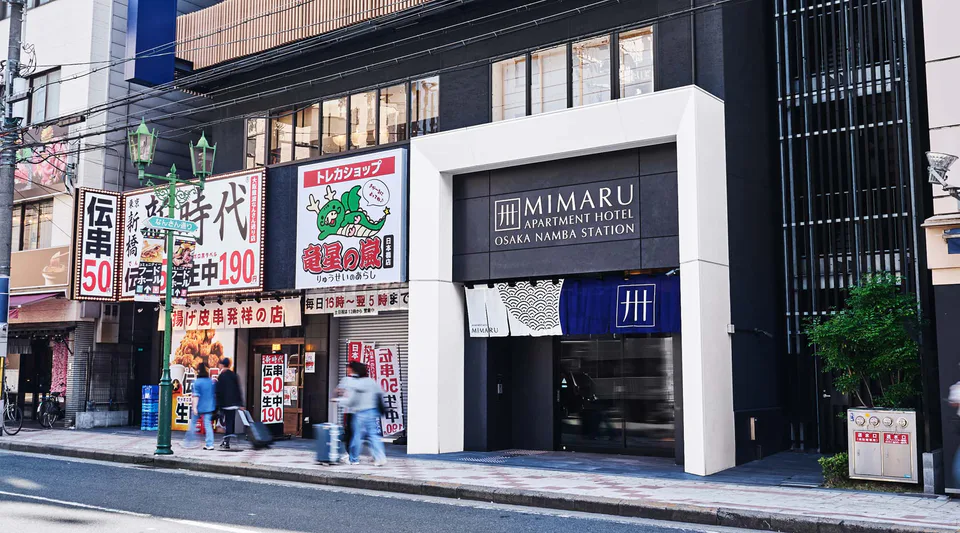
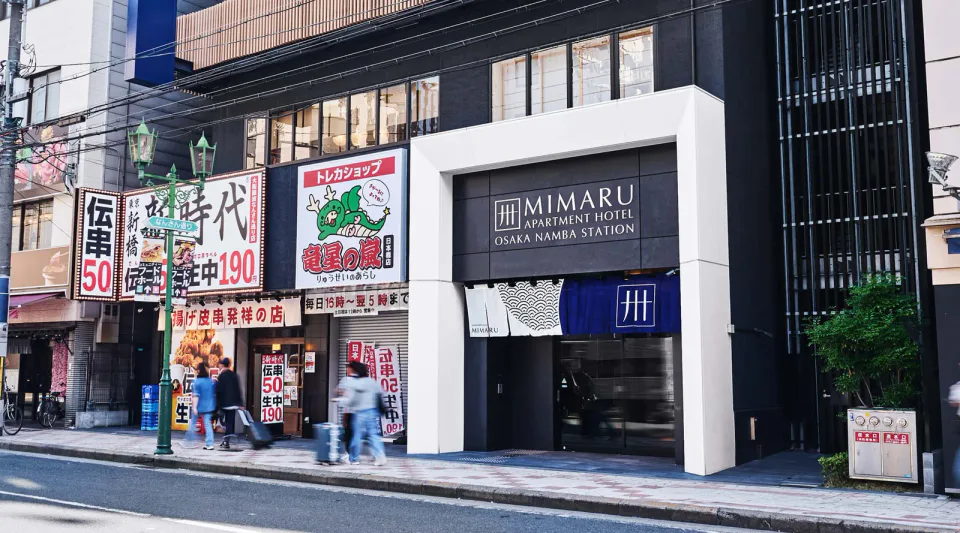
For four adults, MIMARU Osaka Namba Station is worth choosing over two conventional hotel rooms only when the group genuinely values one shared apartment more than parallel bathrooms and privacy. The existing 35 m² Family Apartment gives four adults two single beds plus one bunk bed, a kitchen and dining space, but the official room specification also shows one washbasin, one restroom and one bathroom. That single bathroom is the hidden constraint that matters more than the “sleeps four” label.
There is now a second decision for stays from October 1, 2026. The new MIMARU Osaka Namba Station Annex opens five minutes from Nankai Namba Station and offers a 45 m² Apartment (4 Single-Beds) with four equal single beds and an in-room washer-dryer. It fixes two weaknesses of the existing 35 m² Family Apartment—bunk-bed equality and in-room laundry—but it still has one washbasin, one restroom and one bathroom. Four adults who need two simultaneous shower-and-toilet routines may still be better in two hotel rooms.
MIMARU Osaka Namba Station for four adults: the 30-second decision
↔ Scroll table left or right
Your real constraint | Best starting point | Why |
Four adults, 3–4 nights, happy to share one daily rhythm | Existing 35 m² Family Apartment | One kitchen, one table and four fixed sleeping positions keep the group together at a lower space threshold. |
Four adults staying from 1 Oct 2026, nobody wants a bunk | New 45 m² Annex Apartment (4 Single-Beds) | Four single beds, more published floor area and an in-room washer-dryer. |
Four adults with simultaneous morning routines | Two conventional hotel rooms | Two rooms usually buy two bathrooms and more sleep/privacy separation; neither 35 m² main-building room nor 45 m² Annex four-single room solves that. |
Five or six people, or four people who need more circulation | 51–61 m² main-building categories | Two toilets and stronger zoning matter more than simply adding floor area. |
Long stay with frequent laundry | Annex 45 m² or a larger main-building category with washer-dryer | In-room laundry removes repeated shared-laundry coordination. |
KIX access is the only reason for Namba | Compare exact Nankai final walk | Main building is about 4 minutes from Nankai Namba South Exit; Annex is about 5. The one-minute published difference should not override room fit. |
The hidden four-adult bottleneck is one bathroom, not the bed count
The existing Family Apartment is officially 35 m², accommodates four adults, and uses two single beds plus one bunk bed. Its published room specification lists one washbasin, one restroom and one bathroom. That is a much more useful fact for four adults than the occupancy number.
Imagine four friends leaving for Kyoto at 07:00. If everyone showers in the morning, a single bathroom can become the real departure bottleneck even though all four have legal beds. Two conventional hotel rooms may occupy less shared living area overall, but they normally allow two shower routines, two toilets and two different alarm schedules at once. In that scenario, paying for two rooms is not “wasting money on duplicate space”; it is buying concurrency.
The opposite is also true. A family or close group that showers at different times, shares breakfast and wants to plan together may barely notice the single-bathroom constraint. They may gain far more from having one kitchen and one dining table than they lose from bathroom sequencing. The correct comparison is therefore shared-space utility versus parallel-routine utility, not apartment size versus the combined square metres of two rooms.
From October 1, 2026, the Namba Station Annex changes the four-adult shortlist
MIMARU officially lists MIMARU Osaka Namba Station Annex as opening on October 1, 2026. It is at 3-6-4 Nippombashi, about five minutes on foot from Nankai Namba Station South Exit and about six minutes from Nippombashi Station Exit 5. The existing MIMARU Osaka Namba Station is one block away at 3-6-24 Nippombashi and lists a four-minute walk from Nankai Namba South Exit.
The Annex room that changes the decision most for adult groups is the 45 m² Apartment (4 Single-Beds). The official specification gives:
45 m²
four single beds
one washbasin
one restroom
one bathroom
in-room washer-dryer
capacity for four adults plus eligible young children under the hotel’s child definition.
This is a meaningful new middle product. Before the Annex, four adults who rejected the 35 m² Family Apartment because two people would use the bunk often had to choose between a different MIMARU layout, a much larger six-person category or two hotel rooms. From October 2026, the Annex gives four adults four equal beds without jumping to a 51 or 61 m² room.
But the Annex does not erase the two-room argument. It increases floor area by 10 m² compared with the 35 m² Family Apartment—a published-area increase of about 29%—and adds in-room laundry, yet it still has one bathroom and one toilet. If your group’s problem is bed equality or laundry, Annex can reverse the answer. If the problem is bathroom concurrency or privacy between two couples, it may not.
Do not double-count the Annex upgrade
When comparing the main building with Annex, separate the premium into three functions:
Bed equality: four single beds instead of two singles plus a bunk set.
Interior area: 45 m² instead of 35 m².
Laundry: washer-dryer inside the room instead of relying on shared coin laundry for the 35 m² Family Apartment.
Do not also claim that Annex buys a second bathroom, because it does not. This matters when the price difference is large. A group staying two nights may value four equal beds but barely use the washer-dryer. A group staying seven nights and packing light may use the machine every second day. The same Annex premium therefore has very different value by stay length.
The existing main building still has a stronger answer when circulation is the real problem
The main property’s larger two-bedroom categories remain relevant even after the Annex opens. The official 51 m² Two-Bedroom Japanese Apartment lists two washbasins, two toilets, one bathroom and an in-room washer-dryer. The 61 m² Two-Bedroom Family Suite lists two washbasins, two toilets, one bathroom plus one shower room, four single beds plus a bunk bed, and an in-room washer-dryer.
For four adults, those rooms can look excessive because their legal capacity goes to six. But capacity is not the only reason to upgrade. The 61 m² layout is one of the few MIMARU choices here that actually changes shower concurrency as well as toilet concurrency. If four adults have two early-start days and privacy matters, paying for unused nominal capacity can be rational because the larger layout fixes the bottleneck the 45 m² Annex room does not.
This is also why “always book the smallest room that sleeps everyone” is weak advice. The best upgrade is the one that removes a repeated daily conflict.
Main building vs Annex: the location difference is too small to decide the booking by itself
The existing hotel publishes a four-minute walk from Nankai Namba South Exit; Annex publishes five minutes. Both list roughly six minutes from Nippombashi Station Exit 5. For most four-person groups, that one-minute published difference is smaller than the difference created by bed type, laundry and bathroom layout.
Both still require a street-level final leg. If zero-weather Nankai access is the hard requirement after a late KIX arrival, neither should automatically beat a station-connected hotel. Use the separate Swissôtel Nankai Osaka vs MIMARU comparison for that decision.
Conversely, if the itinerary is mostly Dotonbori, Kuromon, Nipponbashi, Nara and south-Osaka, the apartment location can be more useful over the whole stay than a station-connected arrival advantage used only twice.
Three nights versus seven nights changes what “worth it” means
Three-night stay: I would usually compare the 35 m² Family Apartment against two ordinary rooms first. The kitchen and common table can be used every day, but shared laundry is unlikely to dominate a short trip. If four adults dislike bunk beds, then compare the Annex 45 m² room for dates from October 1, 2026.
Five-to-seven-night stay: laundry, fridge use, takeout, shopping accumulation and different sleep schedules become recurring rather than occasional. The Annex’s in-room washer-dryer becomes much more valuable, while a 51 or 61 m² main-building category may become rational if two toilets or stronger zoning remove morning and evening conflicts.
Two couples: two conventional rooms deserve a serious price comparison even if their combined nightly rate is higher. The premium buys a closed door between couples and usually two bathrooms. If everyone spends almost no awake time in the hotel, that can be more useful than a shared kitchen.
Family with children: one apartment can remain the stronger product because adults may actively want one common space. The bunk-bed layout can be a benefit rather than a compromise, so paying extra for four equal beds at Annex may add little.
Kitchen value is coordination value, not a promise that you will cook
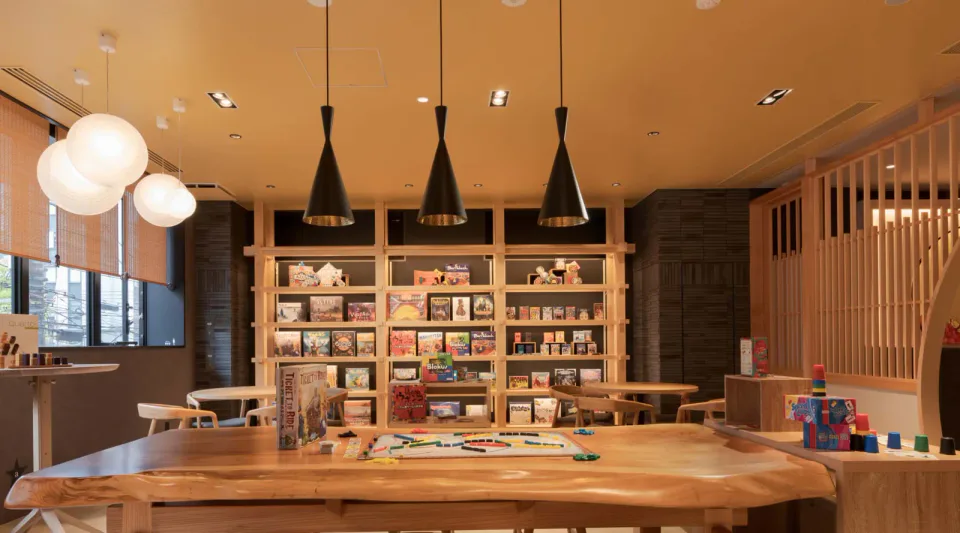
MIMARU’s apartment logic remains strong because every room includes kitchen and dining space. The useful functions are often modest: breakfast, reheating takeaway, keeping drinks cold, preparing food for a child, sorting tickets and purchases, and giving four people one place to sit that is not a bed.
For a group that separates after breakfast and returns only to sleep, the kitchen may be underused. In that case, two conventional hotel rooms can become more competitive because privacy and parallel bathrooms are used every day while the kitchen is not.
Use your actual hotel routine as the test. Count how many mornings you expect to eat together, how many evenings you expect to bring food back, and how often everyone needs to leave at the same time. Those answers are more useful than the word “apartment.”
Laundry: the Annex removes a specific long-stay weakness
The existing MIMARU Osaka Namba Station provides coin laundry, while the 35 m² Family Apartment and 36 m² Loft Bed Apartment do not list an in-room washer-dryer. Its larger 51 and 61 m² categories do. MIMARU’s current FAQ likewise identifies selected Osaka Namba Station two-bedroom categories as the in-room-laundry options.
The Annex 45 m² four-single-bed room changes this ladder because it places an in-room washer-dryer into a room designed specifically for four adults. For travellers planning a week in Kansai with carry-on-sized wardrobes, that can prevent a jump to a six-person room solely for laundry.
Still, do not pay a large nightly premium for a machine you will use once. Multiply the upgrade by every night, then compare that total with the inconvenience of one or two shared-laundry sessions. The laundry premium is strongest on longer stays, with children, or when the group wants to pack light.
Luggage and airport days: Namba helps, but the final 4–5 minutes remain real
The existing hotel lists Kansai International Airport at roughly 50 minutes by train as a route reference and publishes free luggage storage from 07:00 to 22:00 on check-in and check-out days, subject to space. Storage outside those free dates or hours is currently listed at ¥500 per item per day, again subject to capacity.
For four adults, per-piece charges scale quickly. If you have four large cases and the final sightseeing day moves north to Umeda, returning to Namba only to collect luggage can erase part of the location advantage. If the last day remains around Namba before Nankai to KIX, the same storage setup can be very efficient.
For multi-city trips, use the Japan luggage-forwarding guide rather than forcing every suitcase through every hotel change.
A four-adult decision matrix
↔ Scroll table left or right
Profile | I would choose | Reason |
Four close friends, 3 nights, one budget, happy with bunk beds | 35 m² main-building Family Apartment | Lowest-complexity one-unit baseline; kitchen/table likely matter more than laundry. |
Four adults, Oct 2026 onward, equal beds + pack-light laundry | 45 m² Annex Apartment (4 Single-Beds) | Four equal beds and washer-dryer without jumping to a six-person suite. |
Two couples, different sleep and shower routines | Two hotel rooms | Two closed doors and likely two bathrooms solve the actual conflict. |
Four adults, 6 nights, two early starts, lots of luggage | Price 51/61 m² main-building layouts against two rooms | Second toilet—and in the 61 m² suite a separate shower room—can matter more than the Annex’s extra 10 m². |
Family with children who like bunk beds | Main Family Apartment first | Annex bed equality may be an unnecessary premium; shared living is the stronger benefit. |
Final verdict: choose the bottleneck you actually need to remove
Before October 1, 2026, the 35 m² Family Apartment remains a strong four-person baseline when one shared living unit matters more than bathroom concurrency. It gives four legal sleeping positions, a kitchen and dining table, but one washbasin, one restroom and one bathroom should be treated as a real four-adult constraint.
For stays from October 1, 2026, add MIMARU Osaka Namba Station Annex to the comparison. Its 45 m² four-single-bed apartment is the better answer when the original MIMARU loses because adults dislike bunk beds or because in-room laundry matters. Do not assume it also solves the shower queue: it still publishes one washbasin, one restroom and one bathroom.
If four adults need parallel mornings, two conventional hotel rooms—or a larger MIMARU layout with more wet-area capacity—can still be the smarter purchase. The best room is not the one that sleeps four most cheaply. It is the one that removes the repeated conflict your group would otherwise pay every morning and every night.
Hotel Royal Classic Osaka: What Does “Connected to Namba Station” Actually Save?
Osaka Hotels for Kyoto and Kobe Day Trips: When 3–5 Minutes to the Station Matter Twice a Day
Osaka With Kids for 7 Days: Protect Kaiyukan and USJ by Leaving Two Days Deliberately Soft
Nikko vs Kinugawa Onsen: Where Should You Stay for One or Two Nights?
Swissotel Nankai Osaka: Is Nankai Namba Access Worth Paying More For?
References
MIMARU Osaka Namba Station official room, access and luggage information · MIMARU Osaka Namba Station Annex official room and access information · MIMARU official 2026 Osaka expansion announcement · MIMARU official FAQ. Verified August 25, 2026. Room layouts are subject to change; compare the exact room name and stay date before payment.