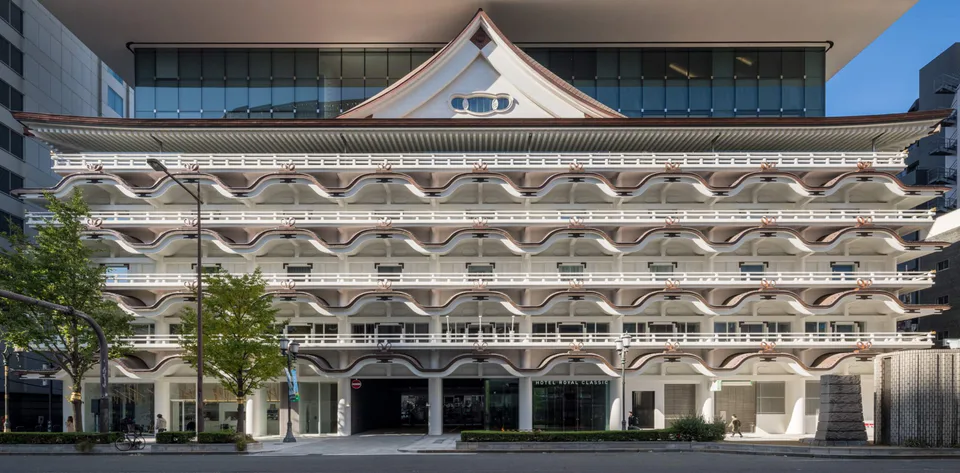
If you are arriving from Kansai International Airport on the Nankai Railway, Hotel Royal Classic Osaka is easy to shortlist because of the phrase “directly connected to Namba Station.” The useful version of that claim is more specific. Current hotel access information separates the different Namba stations: Osaka Metro Namba is connected near the Exit 12 passage, Nankai Namba is about four minutes on foot, and JR Namba is about ten minutes away via Namba Walk. The hotel is extremely central, but it does not turn every Namba railway platform into a zero-walk arrival.
This guide focuses on one decision: if you reach Osaka from Kansai Airport with large luggage and spend the next three or four nights around Namba, Shinsaibashi, Dotonbori and south Osaka, is it worth paying for a hotel that reduces the final arrival friction and gives you 30–31m² Standard Twin rooms? The station distances, room specifications, breakfast and laundry details below come from current hotel information. Judgments about luggage pressure, room value and itinerary fit are editorial decisions rather than claims of a personal stay.
Hotel Royal Classic Osaka: the 30-second answer
I would book it when I am arriving on the Nankai line with large luggage, I expect to use Namba and the Osaka Metro repeatedly, and most evenings end in the south side of the city. The strongest value is not a vague promise that every Namba station is connected. It is the combination of a relatively short final walk from Nankai Namba, direct usefulness of the Metro passage after check-in, and room sizes that do not force every couple into a 15–18m² city room.
I would compare alternatives if Namba is only the arrival point and two or more days are dominated by Umeda, Kyoto or Shin-Osaka. The first evening can still be very convenient, but a location that saves effort once can create repeated northbound travel afterward. In that case, compare the south-side convenience with a north-Osaka base such as Hotel Intergate Osaka Umeda or Hotel Granvia Osaka before locking all nights into Namba.
I would skip it when the real priority is 24-hour self-service laundry, the earliest possible Shinkansen departure from Shin-Osaka, or simply the lowest room price for a place to sleep. Current hotel information describes a laundry service with fixed drop-off and collection times, not coin-operated machines that you can use yourself at midnight.
The hotel is best understood as a low-friction Namba base, not as a property that makes every rail system in the area equally close.
Hotel snapshot: “Namba” is not one station distance
↔ Scroll table left or right
Item | Verified detail | Trip impact |
Osaka Metro Namba | Hotel is near the Exit 12 passage | This is the clearest “connected” advantage after check-in |
Nankai Namba | About 4 minutes on foot | Kansai Airport arrivals still have a final walk; it is not platform-connected |
JR Namba | About 10 minutes via Namba Walk | Do not treat all stations called Namba as the same distance |
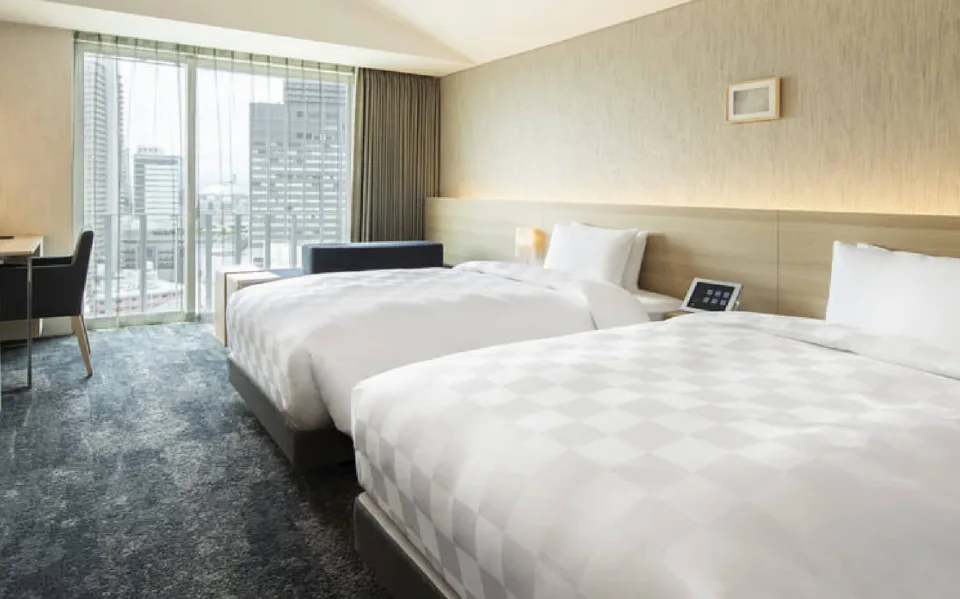
Standard Twin | 30–31m²; two 120×195cm beds | My baseline room for two travellers with two large cases over 3–4 nights |
Laundry | Service: submit before 10:00, collect after 18:00; closed Sundays | Travellers needing flexible self-service laundry should mark this down |
Breakfast | HAFU 07:00–10:30; last entry 10:00 | Early-start days may not use it; room-only guests can decide later |
Check-in / out | 15:00 / 12:00 | Noon checkout makes the departure morning relatively relaxed |
Arrival reality: what the final segment from Kansai Airport actually looks like
The phrase “directly connected to Namba Station” becomes misleading if it is read as “walk off the Nankai Airport Express and enter the hotel without going outside.” The hotel’s own access page separates the systems. Osaka Metro Namba is the connection near Exit 12. Nankai Namba is currently about four minutes on foot. JR Namba is farther away via Namba Walk. For a first-time visitor with luggage, that distinction matters more than a simple straight-line map because the actual arrival involves platforms, exits, lifts, directions and the final street or passage segment.
From Kansai Airport, Nankai is one of the obvious routes into Namba. I would use the published train time only to understand the scale of the journey, not as a hotel-door promise. After reaching Nankai Namba, you still have to exit, navigate to the hotel, complete check-in and reach the room. If the flight lands late, a parent is travelling with you, or each person has a 28-inch suitcase, simplifying this final section is often worth more than shaving a theoretical few minutes from the train ride.
The closest competing Nankai logic is Swissôtel Nankai Osaka, which pushes the Nankai-station connection further. The existing Namba Hotel Comparison is useful when the decision is specifically whether the shortest airport-line exit, the Metro passage or a different hotel format matters most.
Once you are checked in, Royal Classic’s location becomes easier to value. Current hotel information puts Dotonbori at about seven minutes on foot and Kuromon Market at about ten minutes, while Osaka Metro Namba is directly useful through the passage. That creates a repeatable pattern: leave for sightseeing, return to drop shopping, then go back out for dinner. The location can be used more than once in the same day instead of earning its entire premium only on arrival night. If Kuromon is part of your Namba plan, separate location convenience from tour value and check what the Kuromon Market food tour actually includes for the price before adding a guided slot.
Pair the Namba location with the itinerary before you pay for it
If Namba is a genuine three- or four-night base, the hotel starts to look like an itinerary tool. If it is only an airport arrival point, the argument becomes weaker. A four-person group should also compare whether one apartment-style room is more useful than two hotel rooms; MIMARU Osaka Namba Station makes that trade much more explicit. For a family, the Namba Family Hotel Comparison shows how room legality, sleeping layout and in-room equipment can matter more than a generic “family hotel” label.
Room decision: 30–31m² Twin or 25.6–27.7m² Double B?
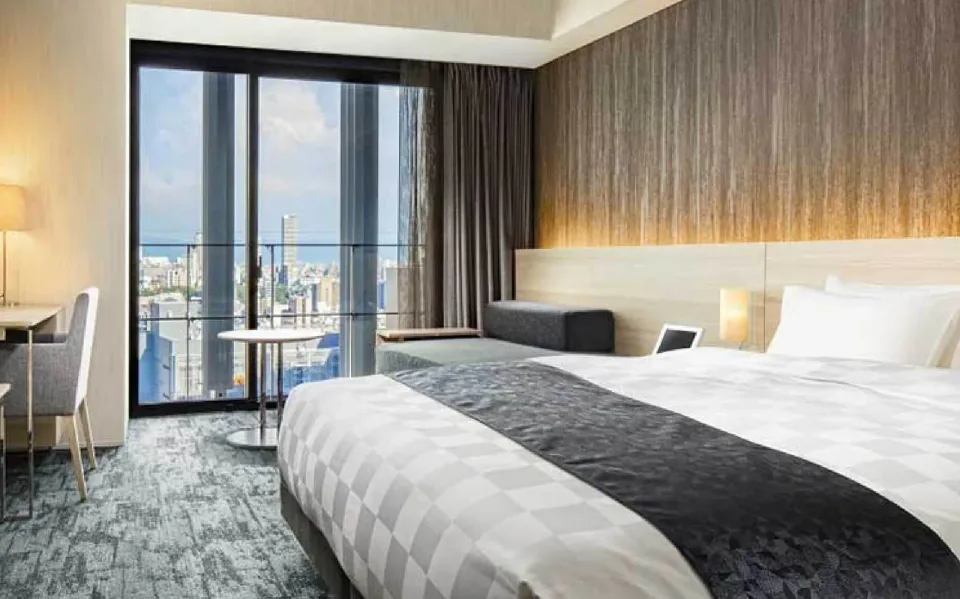
This is not a hotel that forces every central-Osaka guest into a small business-hotel room. Standard Twin is currently listed at 30–31m² with two 120×195cm beds. Standard Double A is 31m² with one 180×195cm bed. Standard Double B is smaller at 25.6–27.7m² but keeps the same 180×195cm bed. The standard rooms are also described with a more generous bathroom washing area, and the hotel FAQ confirms a separate bathroom and toilet arrangement, although the partition door is glass.
↔ Scroll table left or right
Room | Official specification | Editorial fit |
Standard Twin | 30–31m²; 120×195cm × 2 | My first comparison for two adults, two large suitcases and 3–4 nights |
Standard Double A | 31m²; 180×195cm × 1 | Compare when one large bed is preferred without giving up the 31m² area |
Standard Double B | 25.6–27.7m²; 180×195cm × 1 | Good candidate for one night or lighter luggage if the price gap is meaningful |
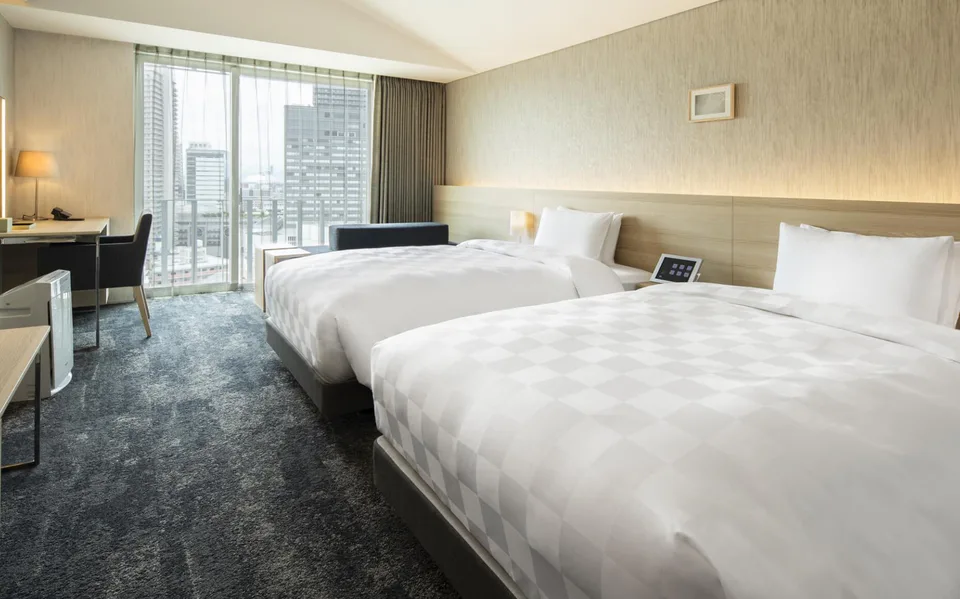
For two people carrying two large suitcases, I would not stop at “this double room sleeps two.” The 30–31m² Twin gives more total area to divide among two beds, a desk, circulation and luggage. Double B uses less floor area while giving the pair one large bed. The hotel does not publish precise suitcase-opening clearance for every room, so I would not guarantee that two 28-inch cases can stay fully open without affecting movement. The safer conclusion is that the Twin gives more total margin for a multi-night stay.
For a one-night airport arrival, Double B can be the better buy if the price difference is meaningful and both travellers are comfortable sharing one bed. For three or four nights, especially when shopping bags accumulate, the room is used repeatedly for packing and unpacking. That is when I would treat the Twin as the baseline and only step down after seeing the actual rate difference.
The bathroom-and-toilet separation is practical for two people because one person can shower while the other continues part of the morning or evening routine. It does not prove anything about soundproofing, bed comfort or exact room circulation. The decision is based only on the published layout, not on imagined details.
If 30m²-class rooms are the real priority rather than Namba itself, compare different Osaka formats. CANDEO HOTELS Osaka The Tower trades room position for a 31F SkySpa, while Hotel Vischio Osaka creates a much wider gap between compact and 28m²-class room tiers. The useful comparison is not “which hotel has a big room?” but what you give up to obtain that room.
Location × itinerary: how many times will you actually use Namba each day?
A realistic itinerary makes the location value easier to measure. Imagine arriving from Kansai Airport around 20:30, walking from Nankai Namba to the hotel, dropping luggage and then going to Dotonbori for dinner. The next morning, use the Metro for Osaka Castle, return to Shinsaibashi for shopping, drop purchases at the room in the late afternoon and go back out for dinner. On the third day, visit USJ or Umeda and return to Namba at night. This is an itinerary simulation rather than a personal stay record; the purpose is to identify where the location removes repeated backtracking.
For a south-Osaka itinerary, the most valuable moments may be the returns to the hotel rather than the first morning departure. With Dotonbori around seven minutes away, Kuromon Market around ten minutes and the Metro passage close to the hotel, a traveller who shops heavily can drop bags and restart the evening with less friction. That repeated mid-day and late-night use is how a central location earns back a premium.
If two or more days go to Umeda, Kyoto or Shin-Osaka, the balance changes. You keep the pleasant Namba evenings, but repeated northbound movement is added back each day. Compare that with a north-Osaka hotel such as Zentis Osaka or Hotel Granvia Osaka when JR-heavy days are more important than Namba evenings.
For a longer five-night stay that splits north and south Osaka more evenly, Tokyu Stay Osaka Hommachi is another useful middle-base comparison because its value comes from room-by-room laundry and kitchenette differences rather than a single leisure district. If the trip stays south and needs in-room laundry, Mercure Tokyu Stay Osaka Namba directly addresses which room categories actually include a washer-dryer.
Facilities only matter when the usage model matches you: laundry and breakfast
The laundry detail is important enough to check before a multi-night booking. The current hotel FAQ describes a laundry service: hand items in before 10:00, collect them after 18:00 the same day, and note that the service is closed on Sundays. This is not the same as a coin laundry that you can use yourself late at night. An OTA or search page that simply says “laundry” does not tell you which operating model you are buying.
For three or four nights, a traveller who usually starts a washing machine at 23:00 may find this much less flexible than self-service. A traveller who is happy to submit clothes in the morning and collect them after dinner can still use it. The Sunday closure also needs to fit the itinerary if laundry is part of a pack-light strategy. This is the main long-stay contradiction in the hotel: the room size and central location can be very comfortable for several nights, but the laundry model is more service-led than self-service-led.
Breakfast at Restaurant HAFU on the 11th floor currently runs from 07:00–10:30 with last entry at 10:00. The source hotel information lists an adult price of JPY 4,500 including tax and the 10% service charge. The FAQ also says room-only guests may decide on breakfast on the day, although advance breakfast reservations are not accepted. That flexibility matters because you do not have to buy breakfast for every night just to use it once or twice.
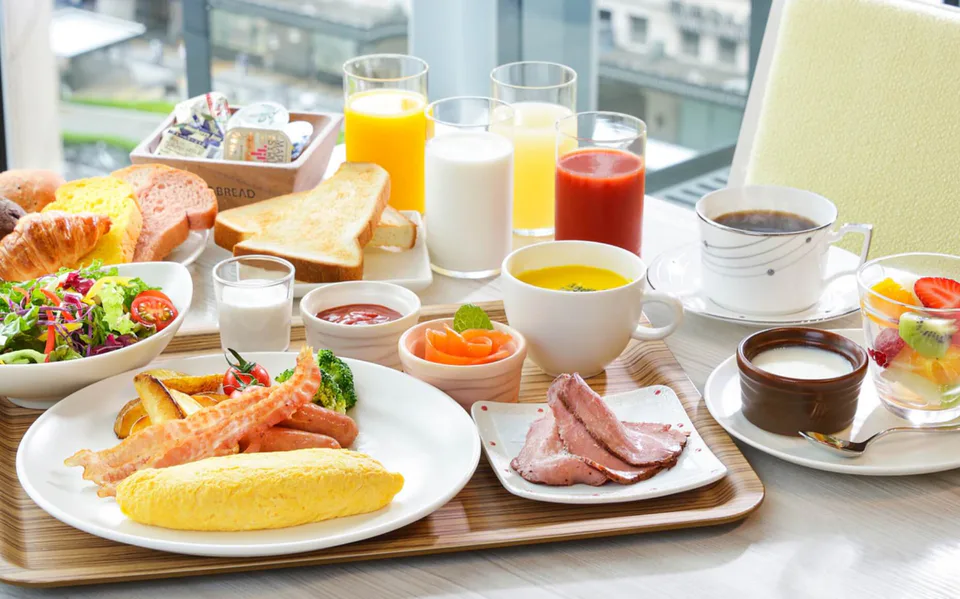
If a day starts before 08:30 for USJ, Kyoto or Shin-Osaka, I would not treat breakfast as a core reason to choose the hotel. On a slow Namba morning or departure day, the 07:00–10:30 window is much easier to use. Compare room-only and breakfast-inclusive plans on the same cancellation conditions instead of assuming one structure is always better.
For a stay where self-service laundry matters more than hotel service, the trade is very different at Zentis Osaka with its 24-hour Room 001 laundry, or Tokyu Stay Osaka Hommachi where washer-dryer availability depends on the exact room tier. These are more useful comparisons than simply asking whether each property “has laundry.”
What are you giving up by staying here?
The first trade-off is south-Osaka convenience versus cross-city efficiency. Nankai airport access, Dotonbori, Shinsaibashi and Osaka Metro are natural from this base. Repeated trips to Umeda, Kyoto or Shin-Osaka add movement back into the itinerary. Decide where the evenings end, not only where the daytime attractions are.
The second trade-off is paying for relatively generous standard-room area when not every traveller needs it. A 30–31m² Standard Twin is attractive for two large suitcases and several nights, but a solo traveller or a couple staying one night may care more about the actual price gap than the extra floor area. There is no universal “30m² is worth it” answer.
The third trade-off is hotel service versus do-it-yourself flexibility. Noon checkout and the option to add breakfast on the day are convenient. Laundry service with a 10:00 cut-off and Sunday closure is less flexible for travellers who prefer to wash clothes themselves after returning at night. That operational difference affects a multi-night stay more than decorative design or a long amenities list.
The fourth trade-off is the marketing phrase itself. “Connected to Namba Station” is accurate for the Osaka Metro passage context, but it should not replace route-specific thinking. Nankai, Metro and JR Namba are not interchangeable. A useful location is one that is close to the route you actually repeat.
For a more direct comparison of the same neighbourhood, the Swissôtel Nankai Osaka vs MIMARU Osaka Namba Station guide shows how station connection, apartment space, privacy and laundry can point four adults toward completely different products. Royal Classic sits between those extremes: conventional hotel service, generous standard-room sizes and a very strong Metro/Namba position.
Compare the same room on all three booking platforms
Before checking Booking.com, Trip.com and Agoda, fix the same room category, guest count and cancellation policy. Standard Twin, Standard Double A and Standard Double B are different sizes, so their lowest prices are not interchangeable. Then confirm bed type, breakfast, taxes, payment timing and free-cancellation deadline. No platform should be treated as automatically cheapest.
Booking.com: compare Hotel Royal Classic Osaka rooms
Trip.com: compare Hotel Royal Classic Osaka rooms
Agoda: compare Hotel Royal Classic Osaka rooms
These are affiliate links. The platform order is not a price ranking, and this article does not use a single live room price as the conclusion.
Final verdict: would I book Hotel Royal Classic Osaka?
↔ Scroll table left or right
Decision | Core conditions and trade-off |
I would book | Arriving from Kansai Airport via Nankai with large luggage, staying 3–4 nights, and repeatedly using Namba / south Osaka. The ~4-minute Nankai walk, Metro passage and 30–31m² Standard Twin can all be used repeatedly. The trade-off is potentially paying more for location and room area while accepting service-style laundry rather than self-service. |
I would compare | Namba is mainly the arrival point while most days and evenings are in Umeda, Kyoto or Shin-Osaka. The first night remains easy, but repeated northbound movement can outweigh that single arrival advantage. |
I would skip | You need 24-hour self-service laundry, the earliest Shin-Osaka departures, or only want the cheapest sleeping base. The hotel’s strengths are south-Osaka location, room area and service; if those do not match the trip, they are difficult to convert into real time savings. |
The shortest version is this: Hotel Royal Classic Osaka is not a “zero-walk from Nankai platforms” hotel. It is a 30m²-class central Namba base that makes repeated movement around south Osaka easier once you have arrived.
Hotel Royal Classic Osaka FAQ
Is Hotel Royal Classic Osaka directly connected to Nankai Namba Station?
No. The hotel separates the railway routes. Osaka Metro Namba is connected near the Exit 12 passage, while Nankai Namba is currently about four minutes on foot. Travellers arriving from Kansai Airport still need to allow for leaving the Nankai station and completing the final walk.
Which room should two travellers with two 28-inch suitcases compare first?
Current room information lists Standard Twin at 30–31m² and Standard Double B at 25.6–27.7m². For two large cases and a 3–4 night stay, I would compare the Twin first. The hotel does not guarantee that two specific 28-inch suitcases can remain completely open simultaneously, so do not turn floor area into an exact luggage-clearance promise.
Does the hotel have self-service laundry machines?
The current hotel FAQ describes laundry service rather than self-service coin machines. Items submitted before 10:00 can be collected after 18:00 the same day, and the service is closed on Sundays. If self-service laundry is essential, treat this as a real limitation.
What time does breakfast start, and can I decide after check-in?
HAFU breakfast is currently 07:00–10:30 with last entry at 10:00. The source hotel information lists JPY 4,500 for adults, including tax and service charge. The hotel FAQ says room-only guests may add breakfast on the day, but advance breakfast reservations are not accepted.
What are the standard check-in and checkout times?
Current hotel information lists check-in at 15:00 and checkout at 12:00. Early check-in depends on room availability and may involve a fee; do not assume early room access is included.
Is Hotel Royal Classic Osaka good for a first Osaka trip?
Yes when the itinerary repeatedly uses Namba, Shinsaibashi and Dotonbori or when Nankai airport access matters. If most days go to Umeda, Kyoto or Shin-Osaka, compare the repeated northbound travel before assuming Namba should be the fixed base.
Osaka 5-Day Itinerary: Give USJ a Full Day — Namba, Umeda, Kaiyukan and Tennoji Without Backtracking
Osaka and Kyoto in 7 Days: 3 Nights Each — When One Hotel Move Is Actually Worth It
Sanrio Puroland Tickets 2026: Save on the 2 PM Pass Only If You Know What You’ll Skip
Kumagaya Fireworks Seats vs Free Viewing: What 2026 Prices Actually Bought
Osaka Attractions Map: How to Group Namba, Umeda, Tennoji and the Bay Area
Sources
Hotel Royal Classic Osaka official access information
Hotel Royal Classic Osaka official standard rooms
Hotel Royal Classic Osaka official breakfast information
Hotel Royal Classic Osaka official FAQ
Hotel Royal Classic Osaka official hotel overview
Room types, rates, availability and cancellation terms can change by date. This article may contain affiliate links; ValueNavi may earn a commission from qualifying bookings at no additional cost to you.