
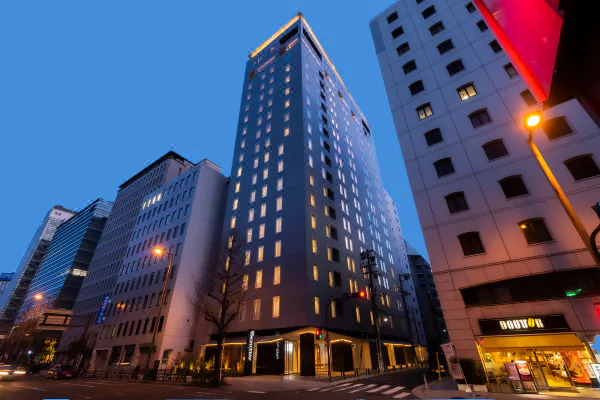
If you are staying in Osaka for only one or two nights, Tokyu Stay Osaka Hommachi does not automatically become the best choice just because some rooms have laundry. The logic changes at four, five or six nights: being able to wash and dry clothes inside the room, reheat a late meal and—only in selected categories—use a kitchenette can reduce the daily friction of a longer stay. This is not an argument that Hommachi is livelier than Umeda or Namba. It asks a narrower question: for a five-night Osaka base, are the long-stay facilities worth choosing Hommachi?
A note on evidence: room sizes, equipment, cleaning rules, breakfast hours and station approaches below are based primarily on the hotel’s own information, cross-checked against transport and booking pages. This article does not claim that I personally stayed here, and it does not present subjective online comments about noise, cleanliness or service as verified facts. The decision is built around checkable room differences and itinerary friction.
Tokyu Stay Osaka Hommachi: the 30-second answer for a five-night stay
I lean toward booking it, but not by choosing the cheapest room just because the hotel name says Tokyu Stay. The real product is the ability to move part of the long-stay routine into the room. I would book for four to six nights when I expect to use laundry repeatedly and can select at least an Economy Double, Standard Double/Twin or a higher category that actually includes the washer-dryer. I would reconsider it for one or two nights, especially if every evening ends in Umeda or Namba. I would skip it if the entire reason for choosing the hotel is in-room laundry but the low rate is attached to a Smart room without that machine.
Hotel snapshot: the details that actually change five nights
↔ Scroll table left or right
Item | Official information | Five-night impact |
Sakaisuji-Hommachi | Exit 11, about 1 minute on foot | Shortest approach for Chuo / Sakaisuji Line days |
Hommachi | Exit 12, about 5 minutes on foot | Midosuji Line is more intuitive for Umeda, Namba and Shin-Osaka |
Check-in / out | 15:00 / 11:00; luggage can be left before check-in and after check-out under current hotel rules | Makes the first and final day easier to split |
Cleaning | Simplified cleaning is requested on multi-night stays; stays of 7+ nights receive weekly full-room cleaning | A five-night stay is not a traditional daily full reset |
Breakfast | 18F; 06:30–10:00; last order 09:30; JPY 2,750 in the source material | Early enough for some departures, but not automatically better than a simple room breakfast |
Arrival reality: the one-minute walk belongs to Sakaisuji-Hommachi, not every Osaka Metro route
The easiest location mistake is memorising only “one minute from the subway”. If your final line is Sakaisuji-Hommachi, Exit 11 makes the last section genuinely short. If the trip repeatedly uses the Midosuji Line for Umeda, Namba or Shin-Osaka, the relevant reference is Hommachi Exit 12 and the hotel’s roughly five-minute walk. From Kansai Airport, the hotel gives a broad rail-access context, but the real fatigue depends on whether you use Nankai or JR, where you transfer and which Metro line handles the last section.
I would therefore choose the base from the whole trip rather than the headline distance. If the itinerary mixes central Osaka with Kobe and Koyasan, use the Osaka, Kobe and Koyasan four-day itinerary to see whether keeping one Osaka base still makes sense. If Koyasan itself becomes a longer stay, the Koyasan autumn and temple-lodging guide shows when a destination overnight changes the equation.
Tokyu Stay Osaka Hommachi room divide: some 16 m² rooms wash clothes and some do not
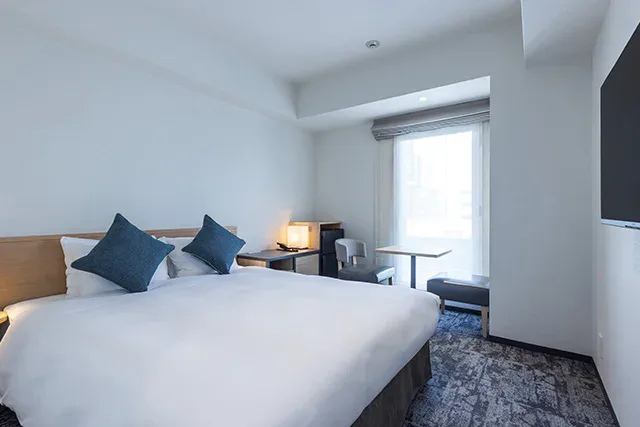
This is the most important room-level distinction in the article. Smart Double is 16 m² for two people and lists a microwave, but not an in-room washer-dryer. Economy Double is also 16 m² for two people, yet it adds the washer-dryer and microwave. The floor area can be identical while the five-night function is completely different.
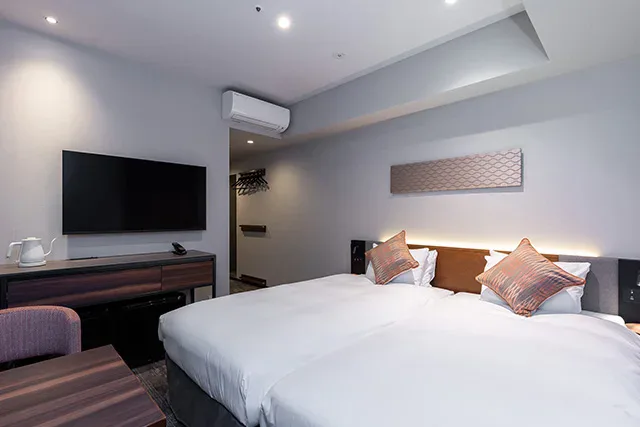
I would not stop the comparison at “Economy has laundry”. Sixteen square metres may still feel tight with two large cases over five nights, and the hotel does not publish enough information to promise that two 28-inch suitcases can always be opened fully at the same time. Standard Double and Standard Twin are 19 m² and retain the washer-dryer and microwave, which gives two travellers a little more buffer. At 21 m², Superior Twin adds the kitchenette. At 28 m², Deluxe Twin keeps the laundry, kitchenette and microwave, adds a separate bathroom and toilet arrangement, and can accommodate two to three guests.
↔ Scroll table left or right
Room | Area | Key equipment | My five-night read |
Smart Double | 16 m² | Microwave; no washer-dryer listed | Do not choose it if in-room laundry is the reason for booking |
Economy Double | 16 m² | Washer-dryer + microwave | Lowest floor-area cost for the core laundry function |
Standard Double / Twin | 19 m² | Washer-dryer + microwave | Worth comparing for two people and bigger luggage |
Superior Twin | 21 m² | Washer-dryer + kitchenette + microwave | The long-stay living function becomes more complete |
Deluxe Twin | 28 m² | Laundry + kitchenette + microwave + separate bath/toilet; 2–3 guests | A meaningful space and living-function upgrade when needed |
The room, kitchenette, laundry and bathroom images above use the same official Tokyu Stay media as the Chinese source. Their English captions describe only room types or equipment that the source can verify.
In-room laundry changes how you wait, not just where you wash
The useful saving is not merely “there is no need to find a laundromat”. A public laundry adds a separate task: carry the clothes, check whether a machine is free and return to collect them. An in-room machine lets the chore overlap with time you were already spending in the room—sorting shopping, showering or planning tomorrow. I am not quoting an exact wash-and-dry cycle because the official room information used here does not give a complete cycle time that can be applied confidently to every load.
Five nights makes this more valuable than one night. You may be able to pack fewer complete changes of clothes, particularly in summer, wet weather, family travel or high-step-count days. But the logic only works if the room you book includes the machine. That is why the washer-dryer belongs in the room filter, not in a list of hotel-wide assumptions. If you prefer one fixed base for many day trips, the Japan autumn trip without changing hotels guide is another useful way to think about the value of repeated room routines.
Long-stay trade-off: the room works like a base, but housekeeping is not a daily full reset
The laundry and cleaning rules need to be read together. On a five-night stay, simplified cleaning can be requested, but you are below the seven-night threshold for the separate weekly full-room clean. Travellers who are comfortable organising clothes and treating the room as a temporary living base may find that trade-off coherent. Travellers who want a fully remade room every day should not assume the long-stay appliances come with a conventional daily housekeeping rhythm.
That is why I would not force this property into either “apartment hotel” or “ordinary business hotel”. Front desk service, breakfast and luggage handling remain hotel functions; selected rooms add laundry, microwave and kitchenette tools. Whether you like the combination depends on whether you actually need those tools. For a much larger apartment-style alternative, MIMARU Osaka Shinsaibashi Central gives a deliberately different room-space trade-off.
If you really stay five nights: put the equipment into a timeline
A simple simulation makes the value easier to judge. Return at 18:30, put the day’s clothes into the washer-dryer, sort purchases and shower, then go out again around 19:30 for dinner. This is an itinerary model, not a record of my own stay. The point is to ask whether the appliance overlaps with time that already exists in your evening. If your normal pattern is 08:00 out and 00:30 back every day, the machine can still be useful, but you should ask whether you will actually operate it.
The central-base logic becomes clearer when the trip crosses several Osaka directions rather than ending in one entertainment district every night. Osaka Castle and Midosuji days pull the trip in different directions; the Osaka autumn leaves guide is one example of how the route changes by destination. If the trip later leaves Osaka overnight, the Osaka to Beppu overnight ferry guide is a good reminder that luggage and check-out day also belong in the base decision.
Breakfast: add it only if you will leave time to use it
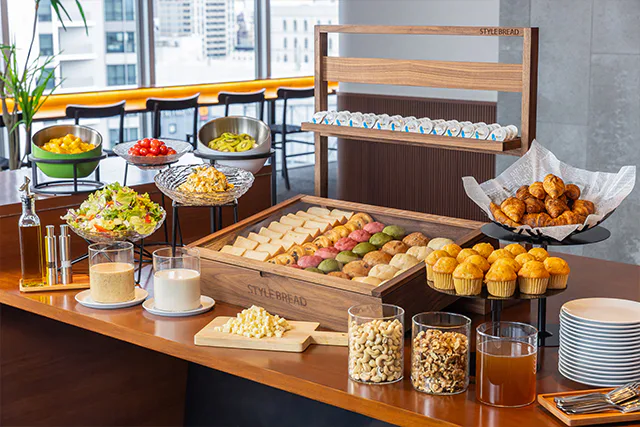
Current source information lists breakfast on the 18th floor from 06:30 to 10:00, with last order at 09:30, at JPY 2,750 including tax. Reconfirm it before travel because breakfast prices and operating details can change. The 06:30 start is workable for some early departures, but if the reason you upgraded is the microwave or kitchenette, a simple in-room breakfast can sometimes fit a five-night routine better.
I would not add breakfast automatically for all five days. A slow first morning may suit the buffet; an early USJ or intercity day may favour a faster start. If USJ is part of the itinerary, use the USJ Halloween one-day itinerary and the USJ ticket and Express Pass guide to decide whether that morning has any room for a sit-down hotel breakfast.
Location × itinerary: Hommachi is not the liveliest base; it lets two Metro nodes divide the work
Sakaisuji-Hommachi gives you the Chuo and Sakaisuji lines; Hommachi gives you the Midosuji, Chuo and Yotsubashi lines. For visitors, the Midosuji Line is particularly useful for Umeda, Namba and Shin-Osaka, while the Chuo Line supports east-west movement. That does not make Hommachi the best nightlife base. It makes it a neutral base for travellers who know they will cross districts repeatedly.
If every night ends in Dotonbori, Namba or Umeda, you still have a final Metro ride or walk that a nightlife-doorstep hotel avoids. If one day is USJ, the return matters more than the morning. Compare where to stay for USJ Halloween with the USJ Horror Night last-train guide. If the fastest possible post-USJ return becomes the trip’s priority, THE SINGULARI HOTEL at Universal City is the opposite location strategy.
For navigation across Tokyo, Osaka and Kyoto—especially when you rely on underground stations—the Japan eSIM guide is a useful practical companion rather than an accommodation decision itself.
What do you give up by staying here?
First, you give up nightlife directly outside the door. Second, you accept more room-identification work: the brand’s laundry proposition is not distributed evenly across every room category. Third, you trade some traditional daily-reset hotel expectations for more long-stay autonomy. Those exchanges are coherent when you actually use the room as a base; they are less attractive when you want to return after midnight and do nothing except sleep.
Compare three booking platforms only after aligning the exact room
Open all three platforms with the same dates, guest count and exact room category. Check whether the room is Smart, Economy, Standard, Superior or Deluxe; confirm washer-dryer, bed type, breakfast, taxes and cancellation deadline. This hotel is especially unsuitable for price-only sorting because the cheapest room can remove the feature that made you choose Tokyu Stay in the first place.
Verify Tokyu Stay Osaka Hommachi rooms for your dates
Trip.com alternative — Tokyu Stay Osaka Hommachi
Agoda alternative — Tokyu Stay Osaka Hommachi
Final decision: would I book Tokyu Stay Osaka Hommachi?
↔ Scroll table left or right
Decision | When it fits |
I would book | Four to six nights, you will genuinely do laundry, and you choose at least a laundry-equipped room; mixed Osaka districts make Hommachi’s neutral position useful |
I would reconsider | One or two nights, or every evening is fixed around Namba, Shinsaibashi or Umeda |
I would skip | You assume the cheapest room has laundry, expect full daily cleaning, or require nightlife directly outside the hotel |
The positioning is simple: Tokyu Stay Osaka Hommachi does not win by being in Osaka’s liveliest district. It wins when a five-night guest can take laundry, food reheating and part of the daily living routine back under their own control. That only works if you choose the correct room and accept that Hommachi is a transport base rather than Namba or Umeda nightlife at the door.
Tokyu Stay Osaka Hommachi FAQ
Does every Tokyu Stay Osaka Hommachi room have a washer-dryer?
No. The source room information does not list an in-room washer-dryer for Smart Single or Smart Double. Economy Double and the relevant higher categories are the laundry-led choices. If laundry is the main reason for booking, confirm the exact room equipment before payment.
Is the hotel one minute or five minutes from the subway?
Both figures can be correct because they refer to different stations. Current official access information lists Sakaisuji-Hommachi Exit 11 at about one minute on foot and Hommachi Exit 12 at about five minutes. If you mainly use the Midosuji Line, think in terms of the Hommachi route rather than applying the one-minute claim to every journey.
Will a five-night stay receive full daily cleaning?
No. Under the source rules, simplified cleaning on a multi-night stay is requested, while a separate weekly full-room cleaning applies to stays of seven nights or more. A five-night guest should not assume traditional daily full housekeeping.
Which room tier starts to include a kitchenette?
The source room matrix lists the 21 m² Superior Twin with a kitchenette, washer-dryer and microwave. The 28 m² Deluxe Twin keeps those facilities and adds a separate bathroom and toilet arrangement. If OTA room names are translated differently, verify the equipment list rather than relying on the category label alone.
What time does breakfast start?
Current source information lists breakfast from 06:30 to 10:00, with last order at 09:30, at JPY 2,750 including tax. Recheck the latest official information before travel because service hours and prices can change.
MIMARU Osaka Shinsaibashi Central: Rooms, Access and Family Fit
Where to Stay for USJ Halloween 2026: Universal City, Umeda or Namba
Osaka Itinerary: 4 Days with Kobe and a Koyasan Temple Stay
USJ Halloween 2026 One-Day Itinerary
USJ Tickets and Express Pass 2026
Best Japan eSIM for Tokyo, Osaka and Kyoto
Osaka to Beppu Ferry: Cabins, Bath and Port Guide
Where to Stay
Centara Grand Hotel Osaka: Is the 40m² Family Room Worth It for Four?
Hotel Hankyu RESPIRE OSAKA: Is a 3-Minute Osaka Station Walk Worth the High-Rise Trade-Off?
Mitsui Garden Hotel Osaka Premier Review: Is Nakanoshima Worth the Trade-off?
Room types, rates, availability and cancellation terms can change by date. This article may contain affiliate links; ValueNavi may earn a commission from qualifying bookings at no additional cost to you.
Tokyu Stay Fukuoka Tenjin vs HOTEL IL PALAZZO: Laundry or More Space for 4 Nights?
Tokyu Stay Hida-Takayama Musubi no Yu: Which Room Works for Two Suitcases and Three Nights?
Osaka Kuromon Market Food Tour 2026: You’re Paying for a Guide, Not the Food
Sapporo Hotel Comparison: Tokyu Stay vs Solaria vs GRANBELL for a Four-Night Winter Stay
Where to Stay in Kyoto for Autumn Leaves: Kyoto Station, Kawaramachi, Gion or Osaka?
Sources
Tokyu Stay Osaka Hommachi official hotel page
Tokyu Stay Osaka Hommachi official room page
Booking.com Tokyu Stay Osaka Hommachi hotel page
Trip.com Tokyu Stay Osaka Hommachi hotel page