
Hotel Hankyu RESPIRE OSAKA is worth its location premium when Osaka Station keeps solving a problem more than once. If you arrive with luggage, take two or more JR-heavy day trips, use Shin-Osaka again and finish several evenings in Umeda, the hotel’s short outdoor approach can keep paying you back. If your trip is mostly Namba, Shinsaibashi or late USJ nights, “three minutes from Osaka Station” can be a specification you keep paying for without actually using.
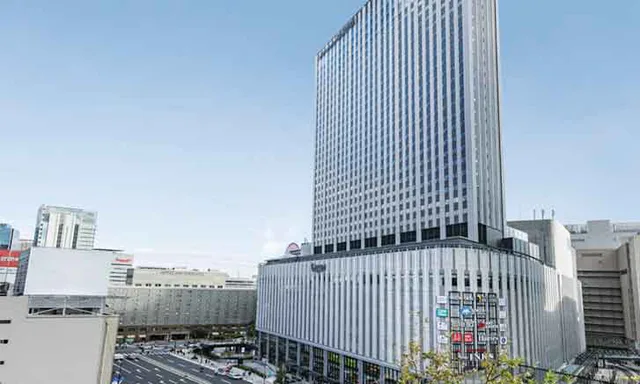
The important correction is that the official three-minute figure begins only after you reach the JR Osaka Station 3F Bridge Exit. It is not platform-to-room time. The hotel entrance is inside the Yodobashi/Links complex, reception is on the 9th floor, and guest rooms are on floors 12–35. The real trade is therefore very short exterior walking versus a large high-rise hotel’s internal vertical movement.
↔ Scroll table left or right
Your stay pattern | My call | Why |
Kyoto/Kobe day trips + Shin-Osaka departure | Strong fit | Osaka Station is reused on several mornings and returns, so the short final walk compounds |
One JR trip, otherwise Namba/Shinsaibashi nights | Compare south Osaka again | The hotel solves one rail day but creates repeated evening travel north |
Two large suitcases, 3–5 nights | Price the 25 m² Twin before the 19 m² Double | The room-size cost repeats every day; the station advantage may not justify living around luggage |
Three adults | Compare 25 m² Triple vs 33 m² Deluxe Triple | The extra 8 m² is a circulation upgrade, not a prestige upgrade |
Four adults | 47 m² Fourth deserves the first quote | Four fixed beds and two washbasins attack the real morning bottleneck |
Two late USJ nights | Usually compare Universal City | Repeated tired returns can outweigh Umeda’s wider rail versatility |
The three-minute claim is useful only when you define its boundaries
The hotel currently states about a three-minute walk from the 3F Bridge Exit of JR Osaka Station. It also lists about six minutes from the Umekita Underground Gate, five minutes from Hankyu Osaka-Umeda Station, five minutes from Osaka Metro Umeda and ten minutes from Hanshin Osaka-Umeda. Those different numbers are the first clue that “Umeda station” is not one point.
Use the three-minute figure for one narrow question: after I exit JR Osaka Station at the correct place, how much outdoor or semi-outdoor luggage movement remains? The answer is very little. That is genuinely valuable in rain, summer heat and when two people are dragging large cases.
But the room is not three minutes from the platform. You still have station navigation, the building entrance, the 9F lobby and another elevator to floors 12–35. The hotel has 1,030 rooms. That does not prove a queue at a specific time, but it does mean the property should be judged as a high-rise operation rather than a small station hotel.
For a first visit, I would therefore compare outside friction and inside friction separately. RESPIRE is excellent at the first. Travellers who strongly dislike large-hotel vertical circulation should not assume the short map distance solves the second.
Count Osaka Station uses before you pay a station premium
A station hotel is most valuable when the station keeps reappearing. Count the number of meaningful Osaka Station events in the stay:
arrival with luggage;
JR departure to Kyoto, Kobe or Himeji;
tired return from that day trip;
connection toward Shin-Osaka;
airport rail using Osaka Station;
an Umeda evening that already ends near the hotel.
Three outside day trips can easily create six station events before arrival and departure are counted. In that pattern, saving the final few minutes is a repeated benefit. One Kyoto day inside a Namba-heavy five-night stay creates only two such events. The same room rate can therefore be excellent value for one itinerary and an unnecessary location premium for another.
If you have not chosen the Osaka district yet, compare Namba vs Umeda first. A hotel should serve the base decision rather than decide it for you.
Shin-Osaka and KIX: useful rail geometry, but not door-to-door promises
The hotel currently gives about seven minutes between Shin-Osaka and Osaka Station by JR Kyoto Line, and about 47 minutes from Kansai International Airport to Osaka Station by HARUKA. Both are useful line-haul references. Neither is room-door-to-platform time.
For a next-morning Shinkansen, RESPIRE makes sense when you still want an Umeda evening and do not need to sleep directly beside Shin-Osaka. The hotel lets Umeda do two jobs: dinner/shopping tonight and a short JR connection tomorrow. But a very early Shinkansen can reverse the answer because every minute of hotel elevator, station walking and train waiting moves into the hard-departure window.
KIX works similarly. A HARUKA arrival into Osaka Station avoids another cross-city transfer before Umeda, but if your actual stay is centred on Namba, a Nankai-oriented hotel may still produce a simpler whole trip. Do not turn one convenient airport train into a four-night location decision.
Room size is a repeated cost, so compare it against repeated station savings
The hotel’s current room ladder creates several genuinely different products:
↔ Scroll table left or right
Room | Published area / capacity | Best use |
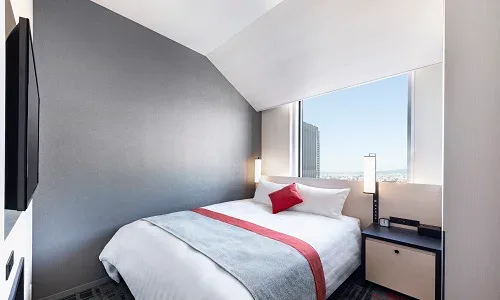
Double | 19 m² / 1–2 | Solo traveller or light-packing couple on a short, transport-heavy stay |
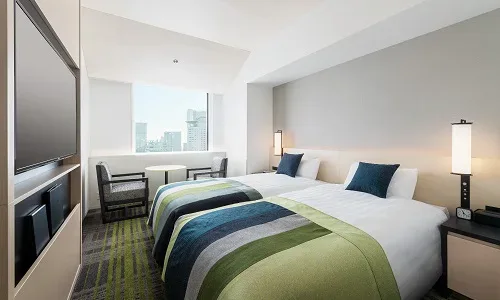
Standard Twin | 25 m² / 2 | Two large cases, several nights or travellers who need more circulation |
Standard Triple | 25 m² / 3 | Cost-first three-person stay when room time is limited |
Deluxe Triple | 33 m² / 3 | Three travellers with more luggage or a longer shared-room routine |
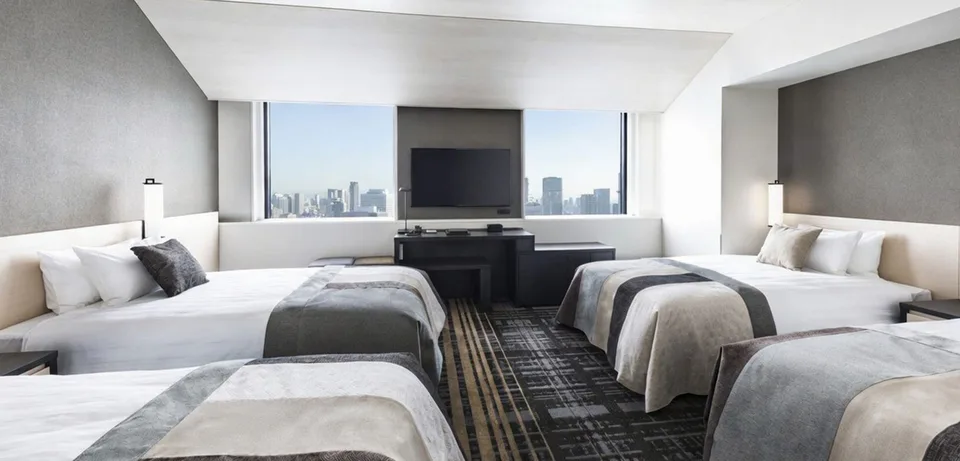
Fourth | 47 m² / 4 | Four-person stay where fixed beds and morning circulation matter |
The official Fourth room has four 110 × 196 cm beds and two washbasins. That is more decision-relevant than the word “Fourth.” Four travellers create two obvious bottlenecks: sleeping surfaces and getting ready at the same time. This room addresses both.
For two travellers, the 19 → 25 m² jump is six square metres, or about 32% more published floor area. That does not tell you exactly how many suitcases can remain open; the hotel does not publish such a guarantee. It does tell you that the upgrade is large enough to be treated as a daily-use change rather than a cosmetic category difference.
My rule is: if you use Osaka Station only twice but live in the room for four or five nights, do not let the three-minute location persuade you to tolerate the wrong room. Price the room you actually need, then reopen the hotel comparison.
Laundry is a long-stay benefit, not a one-night reason to book
The self-service laundry operates 24 hours. The hotel currently lists a standard wash-and-dry programme at JPY 700 for about 120 minutes, and machine status can be checked on the room television. The hotel also warns that the laundry can be crowded at some times.
This matters most after the fourth or fifth night, when laundry can reduce the amount of clothing carried through Japan. It barely matters for a one-night stay. Do not give every amenity the same weight simply because it appears on the facility page.
If private in-room laundry is important enough that waiting for a shared machine would change the trip, compare the Mercure Tokyu Stay Osaka Namba washer-dryer guide. The choice then becomes location versus laundry workflow, not two generic Osaka hotels.
Breakfast and 12:00 checkout only count on mornings that can use them
The hotel currently lists breakfast at JPY 3,200 and check-out at 12:00. A late checkout can be a meaningful final-day benefit when the train or flight leaves later, especially for a family repacking several cases. It is worth exactly zero when everyone leaves the room at 07:00 for a reserved train.
Use the same rule for breakfast. Do not count it as value because the hotel has a buffet; count it only when the breakfast window fits the day without making the first train or attraction more fragile. If the trip is rail-heavy enough to justify Umeda, several mornings may also be early enough to reduce the value of a leisurely hotel breakfast.
This is a useful red-team check: the features that make the hotel attractive to a slow city stay can be the features a transport-heavy itinerary never has time to use.
USJ is where the Umeda recommendation most often breaks
One USJ day inside a Kyoto/Kobe/Osaka itinerary does not make Umeda a bad base. The hotel still provides wider regional rail value on the other days. Two late park days are different. Now the tired return to Umeda repeats, and the location premium is solving the wrong part of the trip.
If USJ is the main anchor, compare Universal City vs Umeda vs Namba and the rebuilt THE SINGULARI HOTEL guide. The goal is not to find one Osaka hotel that wins every direction. It is to put the room beside the movements that repeat most.
Three scenarios
Four nights: Kyoto + Kobe + Shin-Osaka departure
I would book RESPIRE. Osaka Station is reused repeatedly, the final outdoor luggage leg stays short and the hotel is doing the exact job its location premium is designed for. For two adults with large suitcases, I would price the 25 m² Twin rather than using the 19 m² Double as the reference rate.
Four nights: Namba food/shopping + one Kyoto day
I would compare Namba again. One easy Kyoto morning does not necessarily compensate for three or four evenings that require a ride back north. The station benefit is real but underused.
Four adults: one room, morning departures
The 47 m² Fourth is the relevant RESPIRE product. Four fixed beds and two washbasins address the group’s daily bottleneck. Compare that exact room’s total against an apartment hotel or two smaller rooms; do not compare the Fourth against the headline Double price and call the hotel expensive.
Final verdict
Hotel Hankyu RESPIRE OSAKA earns its premium when Osaka Station is a repeated operating hub, not when Umeda merely sounds central. The three-minute official walk is useful because it reduces the final exterior leg after the correct JR exit, but it does not eliminate platform navigation or the hotel’s 9F-to-guest-floor vertical sequence.
For one or two light nights, the 19 m² Double can be rational. For two large suitcases or several nights, the 25 m² Twin should be the real baseline. For three or four guests, choose by circulation and fixed beds rather than maximum occupancy. And if Namba, Shinsaibashi or late USJ nights dominate the stay, reopen the base decision before paying for a station advantage that keeps pointing in the wrong direction.
Compare Hotel Hankyu RESPIRE OSAKA room categories
Hotel WBF Grande Asahikawa: Is a 2-Minute Station Walk Worth It for a Northern Hokkaido Base?
Solaria Nishitetsu Hotel Sapporo: Is the Five-Minute Walk Worth It?
Vessel Hotel Campana Susukino: Is the 25:00 Public Bath Worth a 4-Minute Walk?
Oriental Hotel Okinawa Resort & Spa Review: Is the 170m Pool Worth a 7-Minute Beach Walk?
voco Osaka Central: Is the Premium Room Worth Leaving Osaka Station?
References
Hotel Hankyu RESPIRE OSAKA — official access · Official room categories · Official hotel information · Official laundry/facilities. Checked August 25, 2026. Recheck live room prices, breakfast and transport operations for the travel date.