
For most 10–15 day Tokyo–Kyoto–Osaka trips, I would start with a fixed-data Japan eSIM rather than an unlimited plan. Airalo is the cleaner fixed-data baseline when you value a clearly published validity trigger, named Japanese partner networks and top-up support. Saily becomes more compelling for genuinely heavy use because its current unlimited Japan plan gives 5GB of high-speed data per 24 hours, then continues at up to 1Mbps, with hotspot sharing allowed. Klook can be excellent value, but “Klook eSIM” is not one standardized product: current Japan listings have different networks, activation rules, throttling and even opposite hotspot policies.
You do not need separate eSIMs for Tokyo, Kyoto and Osaka. One nationwide Japan plan normally covers the three-city route. The first decision is therefore not city or 5G logo. It is fixed data vs unlimited, how much tethering you will do, when validity starts, and whether the exact product still works after you hit its high-speed allowance.
Checked August 25, 2026. Airalo currently lists Japan fixed-data and unlimited Moshi Moshi plans; its 20GB/30-day fixed plan is US$25 and explicitly lists SoftBank and KDDI. Saily currently lists 20GB/30 days at US$24.99 and a Japan unlimited plan with 5GB/day at unrestricted speed followed by data at up to 1Mbps. Airalo’s general unlimited policy currently gives 3GB of high-speed data per day before reduced speed. Klook sells multiple Japan eSIM products with materially different rules, so every Klook recommendation below refers to a named listing rather than the marketplace as a whole. Prices and product terms can change.
Best Japan eSIM: the 30-second decision
↔ Scroll table left or right
Your actual use | Start with | Why | Main catch |
10–15 day first trip; maps, tickets, messages, social media; no laptop | Airalo or Saily fixed 10–20GB | Predictable total allowance is usually enough without paying for an unlimited label | Choose by validity and operating rules, not a tiny price gap |
You want the clearest fixed-data baseline | Airalo Moshi Moshi | Current plan page names SoftBank + KDDI, starts validity on network connection in coverage, and supports top-up | This is a transparency/operability preference, not a claim that Airalo has universally better reception |
Heavy video, laptop tethering or repeated large uploads | Saily Unlimited first | Current Japan unlimited rule gives 5GB high-speed per 24h, then up to 1Mbps; hotspot is supported | It costs far more than a 10–20GB fixed plan if you never use the extra capacity |
You want a large daily high-speed allowance and are comparing Klook | Check the exact SoftBank 5G / Docomo listing | One current Klook Japan listing states 10GB/day at full speed before 128kbps and allows hotspot | Another current Klook Japan eSIM explicitly says hotspot sharing is not allowed |
Two travelers may separate during the day | Usually one eSIM each | Each person keeps maps, tickets and messaging when apart | One large plan plus hotspot is cheaper only if staying together is realistic |
You need a Japanese phone number or ordinary SMS/calls | Choose a product that explicitly includes them | Airalo Moshi Moshi and the Klook listings discussed here are data-only; Saily sells separate phone/SMS/minute options | Do not assume an eSIM data plan replaces your home number |
Do not buy three city eSIMs: Tokyo, Kyoto and Osaka are one Japan coverage decision
Tokyo, Kyoto and Osaka do create different usage patterns, but they do not normally require different eSIM products. Airalo’s current Japan plan states nationwide coverage including Hokkaido and Okinawa; Saily sells one Japan plan for cities including Tokyo, Kyoto and Osaka; current Klook Japan listings similarly describe nationwide coverage.
This matters because “best eSIM for Tokyo” can push travelers toward the wrong optimization. The difficult moment is often not standing in Shibuya. It is a Shinkansen transfer, a basement platform, a late hotel arrival, a crowded event exit or a laptop hotspot session. Buy for those failure modes. Do not buy a separate plan simply because the itinerary crosses from Kanto into Kansai.
If the three-city route itself is not fixed, use the 10-, 12- or 14-day first-time Japan itinerary first. Connectivity should support the route; it should not become another product to reconfigure in every city.
Fixed data is the default for most first trips
Maps, messaging, train searches, translation, QR tickets and ordinary browsing are not what normally destroy a travel data allowance. The larger risks are video, cloud photo backup, livestreaming, app updates and laptop tethering. That is why a traveler who mostly navigates and messages can often use a fixed pool comfortably even while moving among three cities.
I would not use a universal “1GB per day” formula. A fixed 10GB pool can be better than 1GB/day because unused data from a quiet Kyoto temple day remains available for a heavy Osaka or transfer day. Daily caps are useful when you want spending discipline; total pools are useful when daily behavior varies.
Use the 1GB vs 2GB vs unlimited comparison if you are unsure how your own video, upload and hotspot habits change the allowance. The goal is not to buy the smallest possible plan. It is to avoid paying for unlimited data merely because the word feels safer.
Airalo vs Saily fixed data: the current price gap is too small to decide the product
Current published prices make the point unusually clear. Airalo currently lists 20GB for 30 days at US$25. Saily lists 20GB for 30 days at US$24.99. The difference is one cent. At that level, “which is cheaper?” is the wrong comparison.
↔ Scroll table left or right
Current plan snapshot | Airalo | Saily | ValueNavi interpretation |
10GB suitable for a 10–15 day trip | 10GB / 15 days: US$17.50 | 10GB / 30 days: US$17.99 | Airalo is currently slightly cheaper; Saily buys a much longer validity window |
20GB suitable for heavier two-week use | 20GB / 15 days: US$24 | 20GB / 30 days: US$24.99 | Again, the useful difference is validity and product workflow, not US$0.99 |
20GB / 30 days | US$25 | US$24.99 | A one-cent gap should have effectively zero weight in the decision |
For fixed data, I slightly prefer Airalo as the comparison baseline because the current Japan product page publishes the network names—SoftBank and KDDI on the 20GB Moshi Moshi plan—and explicitly states that validity begins when the eSIM connects to a supported mobile network in the coverage area. It also lists top-up availability. That is an information and activation advantage, not evidence that its network will be faster in every Tokyo subway or Kyoto street.
Saily is still an entirely rational fixed-data choice, especially when its longer 30-day validity better matches a trip that may move beyond the standard Golden Route or when you prefer its app-based top-up workflow. When two competent plans cost essentially the same, use the term that removes the bigger risk.
“Unlimited” is not the same product across Airalo, Saily and Klook
The word unlimited is where comparison pages become misleading. It usually does not mean unlimited data at maximum speed forever.
↔ Scroll table left or right
Current product | High-speed rule | After the allowance | Hotspot |
Airalo Unlimited | 3GB high-speed data per day under the current general unlimited policy | Continues at reduced speed until the daily reset; Airalo’s general page does not give one universal reduced-speed number | Supported; tethered use counts toward the same allowance |
Saily Unlimited Japan | 5GB high-speed data per 24h | Up to 1Mbps for the rest of that period | Supported on all plans |
Klook SoftBank 5G / Docomo 4G LTE listing | Current unlimited package states 10GB/day at full speed | 128kbps after the daily allowance | Yes on this listing |
These are three different products hiding under one word. Saily currently offers more stated high-speed data per day than Airalo’s general unlimited policy and gives a published post-cap speed of up to 1Mbps. The cited Klook listing offers an even larger 10GB high-speed daily allowance, but its stated fallback is only 128kbps. Which is better depends on whether you expect to cross the cap and what you need after you do.
For a traveler tethering a laptop for work, I would value the post-cap behavior almost as much as the headline allowance. For someone uploading several large videos in the evening and then going to sleep, a larger daily high-speed bucket may matter more. “Unlimited” should therefore be read as a two-stage plan: high-speed allowance + fallback behavior.
Klook is a marketplace problem: the exact listing matters more than the Klook logo
This is the most important correction to the usual Airalo-vs-Saily-vs-Klook comparison. Klook currently carries multiple Japan eSIM products from different suppliers. They do not share one universal network, activation trigger, hotspot rule or fair-use policy.
For example, Klook’s current Japan eSIM | SoftBank 5G / Docomo 4G LTE listing states nationwide coverage, data-only service, hotspot sharing, and an unlimited option with 10GB/day at full speed followed by 128kbps. A different current Klook listing titled eSIM for Japan (QR Code delivery via email) offers 500MB/day, 1GB/day, 2GB/day and unlimited packages but explicitly states Hotspot Sharing: No. Its activation and voucher rules are also different.
So never write “Klook supports hotspot” in your trip plan. Write the full product name or save the exact listing. The same rule applies to “Klook uses SoftBank,” “Klook activates on arrival” and “Klook unlimited means X GB per day.” Those statements can be true for one listing and false for another.
This is also why I would not rank Klook by a single current price. Marketplace pricing, currency, promotions and packages move too often, and comparing the wrong listing can produce a false bargain. Use Klook when the exact package has the terms you want and the final checkout price beats the fixed alternatives—not because the marketplace itself is inherently cheaper.
Hotspot use changes the recommendation more than 5G branding
Airalo says tethering is supported when the device and network support it, and its unlimited plan counts tethered usage inside the same daily high-speed allowance. Saily currently advertises unlimited hotspot sharing on all plans. Klook varies by product, as the two live Japan listings above demonstrate.
If you are sharing data to a laptop for several hours, a tablet for a child, or another traveler’s phone, count that as a separate usage profile. A 20GB plan that feels huge on one phone can disappear quickly when cloud sync or video starts on a tethered device.
There is also a resilience cost. One couple sharing a single eSIM saves money only while the two people remain physically close. If one person goes back to the hotel while the other stays in Shinjuku, or you separate inside a large station, the second phone loses the connection it was depending on. For a first Japan trip, I would usually buy two smaller plans rather than one large plan plus hotspot if the travelers may split up independently.
Use the two-person hotspot guide before making one handset the single point of failure.
Late arrival: installation and activation are not the same event
Airalo’s current Moshi Moshi fixed plan states that validity starts when the eSIM connects to a mobile network in its coverage area. That lets you install the profile before flying and connect after arrival in Japan. Its unlimited setup guidance likewise encourages installation before the trip.
Saily’s Japan page currently gives all plans a 30-day activation period and warns that a plan will automatically activate if you do not activate it within that window. That is useful flexibility, but it creates a different failure mode: buying far too early and assuming the plan can remain dormant indefinitely.
Klook again varies. The current SoftBank 5G / Docomo listing says usage and validity begin when the eSIM connects to an overseas network, while another Klook Japan listing is tied to selected-date/voucher rules. Read the package you actually bought.
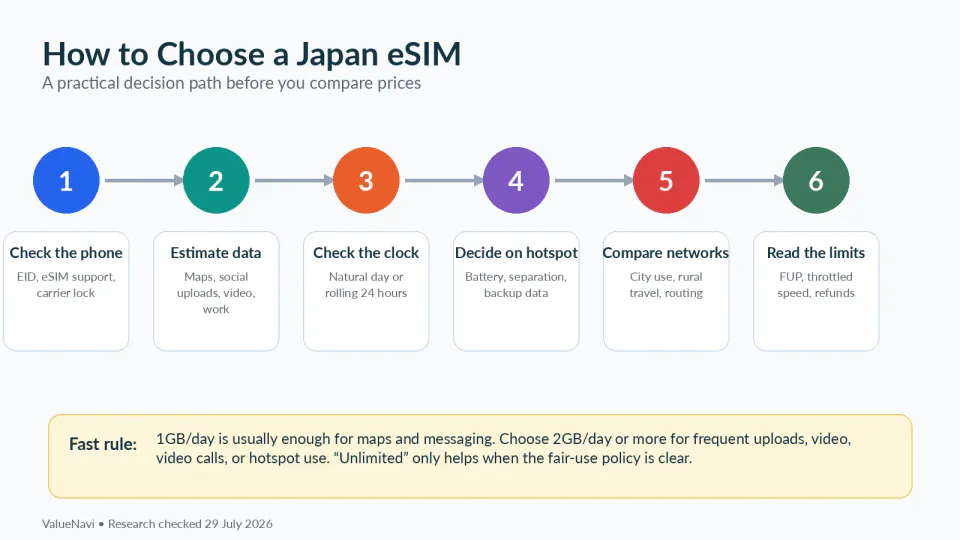
If you land at Haneda, Narita or Kansai close to midnight, this detail can matter more than a US$1 saving. Use the Japan eSIM late-arrival guide and the pre-trip installation guide before deciding when to turn the line on.
Calls and SMS: most travelers are comparing data plans, not phone service
Airalo’s current Moshi Moshi Japan fixed plan is data-only. The Klook Japan products discussed above are also data-only. That is enough for Google Maps, WhatsApp, LINE, iMessage data, FaceTime and other internet services, but it does not create an ordinary Japanese mobile number.
Saily currently advertises separate Japan phone-number/SMS and minute plans in addition to data plans. Treat those as separate products rather than assuming every Saily data package includes calls and texts.
If your home number is needed for banking or verification codes, a common setup is to keep the home SIM enabled for the service you need while preventing it from using roaming data, then use the Japan eSIM for mobile data. Check your home operator’s roaming and incoming-SMS rules first; those charges are outside the eSIM product.
Tokyo, Kyoto and Osaka create different failure modes—not different eSIM requirements
Tokyo: save exits before entering the station maze
Tokyo creates more underground and multi-operator transfer moments. Save the destination exit, hotel address and next transfer before descending into a complex station. A temporary switch from 5G to 4G, or a brief reconnection delay underground, does not by itself prove the eSIM is defective. A signal icon is not a substitute for an offline meeting point when two travelers separate.
Kyoto: bus and walking decisions make small amounts of live data disproportionately useful
Kyoto may use less video but more frequent map, bus and opening-hour checks. Download the broad route, but keep enough live data for service changes and the final walk. The Japan bus boarding guide is worth saving offline before a busy temple day.
Osaka: theme parks and nightlife can create the biggest one-day spikes
USJ, shopping districts, event exits and late-night uploads can make Osaka a heavy day even when Kyoto was light. That is another reason I prefer a total data pool for ordinary users rather than rigidly assuming every city consumes the same gigabytes per day.
Four real trip profiles: what I would choose
10–12 days, solo, first Japan trip, no work laptop
I would start around 10GB of fixed data. At current published prices, Airalo’s 10GB/15-day plan is US$17.50 and Saily’s 10GB/30-day plan is US$17.99. The difference is too small to matter. I would pick Airalo if I value its clearly published SoftBank/KDDI plan information and network-connection validity trigger; I would pick Saily if the 30-day validity or its app workflow better fits a longer or less certain trip.
Two weeks, frequent photo/video uploads, but no laptop
I would test 20GB fixed before paying for unlimited. Airalo currently lists 20GB/15 days at US$24 and Saily 20GB/30 days at US$24.99. If you can move original-quality photo and video backup to hotel Wi-Fi, 20GB can be much better value than an unlimited package.
Two weeks with laptop tethering or daily high-volume uploads
I would compare unlimited rules rather than logos. Saily’s current Japan unlimited plan gives 5GB high-speed per 24 hours then up to 1Mbps and permits hotspot sharing. Airalo unlimited currently gives 3GB high-speed per day before reduced speed and also supports hotspot. The cited Klook SoftBank/Docomo listing advertises 10GB/day at full speed before 128kbps and allows hotspot. Decide whether you care more about the larger pre-throttle bucket or the published fallback speed after it.
Couple traveling together but sometimes splitting up
I would buy two modest eSIMs. A shared hotspot can be economical on a train or in a hotel, but it is a poor dependency for two people navigating Tokyo independently. The second connection is not only extra data; it is failure isolation.
What not to pay for
Do not pay extra just for “5G”. Availability still depends on the local network, location and device. A transparent data and hotspot policy matters more than a logo.
Do not buy unlimited to compensate for automatic cloud backup. Turn photo backup, OS updates and large downloads to Wi-Fi first.
Do not buy a Klook plan from the marketplace name alone. Save the exact product page and package rules.
Do not use a single shared eSIM if the second traveler must remain independent.
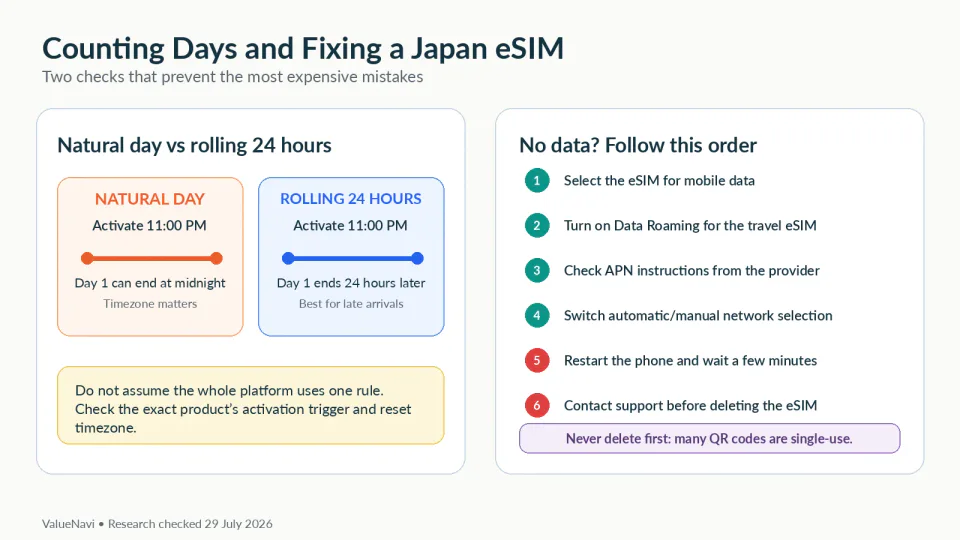
Do not delete an eSIM profile as your first troubleshooting step. Some products cannot be installed again from the same QR code. Use the Japan eSIM troubleshooting guide first.
Current products I would shortlist
Airalo: best starting point for a predictable fixed-data trip when its current validity, top-up and named-network details fit your preference. Its 10–20GB tiers are the part of the range I would compare first for a normal multi-city holiday.
Compare current Airalo Japan eSIM plans
Saily: strongest shortlist when heavy hotspot use or its current unlimited behavior is the reason you are upgrading beyond fixed data. Do not pay the unlimited premium if a 10–20GB pool already covers the trip.
Compare current Saily Japan eSIM plans
Klook: shortlist the exact package, not “Klook eSIM.” The existing ValueNavi link below points to the SoftBank 5G / Docomo 4G LTE product whose current page states hotspot support and a 10GB/day high-speed allowance on its unlimited option before 128kbps. Recheck those terms at checkout because Klook carries other Japan eSIMs with different rules.
Check this specific Klook Japan eSIM listing and its current package rules
Final verdict
For a normal Tokyo–Kyoto–Osaka first trip, buy one nationwide fixed-data eSIM and size it to your behavior, not to the number of cities. Airalo is my default fixed-data benchmark because its current Japan product makes the network and validity trigger unusually clear; Saily is the stronger first comparison when genuinely heavy use makes unlimited data worthwhile, especially because its current Japan unlimited plan publishes a 5GB/day high-speed allowance, up-to-1Mbps fallback and hotspot support. Klook can beat either on the right package, but only after you inspect the exact listing—current Klook Japan products do not even agree on whether hotspot sharing is allowed.
The red-team condition is simple: if your usage is mainly maps, messages, tickets and occasional social uploads, none of the unlimited-plan advantages may matter. In that case, the best eSIM is often the boring 10–20GB fixed plan with the clearest activation rules and enough validity for the whole trip.
Tokyo Autumn Leaves: Timing for Mt. Takao, Okutama, Gardens and Ginkgo
Japan Autumn Leaves in Mid-November: Kyoto, Tokyo, Fuji, Miyajima and Kyushu
20 Things to Do in Osaka When It Rains: Indoor Plans for Couples, Families and Full-Day Rain
Best Day Trips from Osaka: Kyoto, Nara, Kobe or Himeji — When Does a Tour Actually Save Time?
Osaka Solo Travel Itinerary: 7 Days of USJ, Kyoto and Kobe — Without Filling Every Hour