
Two people can share one Japan eSIM through a phone hotspot, but I would only make that the default when the pair genuinely travels as one unit. If either person may split off in a station, queue separately at a theme park, collect a rental car, return to the hotel early or handle a different airport task, two independent lines are usually the more resilient purchase. There is also a useful middle option that most comparisons miss: one large primary plan plus one very small backup eSIM for the second traveller.
The technical question—“does hotspot work?”—is only the first gate. The travel decision is about separation risk, battery concentration, data structure and the cost of one phone becoming unavailable.
Three setups, not two
↔ Scroll table left or right
Setup | Best for | What you gain | Main failure mode |
One large eSIM + hotspot | Couple that stays together almost all day | Lowest duplication; one plan to manage | Host phone becomes the data, battery and proximity single point of failure |
Two smaller independent eSIMs | Travellers who split, families, road trips, airports | Independent maps, messages and tickets | Usually costs more than one shared pool |
One large plan + one tiny backup line | Couple that usually stays together but wants resilience | Most heavy data remains shared; second phone can still navigate/message alone | You must keep the backup line configured and know when to switch to it |
My default for a normal city couple is the third option when the price gap is small enough. It avoids buying two large plans while removing the worst consequence of hotspot failure: the second person becoming completely offline.
Hotspot support is an eligibility check, not a brand assumption
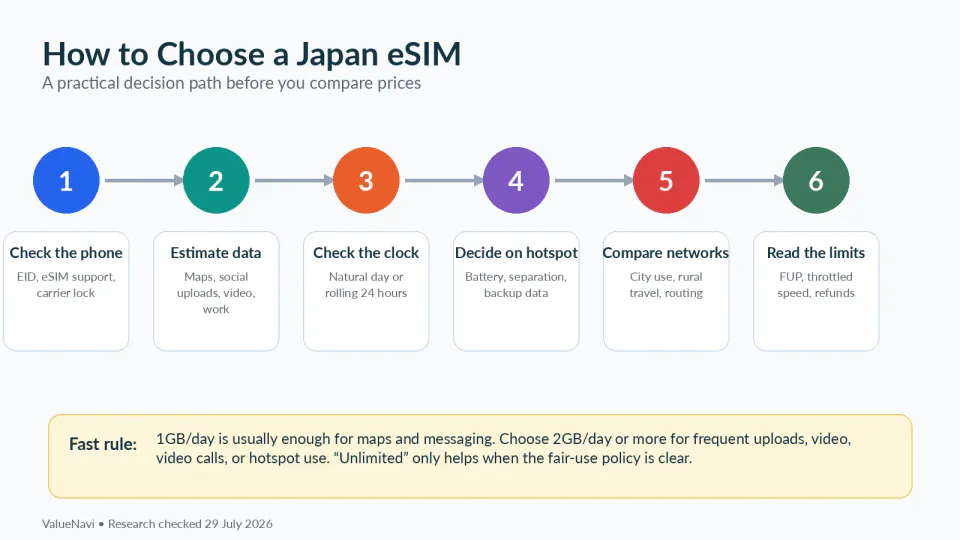
Airalo currently says personal hotspot/tethering can be used when the device and network support it; if the eSIM requires a manual APN, the hotspot APN may also need to be entered. Saily publishes iOS and Android hotspot setup instructions for its eSIM service. Klook’s current Japan listing 109393 explicitly says hotspot sharing is supported and publishes an unlimited tier with 10GB per day at full speed before 128kbps.
That is enough to show why the exact product still matters. A provider or marketplace name does not remove the need to check the selected package. If tethering is essential for a laptop or second phone, make “hotspot explicitly supported on this product” a veto before comparing price.
Use the Airalo vs Saily vs Klook comparison once you know whether you need a fixed pool or an unlimited structure.
Count separation events before counting gigabytes
The strongest decision variable is not data volume. It is how often the two phones will naturally separate.
A couple can spend an entire sightseeing day together and still split for five minutes at exactly the wrong time. One person queues for food while the other holds a ride queue. One takes the luggage to a locker while the other checks a train platform. One returns to the hotel while the other keeps shopping. One parks the rental car while the other checks in. At an airport, check-in, tax-free shopping, baggage and security tasks can split the group without anyone planning to “travel separately.”
I would use this practical rule:
No expected separation: one hotspot-capable plan is a credible default.
One or two low-stakes separations per day: one primary plan plus a tiny backup line becomes attractive.
Repeated or time-critical separation: buy two independent lines.
This is ValueNavi analysis, not a telecom rule. The point is to price connectivity around the itinerary’s failure cost rather than around the number of devices on the booking.
A single host phone concentrates four risks at once
When two people share one hotspot, the host phone must remain:
physically close enough for Wi-Fi;
charged;
connected to the mobile network;
configured so hotspot does not disappear under power-saving or APN settings.
If any one fails, the second phone loses data even when the eSIM still has plenty of allowance left.
This concentration matters most on long days. The host may be doing navigation, photography, messaging and hotspot routing while also charging from a power bank. A power bank reduces battery risk but does not eliminate cable failure, overheating or a phone that must be taken away by one traveller.
Do not ask only whether one phone has enough battery for itself. Ask whether the entire pair is comfortable making that phone their router, map, ticket wallet and communication hub at the same time.
Data structure matters more when two devices share
Two devices do not automatically double data use, but sharing makes background traffic easier to miss. The second phone can sync photos, update apps or play video while the host is navigating. A tethered laptop can be more consequential because cloud-drive sync, browser updates and video calls may consume a large amount in a short session.
This is where the difference between total data and daily high-speed limits becomes important. Airalo’s fixed-data help explains that a fixed package’s allowance is available across the entire validity period rather than being divided evenly by day. Airalo’s current unlimited fair-use default is different: 3GB of high-speed data per 24-hour period, then 1Mbps until that 24-hour window resets. Saily’s current Japan unlimited product publishes 5GB per day without a speed limit, then unlimited data up to 1Mbps.
For a couple with one heavy laptop day and six light sightseeing days, a total 20GB pool may be more forgiving than a small daily bucket. For a pair that uses several gigabytes every day, a transparent unlimited structure may be easier. The 1GB vs 2GB vs unlimited guide handles that structural choice.
The cheapest shared plan can be the most expensive setup at an airport
Airport days are where the “we always stay together” assumption breaks most often. One person may be at baggage services while the other contacts the hotel; one checks a rail platform while the other buys tickets; one handles a rental-car shuttle while the other watches luggage.
If the second phone has no independent data, every separation requires a workaround: airport Wi-Fi, screenshots, meeting points or returning to the host phone. None is catastrophic, but they are exactly the frictions a travel eSIM was supposed to remove.
For a late arrival, I would be particularly reluctant to make one phone the only live connection if the transfer depends on a final train, bus, taxi app or hotel communication. Use the late-arrival validity guide to solve the timing problem, then choose one or two lines separately.
Theme parks and large stations favour independence more than ordinary sightseeing
Tokyo Disney Resort, USJ, Shinjuku Station, Tokyo Station and large shopping complexes are not technically “rural” or poorly connected. The hotspot problem there is human movement. Groups split because it is efficient.
If one person holds a queue and another buys food, independent data lets both check messages, app reservations or meeting points. If one phone is the hotspot host, the second person either stays nearby or loses the connection.
For a normal couple walking the same Kyoto neighbourhood all day, this may never matter. For a family managing queues, children and purchases, it can matter several times before lunch. Connectivity design should follow that behaviour.
Road trips make the primary-plus-backup setup unusually useful
On an Okinawa or Hokkaido road trip, the pair spends most driving time together, so buying two huge plans can feel wasteful. But the group still separates at fuel stops, hotel check-in, parking, ski facilities and attractions.
That is the strongest case for one large plan + one small independent backup. The host handles navigation and most shared data. The second line only needs enough capacity for maps, messages, booking pages and emergency coordination when the phones separate.
More gigabytes still do not create coverage. Save offline maps and hotel phone numbers regardless of which setup you buy. Use the Okinawa eSIM guide or Hokkaido eSIM guide when network resilience matters more than plan size.
Do not scan one eSIM QR code onto two phones
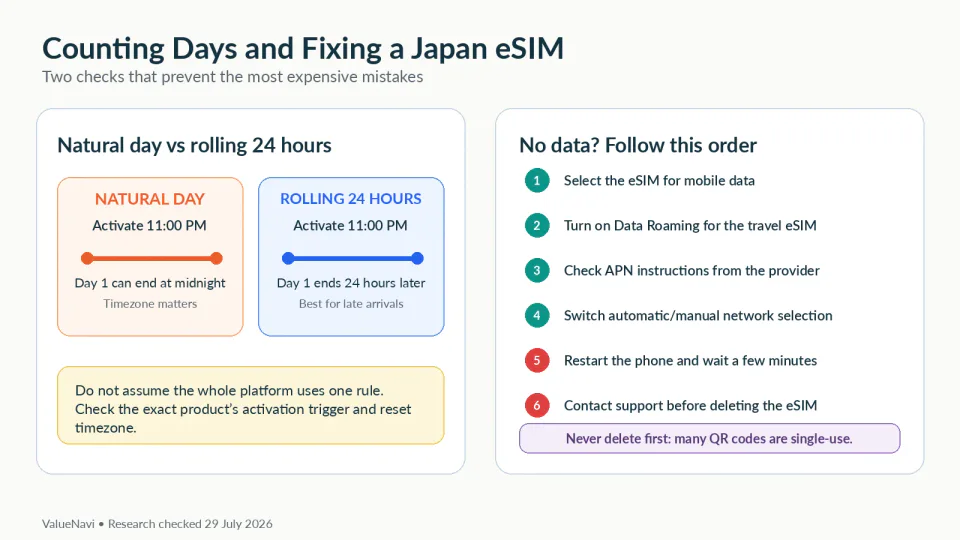
Hotspot sharing is not the same as installing the same eSIM profile on two devices. Many travel eSIM profiles and QR codes are designed for one installation or one device. Do not delete a working profile to “move” it to the second phone unless the provider explicitly confirms transfer or reinstallation.
This is one reason to decide the host phone before departure. If sharing is the plan, install the main eSIM on the device with the better battery, the most reliable hotspot behaviour and the person least likely to separate from the group.
The installation guide explains how to keep QR, APN and recovery details outside the phone before travel.
A cost test that includes redundancy
Do not compare only:
one 20GB plan vs two 10GB plans
Compare:
one large hotspot-capable plan+ power / host-phone dependence+ cost of no independent navigation
against:
two smaller independent plans
and:
one large primary plan+ one minimal backup plan
If the two-line premium is tiny relative to the trip, redundancy can be the better purchase. If it is substantial and the pair genuinely never splits, sharing is rational. If the pair mostly stays together but has a few airport, station or road-trip separation points, the hybrid setup often gives the cleanest trade-off.
Final verdict
Share one hotspot when both travellers move together, data use is moderate, the exact eSIM explicitly supports tethering and the host carries reliable power.
Buy two lines when either person may separate repeatedly, the trip has airports/theme parks/road-trip hand-offs, or both phones need independent live tickets, maps or work access.
Use one large plan plus one small backup line when the pair is together most of the time but does not want one phone to be the entire connectivity system. This is the most underused compromise because the backup line does not need to stream video—it only needs to keep the second traveller functional.
The technical ability to tether answers “can it work?” The itinerary decides whether it is a good design.
References
Airalo — tethering / Personal Hotspot · Airalo — Unlimited Fair Use Policy · Saily — hotspot setup · Saily — Japan plans · Klook — Japan eSIM listing 109393. Checked August 25, 2026. Hotspot, APN, data and fair-use terms can differ by exact product and device.