

For Sapporo and Otaru, almost any well-specified Japan eSIM with enough data can do the job. For a Hokkaido road trip or ski trip, I would put network transparency and redundancy ahead of an “unlimited” badge. Airalo is currently the cleanest transparency-first default because its Japan Moshi Moshi product names both SoftBank and KDDI. Klook listing 109393 is useful when you deliberately want a daily-data SoftBank 5G package or a total-data Docomo 4G LTE package. Saily is the stronger heavy-hotspot option when its 5GB-per-24-hour high-speed unlimited allowance matters more than seeing the Japanese partner carrier on the public destination page.
The Hokkaido-specific decision is not “which eSIM has coverage everywhere?” No consumer travel eSIM can honestly promise that. The decision is how much failure you can absorb when the phone is simultaneously your map, road-closure checker, hotel contact, ski-group meeting tool and ticket wallet. In rural or winter Hokkaido, a second line only adds real resilience when it avoids the same single point of failure; two large plans on the same disclosed carrier family may still fail in the same place.
↔ Scroll table left or right
Your Hokkaido route | Start with | Why | Main boundary |
Sapporo + Otaru | 10GB fixed data from a provider you already use | Urban rail, hotel Wi-Fi and dense services keep the failure cost low | Do not pay a rural-network premium for a city-only itinerary |
Furano / Biei self-drive | Airalo or another product with named local networks | Airalo currently discloses SoftBank + KDDI, giving the buyer more information before leaving the city | Multiple supported networks do not guarantee reception on every rural road |
You deliberately want a different disclosed carrier family | Klook 109393 total-data package | Its current total-data packages use Docomo 4G LTE; its daily-data packages use SoftBank 5G | This applies to that exact listing, not to “Klook eSIM” generally |
Ski group / laptop hotspot / repeated heavy data | Saily unlimited | Current plan gives 5GB/24h high-speed data, then up to 1Mbps, and allows hotspot sharing | The public Japan page does not currently name the local Japanese carrier |
Eastern Hokkaido / winter drive / remote accommodation | Primary line + offline route + optional second line on a different disclosed carrier family | The cost of losing navigation or live road information is higher | Network diversity is backup, not permission to drive through unsafe conditions |
Airalo is the easiest starting point when you care what network sits underneath the eSIM
Airalo’s current Moshi Moshi 20GB / 30-day Japan product costs US$25 at the time of this check and explicitly lists SoftBank and KDDI. It starts validity when the eSIM connects to a supported network in Japan and supports top-ups. Airalo also explicitly states that the Japan product covers Hokkaido.
For Sapporo, that transparency is nice but not decisive. For a long Furano, Biei or eastern-Hokkaido route, it becomes more valuable because the traveller knows which local network families are supposed to be available to the eSIM before leaving a dense city.
Do not turn “SoftBank + KDDI” into “dual-network coverage everywhere.” Actual selection, signal quality, congestion, device bands, tunnels, valleys and building construction still matter. The advantage is that the product discloses more of its network design than a plan that only promises generic Japan 5G/4G.
I would choose Airalo first when: the Hokkaido trip includes driving or rural nights, fixed 10–20GB is enough, network disclosure matters, or I already use Airalo and want one support/top-up account.
Klook 109393 can be used as a carrier-selection tool—if you freeze the exact SKU
Klook listing 109393 currently makes an unusual distinction: daily-data packages use SoftBank 5G, while total-data packages use Docomo 4G LTE. Hotspot sharing is supported. Its unlimited tier currently gives 10GB per day at full speed before dropping to 128kbps.
That means the package type can do two jobs at once: decide the allowance structure and decide the published local carrier. A traveller whose primary eSIM already lists SoftBank/KDDI could, for example, prefer a small Docomo-based total-data backup if the purpose is carrier-family diversity rather than more gigabytes.
This is a ValueNavi inference from the published carrier information, not a claim that the backup will always have signal when the primary does not. Different disclosed carriers reduce one source of correlated failure; they do not eliminate geography, weather or device failure.
Klook remains a marketplace, so another Japan eSIM listing may have completely different terms. Save the exact listing, package type, carrier, hotspot rule and activation conditions before payment.
Saily is the stronger choice when hotspot continuity matters more than carrier visibility
Saily’s current Japan unlimited option gives 5GB of high-speed data per 24-hour period, then unlimited data at up to 1Mbps. It allows hotspot sharing across its plans. For remote work, a family tablet or repeated laptop use at a ski base, that is a clear and useful data shape.
Its weakness for Hokkaido planning is not the data allowance. It is that the public Japan destination page checked for this guide does not identify the Japanese partner carrier. If you are staying in Sapporo and simply need a lot of tethering, that may not matter. If the whole purpose of the comparison is to know which local network family backs a remote road trip, Airalo or an exact Klook SKU currently exposes more useful purchasing information.
I would choose Saily when: the group needs frequent hotspot use, the 5GB high-speed daily allowance fits the workload, and named-carrier transparency is not the deciding requirement.
Sapporo and Otaru are the wrong places to over-engineer redundancy
A city-only Hokkaido trip has many fallback layers: hotel Wi-Fi, station Wi-Fi, staffed transport, taxis, convenience stores and short distances between major services. A temporary mobile-data problem is annoying, but it is less likely to strand the itinerary.
For that route, I would choose a simple fixed 10GB plan, test it at New Chitose Airport and move on. The money saved from a second line can be more useful elsewhere in the trip.
If the route expands into Furano, Biei, Niseko, Rusutsu or eastern Hokkaido, revisit the decision. The eSIM requirement should follow the geography; it should not be fixed before the itinerary.
For winter driving, live data is a planning input—not a safety guarantee
Hokkaido’s official road-information system provides road-closure, road-weather and road-camera information, and the Hokkaido Regional Development Bureau explicitly tells drivers to check current road and weather information during severe winter conditions. That makes live mobile data genuinely useful on a winter road trip.
But the logic must not be reversed. Having two eSIMs does not make a closed road open or a whiteout safe. Download the route in advance, save the hotel and fuel stops, then use live official road information to decide whether the planned drive should change.
Use the Hokkaido winter driving guide alongside the eSIM. Connectivity is there to support a conservative driving decision, not to rescue an aggressive schedule.
The most useful second line is not always another copy of the first
Two travellers often buy identical plans because it is simple. That gives independence when they separate, but it may not give much network diversity when both eSIMs depend on the same local carrier family.
For a high-risk rural itinerary, separate two goals:
person redundancy: each adult can navigate and message independently;
network redundancy: the backup uses a different disclosed local carrier family where practical.
You may need both, one or neither. A couple staying together in Sapporo needs little network redundancy. Two adults driving eastern Hokkaido in winter with all hotel contacts and reservations online have a stronger case.
If you do buy a second line, it can be small. A 1–3GB backup on a different disclosed carrier family may add more resilience than doubling a 20GB primary plan on the same network.
Ski trips move the failure point from the road to the group
At Niseko, Furano or Rusutsu, the biggest connectivity failure may happen when two adults separate rather than when the whole resort loses signal. One person skis a different run, a child returns early, a shuttle changes, or the group chooses different restaurants.
If one phone is the only hotspot, the second traveller can have zero data even though the plan still has 30GB remaining. That is why independent lines become easier to justify for ski groups than for couples doing a city break.
Cold weather adds battery pressure. Keep the power bank accessible and warm, and save the hotel name, address, shuttle stop and meeting point offline. The Niseko vs Furano and Niseko vs Rusutsu guides help decide how spread out the group is likely to become.
Unlimited data does not improve a dead zone
Hokkaido is exactly where “unlimited” can distract from the real problem. Airalo, Saily and Klook all sell heavy-data structures, but a larger allowance only matters when the phone already has a usable connection.
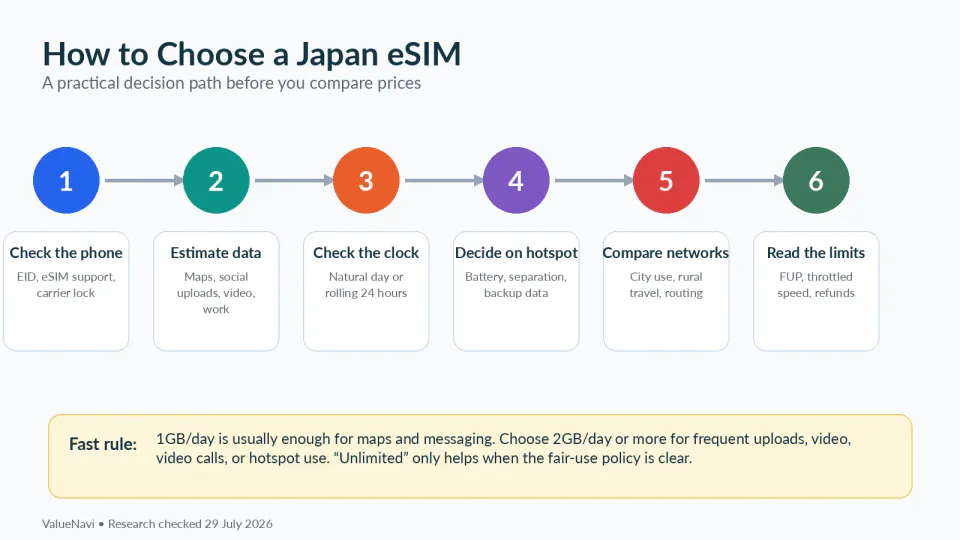
Current published unlimited structures are materially different. Saily gives 5GB/24h at high speed then up to 1Mbps. Klook 109393 gives 10GB/day at full speed then 128kbps. Airalo’s unlimited plans use their own fair-use thresholds. These are useful for repeated uploads, work and hotspot use; they are not coverage upgrades.
For a rural itinerary, I would rather buy a well-disclosed fixed plan plus a small independent backup than pay a large unlimited premium purely because the route looks remote. The recommendation reverses for a work-heavy ski stay where several devices genuinely consume lots of data every day.
Test the line before leaving New Chitose Airport or the last large city
Do not make the first real test of the eSIM on a dark rural road. While airport or hotel Wi-Fi is still available:
turn Wi-Fi off and load a live webpage;
confirm the correct data line and roaming setting required by the provider;
test hotspot if another device depends on it;
save the provider’s support instructions offline;
download the next route and hotel details.
If something fails, use the Japan eSIM troubleshooting guide before deleting the profile. A QR code may not be reusable.
Final verdict
Sapporo and Otaru only: buy a simple fixed plan; 10GB is a practical default for ordinary travel and there is little reason to over-engineer the network.
Furano/Biei or longer self-drive: Airalo is my transparency-first starting point because its current Moshi Moshi plan publishes SoftBank + KDDI. Treat that as disclosed network diversity, not guaranteed coverage.
Need a deliberately different disclosed carrier family: Klook 109393 currently lets its total-data packages use Docomo while daily-data packages use SoftBank. An exact small Docomo-based package can be useful as a backup when the primary relies on other carrier families.
Heavy ski-resort hotspot or laptop use: Saily’s current 5GB/24h high-speed unlimited structure plus 1Mbps fallback is the stronger data-first default when public carrier disclosure is less important.
Eastern Hokkaido or winter driving: buy redundancy only when it changes the failure model. Offline maps, official road information, battery and conservative route decisions remain more important than adding another 20GB.
Compare Airalo Japan eSIM Plans
Compare Saily Japan eSIM Plans
Sapporo vs Chitose for the Last Night: Where to Stay in Hokkaido
Best Airport for Japan Autumn Leaves: Choose by Foliage Window and Open-Jaw Route
Hokkaido Autumn Leaves 2026: Daisetsuzan, Sapporo and Hakodate Routes
Sapporo Station Hotel Comparison: JR Tower Nikko or Granbell for Snow and Onsen?
References
Airalo — Japan Moshi Moshi 20GB · Saily — Japan eSIM plans · Klook — Japan eSIM listing 109393 · Hokkaido Regional Development Bureau — winter driving and road information. Checked August 25, 2026. Network access, packages, fair-use limits and road conditions can change; verify the exact product and live official road information before travel.