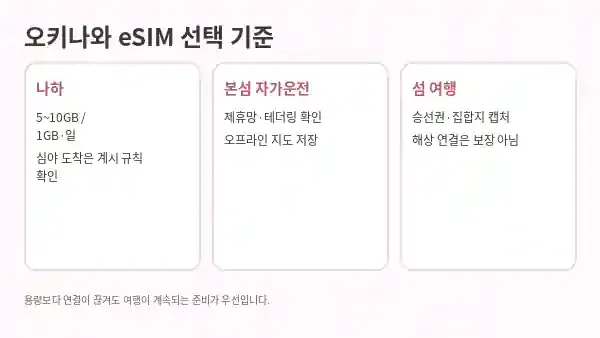
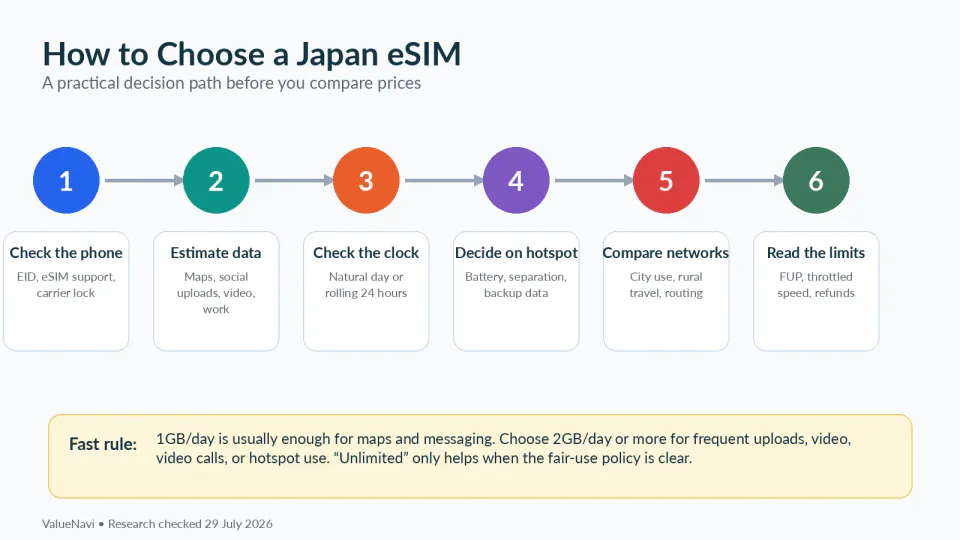
For most Okinawa trips, I would not buy a special “Okinawa” eSIM just because the itinerary leaves mainland Japan. I would buy the Japan plan whose network disclosure, hotspot rules and failure recovery fit the route. For Naha and a normal main-island road trip, 10–20GB of fixed data is usually the cleaner default. Airalo is currently the easiest product to inspect for network diversity because its Moshi Moshi plan lists both SoftBank and KDDI. Klook listing 109393 is useful when you deliberately want to choose between a daily-data SoftBank 5G package and a total-data Docomo 4G LTE package. Saily becomes more attractive when heavy hotspot use matters more than seeing the Japanese partner carrier on the public product page.
The important Okinawa correction is that more gigabytes do not solve a weak-signal road, a ferry day or one dead phone battery. Once the trip includes northern driving, Miyako, Ishigaki or travellers who may separate, the right purchase is a connectivity system: suitable data + a disclosed network where possible + offline maps + saved reservations + power + a second independent connection when the failure cost is high.
The 30-second Okinawa eSIM decision
↔ Scroll table left or right
Your route | Start with | Why | Main boundary |
Naha + monorail / city sightseeing | 10GB fixed data from a provider you already trust | Network micro-optimisation has low value in a simple urban trip | Do not pay an unlimited premium for maps, messages and ordinary social use |
Naha → Onna → Nago / Motobu road trip | Airalo fixed data or another plan with explicit partner-network information | Airalo currently lists SoftBank + KDDI, so you know more about the underlying connectivity than with a generic “Japan 5G” label | Two listed networks are not a guarantee of reception on every road or inside every building |
You want to choose a Japanese carrier by package type | Check Klook listing 109393 | Its current daily-data packages use SoftBank 5G; total-data packages use Docomo 4G LTE | Klook is a marketplace; do not carry these terms to another listing |
Laptop / tablet hotspot or repeated heavy uploads | Saily unlimited or another explicit hotspot product | Saily currently publishes 5GB per 24h at high speed, then up to 1Mbps, with hotspot sharing across plans | The public Japan page does not currently identify the Japanese partner carrier; network transparency is weaker |
Miyako / Ishigaki / ferry-heavy trip | Primary eSIM + offline-first plan; consider a second independent line | Meeting points, ferries and return transport are too important to live only inside one online session | No consumer eSIM can promise continuous offshore or remote-island reception |
Airalo is the strongest transparency-first default for an Okinawa road trip
Airalo’s current Japan Moshi Moshi 20GB / 30-day product lists SoftBank and KDDI, costs US$25 at the time of this check, supports top-ups and starts validity when the eSIM first connects to a supported network in Japan. Airalo also explicitly says the product covers Japan nationwide, including Okinawa and Hokkaido.
That combination makes it a useful starting point for an Okinawa road trip because the buyer can see more than a generic “4G/5G” badge. A traveller driving north from Naha knows that the plan is provisioned for two named Japanese networks rather than relying on an unnamed partner.
Do not over-read that fact. Two supported networks do not mean the phone will always have two equally strong choices, and they do not guarantee continuous reception in tunnels, coastal dead spots, remote beaches or every hotel room. The value is transparency and potential network diversity, not a coverage promise.
I would choose Airalo first when: the trip is mostly main-island driving, 10–20GB is enough, I want the partner networks disclosed before payment, or I already use Airalo elsewhere and value one support/top-up workflow.
Klook 109393 is useful when you want the package itself to choose SoftBank or Docomo
Klook should not be treated as one eSIM provider, but listing 109393 currently exposes an unusually useful distinction. Its daily-data packages use SoftBank 5G, while its total-data packages use Docomo 4G LTE. It also currently supports hotspot sharing. The unlimited option gives 10GB per day at full speed, then falls to 128kbps.
That creates a route-planning option other marketplace comparisons miss. If you have a reason to prefer one listed carrier family, package structure becomes part of the network decision. You are not only choosing “1GB/day vs 10GB total”; on this SKU, you are also choosing a different local carrier.
The trade-off is that Klook is a marketplace. Another Klook Japan eSIM can use different suppliers, activation rules and hotspot terms. Save the exact listing and selected package before checkout. “Klook worked well in Okinawa” is not a transferable specification.
I would choose this Klook SKU when: its exact carrier/package combination fits the route, a daily or total-data structure is useful, or the 10GB high-speed unlimited window matters. I would avoid its unlimited tier if I expect to exceed 10GB and still need normal browsing afterward, because 128kbps is a very weak fallback.
Saily wins a different contest: hotspot headroom, not network disclosure
Saily’s current Japan page lists fixed plans from 1GB to 20GB and a 15-day unlimited option. The unlimited structure currently gives 5GB per 24 hours without a speed limit, followed by unlimited data at up to 1Mbps. Saily also says hotspot sharing is available across its plans.
For a couple sharing a laptop, a family tethering a tablet, or a creator who repeatedly uploads from the hotel or car, that structure can be more useful than a smaller fixed pool. The 1Mbps fallback is also much more usable for maps and messaging than a 128kbps fallback after a heavy day.
The Okinawa-specific trade-off is transparency. On the public Japan destination page checked for this guide, Saily does not name the Japanese partner carrier. That does not mean the service is poor; it means a traveller who specifically wants to know the local network before a rural drive has less information at purchase time.
I would choose Saily when: hotspot and repeated heavy daily use are the dominant requirements. I would choose another product when named-network disclosure matters more than the larger unlimited allowance.
Naha does not justify the same redundancy as a northern road trip
A short Naha stay is the easiest Okinawa connectivity problem. The phone mainly supports Yui Rail navigation, restaurant searches, translation, tickets, messages and airport transport. Hotel Wi-Fi and dense urban services reduce the cost of a temporary mobile-data problem.
That is why a 10GB fixed plan can be more rational than unlimited even when unlimited is only modestly more expensive. You are buying a travel tool, not a replacement home broadband connection.
If the first two days are entirely in Naha, also question whether the rental car should begin immediately. The Naha two-day no-car itinerary and Do You Need a Car in Okinawa? can reduce both driving and connectivity risk before the route ever moves north.
Landing, collecting a car and driving north is the highest-risk activation window
The most fragile version of an Okinawa eSIM setup is: international arrival → baggage → rental-car shuttle → contract → unfamiliar left-side driving → expressway → northern hotel, all on the same evening.
Before leaving airport or rental-office Wi-Fi:
turn Wi-Fi off and confirm that mobile data actually loads;
save the rental return location and hotel address;
download the Naha-to-hotel map area;
save the hotel phone number and check-in deadline;
keep the installation/support instructions offline.
The eSIM with the best speed test inside Naha Airport is not necessarily the most resilient product for this chain. The goal is to leave the city with a tested line and a route that can survive one weak-signal section.
Use the Okinawa car-rental comparison to fix pickup timing and the five-day self-drive itinerary to pre-save the route before the drive.
For Miyako and Ishigaki, spend less effort predicting signal and more effort reducing dependency
Miyako and Ishigaki make “which carrier is best?” tempting because the route feels more remote. But no public product page can honestly tell you which exact beach, road cut, ferry deck or hotel room will have the strongest signal on your travel date.
A more useful strategy is to reduce the number of decisions that require live data. Save bridge routes, fuel stops, activity meeting points, hotel addresses, ferry timetables and return tickets while Wi-Fi is strong. Screenshot any QR code that can be displayed offline.
For ferry days, mobile service offshore should be treated as a bonus rather than infrastructure. If a ferry cancellation or timetable change is possible, save the operator contact and the port layout before boarding. A bigger data package cannot compensate for a location where the phone has no usable radio link.
Two travellers should buy independence when the route repeatedly separates them
One hotspot-capable plan can be perfectly sensible when two people remain together all day. It becomes a poor design when one person parks the car while the other checks in, one adult returns to the hotel with a child, or two travellers join different diving/snorkelling activities.
The useful comparison is:
One large shared plan: cheapest when the pair stays together; one battery/network failure affects both.
Two smaller independent plans: more expensive but each adult retains maps and messaging when separated.
One primary plan + tiny backup line: a useful compromise when separation is rare but the trip contains a few high-cost failure windows.
Use the Japan eSIM hotspot guide for two people before sizing the gigabytes.
Unlimited is only worth paying for when the heavy days repeat
Okinawa driving itself does not consume huge amounts of data. Maps, messages and reservation pages are relatively light. The unlimited case comes from behaviour layered on top: video uploads, laptop tethering, children streaming in the car, cloud backup or repeated long days away from hotel Wi-Fi.
Current unlimited structures show why the label is not enough. Saily publishes 5GB per 24 hours at high speed, then up to 1Mbps. Klook 109393 publishes 10GB per day at full speed, then 128kbps. Airalo’s current unlimited fair-use default uses a smaller high-speed window than Saily before a 1Mbps fallback. Compare the high-speed window + fallback against your actual heavy-day pattern.
If the trip is mostly maps, photos and messages, a 10–20GB total pool is usually easier to value. The Japan eSIM 1GB vs 2GB vs unlimited guide handles the sizing.
Keep mobile data alive until the rental car is returned
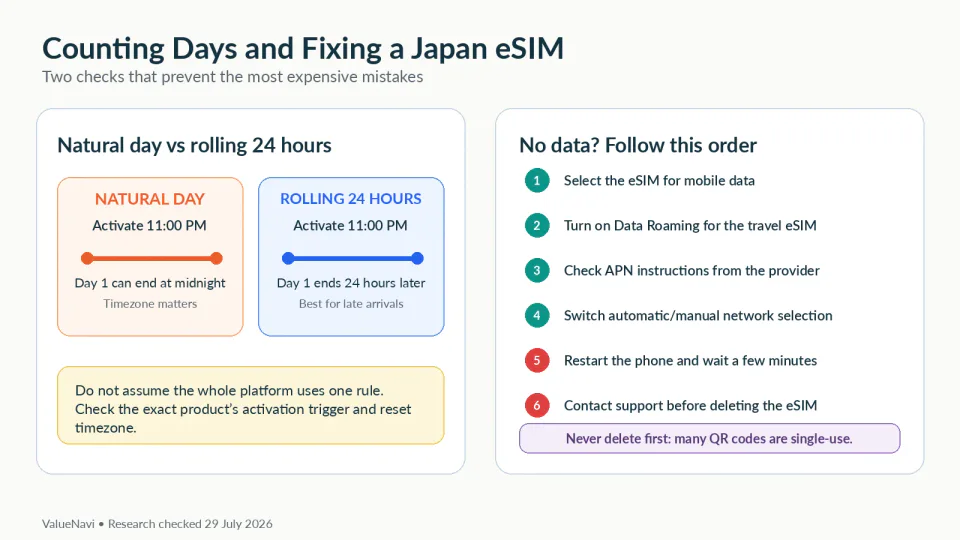
The final Okinawa day often contains the same operational tasks as arrival in reverse: fuel, rental-return navigation, traffic, shuttle to the terminal, airline messages and gate changes. Do not save a few hours of validity by letting the plan expire before this chain is complete.
If the flight leaves early, save the route the night before—but still keep live data available until the car is returned or the airport transfer is complete. A cheap extra day of fixed validity can be better value than falling back to expensive home-SIM roaming during the most schedule-sensitive part of the trip.
Final verdict
Naha only: choose a simple 10GB fixed plan and stop optimising.
Main-island self-drive: Airalo is my transparency-first starting point because its current Japan product lists SoftBank + KDDI; keep offline maps as the failure backup.
Want a specific disclosed carrier through a marketplace SKU: Klook 109393 is useful because its current daily-data and total-data packages explicitly map to SoftBank and Docomo respectively.
Repeated hotspot or heavy uploads: Saily’s current 5GB/24h high-speed unlimited structure plus 1Mbps fallback is the stronger default when network disclosure is not the deciding factor.
Miyako, Ishigaki or ferry-heavy trip: do not buy your way out of uncertainty with more gigabytes. Build offline redundancy and consider a second independent line if two adults may separate.
The recommendation reverses whenever the exact product terms change. Recheck the named network, hotspot rule, activation clock and fair-use threshold on the payment page; those matter more in Okinawa than a generic “5G Japan” badge.
Compare Airalo Japan eSIM Plans
Compare Saily Japan eSIM Plans
Okinawa Trip Cost: 5-Day Budget for Hotels, Car and Activities
Best Dates for USJ Halloween 2026: Crowds, Prices and Hotels
Where to Stay in Fukuoka: Hakata or Tenjin for Trains, Food and Day Trips
Vessel Hotel Campana Okinawa Review: Does Free Bed-Sharing Work for 2 Adults and 2 Kids?
Osaka Hotels for Kyoto and Kobe Day Trips: When 3–5 Minutes to the Station Matter Twice a Day
References
Airalo — Japan Moshi Moshi 20GB plan · Saily — Japan plans and unlimited allowance · Klook — Japan eSIM listing 109393. Checked August 25, 2026. Product prices, networks, hotspot terms and fair-use rules can change; verify the exact package before payment.