
Before choosing 1GB, 2GB or unlimited for Japan, check the unit. “1GB for 7 days” can mean one gigabyte for the entire week; “1GB/day for 7 days” can mean up to seven separate daily buckets. Those are completely different products even though both contain the words “1GB” and “7 days.” For most normal Japan trips, I would choose a total-data pool when usage will be uneven, a daily bucket when usage is consistently light, and unlimited only when repeated heavy days justify the fair-use threshold.
The ValueNavi test uses two numbers: total trip data and the heaviest 24-hour window. Average GB per day is not enough.
First fix the unit: 1GB total is not 1GB per day
Airalo’s current help centre makes the distinction explicit: if you buy a 1GB / 7-day fixed-data package, that 1GB is for the entire seven-day validity period. You can use all of it on Day 1. It is not automatically divided into seven daily slices.
Marketplace products can use a different structure. Klook’s current Japan listing 109393 offers both data per day and data in total package families. A traveller who sees “1GB” without checking that field can buy a plan seven times smaller—or structurally different—than expected.
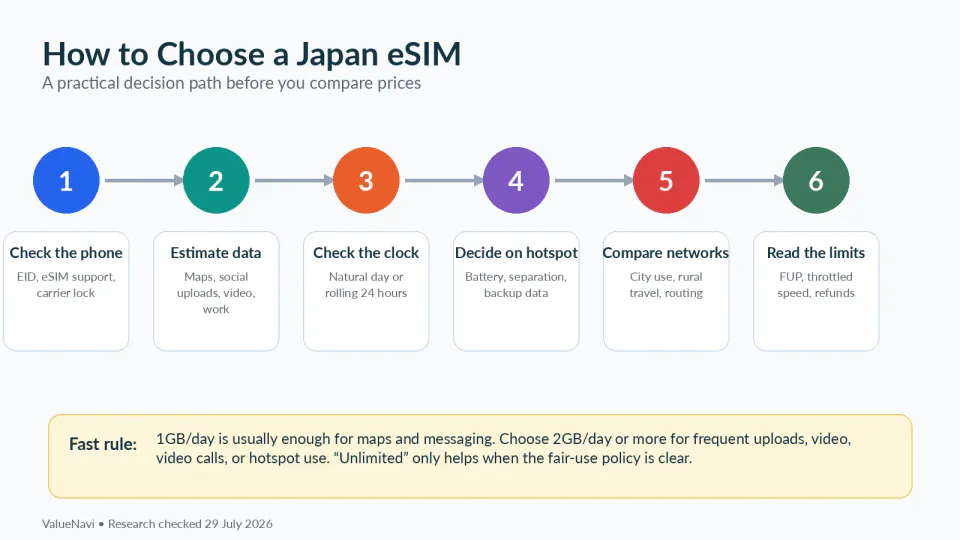
Before price, write one of these labels beside every product: 1GB total, 1GB/day, 2GB/day, 10–20GB total pool, or unlimited with a daily high-speed threshold. If two products do not share the same unit, do not compare their headline GB numbers directly.
The 30-second decision
↔ Scroll table left or right
Your usage shape | Start with | Why | Main failure mode |
Maps, messages, tickets; video backup waits for Wi-Fi | Small total pool or ~1GB/day | Mobile data stays a travel tool rather than a media connection | One background upload can consume a small daily bucket |
Normal social use, occasional reels/music, attraction apps | ~2GB/day or 10–20GB total | More room for ordinary media without constant monitoring | Daily buckets waste unused allowance on light days |
Five light days + one very heavy day | Total-data pool | Quiet days leave capacity available for the heavy day | A daily cap can throttle the one day that matters most |
Laptop tethering or repeated creator/work days | Large total pool or transparent unlimited | High-speed continuity matters more than a small saving | “Unlimited” can still throttle after a daily threshold |
Two people sharing one plan | Recalculate the architecture first | One plan creates battery and separation risk as well as more data use | The second person can lose connectivity while data remains |
Use the peak-day ratio to decide daily bucket versus total pool
A useful planning rule is:
Peak-day ratio = heaviest expected mobile-data day ÷ normal day
If your heaviest day is close to your normal day, a daily bucket is easy to use. If the heaviest day is two or three times larger, a total pool becomes more attractive because unused data from quiet days remains available.
For example, imagine five days around 0.5GB, one day around 2.5GB and one day around 1GB. The total is only 6GB. A 1GB/day plan can still become annoying on the 2.5GB day even though the weekly average is below 1GB/day. A 10GB total pool handles the same pattern without caring which day is heavy.
Those are hypothetical planning numbers, not measured average traveller usage. The decision insight is the unevenness.
1GB total: a minimalist plan, not a normal 1GB/day plan
A fixed 1GB package for an entire week is suitable only when mobile data is deliberately limited: occasional maps, messages and essential lookups with heavy use moved to Wi-Fi. It is not the product I would choose for a typical first Japan trip involving frequent live routing, attraction apps and daily uploads.
The hidden cost is attention. A very small total pool forces you to decide whether each photo upload or route search is worth the data. If the next tier costs only modestly more, buying attention back can be rational.
1GB/day: good for disciplined use, weak for burst days
A 1GB/day structure works when each day looks similar: maps, train searches, messages, translation, QR tickets and modest social use. It gets weaker when the itinerary contains a theme park, exhibition, long transfer, remote-work block or creator day.
I would choose it when large backups stay on Wi-Fi, there is no laptop tethering and no single day has a much heavier digital workload. If one condition fails, compare a total pool before simply upgrading to 2GB/day.
2GB/day: more comfortable, but the structural trade-off remains
Two gigabytes per day gives more breathing room for social media, music, photos and attraction apps. It can be a good comfort tier for travellers whose use is still fairly consistent.
But it does not fix uneven demand. For a 10-day trip, 2GB/day exposes up to 20GB across the trip, but the allowance is still sliced by day. Compare it with a 20GB total pool. If price is similar and there is no reason to prefer daily resets, I would normally take the pool for flexibility.
Total 10–20GB: the resilient default for uneven sightseeing days
Japan itineraries are naturally uneven. A quiet temple day is not the same digital workload as Tokyo Disney, USJ, an airport transfer, a Shinkansen disruption or a creator day.
A total pool lets those days borrow from one another. Airalo’s current help confirms that fixed package data is available across the whole validity period. Saily’s current Japan page also offers fixed 10GB and 20GB plans with 30-day validity.
The trade-off is that if you use the whole pool early, there is no daily reset to rescue you. Check top-up availability on the exact product and keep a low-data warning enabled.
Unlimited: 3GB, 5GB and 10GB thresholds are different products
Unlimited does not mean unlimited full-speed data.
Airalo’s current unlimited fair-use default gives 3GB of high-speed data per 24-hour period, then 1Mbps until the next 24-hour reset from activation. Saily’s current Japan unlimited product publishes 5GB per day without a speed limit, followed by unlimited data at up to 1Mbps. Klook listing 109393 currently publishes an unlimited option with 10GB/day at full speed, then 128kbps.
↔ Scroll table left or right
Structure | High-speed window | Fallback | Trade-off |
Airalo unlimited default | 3GB / 24h | 1Mbps | Smaller high-speed window, more usable fallback |
Saily Japan unlimited | 5GB/day | Up to 1Mbps | More room for daily hotspot/uploads before throttling |
Klook 109393 unlimited | 10GB/day | 128kbps | Large burst allowance, much weaker post-threshold connection |
If you need 6–8GB of full-speed data on one specific day, the 10GB threshold may matter more than fallback speed. If you are likely to cross the threshold and still need normal browsing and navigation, the 1Mbps fallback can be more useful. Compare high-speed window + fallback, not “unlimited vs unlimited.”
Hotspot changes the failure model before it changes the GB number
If two travellers share one line, first decide whether sharing is operationally acceptable. A hotspot-capable eSIM can still be a poor design if the phones separate or the host battery dies.
The rebuilt two-person hotspot guide now compares one shared line, two independent lines and a primary-plus-backup setup. Size the data only after choosing that architecture.
Four background behaviours can destroy a small plan
Move these to Wi-Fi if you want 1GB/day or a small total pool to remain predictable:
photo/video cloud backup;
automatic app or operating-system updates;
high-resolution autoplay video;
laptop cloud sync while tethered.
The point is not to use less data for its own sake. It is to keep non-urgent bulk traffic from competing with transport, tickets and communication.
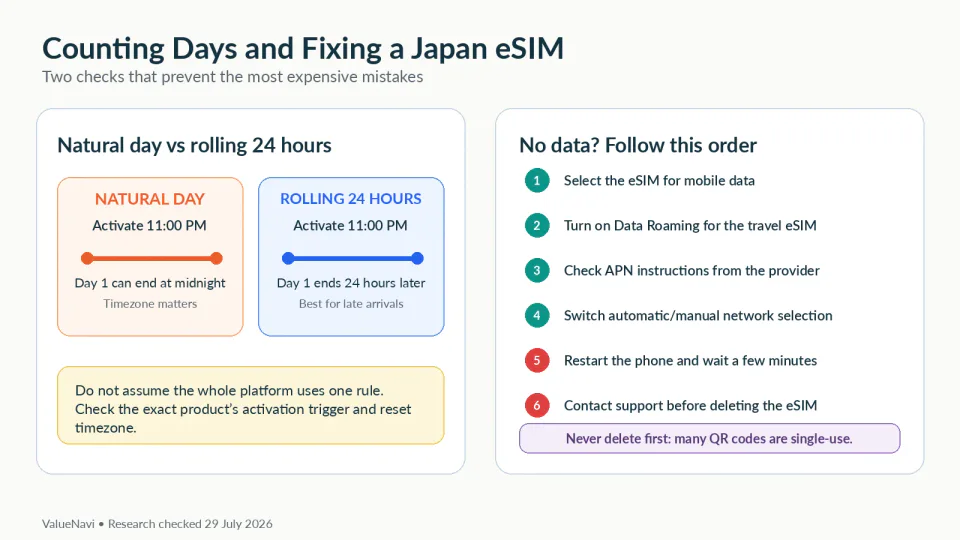
Late arrival changes the clock, not the required gigabytes
A traveller landing at 23:30 can have the correct allowance and the wrong validity structure. Airalo’s unlimited policy defines each daily allowance as a rolling 24-hour period from activation; other marketplace daily-data products can use different rules. Fixed-data plans can have another validity trigger again.
Use the late-arrival validity guide when the trip starts near midnight. Data sizing and time counting are separate decisions.
Final decision
Choose a small total pool or around 1GB/day when mobile data is mainly maps, messages and tickets and you actively move bulk media to Wi-Fi.
Choose around 2GB/day when ordinary daily media use is heavier but still consistent.
Choose 10–20GB total when the trip has light days and burst days. This is the most flexible structure for many first-time itineraries.
Choose unlimited when repeated heavy days—not one isolated upload—make a total pool inconvenient. Then compare the high-speed threshold and fallback.
Most importantly, never compare “1GB” products until you know whether that means 1GB total or 1GB per day. That unit check prevents a bigger mistake than choosing the wrong provider logo.
References
Airalo — fixed data and validity · Airalo — Unlimited Fair Use Policy · Saily — Japan plans · Klook — Japan eSIM listing 109393. Checked August 25, 2026. Package structures and fair-use rules can change; verify the exact SKU before payment.