
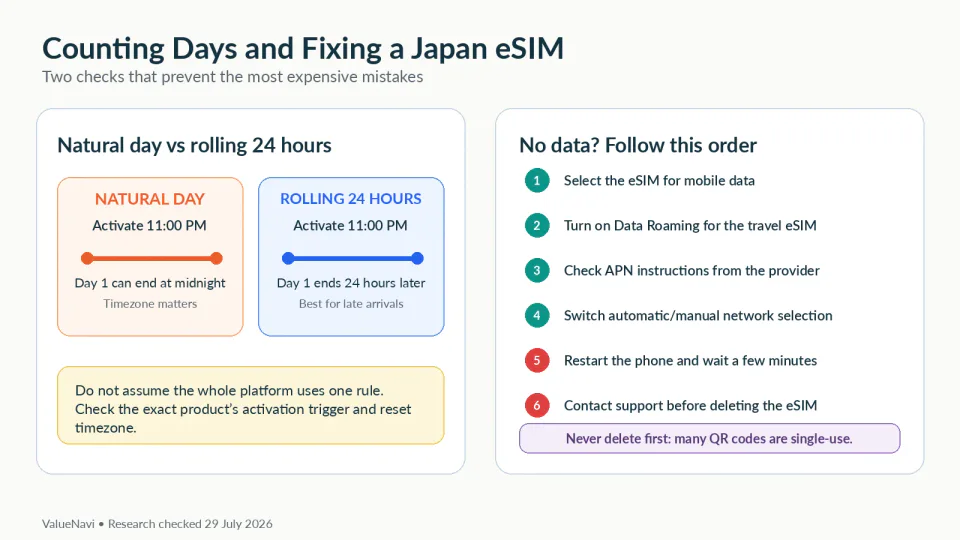
Do not assume a Japan eSIM activated at 11:15 p.m. automatically “wastes Day 1.” That only happens when the exact product counts a day by calendar date or another natural-day rule. Airalo’s current unlimited policy, for example, defines its daily high-speed allowance as a rolling 24-hour period from activation, so a late-night activation does not reset at midnight. Other marketplace products can use different clocks. The correct late-arrival question is therefore: what exactly starts validity, and what exactly resets at midnight?
The “11 p.m. trap” is real for some products and irrelevant for others. Verify the clock before trying to save a day.
There are four clocks, not one
↔ Scroll table left or right
Clock | Question to answer | Why it matters at 23:30 |
Installation | Does adding the profile start anything? | Some products can be installed early; some packages may start validity at installation |
Activation | What event makes the plan live? | First supported-network connection is common but not universal |
Overall validity | When do the purchased 7/15/30 days expire? | A rolling period behaves differently from a calendar-day count |
Daily high-speed reset | When does 1GB/day, 3GB/day or another bucket refresh? | The daily bucket can have a separate timing rule from overall validity |
Do not collapse those clocks into the word “activation.” The rebuilt installation guide separates them before travel; this page decides what to do when the flight arrives late.
Airalo unlimited is the clearest example of why midnight assumptions fail
Airalo’s current unlimited fair-use policy says its default high-speed allowance is 3GB per 24-hour period beginning when the eSIM is activated. After 3GB, speed is reduced to 1Mbps for the rest of that 24-hour period; the allowance resets every 24 hours from activation.
If an Airalo unlimited package following that default is activated at 23:15, midnight is only 45 minutes later—but the high-speed window does not reset merely because the local date changes. Its 24-hour cycle is tied to activation time.
This does not prove every Airalo product has the same overall validity trigger. Airalo explicitly says validity policy is package-specific: most begin when connected to a supported network in the coverage area, while some may begin at installation. The exact package still controls.
Klook listing 109393 starts use on overseas-network connection—but do not invent its reset rule
Klook’s current Japan listing 109393 says the eSIM can be installed before the trip and that data usage and validity begin when the eSIM connects to an overseas network. It also sells “data per day” packages and publishes 10GB/day at full speed before 128kbps for its unlimited tier.
What the currently surfaced product page does not clearly state in the same way is a universal midnight-versus-rolling reset rule for every daily package. That uncertainty should remain uncertainty. Do not convert “10GB/day” into “resets at Japan midnight” unless the selected package or seller instructions actually say so.
This is a useful buying rule: if the reset clock is material to a late arrival and the listing does not define it, ask support before payment.
Saily adds a different risk: the purchase-to-activation window
Saily’s current Japan page says its data plan activates automatically when you arrive, provided the Saily eSIM is enabled and roaming is on. It also states that all plans have a 30-day activation period and will be automatically activated if not activated within that window.
For a flight arriving at 23:30, the most important question is not necessarily “does midnight waste a day?” It can be “did I buy this too early?” A traveller purchasing far in advance can create an activation-calendar problem before the flight even departs.
That is why late-arrival planning begins at checkout, not at immigration.
The 11 p.m. trap only matters when waiting is safe
Suppose your exact product truly counts natural/calendar days and connecting at 23:40 would consume most of Day 1. Waiting until after midnight can preserve value—but only if connectivity is not operationally important during those 20 minutes.
Waiting is reasonable when:
you are staying at an airport hotel with a simple indoor route;
the hotel address and route are saved offline;
airport Wi-Fi remains reliable;
no last train/bus, taxi app or hotel message depends on mobile data.
Activate immediately when:
you are chasing a final train or bus;
the hotel transfer is complicated;
a rental-car pickup or rural drive starts immediately;
two travellers are splitting tasks;
you need airline, hotel or transport updates.
Saving one paid day is a poor trade if it increases the chance of missing the final transport connection.
Use “landside with bags” time, not scheduled landing time
A 22:40 scheduled landing is not a 22:40 eSIM decision. Taxiing, immigration, baggage and customs all occur first. The relevant timestamp is when you are landside with your luggage and ready to move.
This mirrors the same logic used in the rebuilt Narita late-arrival and Haneda late-arrival guides: transport risk is determined by the time you can actually act, not the time printed on the flight schedule.
For eSIM validity, that means a flight scheduled for 22:00 can become a 23:45 activation decision after a slow arrivals process.
Three arrival windows
Before about 21:00 landside: use the eSIM normally. Live data has several useful hours before the hotel, so sacrificing connectivity to optimise validity rarely makes sense.
About 22:30–23:59 landside: inspect the exact clock. This is where calendar-day products can become inefficient and rolling-24-hour products show their advantage. Decide from the onward transfer, not from the instinct to “save Day 1.”
After midnight: the midnight question disappears, but transport risk usually increases. Activate if live data helps navigate the reduced late-night options unless the route is already fully offline-safe.
These are ValueNavi planning windows, not provider cutoffs.
The departure day can cost more than the arrival night
Travellers often optimise the first 45 minutes and forget the final eight hours. A plan that expires before the airport journey can remove live rail disruption information, navigation, airline updates and taxi/rental-car communication when they matter most.
Count validity from the first moment mobile data is operationally useful to the last moment you still need it. If an extra day costs little, preserving the departure transfer can be worth more than shaving a partial arrival night.
I would keep active data through departure when any of these apply:
evening flight after city sightseeing;
intercity train before the airport;
rental-car fuel/return/navigation;
tight terminal or connection timing;
weather or rail-disruption risk.
Daily data and total validity can use different clocks
A product can have a seven-day overall validity and a separate daily high-speed allowance. Those two concepts should not be assumed to reset together.
This matters when comparing 1GB/day, 2GB/day, total-data and unlimited plans. The data structure can be correct while the reset timing is wrong for a late arrival.
Before payment, capture four phrases from the exact product:
validity starts when…
validity lasts…
daily allowance resets when…
unused daily data…
If one is missing and affects the trip, ask support rather than guessing.
If the clock starts earlier than expected, preserve evidence
If the app shows an unexpected validity start, screenshot:
the product’s stated activation/validity rule;
local time;
when the profile was installed;
when the line was enabled;
when roaming was enabled;
when the first Japanese network connection appeared;
the dashboard showing validity.
Do not repeatedly delete/reinstall the eSIM trying to change the clock. Contact support with a timeline. Some profiles cannot simply be re-scanned.
Final decision
Do not fear 11 p.m. automatically. First identify whether the product uses calendar/natural days, rolling 24-hour periods or another rule.
For rolling 24-hour products such as Airalo’s current unlimited fair-use cycle, midnight is not the daily reset. A 23:15 activation keeps its 24-hour relationship to 23:15.
For products whose reset timing is not clearly published, do not invent a midnight rule. Ask support if the answer changes how many days you need.
If waiting until midnight creates transport risk, activate now. Connectivity is bought to reduce travel friction; saving a small validity amount should not make the arrival itself less resilient.
References
Airalo — Unlimited Fair Use Policy · Airalo — package validity policies · Saily — Japan activation terms · Klook — Japan eSIM listing 109393. Checked August 25, 2026. Reset and validity rules can differ by exact package; recheck before purchase.