
For a normal 10–14 day Tokyo–Kyoto–Osaka trip, I would usually buy a fixed 10–20GB plan rather than choose a provider by its “unlimited” headline. Airalo and Saily are almost tied on ordinary fixed-data pricing, so the better choice comes down to activation, account preference and failure recovery. Saily becomes more attractive for sustained hotspot or heavy daily use because its current Japan unlimited plan publishes 5GB of high-speed data per 24-hour period before dropping to 1Mbps. Airalo’s current unlimited fair-use default is 3GB per 24 hours before 1Mbps. Klook can beat both for a specific use case, but only at the product-listing level: one current Japan listing gives 10GB per day at full speed before 128kbps and allows hotspot sharing, while another current Klook Japan eSIM explicitly says hotspot sharing is not supported.
That is the main ValueNavi verdict: Airalo vs Saily is a provider comparison; Klook is a SKU comparison. Do not transfer the rules from one Klook listing to another, and do not pay an unlimited premium until you know the high-speed threshold and the speed after it.
The 30-second decision
↔ Scroll table left or right
Your real requirement | Start with | Why | What can reverse it |
10–14 days, maps/messages/social media, under about 20GB total | Airalo or Saily fixed data | Current 20GB pricing is effectively tied; there is little reason to buy unlimited just for the label | Heavy video uploads, laptop tethering or several devices can justify an unlimited plan |
Already use Airalo in other countries | Airalo | Account continuity, top-ups and familiar installation can be worth more than a trivial price difference | Saily’s heavier daily high-speed allowance matters more than account familiarity |
Need sustained hotspot / laptop use | Saily unlimited | Current Japan plan publishes 5GB/day at high speed, then unlimited data up to 1Mbps; hotspot sharing is allowed | You regularly need more than 5GB at high speed in one day |
Need roughly 5–10GB of full-speed data on some individual days | Check Klook listing 109393 | Its current unlimited option publishes 10GB/day at full speed and hotspot support | After the threshold it falls to 128kbps, much lower than the 1Mbps fallback published by Airalo/Saily |
Buying through Klook because of a coupon or bundle | Freeze the exact listing first | Klook Japan eSIM products can have different suppliers, activation, hotspot and refund rules | A coupon does not compensate for a product that blocks tethering or has the wrong validity structure |
Buying more than a month before travel | Read activation rules before paying | Saily currently gives plans a 30-day activation window; some Klook products also impose a 30-day QR/voucher window | The exact plan may have different purchase-to-activation terms |
Fixed data first: Airalo and Saily are too close in price for price to decide the winner
Checked on August 25, 2026, Airalo’s Japan Moshi Moshi page listed 20GB for 30 days at US$25. Saily’s standard Japan page listed 20GB for 30 days at US$24.99. That is a one-cent difference. Airalo also listed a 20GB / 15-day option at US$24, so a 10–14 day traveller can save slightly by matching validity more tightly, but even that difference is too small to justify choosing a worse activation or support fit.
This matters because many eSIM comparisons make price look more decisive than it is. For an ordinary first Japan trip, a US$0.01 or US$0.99 difference is usually worth less than one failed activation at the airport, one missing hotspot feature or one plan that starts its clock earlier than expected.
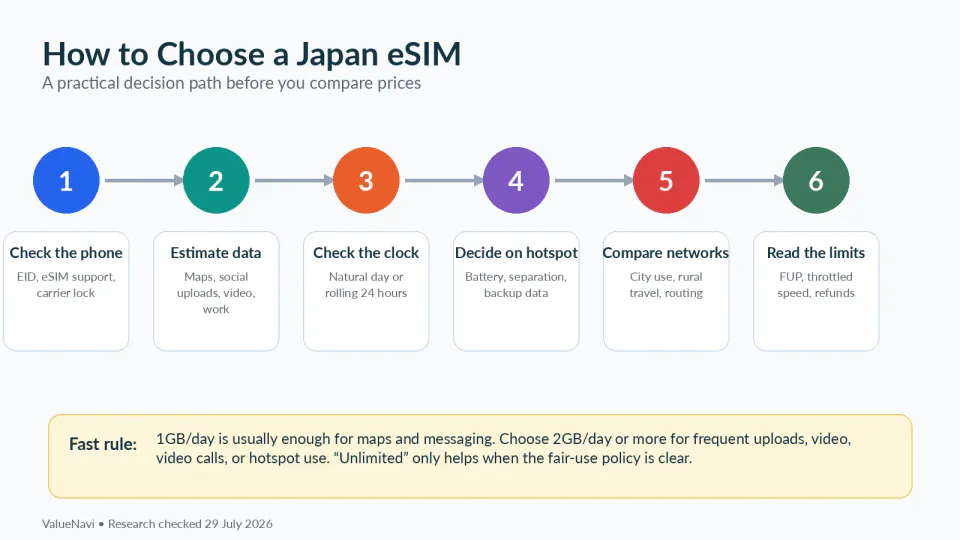
Use the Japan eSIM 1GB vs 2GB vs unlimited guide if you have not yet estimated usage. Once a fixed 10–20GB plan covers the trip, provider selection should move to the next layer rather than continuing to chase tiny headline savings.
Airalo: the strongest fit when account continuity and predictable first-connection activation matter
Airalo’s current Moshi Moshi 20GB / 30-day Japan plan is data-only, uses SoftBank and KDDI according to the product page, supports top-ups, and starts its validity when the eSIM connects to a supported mobile network in the coverage area. That means the profile can be installed before departure without the plan clock starting merely because it was installed outside Japan.
Airalo also supports personal hotspot when the device and network support it. Some devices may require the hotspot APN to be entered manually, so “hotspot supported” should not be interpreted as “zero setup on every phone.”
The strongest reason to choose Airalo is therefore not that it is universally cheaper or faster. It is that a traveller who already uses Airalo can keep one account, one support path, one top-up workflow and familiar installation behaviour across multiple countries.
Choose Airalo when: you already use it, a fixed 10–20GB plan is enough, you want a clearly published first-network-connection validity trigger, or the Japan leg is one part of a multi-country trip where account continuity matters.
Do not default to Airalo when: you expect to burn through more than 3GB of high-speed data on many individual days and are specifically choosing an unlimited product. Airalo’s current unlimited fair-use policy uses a default high-speed threshold of 3GB per 24-hour period, then reduces speed to 1Mbps for the rest of that period unless the exact package states a different threshold.
Saily: the stronger unlimited default when 5GB of high-speed data per day is actually useful
Saily’s normal fixed-data pricing is effectively tied with Airalo, so the more meaningful difference appears at the heavy-use end. Saily’s current Japan unlimited plan publishes 5GB per 24 hours without a speed limit, followed by unlimited data at up to 1Mbps. Saily also says hotspot sharing is available across its plans, including unlimited.
For a traveller uploading lots of photos and video, using a laptop for work or sharing data with another device, that extra 2GB of full-speed daily allowance versus Airalo’s default 3GB threshold can matter far more than a one-cent fixed-data price difference.
But Saily has an activation boundary worth knowing before an early purchase. Its current Japan page says plans have a 30-day activation period; if a purchased plan is not activated within that period, it is automatically activated. Saily’s help centre says that when the eSIM is installed before the trip and enabled correctly, the data plan starts automatically on arrival at the destination. If you buy unusually far in advance, do not assume the plan can sit unused indefinitely.
Choose Saily when: hotspot matters, you want the current 5GB/day high-speed unlimited structure, you prefer the app-led setup, or the 1Mbps post-threshold connection is a useful safety net for a heavy-use day.
Do not pay for Saily unlimited when: your actual Japan usage is maps, messaging, reservations and ordinary social media that fits comfortably inside 10–20GB total. In that case the unlimited premium is buying capacity you may never use.
Klook: do not ask “Is Klook eSIM good?” until you can name the listing
Klook is the easiest of the three to compare incorrectly because the marketplace contains different Japan eSIM products with different suppliers and rules. Two current listings show why a platform-level verdict is unsafe.
Klook listing 109393 currently advertises Japan coverage through SoftBank 5G for daily-data options and Docomo 4G LTE for total-data options. Its unlimited option publishes 10GB per day at full speed, then 128kbps, and it explicitly says hotspot sharing is supported. It also advertises immediate eSIM delivery, 24/7 support and a quality-guarantee/refund proposition before use or when problems occur under the listing’s terms.
Klook listing 39586 is a different product. It currently says Hotspot Sharing: No. Its activation QR and instructions may arrive within one day after booking confirmation, the QR/voucher has a 30-day activation window, and the listing warns that compatibility problems are not refundable. The QR can only be scanned once and the eSIM cannot be transferred to another device after scanning.
Those are not minor differences. One Klook product can be attractive for a hotspot-heavy traveller; another can be eliminated immediately by the same traveller. One can deliver immediately; another tells you to allow up to a day. One advertises a quality guarantee; another explicitly excludes compatibility-related refunds.
The useful Klook rule is therefore: take a screenshot of the exact listing title, selected data package, hotspot rule, high-speed threshold, post-limit speed, activation window and refund language before paying. If you cannot identify those fields, the coupon is not yet a valid reason to buy.
Unlimited is three different products here: 3GB, 5GB and 10GB are not the same promise
The word “unlimited” hides the most important number: how much full-speed data you receive before throttling.
↔ Scroll table left or right
Current unlimited structure checked Aug 25, 2026 | High-speed allowance | After threshold | Best fit |
Airalo unlimited fair-use default | 3GB per 24 hours | 1Mbps | Moderate daily use, existing Airalo user, wants a usable reduced-speed fallback |
Saily Japan unlimited | 5GB per 24 hours | Up to 1Mbps | Heavier hotspot, uploads and laptop use |
Klook listing 109393 unlimited | 10GB per day | 128kbps | Very high burst use where staying under 10GB matters more than the fallback |
This creates a trade-off most provider roundups miss. Klook’s 10GB/day threshold is the largest of these published allowances, but its 128kbps fallback is far slower than 1Mbps. If you normally use 6–8GB and then stop, that structure can be excellent. If you sometimes cross the threshold and still need navigation, bookings, messaging and ordinary browsing for the rest of the day, the 1Mbps fallback published by Airalo and Saily is materially more forgiving.
Do not infer real-world speed from the threshold alone; congestion, routing, device radio and local carrier conditions still affect performance. This comparison is about the published data shape, not a claim that one network is always faster everywhere in Japan.
Hotspot should be a veto question before it becomes a feature comparison
If two travellers will share one eSIM, a child’s tablet needs data, or a laptop is part of the trip, check tethering before price. Airalo’s help centre says personal hotspot is supported when the device and network allow it. Saily currently advertises unlimited hotspot sharing across its plans. Klook listing 109393 says hotspot sharing is supported; Klook listing 39586 says it is not.
That means a no-hotspot product should be deleted from the shortlist before you compare coupons, reviews or headline data. The same applies if hotspot exists but the high-speed allowance is too small for the second device.
For two independent adults, also ask whether sharing should happen at all. One large plan can be cheaper, but two smaller independent eSIMs avoid a single point of failure when the pair separates in a station, shopping district or theme park. The Japan eSIM hotspot guide for two people covers that trade-off in more detail.
Activation rules can matter more than price for a late arrival or an early purchase
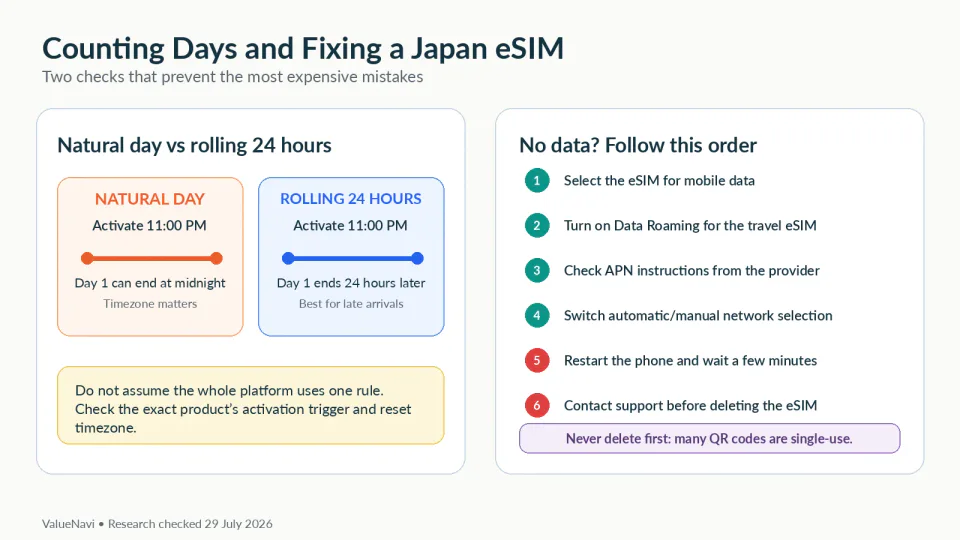
Activation is not one universal eSIM rule. Airalo’s current Moshi Moshi product says validity starts when it first connects to a supported network in Japan. Saily says a correctly installed plan activates automatically on arrival, but also gives purchased plans a 30-day activation window before automatic activation. Klook’s older listing 39586 imposes its own 30-day QR/voucher timing and single-scan rule.
For a traveller landing close to midnight, this matters because a plan that starts on first network connection behaves differently from one whose validity can be affected by a purchase-to-activation deadline. For someone buying two months before the trip, it matters even more.
Use the Japan eSIM installation guide before departure, and the late-arrival validity guide if the first night crosses midnight. Do not discover the activation clock while standing in the airport arrivals hall.
Refund rules show another reason Klook must be judged product by product
Failure recovery is part of the product.
Airalo’s current refund framework allows eligible refund requests through the account or support. Its July 2026 terms say the consumer withdrawal right expires on the earlier of 14 days after purchase or activation; technical failures attributable to Airalo can qualify for replacement or refund under stated conditions. Airalo’s help centre also distinguishes wrong-purchase/changed-plan cases from technical failures in the refund method offered.
Saily currently says a plan that has not been installed or activated can receive a full refund within 30 days of purchase. Once installed and activated, it is treated as used, although partial or full refunds may still be considered for Saily-related quality issues or when more than 99% of the plan remains unused.
Klook cannot be summarised with one refund sentence. Listing 109393 advertises a quality guarantee and refund proposition; listing 39586 explicitly warns that eSIM compatibility problems are not refundable. That is a product-level risk difference, not merely customer-service wording.
The practical rule is simple: check compatibility before installation and save screenshots of the checkout terms. A refund policy cannot rescue a phone that was never eSIM-compatible if the listing excluded that case.
Four traveller profiles: what I would actually choose
1. Ten-day first Japan trip, normal phone use
Choose a fixed 10–20GB Airalo or Saily plan. I would not pay for unlimited unless your own usage history shows a reason. At current standard pricing, the fixed-data price gap is too small to matter. Pick the app, activation behaviour and support flow you prefer.
2. Two-week trip with daily photo/video uploads and occasional laptop work
Start with Saily unlimited. The current 5GB/day high-speed allowance plus 1Mbps fallback is a more useful shape than Airalo’s default 3GB/day for sustained heavy use. Recheck the live Airalo package before buying because Airalo says an exact package may publish a different threshold from the default policy.
3. Creator or heavy user who needs 6–10GB at full speed on some days
Check the exact Klook 109393 unlimited SKU. The 10GB/day full-speed allowance is the largest of the three structures compared here. But treat 128kbps after the threshold as a hard trade-off; if you frequently cross 10GB and still need meaningful data afterward, the product shape becomes much less attractive.
4. Two travellers who will often split up
Buy two independent fixed-data eSIMs unless one person genuinely needs to provide hotspot all day. The modest saving from sharing one big plan is usually not worth turning one phone’s battery, signal and location into a dependency for both people.
Voice and SMS: do not assume a travel-data eSIM replaces a Japanese phone line
The Airalo Moshi Moshi product used in this comparison is data-only. Klook listing 109393 is also data-only. Saily’s standard Japan data plans are data plans; Saily separately advertises phone-number, SMS and calling products. If you need a Japanese number for voice calls or SMS verification, make that a separate buying requirement rather than assuming it comes with the data package.
For most tourists, LINE, WhatsApp, iMessage, FaceTime and other VoIP apps cover communication. But a hotel, restaurant or local service that insists on a conventional phone call is a different problem from mobile data.
Final verdict: compare the failure you cannot tolerate
Normal 10–14 day city trip: Airalo or Saily fixed data. The current price difference is too small to justify overthinking it.
Existing Airalo user: Airalo is rational when account continuity and first-network-connection validity are worth more than squeezing out another daily high-speed gigabyte.
Heavy hotspot / laptop use: Saily unlimited is the stronger default because the current Japan product publishes 5GB/day high speed before a 1Mbps fallback.
Very high daily burst use: Klook listing 109393 can be compelling at 10GB/day full speed, but the 128kbps fallback is the cost you accept.
Klook buyer: never buy “a Klook eSIM.” Buy one exact listing after checking hotspot, data threshold, fallback speed, delivery timing, activation window and refund language.
The deletion test for this comparison is simple: if two plans cost almost the same, the winning question is no longer “which brand is cheaper?” It is which plan fails least badly when your actual usage, arrival time or device setup stops matching the ideal case.
Compare current Airalo Japan eSIM packages
Compare current Saily Japan eSIM packages
Check the current Klook Japan eSIM listing
References and verification date
Checked August 25, 2026. Airalo Japan Moshi Moshi plans · Airalo unlimited fair-use policy · Airalo hotspot help · Saily Japan plans · Saily refund policy · Klook Japan eSIM listing 109393 · Klook Japan eSIM listing 39586. Prices, promotions and product terms can change; recheck the exact plan and checkout terms before purchase.
Hakone vs Kawaguchiko: Which Is Better for Your First Japan Trip?
Aso Day Trip or Overnight: Which Fits a 4-Day Kumamoto Trip?
Niseko vs Rusutsu: Which Ski Resort Is Better for Your Hokkaido Trip?
35 Best Things to Do in Osaka 2026: What’s Worth Your Time by Area, Budget and Trip Style
Does Your Phone Support a Japan eSIM? Model, EID and Carrier-Lock Checks