
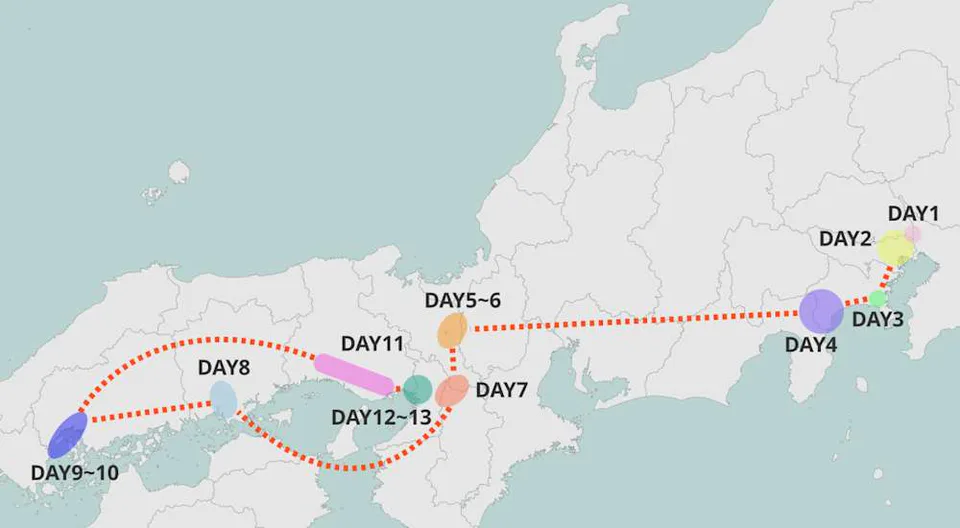
For a first Japan trip, 12 days is still the easiest length to recommend—but not because it supports a longer checklist. Ten days is enough for a strong Tokyo–Kyoto/Kansai spine. Twelve days lets you add one experience block without hollowing out the two core regions. Fourteen days is where a third region such as Hiroshima/Miyajima becomes much easier to justify, or where Disney and USJ can both fit without quietly stealing the days you thought belonged to Tokyo and Kyoto.
The important correction is that 10, 12 and 14 days should not be treated as three fixed itineraries. The answer changes with your arrival and departure airports, how many full days have already been claimed by theme parks or day trips, and how many hotel changes you are willing to absorb. The extra two days should buy a function—depth, a different overnight experience, a third region, or a cleaner departure—not merely another pin on the map.
↔ Scroll table left or right
Trip length | ValueNavi default | What the extra time should buy | Main overplanning risk |
10 days / 9 nights | Two-region spine: Tokyo + Kansai | Enough depth to experience both properly | Adding Fuji, Osaka hotel, Nara overnight and Hiroshima because each looks “close enough” |
12 days / 11 nights | Tokyo + Kansai + one deliberate experience block | Hakone/Fuji overnight, real Osaka time, Disney/USJ recovery, or another depth day | Spending both new days on two new check-ins |
14 days / 13 nights | Tokyo + Kansai + one additional region, or a slower two-region trip | Two-night Hiroshima/Miyajima block, both theme parks, or more regional depth | Assuming two weeks means five or six hotel bases are automatically comfortable |
ValueNavi First-Trip Compression Score
The same 12 calendar days can feel spacious or rushed. To make that difference measurable, ValueNavi scores the itinerary shape, not the destination list. The score weights usable-day retention 30%, base efficiency 25%, one-way route progression 20%, recovery/weather buffer 10%, capacity for fixed commitments 10%, and luggage resilience 5%.
Scenario | Score | Interpretation |
|---|---|---|
10 days: Tokyo 4N + Kyoto/Kansai 5N | High retention: almost every move advances the national route. | |
10 days: Tokyo + Disney + Fuji + Kyoto + Osaka + Hiroshima | Too many fixed blocks and bases for the available useful days. | |
12 days: Tokyo + Kansai + one Hakone/Fuji experience block | The extra two days buy a new experience without hollowing out the core cities. | |
12 days: five hotel bases because every side trip becomes an overnight | The nominal extra time is converted into repeated check-out/check-in friction. | |
14 days: open-jaw + two-night Hiroshima block | A third region earns its place because the route keeps moving in one direction. | |
14 days: round-trip Tokyo + five bases + Disney + USJ | Still possible, but the return east and multiple fixed days consume much of the two-week advantage. |
The score is an editorial planning model, not an official tourism rating. A low score can still be correct if one overnight or theme park is a top reason for the trip; it simply makes the trade-off visible.
ValueNavi Compression Load: how a 12-day trip becomes an 8-day-feeling trip
Use this simple pressure model:
Compression Load = fixed full-day commitments + 0.5 × hotel changes + 0.5 × transfer-heavy days
Then divide that load by the number of usable sightseeing days after your real arrival and departure constraints are removed:
Compression Ratio = Compression Load ÷ usable sightseeing days
↔ Scroll table left or right
Compression Ratio | ValueNavi read | What to do |
Below 0.45 | Resilient | You still have enough flexible days to absorb weather, fatigue or one changed booking. |
0.45–0.70 | Conditional | Keep the route, but stop adding hotel bases or hard reservations. |
Above 0.70 | High compression | Delete a fixed day, combine bases or remove a side trip before adding another destination. |
These thresholds are ValueNavi editorial thresholds. A “hotel change” receives half weight because it rarely consumes a whole day, while a Disney/USJ/event day receives full weight because the day has already been assigned a job.
ValueNavi Base-Change Tax: a hotel move must repay itself
A base change has five components: packing, checkout constraint, loaded transit, orientation from a new station, and the next check-in constraint. Do not count only the Shinkansen ride.
I treat a move as productive only when it does at least one of three jobs already used in this guide: advance the national route, unlock hours a day trip cannot reproduce, or solve the next departure. If it does none of those, the Base-Change Tax is being paid for decoration rather than itinerary value.
This is the reason two extra days do not automatically justify two extra hotels. A 12-day trip with one meaningful ryokan night can be less compressed than a 14-day trip that repeatedly changes hotels for destinations that work as day trips.
Start with the flight shape, not the attraction list
Before allocating a single hotel night, write down the international arrival airport and departure airport. A Tokyo-in / Kansai-out open-jaw trip behaves very differently from a round trip through Tokyo.
Tokyo in, Kansai out: this is the cleanest first-trip shape for a Tokyo-to-Kyoto/Osaka route. Every major hotel move can continue west. An Osaka final night can also perform two jobs when it gives you an Osaka evening and a cleaner Kansai Airport departure.
Tokyo in, Tokyo out: the same destinations can still work, but the itinerary must pay for the return to Tokyo. A western extension therefore needs a higher burden of proof. Adding Hiroshima because “there are 14 days” is less attractive if you then cross the country again for the flight home.
Kansai in, Tokyo out: simply reverse the national spine rather than preserving a Tokyo-first template. Kyoto/Osaka can come first, then the trip moves east.
This is one reason generic day-by-day itineraries can mislead. Two travellers with the same number of nights but different flight endpoints do not have the same usable route.
Count usable days after subtracting the days that already have a job
A “12-day Japan trip” is often 11 hotel nights, and not all 12 calendar dates are equal. A 19:30 international arrival may create little more than airport transfer, dinner and sleep. A 10:00 departure can erase the final sightseeing day. Jet lag can make the first morning unusually useful—or make an ambitious first evening unrealistic.
Then subtract fixed full-day commitments:
Tokyo Disney day
USJ day
Nikko or other long day trip
fixed event, concert or sports day
a transfer that genuinely consumes most of the useful daylight
If a 10-day trip has a late arrival, an early departure, Disney and USJ, it no longer has the same city capacity as a 10-day itinerary with nine flexible sightseeing nights. Do not cut Kyoto from four useful days to two merely because the calendar still says “10 days.”
If Disney is already part of the plan, use 1 or 2 Days at Tokyo Disney? before finalising the national route. If the real uncertainty is Tokyo itself, use How Many Days in Tokyo?.
Use a hotel-change budget: every move needs a job
The biggest hidden cost in a first Japan trip is not the Shinkansen. JR Central currently lists Tokyo to Kyoto at about 130 minutes by Tokaido Shinkansen, which makes the national spine unusually efficient. The more common self-inflicted cost is repeatedly checking out, moving luggage, waiting for the next check-in and rebuilding the route from a new station.
I would use a simple test: every hotel change must do at least one of these three jobs.
Advance the national route. Tokyo → Kyoto is productive because the trip has genuinely moved west.
Unlock time that a day trip cannot reproduce. A ryokan dinner, private onsen, early temple morning or quiet island evening can justify one night.
Solve the next departure. A final Osaka/Namba night can make sense when it also fixes a KIX morning.
If the move does none of those things, it is probably a decorative hotel change. “We wanted to sleep in Osaka once” is weak when Osaka works as a day/evening trip from Kyoto. “USJ + late Namba + KIX the next morning” is much stronger because the Osaka hotel removes several separate problems.
As an editorial ceiling rather than a rule, I would usually keep a 10-day first trip to two main bases, a 12-day trip to roughly two or three, and a 14-day trip to roughly three or four. More can work, but every extra base should face a higher burden of proof.
10 days: protect the Tokyo–Kansai spine
For 10 days / 9 nights, the most resilient first-trip structure is still two core regions. A simple version is Tokyo 4N → Kyoto/Kansai 5N. Osaka and Nara can be day or evening branches instead of compulsory hotel changes.
The point is not that Fuji, Hakone or Hiroshima are “not worth it.” The point is opportunity cost. A one-night side trip does not consume only one night. It also creates a packing event, a transfer, luggage decisions and another check-in. On nine hotel nights, those edges occupy a larger share of the holiday.
When I would break the two-base rule: the overnight itself is a top-three reason for the trip. A Hakone ryokan with dinner and onsen is a fundamentally different product from another Tokyo hotel night. If that experience outranks one Tokyo or Kyoto day, include it deliberately and cut something else.
When I would not: the only reason is “we should see Mount Fuji too.” Fuji visibility is weather-dependent, and a short itinerary should not sacrifice a whole core-city day merely to collect another destination name.
Nara usually does not require another hotel. The Nara day-trip guide shows how the core sights fit into a day, while the Nara overnight decision sets a higher bar for moving the room.
12 days: the extra two days should buy one coherent upgrade
Twelve days is my default recommendation because the extra two days can change the type of trip rather than merely lengthen it. But I would not automatically use both days to create more destinations.
Choose one of these upgrades:
Experience upgrade: one Hakone or Kawaguchiko overnight plus one extra depth/buffer day.
Kansai upgrade: keep Kyoto strong and give Osaka one or two nights because USJ, nightlife or KIX now gives the second base a real job.
Tokyo upgrade: keep the added days in Tokyo when Disney, a major day trip or fixed events have already consumed city time.
Slow-travel upgrade: do not add a new base at all; use the extra days to reduce back-to-back long days and make weather changes easier.
A common twelve-day mistake is Tokyo 4N → Kawaguchiko 1N → Hakone 1N → Kyoto 3N → Osaka 2N. It looks varied, but both extra days have been converted into extra packing and mountain transfers while Kyoto loses depth. Unless both Fuji-area stays are the purpose of the holiday, choose one.
Hakone and Kawaguchiko are not interchangeable one-night slots
They can both add a mountain/Fuji-area night, but they interact differently with the national route.
Hakone is structurally easier to place between Tokyo and Kyoto. Odawara Station is the rail gateway to Hakone and also has Tokaido Shinkansen platforms. That means a Tokyo → Hakone → Kyoto sequence can continue west through Odawara rather than requiring a return to central Tokyo.
Kawaguchiko is a stronger choice when the Fuji-view objective itself wins. But it is not on the Tokaido Shinkansen. One current westbound option is the Fujikyu highway bus between Kawaguchiko and Mishima, then a Shinkansen connection. That can work well, but it is a more timetable-sensitive transfer than leaving Hakone through Odawara.
This is derived itinerary logic, not a claim that Hakone is “better.” If a lakeside Fuji view is one of the trip’s main goals, Kawaguchiko can easily justify the extra transfer. If the overnight is mainly there to add an onsen/ryokan pause while moving toward Kyoto, Hakone usually fits the route more cleanly.
Use Hakone vs Kawaguchiko to make that choice before reserving both.
14 days: add a third region only when it gets two useful nights
Fourteen days is where Hiroshima and Miyajima become much easier to add. A reasonable starting point is Tokyo 4N → one Fuji/Hakone night → Kyoto 4N → Hiroshima 2N → Osaka 2N, especially on a Tokyo-in / Kansai-out trip.
The important part is the two-night block, not Hiroshima’s name. One night can turn Hiroshima into an arrival afternoon followed by a hurried Miyajima day and immediate departure. Two nights give the city and island separate breathing room and make the long westward move earn more value.
But two weeks does not automatically mean Hiroshima should be added. The recommendation reverses when:
Disney and USJ already consume two complete days;
the international flight is round-trip Tokyo and the western extension creates major backtracking;
Kyoto is a primary interest and would fall below roughly three useful sightseeing days;
the group is travelling with young children or several large bags and already has four hotel moves;
the extra four days would be more valuable as Tokyo/Kansai depth, a ryokan night and weather flexibility.
Before protecting Hiroshima nights, use Is Hiroshima Worth Visiting on a First Japan Trip? and then test the actual block with the Hiroshima + Miyajima 2-day itinerary.
Kyoto and Osaka should not receive equal nights by default
Kyoto and Osaka are close enough that the decision is not “which city deserves 50%?” It is which hours are difficult to commute into or out of.
Kyoto gains unusual value from early mornings and from being able to end an evening around Gion, Higashiyama or central Kyoto without returning across Kansai. Osaka gains value from late food/nightlife, USJ, repeated Osaka-side rail days and a Namba-oriented KIX departure.
On a 10-day trip, one Kyoto/Kansai base is often enough. On 12 or 14 days, an Osaka hotel becomes more compelling when it deletes at least two costly crossings—for example USJ + late Osaka evening, or USJ + KIX departure. Use Kyoto vs Osaka rather than splitting nights symmetrically.
Theme parks change the national itinerary more than many side trips
A Disney or USJ day is not “extra evening entertainment.” It is a full operating day that occupies one of the limited high-energy blocks in the trip.
10 days + Disney: keep the rest of the route simple. Tokyo + Kansai still works, but adding both Fuji and Hiroshima becomes difficult without sacrificing core city time.
12 days + Disney or USJ: one theme park is easy to absorb. Both are possible, but the extra two days have effectively been spent; do not also assume a Fuji overnight is free.
14 days + Disney + USJ: the two-week length restores flexibility, but Hiroshima still needs to compete with the city days that the parks replaced.
This is why “How many days?” should be answered after fixed commitments, not before them.
Large luggage changes how many bases are comfortable, not which cities are interesting
Travellers often diagnose the wrong problem. They say they dislike changing hotels when what they actually dislike is moving two 28- or 29-inch suitcases through stations.
Luggage forwarding can make Tokyo → Kyoto or Kyoto → Osaka/Hiroshima much easier, but it does not erase every cost of a hotel move. You still have checkout timing, a day bag, check-in and a new local route. Use forwarding to support a geographically sensible move—not to justify five bases that would otherwise be unnecessary.
For a family or older traveller, I would lower the base count before cutting the trip length. A 14-day trip with three bases can feel easier than a 10-day trip with four.
Three sample frameworks—not three mandatory itineraries
10 days / 9 nights: core first trip
Tokyo 4N → Kyoto/Kansai 5N. Use Osaka and Nara as branches. Best for first-time visitors who want the lowest hotel-change friction. Add a one-night Hakone stay only if the ryokan/onsen experience is important enough to replace one core-city night.
12 days / 11 nights: one meaningful upgrade
Tokyo 4N → Hakone 1N → Kyoto 4N → Osaka 2N is coherent when Hakone provides the experience change and Osaka has a real job such as USJ, nightlife or KIX. If Osaka does not have that job, keep more nights in Kyoto instead. If Kawaguchiko replaces Hakone, recalculate the onward transfer rather than copying the same times.
14 days / 13 nights: third-region version
Tokyo 4N → Hakone/Fuji 1N → Kyoto 4N → Hiroshima 2N → Osaka 2N works best when the trip keeps moving west and the departure airport supports that shape. If the flight returns from Tokyo, test whether Hiroshima’s two nights still justify the extra national backtracking. If not, spend the four extra days on Tokyo/Kansai depth, theme parks or a slower regional overnight.
Red-team the route before booking non-refundable hotels
Ask these five questions:
If Fuji is hidden by cloud, does the mountain overnight still have value? Hakone may still have onsen/ryokan value; a Fuji-view-led Kawaguchiko stay needs a stronger weather backup.
If a child or older traveller is exhausted on Day 5, which transfer is easiest to delete? If the answer is “none,” the route is too brittle.
Does every hotel change either move the route, unlock special hours or solve a departure? If not, delete one.
Have Disney/USJ already consumed the extra days that made 12 or 14 days look generous?
Does the flight itinerary force you to backtrack across Japan at the end? If yes, compare an open-jaw flight before adding another western city.
A strong first trip is not the route with the most famous names. It is the route whose expensive days still work when the weather, energy level or one reservation changes.
Final verdict: what should 10, 12 or 14 days actually buy?
Choose 10 days when you want Tokyo and Kansai to feel like destinations rather than transit stops. Keep the base count low and make any overnight side trip replace something.
Choose 12 days for the best all-round first-trip balance. Use the extra two days for one coherent upgrade: a Hakone/Fuji experience block, meaningful Osaka time, a theme-park commitment or simply more depth and recovery. Do not automatically spend both days creating two new hotel moves.
Choose 14 days when a third region genuinely deserves at least two useful nights, or when Disney/USJ and other fixed days would otherwise cannibalise Tokyo and Kyoto. Hiroshima/Miyajima is a strong extension when the national route keeps moving west; it is less automatic when you must return to Tokyo for the flight home.
The recommendation reverses whenever one destination is the actual reason you are going to Japan. Build around that purpose first. The 10/12/14-day framework is there to protect the trip from unnecessary movement, not to force every first-time visitor through the same checklist.
Continue planning
How to Plan a Trip to Japan for the First Time · How Many Days in Tokyo? · Hakone vs Kawaguchiko · Kyoto vs Osaka · Japan Luggage Forwarding Guide
References
JR Central — Tokyo to Kyoto by Tokaido Shinkansen · JR Central — current Tokaido Shinkansen timetable · Hakone Navi — Odawara Station and Shinkansen connection · Fujikyu Bus — Kawaguchiko–Mishima highway bus. Checked August 26, 2026. Timetables, flight schedules and operating conditions can change; verify the actual travel dates before locking non-refundable bookings.