
Plan a first Japan trip in dependency order, not attraction order. Fix four structural decisions first: your usable trip length, the regions that genuinely fit, the airport pair, and the number of hotel bases. Only then choose luggage strategy, long-distance transport, timed reservations and flexible attractions. The reason is simple: a bad attraction choice wastes a few hours; a bad airport or hotel-base choice can force days of backtracking.
For most first trips, seven calendar days should behave like one-region travel, ten days can support Tokyo plus Kansai, twelve days can absorb one deliberate extension, and fourteen days can justify a third region such as Hiroshima if it adds a different experience. These are planning thresholds, not rules. What matters is how many usable days remain after arrival, departure, hotel moves and full-day commitments such as Disney or USJ.
The 30-second planning order
↔ Scroll table left or right
Decision | Lock it when | Why it comes before the next step |
1. Usable days | Flights or date window are known | Calendar length overstates sightseeing capacity |
2. Region structure | You know the trip’s main purpose | Every extra region creates a transfer and usually another luggage decision |
3. Airport pair | Region direction is clear | Open jaw can delete a return journey; round trip can be cheaper if the route is compact |
4. Hotel bases | Daily geographic jobs are visible | The base determines repeated mornings, evenings and station friction |
5. Luggage | Hotel moves are fixed | Forwarding, storage and overnight bags change how painful those moves are |
6. Long-distance tickets / passes | The actual route exists | A pass should serve the itinerary, not create it |
7. Hard reservations | Each day has one geographic job | Timed tickets can otherwise split a day across the city |
8. Flexible attractions | The skeleton is stable | These are the easiest pieces to move or delete |
First calculate usable days, not calendar days
A seven-night booking does not automatically create seven sightseeing days. Arrival and departure days are edge days: immigration, luggage, airport transfer, hotel check-in, rental return or airport buffers consume part of them. A hotel-change day is also not equivalent to a full city day.
Use three day types before building an itinerary:
Edge day: arrival or departure controls the clock.
Full city / regional day: no major hotel move; one geographic job can own the day.
Full-day commitment: Disney, USJ, a long rural excursion, skiing or another activity that effectively replaces a normal sightseeing day.
This classification prevents one of the most common first-trip errors: counting a 16:00 arrival, a Disney day and a morning Shinkansen transfer as if all three were ordinary Tokyo sightseeing days.
How much Japan should 7, 10, 12 or 14 days contain?
↔ Scroll table left or right
Calendar length | Strong starting structure | What usually breaks it |
7 days | Tokyo region or Kansai; two bases maximum if crossing regions | Tokyo + Kyoto + Osaka + Fuji treated as four equal stops |
10 days | Tokyo + Kyoto/Osaka, with one major optional commitment | Adding Hiroshima, Fuji overnight and two theme parks because each looks like “only one day” |
12 days | Tokyo + Kansai + one deliberate extension | Turning the extra days into extra checkouts rather than fuller city days |
14 days | Tokyo + Kansai + one third region when it changes the trip meaningfully | Four or five regions with repeated long-distance positioning |
If trip length itself is the unresolved decision, compare 10, 12 or 14 days for a first Japan trip before choosing hotels.
Step 1 | Choose a region structure by what you are willing to sacrifice
Tokyo, Yokohama, Kamakura and many Kanto day trips can orbit a Tokyo base. Kyoto, Osaka, Nara and Kobe form another natural Kansai cluster. Connecting Kanto and Kansai is reasonable; adding a third region is where the opportunity cost becomes visible.
Do not ask only, “Can Hiroshima fit?” Ask, “Which Tokyo or Kyoto day disappears if Hiroshima fits?” The same applies to Fuji, Hakone, Disney and USJ. A full-day addition is a replacement before it is an addition.
For a realistic Tokyo capacity check, use Tokyo Itinerary 2026: 4, 5 or 7 Days. If Tokyo itself has already been compressed into two useful city days, another day trip is no longer a free extra.
Step 2 | Use the change-cost test before you book anything
Some decisions are cheap to change later; others force several downstream changes. That difference should control booking order.
ValueNavi change-cost test: if changing one decision later would force you to change two or more of flights, hotel nights, long-distance tickets, luggage plans or hard reservations, treat it as a structural decision and settle it early.
↔ Scroll table left or right
Decision | Typical change cost | Planning treatment |
International airport pair | Very high | Set before non-refundable route-dependent bookings |
Tokyo vs Kyoto/Osaka night split | High | Set before choosing individual hotels |
Disney / USJ full day | High once ticketed | Reserve a whole day, then protect surrounding geography |
Shibuya Sky or a museum slot | Medium | Book after that day’s area is fixed |
Flexible shrine, street or shopping stop | Low | Leave until late |
This is why starting with a spreadsheet of 40 attractions feels productive but often creates rework. The low-cost decisions are being made before the high-cost ones.
Step 3 | Compare airport pairs as a trip-shape decision
If the route runs Tokyo → Kyoto/Osaka, an open-jaw ticket such as arrival in Tokyo and departure from Kansai can remove a return journey. But open jaw is not automatically better. Compare the total price difference against the Shinkansen backtrack, final-night hotel consequences, baggage allowance and departure time.
A same-airport round trip can still win when the airfare saving is large, the final Tokyo stay has value, or the route is mostly one region. Open jaw wins when it deletes a transfer you would otherwise make purely to reach the airport.
Hidden-cost rule: a cheaper flight is not cheaper if it creates an extra hotel move plus a long-distance transfer that has no sightseeing value.
Step 4 | Choose the hotel base by repeated use, not by the prettiest room
Choose the area before the hotel. A hotel is used every morning and every evening; a famous attraction may be visited once. That means repeated transport can outweigh a small nightly price saving.
In Tokyo, map where three or four important days begin and end. In Kansai, decide whether you value Kyoto’s early mornings or Osaka’s late evenings more. One Nara day does not normally justify moving hotels. One USJ day does not automatically require an Osaka base if the rest of the trip is built around Kyoto.
If Kansai is the unresolved base decision, use Kyoto vs Osaka: Where Should First-Time Visitors Stay?
When is a hotel move worth it?
A hotel move should have a job. For a first trip, I would normally require it to do at least one of these:
protect two valuable mornings or evenings that would otherwise be spent commuting;
remove one genuinely fragile early-flight or late-arrival transfer;
create an experience that cannot be reproduced as a day trip, such as a ryokan evening and early-morning onsen stay;
convert repeated two-hour round trips into local travel for several days.
If the move merely saves 20 minutes to one attraction, keep the original base. The checkout, luggage handling and check-in cycle can easily consume the apparent gain.
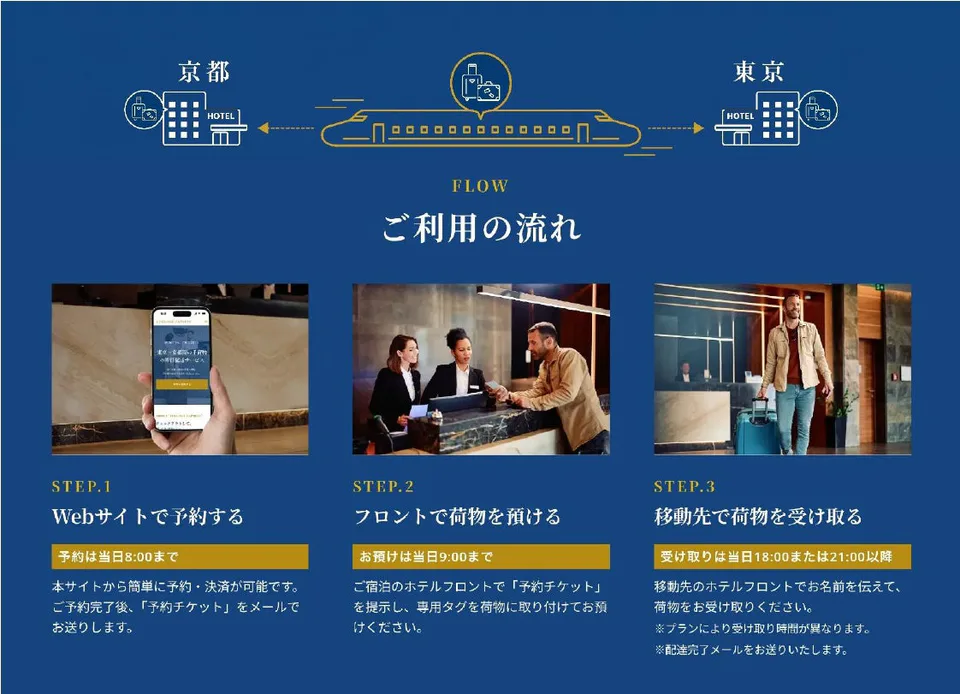
Step 5 | Plan luggage before deciding that every transfer is “easy”
Large luggage turns station changes into a different trip. The practical cost is not just carrying the suitcase on a train. It is elevators, station entrances, platform changes, storage before check-in and the loss of flexibility when you want to stop somewhere en route.
Use three patterns deliberately:
Carry everything: best when hotel moves are few and direct.
Forward the main suitcase: useful when the next hotel supports the service and you can tolerate delivery timing.
Forward ahead and keep one overnight bag: often strongest when inserting Hakone, Fuji or another short stay between major cities.
Luggage forwarding is not permission to add more hotels. It reduces the cost of a necessary move; it does not erase the move itself.
Step 6 | Price the route first; buy passes second
Do not start with “Which rail pass should I buy?” Start with the journeys you would take without a pass. Use ordinary city fares or an IC card as the baseline, list the expensive long-distance segments, then compare relevant regional or nationwide products.
The pass is wrong if it changes the route simply to make the arithmetic look better. A traveller who adds Hiroshima only because a pass is already paid for has turned a transport product into an itinerary manager.
For the Tokaido–Sanyo–Kyushu Shinkansen corridor, official Smart EX rules and products can change over time, so price the actual travel date rather than reusing an old screenshot or round-trip assumption. The durable planning rule is still route first, ticket product second.
Step 7 | Hard reservations need a geographic home
Once the trip skeleton is stable, add tickets that can actually control a day. Theme parks should usually own the day. Timed observation decks, museums, tours and dining reservations should sit inside a geographic cluster rather than forcing a cross-city sprint.
One-hard-anchor rule: on a normal city sightseeing day, let one reservation control the clock. A second timed booking is acceptable only when it is nearby and failure between them is unlikely.
This is especially useful in Tokyo. A morning reservation in Toyosu and a sunset slot in Shibuya can work if the middle is deliberately flexible. Add a third fixed booking in Ueno and the day stops being sightseeing and becomes timetable management.
Step 8 | Keep cheap-to-change attractions until the end
Neighbourhood walks, shopping streets, many shrines, cafés and flexible viewpoints are useful because they absorb weather, fatigue and delays. Do not destroy that flexibility by assigning a fixed attraction to every hour before the trip starts.
The final itinerary should contain intentional slack. If rain makes an outdoor block weak, you should be able to move a flexible museum or shopping area into that space without changing hotels or long-distance tickets.
Different travellers should start with different vetoes
↔ Scroll table left or right
Traveller | First veto | What that changes |
Parents with young children | Too many hotel moves | Use fewer bases even if one day has a longer train ride |
Two or more large suitcases | Transfers requiring repeated stairs / storage / check-ins | Forward bags or remove one base |
Disney or USJ is non-negotiable | Treating the park as a half day | Subtract a city day before adding anything else |
Early international departure | Fragile final-morning transfer | Let the last hotel base protect the flight |
Ski / Okinawa / Hokkaido road trip | Forcing the Golden Route | Build around the regional purpose from the start |
The Golden Route is a framework, not a requirement
Tokyo plus Kansai is a strong first-trip structure because it combines two distinct regions with straightforward long-distance travel. It is not a badge of completeness. If the purpose is skiing, Okinawa beaches, Hokkaido driving or Kyushu onsen, forcing Tokyo and Kyoto into the itinerary can make the trip worse.
The moment a trip has a clear primary purpose, that purpose outranks the generic first-timer checklist.
Red-team the itinerary before paying for the final tickets
Run five failure tests:
Late-flight test: if arrival is three hours later than planned, does Day 1 still work without losing a prepaid attraction?
Rain test: if one outdoor day moves, is there another day that can absorb it without breaking a hard reservation?
Luggage test: can every hotel move still work with the largest bags you are actually bringing?
Fatigue test: if one traveller needs a slow morning, which stop is explicitly deletable?
Departure test: is the final night positioned to protect the flight rather than squeeze in one last distant attraction?
If the itinerary fails three of these, do not solve it with tighter timing. Remove a hotel base, a full-day commitment or a distant side trip.
What to cut first when the plan is too full
Use this deletion order:
the extra hotel base that performs no unique job;
the side trip that duplicates something already in the itinerary;
the second hard reservation on an already fixed day;
the attraction added only because it is “nearby” on a map;
only then, a genuinely high-value city day.
This protects the parts of the trip you chose deliberately instead of shaving 30 minutes from every good day.
Final verdict
For a first Japan trip, the winning order is usable days → region structure → airport pair → hotel bases → luggage → long-distance transport → hard reservations → flexible attractions. The most expensive mistakes happen when this order is reversed: a hotel is booked before daily geography is known, a pass is bought before the route exists, or timed tickets force the traveller to cross a city repeatedly.
Seven, ten or fourteen days do not tell you how many places you should add. They tell you how much transfer friction the trip can survive. When the plan feels crowded, remove one source of structural friction before cutting the best part of every day.
Read next
Still choosing length? Compare 10, 12 or 14 days for a first Japan trip. For Tokyo, use the 4-, 5- and 7-day itinerary framework. For Kansai, settle Kyoto vs Osaka as the accommodation base before comparing individual hotels.
Sources and date-sensitive checks
Transport products and booking interfaces change even when the planning framework does not. Before purchase, recheck the official Smart EX reservation rules for the Tokaido–Sanyo–Kyushu Shinkansen, current IC-card availability, the relevant operator’s rail-pass conditions and the luggage-forwarding rules of the service you intend to use. For immigration and customs procedures, use the current official Visit Japan Web guidance rather than an old travel-blog screenshot.