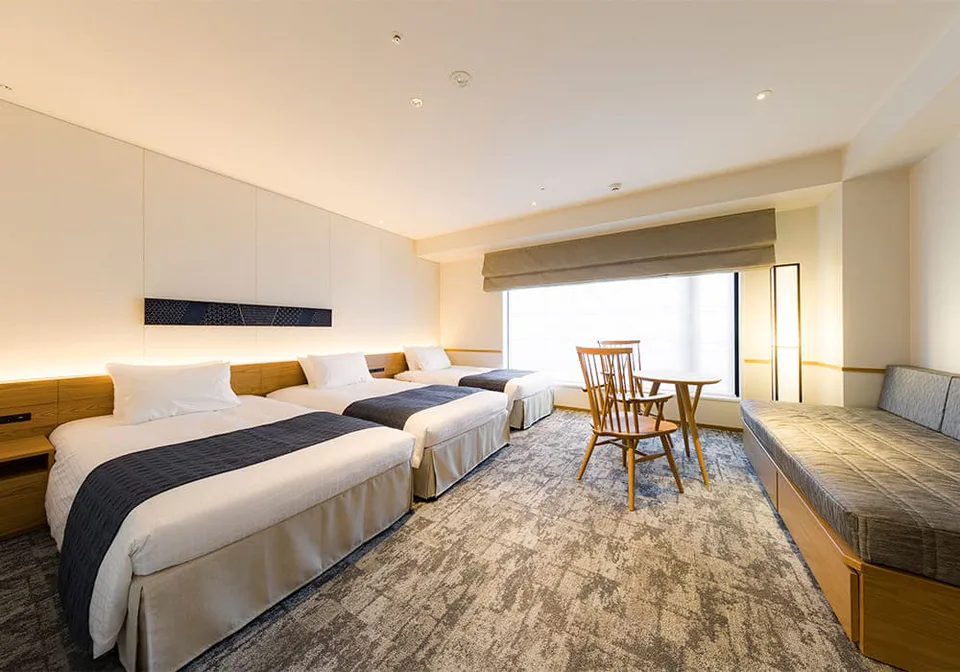

For two travellers staying three nights in Takayama with large luggage, I would start with a Residential Twin rather than the cheapest room at Tokyu Stay Hida-Takayama Musubi no Yu. The reason is not simply the extra floor area. The confirmed 27–28 m² Residential rooms combine the station-side location with a washer-dryer, microwave and kitchenette, so the room removes repeated laundry and repacking friction over a multi-night stay.
For one night, the answer changes. A 20–23 m² room can be perfectly rational when the hotel is mainly a two-minute walk from JR Takayama Station plus an onsen. The mistake is assuming every Tokyu Stay room automatically includes the same long-stay equipment: the hotel's own room pages state that equipment varies by room type and that some rooms do not have a washer-dryer.
The 30-second room decision
↔ Scroll table left or right
Your stay | Start with | Why | Main trade-off |
Solo / couple, one night, light luggage | 20 m² Double or compact Twin | You buy the station location and onsen without paying for unused long-stay functions | Less circulation space for large open cases |
Two people, two large suitcases, 2–3 nights | 27–28 m² Residential | Confirmed washer-dryer + microwave + kitchenette; more useful floor area | Higher room rate must be justified by repeated use |
Family of 3–4 | 37 m² Japanese-Western Twin or exact 4-person room | More area and confirmed washer-dryer/microwave in the Japanese-Western Twin | Capacity for four still does not guarantee four equal beds or unlimited luggage space |
Driver arriving late | Recalculate | Station proximity matters less and the 26 hotel parking spaces cannot be reserved | You may still pay the station premium and end up in off-site parking |
Early bus every morning | Station-side room remains strong | The two-minute station location protects rural departures | Breakfast from 07:00 may be unusable on early-departure days |
The washer-dryer is worth paying for only when it changes what you pack
Tokyu Stay's official Residential room pages confirm a washer-dryer, microwave and kitchenette in both the 27 m² Residential Hollywood Twin and 28 m² Residential Twin. The hotel also publishes a useful operational number: a full wash-to-dry cycle takes about 2 hours 50 minutes.
That turns the machine from a vague amenity into a time decision. You should not plan to return at 23:30, start a full load and expect the room to be quiet and finished before sleep. Instead, use the machine during a long dinner, an onsen session or an evening when you will remain in the hotel.
↔ Scroll table left or right
Stay length | Likely laundry value | Room decision |
1 night | Usually low | Do not pay much more for Residential unless luggage space or kitchenette use matters |
2 nights | Conditional | One useful load can justify some premium on a longer Japan trip |
3–4 nights | High for light packers / active travellers | Residential becomes much easier to justify if you will run 2+ loads |
5+ nights | Very high if Takayama is a base | Household functions become part of the accommodation product, not a bonus |
ValueNavi test: count the clothes you can remove from the suitcase because you have confirmed laundry. If the washer-dryer lets two travellers pack materially lighter, the room upgrade buys luggage capacity twice—first by giving more space, then by reducing what needs to occupy that space.
Do not assume the Tokyu Stay brand means every room has laundry
The hotel's current room overview explicitly says equipment differs by room and that some rooms do not have a washer-dryer. This matters because the brand is strongly associated with extended-stay functions, and a search result can make “Tokyu Stay = washer in room” feel automatic.
For the 20 m² Comfort Double, the current room page does not display the washer-dryer, microwave or kitchenette icons. By contrast, the Residential rooms explicitly display all three. The 37 m² Japanese-Western Twin explicitly displays a microwave and washer-dryer.
Therefore compare the exact room page, not the hotel-level amenity list. A cheaper room that removes the machine may be a good one-night bargain and a poor three-night long-stay choice.
Two minutes from Takayama Station buys more than an easy arrival
Tokyu Stay officially places the hotel about two minutes on foot from JR Takayama Station and about ten minutes from the historic streets. That makes it especially strong when Takayama is a transport base rather than a single sightseeing night.
The repeated high-friction uses are:
arriving by Limited Express with large luggage;
using the nearby bus terminal for Shirakawa-go or regional buses;
dropping or collecting luggage around a transfer day;
catching an early bus without a long old-town walk;
checking out, storing luggage and using the morning markets before the next train.
If your wider route is Takayama → Shirakawa-go → Kanazawa, the station-side geometry can matter more than a slightly more atmospheric old-town address. If the entire stay is slow evenings in Sanmachi and you rarely use the station, the premium has fewer chances to repay itself.
Parking is the hidden weakness for drivers
The hotel has 26 paid parking spaces, currently ¥1,500 per vehicle per night (about US$9.40) from 15:00 to 11:00. They are first come, first served and cannot be reserved. Oversize vehicles and motorcycles are not accepted in the hotel lot.
This creates an unusual inversion: the hotel's strongest location advantage is for rail and bus travellers, while a driver can still arrive at a station-centred hotel and need nearby coin parking.
If you are self-driving through Hida, do not value “parking available” as guaranteed parking. Compare the likely off-site fallback and the next morning's drive before paying a station premium you may not need.
The onsen adds value even when you skip the private bath
The second-floor public hot-spring baths currently operate 15:00–24:00 and 06:00–11:00, with the two bath areas alternating between male and female guests. The ninth floor adds three private open-air baths plus a footbath.
The private bath currently costs ¥2,750 per room for 45 minutes (about US$17) and can only be reserved at the front desk on the day of use, first come, first served. It is not a benefit you should count as guaranteed before arrival.
This is important for couples and families booking primarily for private bathing. The public onsen is the dependable hotel feature; the private bath is a same-day upgrade opportunity. If private bathing is non-negotiable, a ryokan or hotel with a reservable/private in-room bath may be a more reliable product.
A good three-night routine uses laundry and onsen in parallel
The most efficient Residential-room use is not “do laundry at midnight.” It is to overlap the 2h50 wash/dry cycle with hotel time you wanted anyway.
↔ Scroll table left or right
Example | Sequence | Why it works |
After a hiking / autumn day | 18:00 start laundry → dinner → onsen → return | The machine works while you are already occupied |
After Takayama Festival | Do not wait until the final late return | A near-3-hour cycle started too late can compete with sleep |
Night before early bus | Finish laundry and repacking before bed | The station location is valuable only if the morning departure stays simple |
For autumn timing and regional events, use the Takayama autumn guide. If the trip continues through Gujo, the Gujo Odori guide should control the event-day timing rather than the hotel routine.
Breakfast is a ¥2,500 decision, not an automatic add-on
Restaurant YUI currently serves breakfast from 07:00–10:00 with last order at 09:30 for ¥2,500 (about US$16). Dinner is currently ¥6,500 (about US$41), with evening service running to 21:00 and reservation required for guests whose accommodation plan does not already include the meal.
Breakfast is easy to justify on a normal Takayama sightseeing morning. It is worth zero on a morning when your bus leaves before the restaurant becomes useful. Before adding breakfast for every night, count the mornings that actually fit the 07:00 opening.
This matters most for a station hotel because the location encourages early regional departures. Do not pay for both “excellent early-bus geometry” and a breakfast you repeatedly abandon.
For families, 37 m² solves space better than it solves bed equality
The Japanese-Western Twin is currently 37 m² and accepts up to four guests, with 110 cm beds plus the room's Japanese-Western sleeping configuration. It also has a washer-dryer and microwave. That makes it a strong functional family category.
But “capacity four” should still trigger a bed check. A legal four-person occupancy is not the same thing as four identical Western beds. Families with older teenagers or four adults should inspect the exact sleeping arrangement before comparing price.
The room works best when the family values space, laundry and station access together. If nobody will use the washer and everyone wants conventional beds, another Takayama hotel may solve the actual problem more cleanly.
One night, two nights or three nights?
One night: choose the hotel for station access and onsen. A compact room can be enough.
Two nights: the station base starts to gain repeat value because you can leave luggage in place for one full regional day.
Three nights: Residential becomes the strongest fit for many couples because laundry, kitchenette and reduced repacking can be used more than once.
Four or more nights: ask whether Takayama itself should remain the base for every day. A great long-stay room cannot fix a regional itinerary that keeps repeating two-hour transfers.
When I would choose another hotel
I am driving and parking certainty matters. The 26 spaces are not reservable.
I want a traditional half-board ryokan experience. Tokyu Stay is a functional station hotel with an onsen, not a substitute for a ryokan stay.
I will stay one night and never use the washer or kitchenette. A cheaper nearby hotel can deliver the same transport geometry.
I need guaranteed private bathing. The private baths are same-day, first come, first served.
Final verdict
For two travellers with two large suitcases staying three nights, the 27–28 m² Residential room is the sweet spot because it combines enough extra space with confirmed long-stay equipment you can use repeatedly. For a one-night stop, do not automatically pay the Residential premium: the two-minute station walk and public onsen may already be the main value.
The recommendation reverses for drivers and for travellers who never use laundry. The hotel's strongest advantage is repeated rail/bus/luggage efficiency. If your trip does not repeatedly use that advantage, a station hotel with a washer-dryer can become an expensive solution to a problem you do not have.
Sources and verification date
Checked August 26, 2026 against Tokyu Stay Hida-Takayama Musubi no Yu's official room pages, access and parking information, onsen information and restaurant information. Room equipment varies by exact category; verify the selected room rather than relying on hotel-level amenity summaries.
Where to Stay in Kamakura or Fujisawa: The Best Base for Two Nights, With Enoshima as the Wild Card
Mercure Tokyu Stay Osaka Namba: Which Room Actually Has a Washer-Dryer?
Tokyu Stay Osaka Hommachi: Is It the Right Base for Five Nights?
Tokyu Stay Hakodate Asaichi Akarinoyu: Is It Worth Staying Three Nights?
HOTEL STRATA NAHA: For Two Nights, Is a Twin Room Worth More Than a Compact Room?

