
For two car-free nights split between Kamakura and Enoshima, Fujisawa is the best default when the hotel is mainly infrastructure. Kamakura is better when early temple time and an old-town evening are part of the reason to stay. Enoshima is the experience-first choice when sunset, the island and a coastal morning matter enough to accept a less efficient next-day route.
The key is not which town is “best.” It is which journey you are willing to repeat. Enoden currently takes about 23 minutes from Kamakura to Enoshima and about 34 minutes from Kamakura to Fujisawa. Those are short enough that one stable hotel can cover the whole corridor. A split stay therefore needs a stronger reason than saving one train ride: the second hotel should unlock a morning or evening you could not use as well from the first base.
Checked August 25, 2026. Kamakura’s official tourism site currently gives about 60 minutes from Tokyo Station to Kamakura and about 25 minutes from Yokohama to Kamakura by JR. Enoden currently lists Kamakura–Hase at about 5 minutes, Kamakura–Enoshima at about 23 minutes and Kamakura–Fujisawa at about 34 minutes. Train operations, hotel luggage policies and coastal-weather conditions can change.
Kamakura, Fujisawa or Enoshima: the 30-second decision
↔ Scroll table left or right
Your real priority | Start with | Why | Main catch |
Temples, Komachi-dori, early old-town morning | Kamakura | The hotel protects the hours before and after the day-trip peak | Enoshima/Fujisawa requires another westbound trip |
One Kamakura day + one Enoshima day | Fujisawa | JR, Odakyu and Enoden make it the strongest transport node | Less atmosphere around the hotel itself |
Sunset, island evening, coastal breakfast | Enoshima | The stay converts an attraction into usable evening/morning time | Weakest base for an early Kamakura temple route |
Large luggage / older travellers / weather uncertainty | Fujisawa | Fewer awkward hotel moves and easier route changes | You trade atmosphere for resilience |
Only one night | Choose the evening you care about | Kamakura and Enoshima both gain value after day-trippers leave | Do not split a one-night stay |
Fujisawa wins the mixed two-day itinerary because it reduces repeated travel
Fujisawa is the least romantic answer and the most useful one when the trip contains both Kamakura and Enoshima. Its value comes from network geometry: JR handles the long-distance side, Odakyu connects toward central/west Tokyo, and Enoden runs along the coastal sightseeing corridor.
Enoden currently publishes Kamakura–Fujisawa at about 34 minutes and Kamakura–Enoshima at about 23 minutes. That means a Fujisawa base can send one day east to Kamakura and another south toward Enoshima without moving the hotel or carrying luggage through the sightseeing day.
The advantage compounds when the weather is uncertain. If coastal wind makes Enoshima unpleasant in the morning, switch to Kamakura. If rain makes a long temple day less appealing, keep the same hotel and re-order the days. A base that allows the itinerary to change without touching the luggage is buying resilience, not glamour.
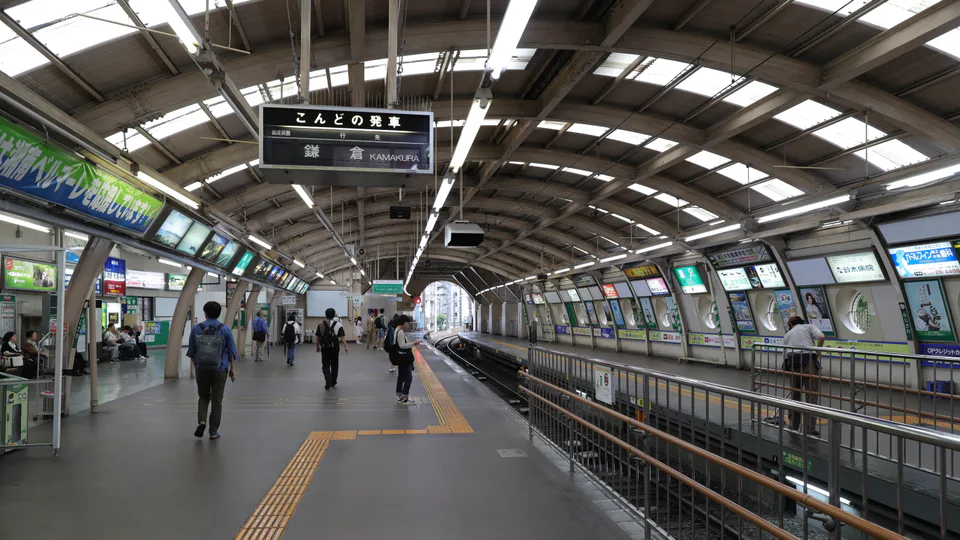
Enoden Fujisawa Station.
Kamakura wins when the stay is buying quieter hours, not transport efficiency
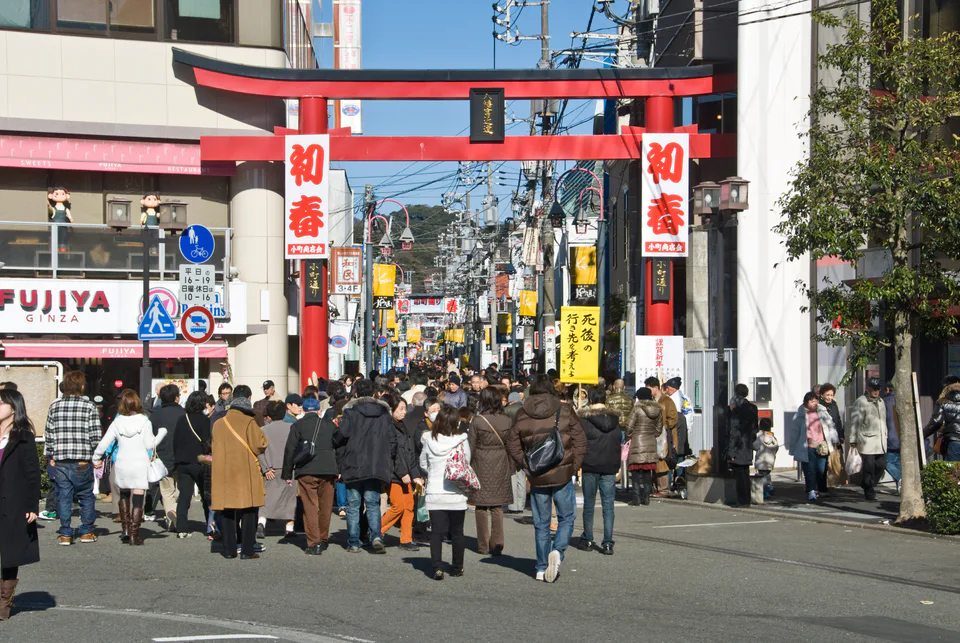
Kamakura is worth sleeping in when you want the town before it becomes a day-trip product. The practical advantage is not that Kamakura has better regional transport than Fujisawa—it does not. The advantage is that the hotel protects high-value local hours around Komachi-dori, Tsurugaoka Hachimangu and the old-town streets.
Kamakura’s official tourism site currently places Tokyo Station about 60 minutes away and Yokohama about 25 minutes away. That makes Kamakura easy enough to visit as a day trip, which is exactly why an overnight should justify itself with something a day trip cannot do as well: an early temple morning, a slow dinner, or a less rushed sequence before heading toward Hase.
If you are leaving the hotel immediately after breakfast for Enoshima and returning only to sleep, Kamakura’s experiential premium is being underused. If the first two or three hours of the day are temple-focused and the evening matters too, staying in the old town makes more sense.
Komachi-dori near Kamakura Station.
Enoshima is inefficient on purpose—and that can be the correct purchase
Enoshima should not win an efficiency contest. The island, bridge and coastal positioning all make it less convenient for an early Kamakura temple day. But efficiency is not the only reason to book a hotel.
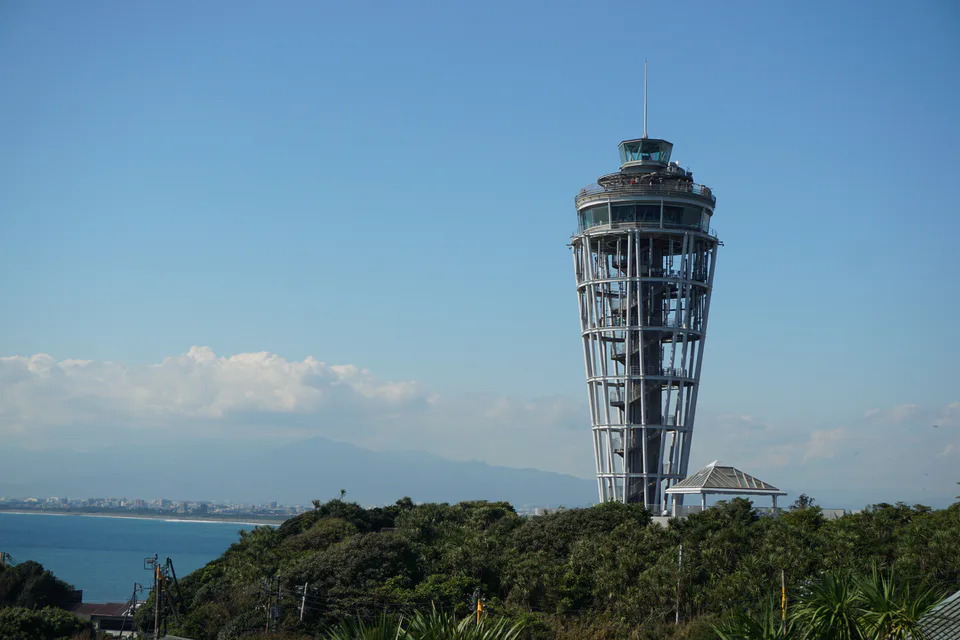
If sunset, the Sea Candle, an island dinner or a coastal morning is one of the memorable experiences you want from the trip, sleeping near Enoshima converts the destination from a timed day stop into part of the stay. That is genuine value even if the next morning contains more travel.
The red-team condition is simple: if you will arrive after dark exhausted and leave before breakfast, the Enoshima hotel is not buying the evening/morning experience. It is only buying a less efficient location. In that case Fujisawa is usually the cleaner base.
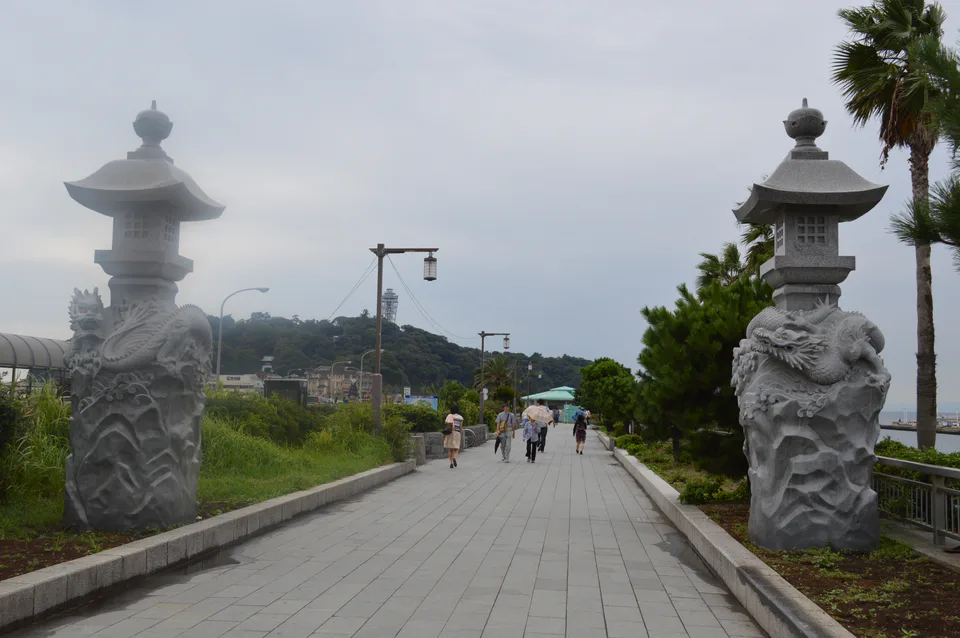
Enoshima Benten Bridge.
The 23-minute and 34-minute Enoden rides change the split-stay math
Because Kamakura, Enoshima and Fujisawa are already connected by one short coastal railway, the theoretical time saving from moving hotels is smaller than it looks. A Kamakura hotel does not make Enoshima inaccessible; an Enoshima/Fujisawa hotel does not make Kamakura inaccessible.
This means a split stay has to beat the cost of checkout, luggage handling, the period before the second room is ready, another check-in and another unpacking cycle. Saving one 23- or 34-minute rail ride is rarely enough.
I would split only when the second hotel changes the time of day you can use. Kamakura night one + Enoshima night two can work if Day 1 ends in old-town Kamakura and Day 2 naturally moves west toward a deliberate coastal sunset. Kamakura + Fujisawa is much harder to justify for only two nights because Fujisawa’s main advantage is logistics, not a unique evening.
Large luggage makes Fujisawa stronger because the hotel becomes a storage strategy
With a day bag, all three bases are easy enough. With two large suitcases, the station-to-hotel path, slope, bridge and ability to leave bags after checkout matter more than small differences in rail time.
Fujisawa gains because it lets the large luggage stop moving while the traveler uses Enoden for the sightseeing corridor. Kamakura can still be excellent if the hotel is close to the station and the old-town stay is the objective. Enoshima should be chosen with the approach itself in mind; a beautiful hotel is less appealing if the final bridge or slope becomes the worst part of arrival.
If the baggage problem continues beyond Shonan, solve that separately with Japan Luggage Forwarding instead of forcing every hotel choice to accommodate the same suitcase.
The next regional stop can reverse the answer
If the next stop is Tokyo or an airport, Fujisawa’s stronger long-distance rail position becomes more valuable. If the next stop is Yokohama, either Kamakura or Fujisawa works without needing a return to central Tokyo.
If the route continues west toward Odawara and Hakone, Fujisawa becomes easier to defend because it sits on the JR Tokaido corridor. That does not mean you should automatically sleep in Fujisawa; it means the departure morning should be counted alongside the sightseeing days.
If Hakone is next, use Tokyo to Hakone: Romancecar, JR or Hakone Freepass? and Where to Stay in Hakone before adding another hotel move just to make a transfer look elegant on a map.
Families and older travellers should value the final 500 metres more than the town name
Kamakura sightseeing itself contains a lot of walking. Enoshima adds the bridge and elevation. A family with a stroller or an older parent can therefore spend the energy budget before the train ride even begins.
A straightforward Fujisawa hotel can protect energy for the actual attractions, even if the district is less memorable. Conversely, a genuinely convenient Kamakura hotel can outperform Fujisawa when the family’s main sightseeing is concentrated around central Kamakura and Hase.
Do not compare districts without opening the hotel map. Station exit, lift availability, slope, bridge, luggage hold and room size can reverse the area-level winner.
Weather creates a different kind of base value on the coast
Enoshima is more exposed to coastal wind and rain than an indoor city itinerary. Kamakura temple days also become more tiring in heavy rain. The best base is therefore partly the one that lets you swap days without rebuilding the hotel plan.
This is another reason Fujisawa works so well for a two-night mixed itinerary: it is deliberately neutral. The cost of that resilience is that the hotel district itself contributes less to the trip.
Final verdict
For two mixed sightseeing days, I would use Fujisawa as the default because it minimizes repeated transport and keeps luggage out of both day trips. I would choose Kamakura instead when the early temple morning and old-town evening are part of the stay, not merely sightseeing items. I would choose Enoshima only when sunset, the island and a coastal morning are deliberately worth the extra transfer friction. For only two nights, avoid splitting hotels unless the second base unlocks a different high-value time of day.
Tokyu Stay Hida-Takayama Musubi no Yu: Which Room Works for Two Suitcases and Three Nights?
Where to Stay in Osaka With Parents: Cut Transfers Before You Pay for More Luxury
Hakone Loop Before Check-In or After Checkout? The Best Order for a One-Night Ryokan Stay
References
VISIT KAMAKURA — current access guidance from Tokyo, Yokohama and Haneda
Enoshima Electric Railway — current Kamakura, Enoshima and Fujisawa travel-time examples and timetables
Fujisawa City Tourism Association — current regional access guidance