

For two adults plus two eligible children who want Namba at night, Centara Grand Hotel Osaka is the cleaner starting point. For four adults, older children, five to six travellers, or a three-to-five-night stay where laundry and morning queues matter every day, Hotel Keihan Namba Grande usually becomes the stronger family tool. The decision should be made before comparing prices, because the rooms do not solve the same occupancy problem.
Centara’s current 40m² Family - Rei and Family - Miyabi rooms list a maximum of two adults plus two children; its FAQ says the family-room bunk beds are for children under 11. Hotel Keihan’s current Family Room is 44m² for up to five guests, while Connecting Rooms combine two 20m² rooms for up to six. That difference is more important than the hotels’ nominal two-minute gap from the Nankai side of Namba.
The one-minute decision
↔ Scroll table left or right
Party / trip pattern | Start with | Why |
2 adults + 2 children within Centara’s family-room rules | Centara | 40m² family layout, children’s bunk zone and a slightly shorter quoted Nankai walk. |
4 adults or older children needing ordinary beds | Hotel Keihan | Centara Family Room should be removed before price comparison; Keihan has eligible group layouts. |
4–5 people, 3–5 nights, laundry/simple food likely | Hotel Keihan Family Room | In-room washer-dryer, IH, oven-microwave, 90L refrigerator-freezer and twin basins repeat their value. |
4 adults with early starts or different sleep schedules | Hotel Keihan Connecting Rooms | Two bathrooms and two washbasins can remove the group’s biggest queue. |
2A+2C with repeated Club use | Centara Miyabi | Club value is real only if 14:30–16:30 tea or 17:30–19:30 cocktails actually intersect the itinerary. |
ValueNavi Family Hotel Logistics Score
This cluster uses one reusable model so “family-friendly” does not become a vague label. Each option is scored from 0 to 10 on occupancy and bed fit 25%, parallel morning/evening capacity 20%, arrival and luggage friction 15%, long-stay self-sufficiency 15%, itinerary fit 15%, and likely premium/facility utilisation 10%. It is a ValueNavi editorial score for a scenario, not a permanent hotel rating.
↔ Scroll table left or right
Scenario | Score | Why |
Centara Family: 2A+2C, two-night Namba stay, lounge windows used | 8.7/10 | Very strong occupancy fit, location fit and premium utilisation. |
Keihan Family: 2A+2C or 4 travellers, four-night stay, laundry/simple food used repeatedly | 9.0/10 | Self-sufficiency and room workflow repeat across several nights. |
Keihan Connecting: 4 adults with early starts | 9.2/10 | Two bathrooms sharply improve parallel capacity, the most important factor after bed legality. |
Either hotel: one-night sleep-only transit stay | About 7.3–7.7/10 | Most premium family features have too few repetitions; same-date price and arrival route should dominate. |
Centara Family: 4 adults | Not scored | The room does not match the published party rule, so it is removed before scoring. |
For this model, 8.5+ is a strong fit, 7.5–8.4 is useful but conditional, and below 7.5 means the itinerary is underusing a meaningful part of the product. A room that cannot legally fit the party is not given a bad score; it is disqualified from that comparison.
First remove the wrong room
The most expensive family-hotel mistake is comparing attractive room cards before checking occupancy. Centara’s Family room is designed around two adults and children, not as a generic four-adult room. Hotel Keihan’s Family Room is currently listed at 44m² for up to five; for four guests it uses four 110cm beds. Its Connecting Room is 20m² × 2 for up to six.
This creates a hard ValueNavi rule: room legality and bed fit come before price, floor area and hotel class. If a room fails that gate, a lower OTA price does not make it a valid alternative.
Arrival friction: two minutes matters once; room friction can repeat eight times
Centara quotes roughly four minutes from the south side of Nankai Namba, while Hotel Keihan quotes about six minutes from the Nankai south gate. With luggage, rain or tired children, two minutes can matter. But on a four-night stay, an in-room laundry task or bathroom queue can repeat every morning and evening.
That is why I do not let the final walk dominate this comparison. Use a simple weighting question: is the Nankai arrival/departure the main stressful event, or will the room routine create friction twice a day? For a late KIX arrival and early departure, Centara’s access gains weight. For four nights with four people, Keihan’s room systems often gain more total weight.
For the broader airport-and-USJ trade-off, compare the OMO7 Osaka vs Centara guide.
Centara’s strongest case: the family layout and Namba rhythm reinforce each other
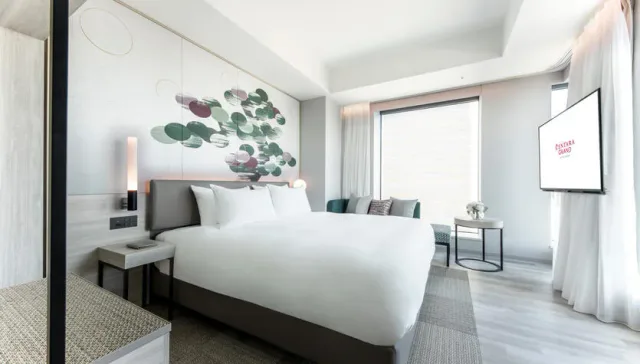
For two adults plus two eligible children, Centara’s 40m² family layout can separate the adult bed from the children’s bunk zone. That matters when children sleep earlier or when adults need a small amount of separation after bedtime. The location also works when the trip repeatedly ends around Namba, Dotonbori and nearby shopping.
The hidden trade-off is that the room’s family label does not add extra bathrooms or long-stay equipment. If the family’s recurring problem is laundry, simple food or several people trying to get ready at once, Hotel Keihan may solve more practical friction even if Centara feels more polished.
Miyabi Club: use a time-intersection test before paying the premium
Centara’s Family - Miyabi remains 40m². Current Club Lounge service includes breakfast 07:00–10:30, afternoon tea 14:30–16:30 and evening cocktails 17:30–19:30. The upgrade therefore depends on schedule overlap rather than extra room area.
Use this ValueNavi test:
↔ Scroll table left or right
Expected usable Club windows during stay | Decision |
0–1 | Do not justify the upgrade on Club access alone. |
2–3 | Compare the premium against the family’s actual food/rest routine. |
4+ | The Club becomes a repeatable trip component rather than an occasional extra. |
This is not a financial break-even claim because Club pricing changes by date. It is a utilisation threshold: a benefit that never intersects the itinerary should receive almost no decision weight.
Why Hotel Keihan gains ground after the third night
Hotel Keihan’s current Family Room includes a washer-dryer, IH hob, oven-microwave, 90L refrigerator-freezer, twin washbasins and a bathroom with a separate washing area. Its Twin Room with Japanese Room carries the same core long-stay equipment with a different sleeping system. These features matter because they let tasks overlap.
One adult can start laundry while another prepares a child’s breakfast; two people can use the basins while luggage is being sorted. The room still has one bathroom, so it does not eliminate every queue. But on a three-to-five-night stay, reducing several small errands can be worth more than shaving two minutes off the station walk once.
The advantage collapses on a one-night stay. If nobody washes clothes, stores food or spends awake time in the room, do not pay a premium just because the equipment list is long.
For another Osaka long-stay comparison, see Tokyu Stay Osaka Hommachi for five nights.
Family Room vs Connecting Rooms: identify the bottleneck
↔ Scroll table left or right
Recurring problem | Better starting point | Reason |
Laundry, food storage, one shared family space | Keihan Family Room | The self-sufficiency equipment stays inside one 44m² room. |
Four adults showering/getting ready before 08:00 | Keihan Connecting Rooms | Two bathrooms and two washbasins increase parallel capacity. |
Children sleep earlier than adults | Centara Family Room | The family layout is built around an adult sleeping zone and a children’s bunk area. |
One-night Nankai transit | Compare eligible basic totals | Repeated-use family features have too little time to earn a large premium. |
The ValueNavi Premium-Use Rule
Before paying more for any of these rooms, list the advantage and count how many times you expect to use it. If a paid feature appears only once in a four-night stay, treat it as a weak reason to upgrade. If it removes a problem every morning or evening, treat it as a strong reason.
This rule catches two common false economies. A cheaper room can be poor value if it forces four adults into repeated bathroom queues. A more expensive Club room can also be poor value if every service window is missed. The objective is not the lowest nightly rate; it is the lowest recurring friction for the party you actually have.
Three situations that reverse the recommendation
Late KIX arrival, only two nights
Centara becomes stronger because the access difference is used immediately and Hotel Keihan’s long-stay equipment has little time to repeat.
Four adults, four nights, two early day trips
Hotel Keihan Connecting Rooms become stronger. Two bathrooms can directly shorten the morning bottleneck, while Centara’s Family Room is not an eligible four-adult product in the first place.
Two adults + two children, four nights, no lounge use but frequent laundry
Hotel Keihan can overtake Centara even though Centara’s family layout fits. The recommendation reverses because the repeated problem is laundry/self-sufficiency rather than sleeping-zone separation.
Compare the same booking product, not the cheapest card
Lock the real guest ages, actual beds, breakfast, Club access, tax treatment, payment timing and cancellation deadline before comparing. Room prices change by date, so a single “typical” rate is not reliable enough for this decision. A Family Room for two adults and two children is not equivalent to a Connecting Room for four adults simply because both search results show four guests.
Final verdict
Start with Centara for two adults plus two eligible children when Namba is the repeated evening base and the separated family layout matters. Upgrade to Miyabi only when the Club schedule intersects the trip several times. Start with Hotel Keihan for four adults, older children, five to six travellers, or a longer stay where laundry, food storage and parallel morning routines matter repeatedly.
The red-team question is: if the signature feature disappeared, would the hotel still fit? If Centara loses the Club and still wins on room legality and Namba, the choice is resilient. If Keihan loses the washer-dryer and Connecting Rooms still win because two bathrooms solve the real problem, the choice is resilient. If the answer collapses, you are probably overpaying for a headline feature rather than solving the trip.
Where to Stay in Osaka With Kids — USJ, Namba or Osaka Station?
Where to Stay in Osaka: Start With Your Last Stop, Then Choose Namba, Umeda, USJ or Shin-Osaka
Citadines Namba Osaka: 24m² Studio or 36m² Premier for 4 Nights?
Hotel Royal Classic Osaka: What Does “Connected to Namba Station” Actually Save?
Sources
Centara Grand Hotel Osaka — rooms | Centara Grand Hotel Osaka — FAQ | Centara Grand Hotel Osaka — Club Lounge
Hotel Keihan Namba Grande — rooms | Family Room | Connecting Room
Room inventory, child rules, lounge service and rates can change. Reconfirm the exact room and party conditions for your stay dates.