
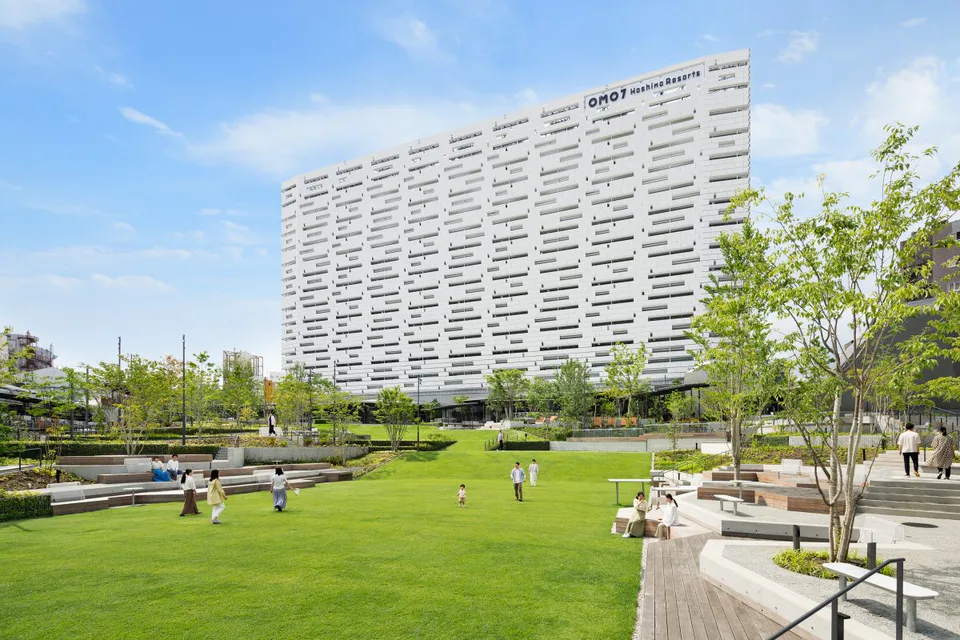
Choose OMO7 Osaka when your trip repeatedly uses Shin-Imamiya, a USJ day that fits the hotel shuttle, and at least one block of actual hotel time. Choose Centara Grand Hotel Osaka when Namba is your nightly base and its 40m² family-room rules match your party. The wrong way to compare these hotels is by star category or room size alone. The useful comparison is how many times each hotel removes a real piece of family friction over the whole stay.
OMO7’s current free USJ shuttle runs at 08:00 and 09:20 outbound and 17:30 and 18:50 back from the park, with about 30 minutes scheduled each way. Centara’s current Family - Rei and Family - Miyabi rooms are 40m² and list a maximum of two adults plus two children; the hotel FAQ says the family-room bunk beds are for children under 11. Those facts create two very different decision boundaries rather than one universal winner.
OMO7 Osaka vs Centara Grand Hotel Osaka: the quick decision
↔ Scroll table left or right
Trip pattern | Start with | Why |
KIX arrival + one USJ day + an early hotel evening | OMO7 | You can use the Shin-Imamiya arrival advantage, a shuttle leg and the hotel’s social space in the same short stay. |
Two adults + two eligible children, with Namba dinners most nights | Centara | The 40m² family layout matches the party and Namba convenience repeats every evening. |
Four adults | Do not default to Centara Family Room | The Family room is not a four-adult workaround; price another eligible Centara room type, two rooms or OMO7 group inventory. |
USJ until late park close | Compare again | OMO7’s listed return shuttles finish at 18:50, so the special transport advantage may become outbound-only. |
ValueNavi Family Hotel Logistics Score
To stop family-hotel comparisons from becoming feature lists, ValueNavi uses the same six-factor model across this Osaka cluster. Each factor is scored from 0 to 10 and then weighted: occupancy and bed fit 25%, parallel morning/evening capacity 20%, arrival and luggage friction 15%, long-stay self-sufficiency 15%, itinerary fit 15%, and likely premium/facility utilisation 10%. This is an editorial planning score, not a hotel quality rating. A score changes when the traveller scenario changes.
↔ Scroll table left or right
Scenario | ValueNavi score | What drives it |
OMO7: 2 adults + 2 children, KIX arrival, USJ day fits shuttle, one early hotel evening | 8.2/10 | Strong arrival and itinerary fit; the score falls if the room is mostly used for sleep. |
Centara: 2 adults + 2 eligible children, Namba-focused evenings, lounge windows used | 8.4/10 | Very strong room legality, Namba fit and premium utilisation. |
OMO7: Namba-heavy trip with three consecutive late returns and no usable shuttle | 7.0/10 | The distinctive hotel and shuttle advantages are available but mostly unused. |
Centara Family Room: four adults | Not scored | The advertised family-room occupancy does not match the party, so it should be removed before price comparison. |
Interpretation: 8.5+ is a strong scenario fit, 7.5–8.4 is good but conditional, and below 7.5 means a meaningful part of the product is being underused or the route is creating repeated friction. The score is deliberately scenario-specific: it should never be quoted as “OMO7 is an 8.2 hotel.”
The ValueNavi Repeated Advantage Count: a simpler way to break a tie
For a three- or four-night stay, count how many times each hotel’s special advantage actually enters the itinerary. Give OMO7 one use for each of these that genuinely happens: easy Shin-Imamiya arrival with luggage, USJ outbound shuttle, USJ return shuttle, and a meaningful early-evening/hotel-time block. Give Centara one use for each real occurrence of a Namba-centred evening, a useful midday room return or bag drop, a family-room layout that directly fits the party, and a Club tea/cocktail window that you will actually attend.
My threshold is practical rather than absolute: if one hotel leads by at least two repeated uses and has three or more total uses, let the itinerary decide before the room rate does. If the count is within one use, compare the same-date eligible room totals and cancellation terms. This prevents a one-off feature from dominating a multi-night decision.
↔ Scroll table left or right
Example itinerary | OMO7 count | Centara count | Decision signal |
KIX → hotel, USJ outbound + return shuttle, one relaxed hotel evening | 4 | 0–1 | OMO7 has a repeatable advantage, not just a marketing feature. |
Three Namba dinners, one afternoon room return, 2A+2C Family Room | 0–1 | 5 | Centara’s location and room fit repeat across the stay. |
USJ until late + Kyoto day trip + late Dotonbori nights | 1 | 2–3 | The shuttle alone should not decide the hotel. |
Same airport rail corridor, different last-mile logic
Both hotels can use the Nankai corridor from Kansai Airport. OMO7’s official access material places Shin-Imamiya on the direct KIX route with a very short final hotel segment. Centara places you at Nankai Namba and then roughly a few minutes on foot to the hotel. For a family with a pushchair and several cases, the difference matters most on arrival day. It matters much less if Centara then saves a return journey to Namba every night.
That is the first hidden-cost rule in this comparison: one easier airport arrival should not automatically outweigh three easier evenings. If you land late and leave for USJ the next morning, OMO7 can use its location twice in less than 24 hours. If you spend three nights eating and shopping around Namba, Centara can use its location three or four times after check-in.
OMO7’s USJ shuttle is valuable only when its clock matches your park day
The official schedule currently lists two outbound services at 08:00 and 09:20 and two returns at 17:30 and 18:50, with about 30 minutes scheduled each way. The shuttle is for hotel guests and requires a reservation. That can remove a transfer and one decision from a family morning, which is real value.
But the return clock is a boundary condition. If you intend to stay for a later closing, night-time show or dinner near Universal City, keep a rail plan. In that itinerary I treat OMO7’s shuttle as one useful leg, not a round-trip guarantee. A free service you cannot use is worth zero in the Repeated Advantage Count.
If USJ is the main reason for the Osaka stay, compare Universal City, Umeda and Namba hotel bases before letting one shuttle decide the entire trip.
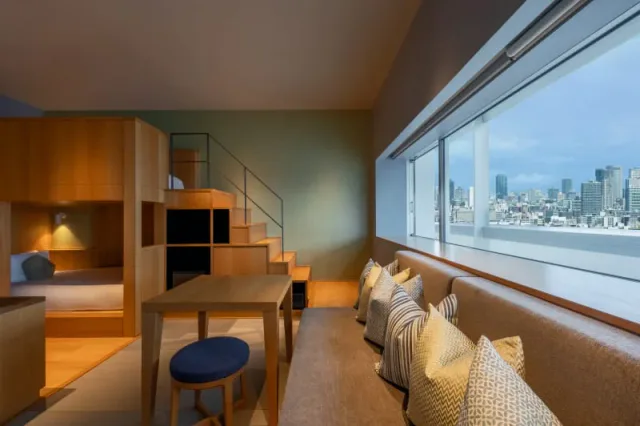
OMO7’s 59m² IDOBATA Suite: large shared space has to earn its premium
The 59m² IDOBATA Suite is most defensible when the group spends awake time together in the room: takeaway dinner around the table, repacking park purchases, children spreading out while adults plan the next day, or a rain break that lasts longer than a shower. If everyone comes back at 23:30 and leaves at 07:00, most of that shared-space advantage is unused capacity.
This is why maximum occupancy is not a comfort score. A group room can legally sleep several people yet still be a poor fit for four adults with different sleep times or morning routines. If your real priority is apartment-style equipment rather than a social hotel concept, compare MIMARU Osaka Shinsaibashi Central. If in-room laundry drives a five-night stay, Tokyu Stay Osaka Hommachi tests a different kind of utility.
OMO7 hotel time only counts when it appears on the schedule
Miya-green, OMO Base and the hotel’s programming can make an early return part of the Osaka experience. But a packed itinerary that ends late in Namba, Umeda or Universal City weakens that proposition. For a three-night stay, one early return may be enough to make the hotel feel meaningfully different. Three consecutive sleep-only nights should push the premium-utilisation score down.
Booking.com: View OMO7 Osaka rooms
Trip.com: View OMO7 Osaka rooms
Centara: Namba wins when the city itself is the evening plan

Centara’s advantage is repetition. Namba is already the hotel neighbourhood, so a late dinner, a shopping-bag drop or an early-child-bedtime return does not first require a trip back to Shin-Imamiya. If Namba appears on the schedule repeatedly, that can outweigh a slightly easier airport arrival elsewhere.
This also explains when Centara is overbought. If the trip is USJ, Kyoto and a northern-Osaka day with almost no time around Namba, the address is less valuable than it looks on a map. A premium Namba hotel should be paid for because you use Namba, not because Namba is famous.
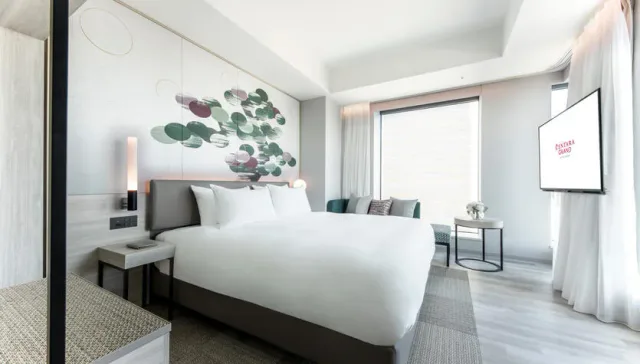
Centara’s 40m² Family Room is a specific family product, not a four-adult room
Current Centara pages list the Family - Rei and Family - Miyabi rooms at 40m² with a maximum of two adults plus two children. The hotel FAQ says family-room bunk beds are available for children under 11. That is a clear decision gate: if your party is four adults, remove this room from the comparison before looking at price.
For two adults with two eligible children, the separated adult bed and children’s bunk zone can be useful when children sleep earlier. But even a legally compatible room is not automatically the best room. Compare what happens before 09:00: showering, dressing, packing a day bag and getting everyone out of the room. A family room earns its premium by improving that routine, not simply by printing “family” in the room name.
Miyabi Club: pay for service windows you can actually use
The Family - Miyabi room remains 40m², so the main upgrade is Club Lounge access rather than extra floor area. Current Club hours list breakfast 07:00–10:30, afternoon tea 14:30–16:30 and evening cocktails 17:30–19:30, with the lounge open 07:00–22:00. If your itinerary returns during those windows more than once, the benefit is repeatable. If every afternoon is at USJ or Kyoto and dinner starts outside the hotel, the entitlement may barely enter the trip.
That is why the ValueNavi score includes premium utilisation. A benefit should score highly only when it intersects with the actual itinerary. “Included” is not the same as “used.”
Booking.com: View Centara Grand Hotel Osaka rooms
Trip.com: View Centara Grand Hotel Osaka rooms
Agoda: View Centara Grand Hotel Osaka rooms
Three itinerary tests that can reverse the answer
1. KIX arrival, USJ next morning, quiet first evening
This is OMO7’s strongest pattern. The arrival direction, a compatible shuttle and hotel-time block all appear in sequence. The hotel can remove several pieces of friction inside one day. If the same family instead plans to go straight to Dotonbori on arrival and stay in USJ until late the next night, two of those advantages disappear.
2. Namba every night, one child rests in the afternoon
This is Centara’s stronger pattern. A midday return, shopping-bag drop and several Namba evenings turn location into a repeated benefit. If the 40m² room also legally fits the family, the room and neighbourhood reinforce each other.
3. Four adults with different sleep schedules
Do not force either hotel’s family marketing into a group-room decision. Centara Family Room is removed by occupancy rules. At OMO7, compare the exact bed layout rather than maximum occupancy. If conventional beds, two bathrooms or in-room laundry matter more, a different Namba group hotel may be the better fit.
What do you give up with each choice?
↔ Scroll table left or right
Choice | You gain | You give up |
OMO7 | Shin-Imamiya arrival fit, USJ shuttle when compatible, large social-room/hotel-time proposition | Namba is not the hotel neighbourhood; shuttle return times can be too early; hotel experience is wasted on late sleep-only nights |
Centara | Namba as the nightly base, defined 2A+2C family layout, Club option | No equivalent USJ shuttle in this comparison; Family Room does not solve four-adult occupancy; Club value is schedule-sensitive |
Compare equivalent products before comparing price
Hotel prices move by date, party size and cancellation terms, so I would not publish one “typical” room rate as if it were stable. Fix the same dates, guest ages, actual bed requirement, breakfast, Club access, taxes and cancellation deadline first. Then compare totals. A 40m² Family Room for two adults and two children is not equivalent to a four-adult room, and a large OMO7 room is not automatically comfortable for every adult group simply because the maximum occupancy is high.
Final verdict
Book OMO7 when KIX arrival, a USJ day that fits at least one useful shuttle leg, and genuine hotel time all occur in the same stay. Book Centara when Namba is the repeated evening base and its family-room rules match the actual ages, especially if Club windows will also be used. Choose neither by default when four adults need conventional beds, every night ends late away from the hotel, or the itinerary uses neither the shuttle nor the Club timetable.
The red-team test is simple: remove the hotel’s headline feature and ask whether you would still choose the location and room. If removing the shuttle makes OMO7 unattractive, confirm that the shuttle truly fits. If removing Club access makes Centara unattractive, confirm that the family room and Namba location still work. A resilient hotel choice survives that test.
Osaka and Kyoto 4-Day Itinerary With USJ: Does Kyoto Still Fit?
A 7-Day Osaka Premium Experiences Itinerary: USJ Express, Sumo, Samurai — and Only One Big Splurge
Osaka Hotels for 4–6 Friends: When One Big Room Stops Being the Better Deal
Hilton Tokyo Bay Happy Magic vs Family Happy Magic: Which Room?
Osaka Itinerary: 3, 4 or 5 Days — When to Add USJ, Kyoto or Kobe
Sources
OMO7 Osaka — Universal Studios Japan shuttle bus | OMO7 Osaka official website
Centara Grand Hotel Osaka — rooms | Centara Grand Hotel Osaka — FAQ | Centara Grand Hotel Osaka — Club Lounge
Room types, occupancy rules, shuttle operations, rates and cancellation terms can change by date. Reconfirm the exact product for your stay. This article may contain affiliate links; ValueNavi may earn a commission from qualifying bookings at no additional cost to you.