
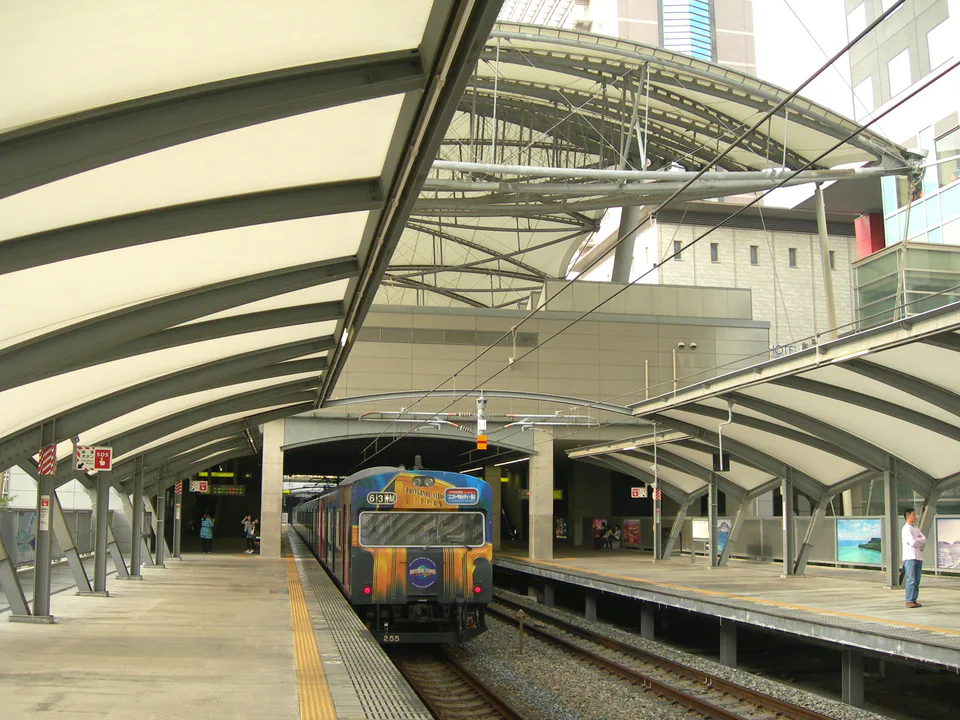
For most first-time visitors, the Osaka hotel decision should start with the movements you repeat, not the area with the best reputation. Choose Namba when several evenings genuinely end around Dotonbori/Shinsaibashi and KIX access matters. Choose Umeda when Kyoto, Kobe or Himeji departures repeat. Use Universal City as a specialist base when USJ controls more than one hard morning or late night. Use Shin-Osaka tactically when an unusually early Shinkansen is important enough to justify a final-night move.
The key rule is simple: do not move hotels unless the second base deletes at least two high-cost movements. One USJ day, one early train or one airport ride usually does not justify packing, checkout, luggage handling and another check-in. A specialist base becomes valuable when it solves two or three hard edges at once.
↔ Scroll table left or right
Your repeated constraint | Start with | What you are buying | When to reject it |
3+ evenings around Dotonbori / Shinsaibashi / Namba | Namba | A shorter final walk plus direct Nankai airport access | Most mornings are JR day trips and most nights end north of the city |
2+ Kyoto / Kobe / Himeji days | Umeda / Osaka Station | The same rail-hub convenience is used on departure and tired return | You only have one intercity day and every Osaka evening is in Minami |
Two serious USJ days, or park opening + very late park finish | Universal City | You delete the park commute at both edges of the day | USJ is one ordinary day inside a longer Osaka stay |
Very early Shinkansen plus large luggage / family | Shin-Osaka final night | You buy departure-morning certainty | The train leaves late enough that a normal Osaka base has comfortable margin |
5–7 nights with mixed priorities | One stable Namba or Umeda base first | You avoid repeated packing and keep itinerary flexibility | The trip genuinely changes geographic centre for 2+ hard days |
Use the “hard-edge count” before you compare hotel prices
Every itinerary has soft movements and hard movements. A soft movement is an ordinary daytime trip where another 10 or 15 minutes is annoying but recoverable. A hard edge is a movement where delay, fatigue or luggage makes the cost much higher: a park-opening morning, a final train after a late event, a KIX departure, an early Shinkansen, or the third straight day of a long intercity commute.
Count those hard edges first. Then choose the base that removes the most of them.
Namba hard edges: late Minami evenings, Nankai KIX mornings, shopping-heavy returns.
Umeda hard edges: repeated JR/Hankyu day-trip mornings and evening returns.
Universal City hard edges: early USJ arrival and exhausted post-park return.
Shin-Osaka hard edge: a genuinely early Shinkansen departure.
This prevents one vivid day from hijacking the whole booking. A single 07:00 train should not automatically decide five nights. A single USJ day should not automatically move the family to Universal City. The hotel should solve what repeats.
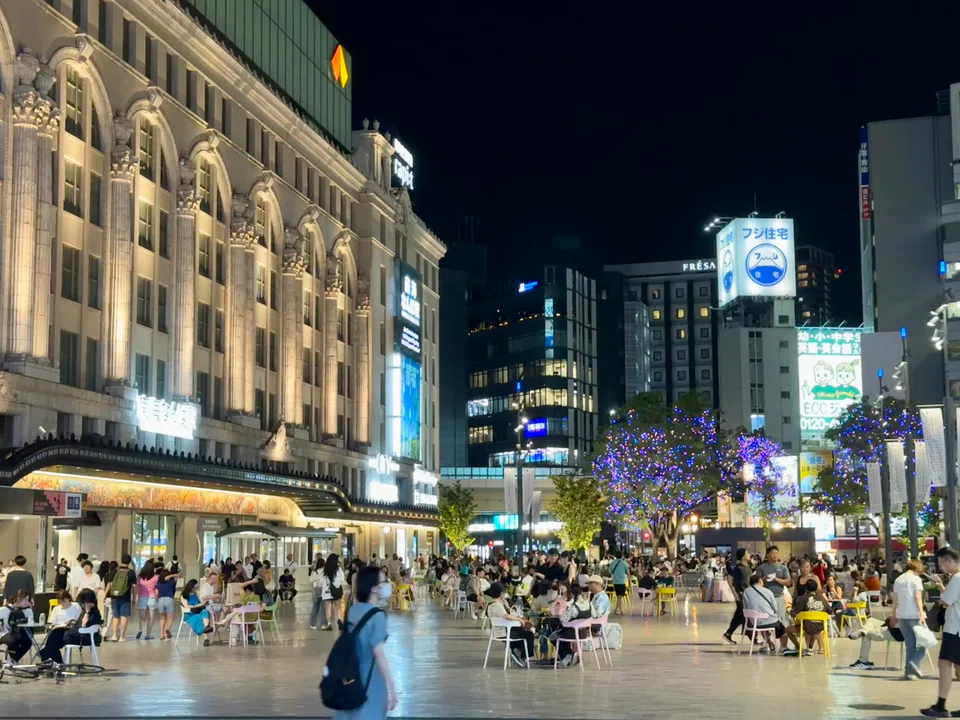
Namba is strongest when the final 20 minutes of the day repeat
Namba’s best argument is not “tourists like Dotonbori.” It is that several common Osaka evenings naturally end in the same southern core: Dotonbori, Shinsaibashi, Hozenji, Namba Parks and Minami dining. If that happens three or four nights, a hotel nearby removes the same tired return repeatedly.
The value rises with shopping. Two people carrying bags at 22:30 experience a ten-minute station-to-hotel walk differently from two people leaving breakfast at 09:00. This is why a modestly more expensive Namba room can be rational even when Umeda looks marginally faster on one daytime route.
KIX is a second, but narrower, advantage. Kansai International Airport currently lists Nankai Rapi:t at about 34 minutes to Namba on the fastest pattern, about 39 minutes on the other Rapi:t pattern and about 43 minutes by Airport Express. That is real airport convenience.
But do not let it decide the entire trip. Airport access normally affects one arrival and one departure. If the other eight or ten hotel movements all favour Umeda, paying for Namba because of one airport train is backwards optimisation.
If Namba wins, the next question is whether you need true station integration, nightlife walkability, a larger family room or an in-room washer-dryer. Use the Namba vs Umeda comparison and then compare specific room geometry rather than assuming every “Namba” hotel solves the same last mile.
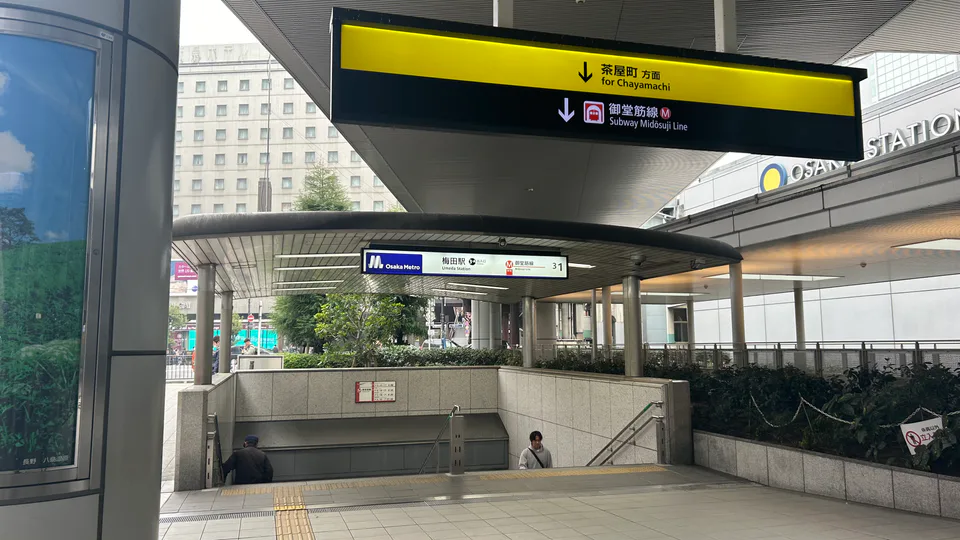
Umeda wins when external day trips become the daily rhythm
Umeda/Osaka Station becomes valuable when Kyoto, Kobe or Himeji is not a one-off excursion. The station advantage is paid twice per day: once when you leave and again when you return tired.
Count station uses rather than destinations. Three external day trips create roughly six meaningful hotel-to-hub / hub-to-hotel legs. Add a Shinkansen connection or another JR-heavy morning and the transport premium becomes easier to justify.
Do not make “Umeda = JR” the whole analysis. Hankyu Osaka-Umeda can be a strong departure point when Kyoto-Kawaramachi or Hankyu Kobe-Sannomiya fits the day better. A Kyoto Station itinerary and a Gion/Shijo itinerary are not the same day-trip geometry.
The failure mode is buying Umeda for one Kyoto day while every other night ends in Dotonbori. In that trip, the hotel saves one morning and one evening but creates extra movement on several Osaka nights. The correct centre is the node you repeat most, not the node with the most lines on a railway map.
Once Umeda wins, use the Osaka hotels for Kyoto/Kobe day trips to compare direct station connection with a three- or five-minute walk. A few minutes matters only when it repeats enough times.
Universal City should only control the booking when USJ controls the trip
USJ is the clearest example of a specialist base. Official access is built around JR Universal City Station, and USJ warns that actual admission can begin earlier than the published opening time. That makes proximity valuable when your group cares about arriving early.
But one park day is still one park day. If the stay is five nights, moving hotels for a single USJ visit can replace one commute with:
packing;
checkout;
moving or storing luggage;
another check-in;
unpacking;
then moving back or onward.
That is why the specialist base should pass the two-hard-edges rule. Universal City becomes much stronger when it protects both an aggressive park-opening morning and a late park finish, or when you have two consecutive USJ days.
A 2026 edge case shows why this matters. USJ currently lists Halloween Horror Nights: All Night for September 25, 2026 from 22:00 to 05:00. On that night, a park-side room can actually lose some overnight utility because guests may spend most normal sleeping hours inside the park. The decision then becomes shower/sleep/luggage value after 05:00 rather than “late event = hotel automatically worth more.”
Use the USJ one-day vs two-day hotel guide before moving the whole Osaka itinerary around the park.
Shin-Osaka is usually a tactical last night, not an Osaka holiday base
Shin-Osaka solves one problem unusually well: it reduces the number of things that can go wrong before an early Tokaido/Sanyo Shinkansen departure. It is therefore a strong final-night option for a family, older travellers or anyone with several large cases when the train time is genuinely unforgiving.
Its weakness is everything you use after sightseeing. Most first-time visitors do not repeatedly end dinner, shopping and nightlife at Shin-Osaka. A five-night stay there can save a departure morning while charging a small convenience tax on many ordinary evenings.
Use the same two-hard-edges test. Moving to Shin-Osaka is easy to justify when the move also aligns with the previous day’s route, luggage forwarding or another northern-Osaka task. It is harder to justify when the only benefit is saving a modest amount of time before a mid-morning train.
For the actual last-night threshold, use the Shin-Osaka early-Shinkansen hotel guide and work backwards from the train, not forwards from the hotel.
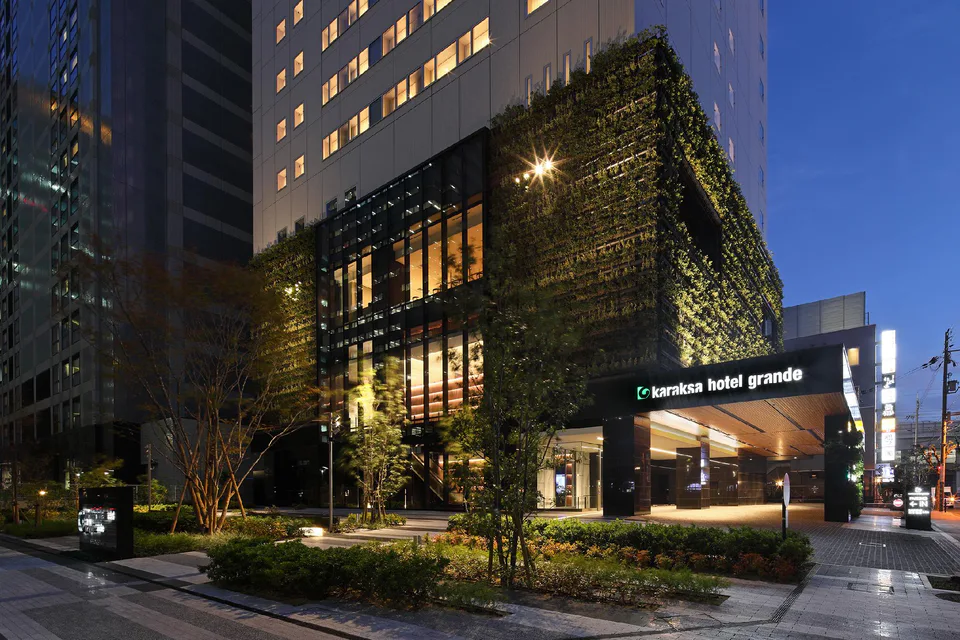
KIX is a boundary-day problem, not a five-night hotel strategy
Kansai Airport’s current rail information illustrates the trap. Namba is excellent for KIX: about 34–39 minutes by Rapi:t. Shin-Osaka is also directly connected by HARUKA in about 50 minutes, and Osaka Station has JR airport options. The fastest airport geometry depends on the exact base.
That does not mean the airport should choose the hotel for the middle of the trip. Give KIX heavy weight only when the flight timing is genuinely difficult: very late arrival, early departure, children, large luggage or a connection you cannot afford to miss.
If the flight is at 15:00, moving from a perfectly placed Umeda hotel to Namba purely to save part of the airport ride may create more total work. If the flight is early and the final Namba night also gives you a Dotonbori evening, then the move performs two jobs and becomes much stronger.
This “two jobs” rule is the recurring theme of a good split stay.
The hotel move has a fixed cost; demand a measurable payback
A hotel change is often treated as a free line in an itinerary: “3 nights Namba + 1 Universal City + 1 Shin-Osaka.” In practice it has a fixed workflow:
pack → checkout → store/carry luggage → travel → wait for room/check-in → unpack.
That cost becomes larger with children, shopping bags and multiple full-size suitcases. It becomes smaller when luggage forwarding or station lockers remove the hand-off.
I would use this ValueNavi threshold:
One hard movement removed: normally keep the existing hotel.
Two hard movements removed: price the split seriously.
Three hard movements removed: the second base usually has a real job.
Examples:
Weak split: Namba → Universal City for one ordinary USJ day → back to Namba. One commute has been traded for a hotel move.
Strong split: Namba → Universal City before two USJ days. The move deletes two early starts and two late returns.
Strong final-night split: Kyoto/Kobe day ends at Osaka Station → Shin-Osaka hotel → very early Shinkansen. The move aligns with both the previous route and next departure.
Strong Namba final night: last Osaka evening in Dotonbori → Namba hotel → early-ish KIX transfer. One room solves evening and airport edge.
Families should let the hardest day choose the base
A family hotel is not simply a larger room. The base should reduce the day with the highest operational burden: USJ, a long Kyoto outing, an arrival with several bags or a departure morning.
For a stroller and two children, one fewer transfer after a 12-hour park day can be worth more than ten extra square metres. For a five-night stay with a washer-dryer and several child outfits, room utility can outweigh a small station-distance advantage.
Run the hardest-day test: imagine the group at its most tired. Which journey do you most want to remove? That answer often reveals the right area faster than averaging every Google Maps travel time.
Use where to stay in Osaka with kids when room layout, baths and child logistics need to be added to the area decision.
Older travellers should value transfers more heavily than kilometres
A route that is five minutes faster but requires another platform change, long station corridor or staircase can be the worse route for older parents. For that group, count:
number of transfers;
outdoor walking;
elevator dependency;
places to sit;
luggage hand-offs;
the walk after dinner.
That can push the answer toward a true station-connected Umeda hotel, a Namba hotel above the transport hub, or a specialist final night even when the room rate is higher.
Solo travellers and couples can tolerate more imperfect geography
One carry-on changes the economics of Osaka. A solo traveller can cross the city late, change hotels cheaply and use small rooms without the same friction a family experiences. That means the area decision can lean more heavily toward nightlife, food and personal preference.
But the principle does not change: pay for what repeats. A solo traveller who spends four evenings in Namba should not stay in Umeda simply because Kyoto appears once in the itinerary.
Three nights: one base almost always wins
With only three Osaka nights, routine split stays are usually overengineering. Pick the area that best serves the majority of hard edges.
Food/nightlife + KIX: Namba.
Kyoto/Kobe/Himeji heavy: Umeda.
USJ is the primary purpose for most of the stay: Universal City can become the main base.
Use Shin-Osaka only when the departure constraint is genuinely exceptional. Three nights are too short to spend one of the transitions proving that several Osaka hotels are convenient.
Five to seven nights: split only when the trip changes geographic centre
A longer stay can justify two bases, but it does not require them. The strongest split happens when the itinerary itself changes phase.
For example:
3 nights Namba for Osaka evenings → 2 nights Universal City for two park days.
4 nights Umeda for regional days → 1 final Shin-Osaka night for a very early departure.
4 nights Umeda/Namba → 1 Namba final night only when it also delivers the final Minami evening and easier KIX morning.
A weak split simply alternates famous neighbourhoods. A strong split changes when the repeated transport problem changes.
Final decision: choose the node you repeat, then add a specialist base only when it earns two jobs
Namba is the default for repeated Minami evenings and strong KIX geometry. Umeda is the default for repeated Kyoto/Kobe/Himeji movement. Universal City is the specialist answer when USJ creates at least two hard edges. Shin-Osaka is usually a tactical final night for a genuinely early Shinkansen, not a general Osaka base.
Do not average every journey equally. Weight early departures, late returns, children, luggage and repeated station use more heavily. Then demand that any hotel move remove at least two meaningful problems before you accept the packing cost.
If two areas still tie after that test, choose the better room and cancellation terms. Once the transport difference is small, the hotel itself is allowed to decide the answer.
Where to Stay in Tokyo With Parents: I’d Eliminate These “Convenient” Hotels First
Osaka Budget Itinerary: 7 Days With USJ, Kyoto, Nara and Kobe — Without Buying Every Pass
Osaka Attractions With Kids: Choose by Age, Rain and Stroller Friction — Not a Must-See List
References
Kansai International Airport — current rail access times · Universal Studios Japan — train access · Universal Studios Japan — current operating-hours guidance. Checked August 25, 2026. Train patterns, park hours and event operations can change; verify the exact travel date.