
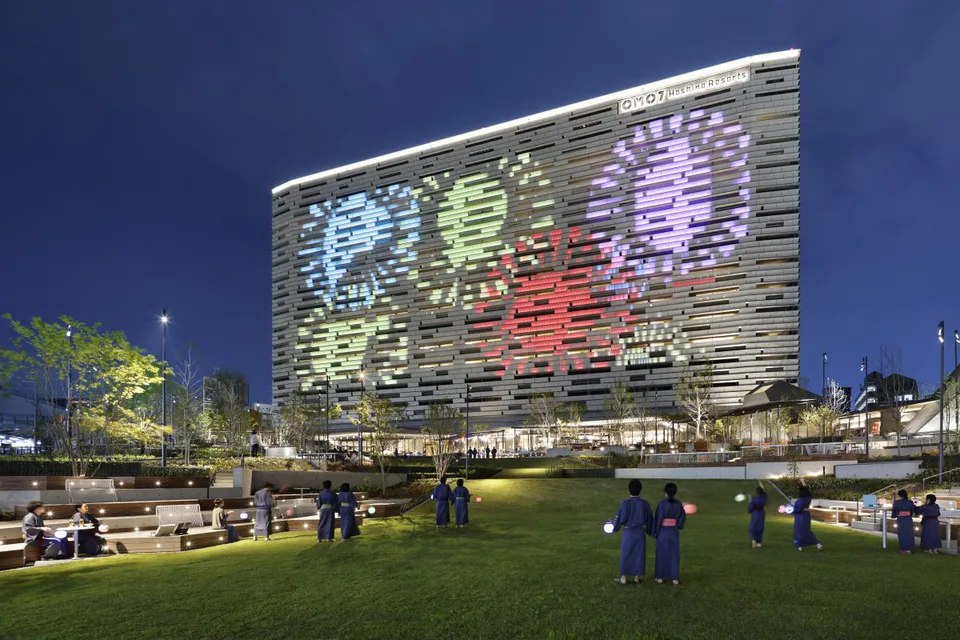
OMO7 Osaka is a strong Osaka base when Shin-Imamiya solves more than one hard part of your trip: Kansai Airport, south-Osaka sightseeing, an earlier-return USJ day, or hotel evenings you will actually use. I would not book it simply because it is “near Namba” or because the USJ shuttle is free. The shuttle returns from USJ at 17:30 and 18:50, the public bath costs JPY 1,000 per guest per night, and OSAKA PIKAPIKA NIGHT finishes at 22:00. If your trip repeatedly returns after those windows, much of the hotel-specific premium disappears.
The better way to judge OMO7 is to count repeatable benefits. Kansai Airport access pays mainly on arrival and departure. A USJ shuttle may pay once. Miya-green, the evening programme, the bath, shared spaces and a group-friendly room can pay repeatedly. Over a three- or four-night stay, the hotel makes sense when several of those layers overlap—not when one attractive feature is doing all the work.
OMO7 Osaka: the 30-second decision
↔ Scroll table left or right
Your trip pattern | My verdict | Why | What can reverse it |
KIX arrival/departure + south Osaka + early-return USJ day | Strong fit | Shin-Imamiya solves multiple edges of the trip | Most evenings finish in Umeda, Kyoto or USJ after the hotel windows close |
One night after a late KIX arrival | Good transport choice | Nankai Rapi:t reaches Shin-Imamiya in about 37 minutes and the hotel is directly outside the station | An airport-area hotel removes the train completely and your onward route does not need Osaka |
You want Shinsekai's retro downtown atmosphere in the stay | OMO7 gets stronger | The hotel deliberately builds local Shinsekai walks and neighbourhood culture into its experience | You actually want a polished business/shopping-district base rather than a south-Osaka neighbourhood experience |
USJ until park close / Halloween late night | Do not value the return shuttle highly | Current hotel shuttle returns leave USJ at 17:30 and 18:50 | You deliberately leave early enough to use the shuttle and hotel evening |
Four to six travellers sharing one room | IDOBATA Suite gets stronger | 59 m², four fixed beds and shared living space solve a different group problem | Guests five and six still use sofa beds; equal-bed groups must verify the layout |
Three to four nights dominated by Umeda / Kyoto / Shin-Osaka | Compare another base | The airport benefit is one-off while northbound travel repeats | You repeatedly use Nankai, Shinsekai, Tennoji or hotel facilities at night |
Shin-Imamiya is valuable when it solves a direction, not because it sits “in Osaka”
The hotel is directly beside JR Shin-Imamiya Station East Exit and Nankai Shin-Imamiya Station North Exit; Osaka Metro Dobutsuen-mae is also nearby. That gives OMO7 three useful directional advantages.
Kansai Airport: the hotel’s official access page gives about 37 minutes by Nankai Rapi:t from Kansai Airport to Shin-Imamiya, with the hotel directly outside the station.
South Osaka / Shinsekai / Tennoji: the hotel is already inside this side of the city rather than requiring a cross-Osaka return every night.
JR Osaka Loop Line: Osaka/Umeda and other city districts remain reachable, but they are journeys you should count when they repeat.
The common planning mistake is letting the airport ride choose a four-night hotel. A 37-minute KIX transfer can be excellent and still be irrelevant to three days spent north of the hotel. The airport journey happens once at each edge; your daily sightseeing pattern happens repeatedly.
If your nights are mostly Dotonbori and Namba, compare Namba vs Umeda before assuming Shin-Imamiya is “close enough”. If repeated Kyoto, Kobe or Himeji days dominate, an Osaka Station/Umeda base may reduce more total movement even though KIX is less elegant.
Shin-Imamiya is also a neighbourhood choice, not just a rail interchange
Official Osaka tourism material describes nearby Shinsekai as a south-Osaka downtown district built around Tsutenkaku, Janjan Yokocho, kushikatsu shops and a strong retro entertainment atmosphere. Hoshino Resorts leans into that identity rather than hiding it: OMO7 currently runs a guided Shinsekai neighbourhood walk, and its own hotel guide presents the district as part of the stay.
That matters because the same location can be a benefit or a mismatch even when the train times are perfect. A traveller who wants local food, Tsutenkaku, Shinsekai streets and a visibly different side of Osaka can treat the neighbourhood as a repeatable hotel benefit. You can finish sightseeing, walk locally, eat nearby and return without turning every evening into a Namba or Umeda trip.
The answer changes if the preferred hotel environment is a polished department-store district, a major office hub or a base where the streets immediately outside the hotel feel like an extension of Umeda or central Namba. Shin-Imamiya is not a cheaper imitation of those districts. Its south-Osaka, retro-downtown character is part of what you are booking.
This is not a claim that ordinary visitors should avoid Shin-Imamiya or Shinsekai. Osaka's official tourism pages actively promote the area as a sightseeing and food district, and OMO7 itself sells guided neighbourhood experiences for hotel guests. The decision point is fit: if the local character is something you want to use, add it to OMO7's value; if you expect to bypass the neighbourhood every day, value it at zero rather than assuming “interesting area” is automatically a benefit.
ValueNavi rule: do not let KIX access choose a multi-night base before you decide whether you actually want to live in south Osaka for those nights. Transport convenience and neighbourhood preference are separate dimensions.
Use a repeat-value ledger for stays longer than one night
Instead of asking whether OMO7 has good facilities, count how many times you will realistically use them.
↔ Scroll table left or right
Benefit | How often can it pay? | When to discount it |
KIX / Nankai access | Usually once or twice | Open-jaw trip, Itami flight, or another final-night airport hotel |
Shinsekai / south-Osaka neighbourhood | Potentially every day and evening | You leave the area immediately after breakfast and return only to sleep |
USJ shuttle | Usually one park day | You stay until late evening and return by rail |
OSAKA PIKAPIKA NIGHT | Potentially every night | You return after 22:00 or simply do not want a hotel event |
Yuya public bath | Morning and/or evening on nights you pay for it | You return near midnight, dislike public baths or do not need the recovery time |
Large group room / shared living space | Every hour spent in the room | Two travellers would be paying for unused capacity |
This is why a one-night and four-night OMO7 booking are different decisions. For one night, station access can dominate. Over four nights, the room layout, neighbourhood fit and repeated evening geography matter much more.
OSAKA PIKAPIKA NIGHT is a real hotel benefit only before 22:00
OMO7 currently runs its year-round OSAKA PIKAPIKA NIGHT from 19:15 to 22:00, with the main KOTEKOTE SHOW TIME around 20:30–20:45 and final reception at 21:50. It is free for hotel guests and does not require a reservation.
There is also a current seasonal layer: the OSAKA PIKAPIKA NIGHT Summer Festival runs through August 31, 2026, with summer-festival food and games. After that date, do not assume the summer stalls continue merely because the year-round night programme does. The permanent value is the 19:15–22:00 hotel evening; the summer festival is a dated overlay.
This creates a useful return-time test. A traveller back at 19:30 can shower, eat, use Miya-green and still join the evening. A traveller back at 22:20 cannot. If three nights in your itinerary look like the latter, remove PIKAPIKA NIGHT from the rate premium before comparing OMO7 with another hotel.
The USJ shuttle is an early-return product, not a “park-close transport” product
OMO7’s current guest-only USJ shuttle takes about 30 minutes and requires a reservation. The official timetable currently lists:
OMO7 → USJ: 08:00–08:30 and 09:20–09:50.
USJ → OMO7: 17:30–18:00 and 18:50–19:20.
The bus leaves on time, can be delayed or cancelled by traffic conditions, and reservations are accepted until the relevant boarding time while capacity remains. The USJ pickup is at Hotel Kintetsu Universal City’s first-floor bus depot, about a three-minute walk from the park.
The decision value is not “free shuttle = good”. The return timetable tells you which park day it fits. If you want Horror Nights, a closing-time park strategy or dinner inside the park, the shuttle may have zero return value. Rail remains the real late-evening plan.
Conversely, families intentionally leaving around 17:30–18:50 can turn the shuttle into a sequence: park → seated ride → hotel by early evening → PIKAPIKA NIGHT → bath → sleep. That is when OMO7’s different features reinforce each other instead of competing for the same hours.
The public bath costs JPY 1,000—so count the sessions you will actually use
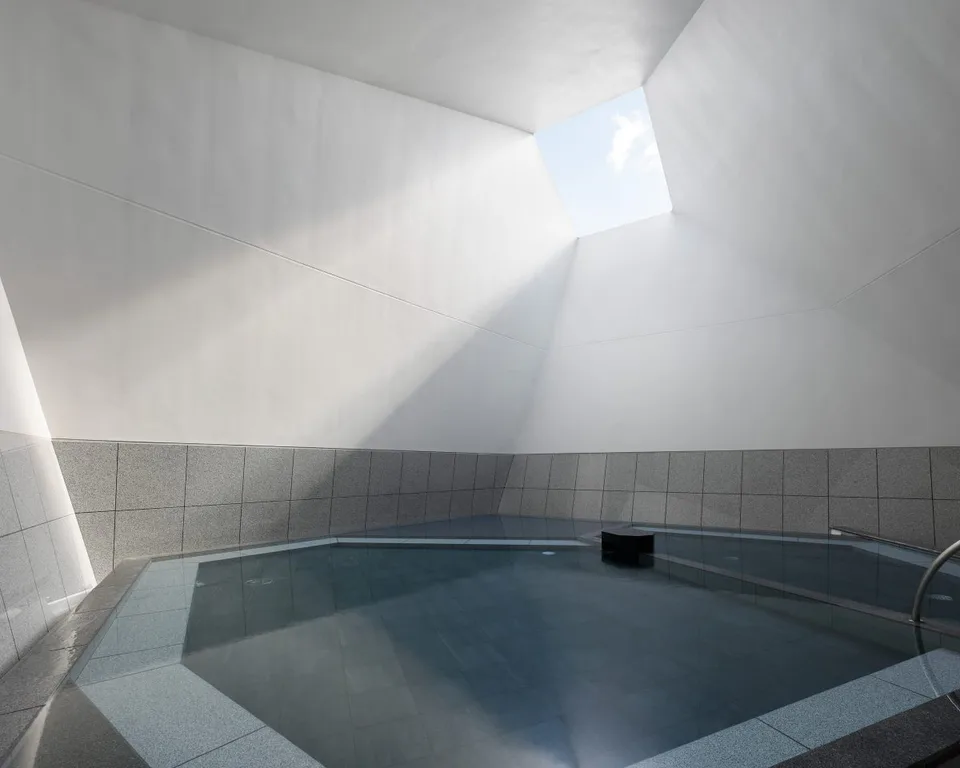
The guest-only Yuya public bath currently operates 06:00–10:00 and 15:00–00:00 and costs JPY 1,000 per person per night; children under six are free. The hotel explicitly says it is not a natural hot spring. Children in nappies cannot use the main bathtub and must use the baby bath provided.
That means Yuya is not an automatically included “onsen benefit”. For two adults over three nights, paying every night would be JPY 6,000. If you only intend to bathe once, judge it as a one-session JPY 2,000 couple expense, not as a defining feature of the entire stay.
I would value it highly after a long walking day when the group returns by 21:00. I would value it much less after a late USJ night when the useful window before midnight is short. This is another reason the hotel’s best features favour earlier-return travellers.
DANDAN Room vs IDOBATA Suite: occupancy is not the same as equal beds
The DANDAN Room is 29.6 m² for one to three guests. The current official room information lists two 105 × 200 cm beds and a 90 × 200 cm sofa bed for the third guest; when three people stay, guests set up that bedding themselves.
The IDOBATA Suite is 59 m² for up to six guests and is designed around a large shared living area and four fixed beds. That makes it a much more credible four-person group room than simply booking two compact rooms elsewhere when everyone wants to plan, eat or talk together.
But capacity six does not mean six equal fixed beds. For groups of five or six, verify the additional sleeping surfaces and decide whether the shared 59 m² space is worth that trade-off. Four adults who strongly prefer four fixed beds are a much cleaner IDOBATA fit than six adults who assume every sleeping position is identical.
For two travellers, do not upgrade merely because 59 m² sounds luxurious. The suite’s value is group circulation: shared seating, planning space, wash-area convenience and fewer people queuing around one compact room. If those problems do not exist, the extra area can be mostly unused premium.
One night, two nights or four nights?
One night: judge OMO7 as a transport hotel first
A late KIX arrival, an early south-Osaka start or a transition between KIX and the city can make the station location the main product. Do not overpay for hotel facilities you will not use before checkout.
Two nights: the hotel can finally create a coherent USJ sequence
Arrive, use Shinsekai/Osaka, sleep, take the USJ shuttle the next morning, return on an early shuttle and use the hotel evening. This is one of the cleanest two-night patterns because the shuttle, programme and bath can all be used without forcing them into one late arrival.
Three to four nights: the repeated direction matters more than KIX
Now count where each complete day begins and ends. If two or three evenings are around Shinsekai/Tennoji/Namba and the group actually uses Miya-green, the hotel can keep earning its premium. If every day pushes north to Umeda, Shin-Osaka or Kyoto and every night returns after 22:00, the station-front KIX advantage has become a small part of a much larger stay.
The OMO Kansai Airport luggage service can make a final-night split unusually clean
There is one OMO-specific transition that deserves separate consideration. Hoshino Resorts currently operates a luggage-delivery service between OMO7 Osaka and OMO Kansai Airport. The current service starts from JPY 500 per item, requires web reservation by 23:00 the previous day and baggage drop by 09:00 on the day of transfer.
This can change the final-night calculation. A normal Osaka → airport-hotel split means checking out, carrying large luggage through the train, checking in again and then going back out if you still want to sightsee. With the OMO-to-OMO service, you can send the main bags and keep a day bag.
I would use this only when an airport hotel genuinely solves an early flight or very low-stress departure. Do not add an airport night just because luggage delivery exists. The service reduces the friction of a justified split; it does not justify the split by itself.
Who should choose another Osaka base?
I would move OMO7 down the list when at least two of these are true:
most complete days start around Osaka Station, Shin-Osaka or Kyoto;
every evening ends after 22:00, so the hotel programme is repeatedly unusable;
USJ is a closing-time day, making the return shuttle irrelevant;
nobody wants the paid public bath or shared hotel spaces;
you want a polished Umeda/Namba-style commercial district outside the hotel and do not plan to use Shinsekai's retro downtown character;
the group is only two people and a smaller room in the preferred district is materially cheaper;
KIX is only one trip edge and another hotel reduces more repeated city travel.
If your repeated high-cost movement is JR day trips, compare Osaka Station hotels for Kyoto and Kobe day trips. If your nights belong to Dotonbori and Shinsaibashi, compare Namba vs Umeda. If USJ itself owns two days, compare Universal City, Umeda and Namba for USJ.
Three traveller scenarios
Family of four: KIX → Osaka → one USJ day
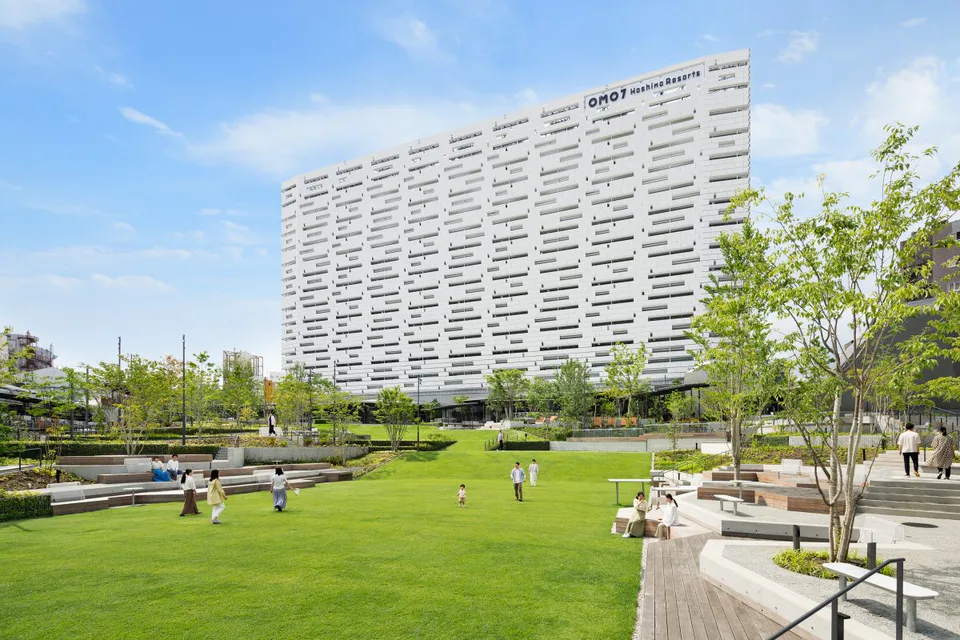
OMO7 is a strong candidate. The KIX arrival is simple, IDOBATA can keep the family in one large shared room, and an early-return USJ day can feed directly into the hotel evening. Recheck the total suite price against two rooms elsewhere; “one room” is only a benefit when the rate and sleeping layout still make sense.
Couple: four Osaka nights, late food every night
I would usually compare Namba first. OMO7’s airport access is attractive, but the nightly return pattern matters more than one airport ride. If both travellers return after PIKAPIKA NIGHT and never pay for Yuya, the hotel-specific experience is largely unused.
Two adults: one OMO7 night, then early flight next day
OMO7 can work when the flight is not so early that an airport hotel is clearly safer. For a genuinely early KIX departure, compare moving to OMO Kansai Airport and using the dedicated luggage delivery rather than assuming Shin-Imamiya should remain the final night simply because Rapi:t is direct.
Final verdict
OMO7 Osaka is best when several parts of the same itinerary point south: KIX, Shinsekai/Tennoji, an earlier-return USJ day and hotel evenings before 22:00. In that pattern, Shin-Imamiya is not a compromise location; it is the node that lets several benefits overlap.
That verdict also assumes the neighbourhood itself fits the trip. Shinsekai's retro downtown streets, local food and south-Osaka atmosphere can be a repeatable benefit when you actually want them; if you plan to bypass the area every day and would rather step outside into a polished Umeda/Namba-style commercial district, treat the neighbourhood premium as zero and compare another base.
The answer reverses when only the airport points south. A four-night guest commuting north every day and returning after the hotel programme has ended is paying repeatedly for the wrong geography. A free shuttle you cannot use, a JPY 1,000 bath you will not enter and a night programme you never see should all be valued at zero.
Choose the room and base by what repeats. For two or three guests, DANDAN can be enough when its bunk/sofa-bed layout fits. For four travellers, IDOBATA’s four fixed beds and 59 m² shared space create a materially different product. For a final justified airport-night split, the OMO7 ↔ OMO Kansai Airport luggage service is a rare case where the hotel ecosystem can remove part of the usual transfer penalty.
Compare OMO7 Osaka rooms on Booking.com
Compare OMO7 Osaka rooms on Trip.com
Compare OMO7 Osaka rooms on Agoda
References
OMO7 Osaka official hotel page · Official access · OMO7 Osaka official neighbourhood activities · OSAKA-INFO — official Shinsekai tourism guide · Official USJ shuttle · Official Yuya public bath · Official OSAKA PIKAPIKA NIGHT · OMO7 Osaka–OMO Kansai Airport luggage delivery. Checked August 25, 2026. Shuttle schedules, activity times, room inventory and service conditions can change; verify the actual stay date before booking.