
For most families spending four or five nights in Osaka, I would keep one main base in Namba or around Osaka Station unless USJ takes two days or creates the hardest part of the trip. Universal City is strongest when it removes repeated early starts and exhausted late returns. Namba is stronger when the family needs a practical room—real beds, washer-dryer, fridge, microwave or kitchen—and most evenings end in Minami. Osaka Station is stronger when the stroller keeps passing through JR for Kyoto, Kobe or other day trips.
One family-specific correction matters before anything else: a hotel beside Universal Studios Japan does not automatically give a standard Studio Pass holder a midday hotel break. USJ currently says admission tickets other than Annual Passes do not allow re-entry after leaving the park. For a normal one-day ticket, Universal City mostly buys an easier morning and an easier final return—not a guaranteed nap-in-the-room-and-go-back strategy.
The 30-second family base decision
↔ Scroll table left or right
Your repeating problem | Start with | What the base solves | Main boundary |
Two USJ days, stroller, child likely asleep after the park | Universal City | Two early park approaches and two post-park journeys disappear | Standard Studio Passes do not allow ordinary midday exit-and-re-entry |
One USJ day inside a 4–5 night Osaka stay | Namba or Osaka Station | You absorb one park commute instead of commuting from Universal City on every other day | A very late park finish, toddler or mobility constraint can still justify one park-side night |
2 adults + children, 3–5 nights, laundry and food reheating matter | Namba / Hotel Keihan Namba Grande | In-room washer-dryer, large fridge, microwave/kitchen functions and double basins | Those features have little value on a short stay if you will not use them |
4–6 people need a real table, kitchen and more separation | Namba / MIMARU | Apartment-style group living rather than extra beds squeezed into one room | Not every room has in-room laundry; exact room type matters |
Two or more JR day trips plus Osaka Station arrival/departure | Osaka Station / Umeda | The same stroller-and-luggage station leg is shortened repeatedly | It is a poor premium if Namba and USJ dominate the itinerary |
For families, start with the hardest day—not the biggest room
A “family-friendly hotel” can still be wrong for the itinerary. The room may have toys and children’s amenities but force a sleeping child through two transfers every night. Another hotel may look plain but remove the exact station the stroller would cross six times.
Before comparing hotels, write down the hardest family day:
two consecutive USJ days;
a late park finish with a sleeping child;
three nights of dirty clothes and bottles/food to manage;
two or three JR day trips with a stroller;
four to six people all getting ready in one room;
an early airport or Shinkansen departure.
The base should remove the problem that repeats. A feature used once is a bonus; a transfer repeated twice a day is part of the trip.
Universal City is strongest for two USJ days—but the no-re-entry rule changes the toddler calculation
With two consecutive USJ days, Universal City is easy to justify. The family removes the city-to-park journey twice in the morning and removes the exhausted return twice at night. For a stroller, that is four high-friction transitions deleted from the trip.
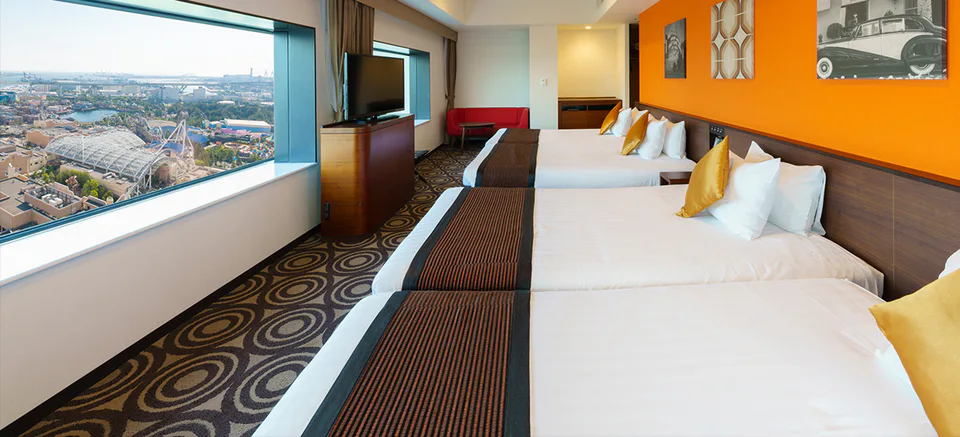
The Park Front Hotel is the cleanest example. Its official site puts the park entrance about one minute away, and current Park View / Family categories commonly run around 40–45.5 m². That gives families two separate benefits: the near-gate location and room sizes that can be more realistic for several people and several bags.
But the hotel should not be justified with a standard “we can take the toddler back to the room for a nap, then re-enter” assumption. USJ currently states that Studio Passes other than Annual Passes do not permit re-entry after exiting. If you leave the park on a normal one-day pass, you have normally ended that park day.
That changes who should pay the Universal City premium:
Strong: two USJ days, very early starts, stroller, late finishes, larger family room required.
Conditional: one USJ day with a young child. The hotel still protects the morning and final return, but it does not automatically solve the midday-nap problem.
Weaker: one USJ day, older children who handle trains well, and three or four other days in central Osaka/Kyoto.
Different answer: Annual Pass holders. USJ currently permits Annual Pass re-entry, so a nearby room can genuinely become part of the day.
Use the rebuilt Park Front Hotel decision guide before paying specifically for gate proximity.
One USJ day usually does not justify moving the whole Osaka stay
One park day creates one outbound commute and one return. A hotel move creates packing, checkout, luggage storage or forwarding, another check-in and a new room setup. With children, that move costs more than it does for two adults because the family is also repacking chargers, snacks, medication, sleep items, stroller accessories and children’s clothes.
I would therefore use a higher burden of proof for a split stay:
Weak split: three Namba nights + one Universal City night solely to save one ride home.
Stronger split: two central nights + two Universal City nights around two park days.
Stronger one-night exception: a very late USJ event followed by a slow departure morning, where the park-side night protects sleep and does not force another early hotel move.
The second hotel should remove at least two high-friction family journeys before the move starts looking efficient.
Namba wins when the room needs to perform family work every day
Namba is not only a food-and-shopping answer. It becomes a family answer when the room itself saves repeated domestic work.
Hotel Keihan Namba Grande’s current Family Room is 44 m², sleeps up to five, and uses four 110 cm fixed beds for four guests with an extra bed for a fifth. More important for a multi-night family stay, the official room information lists a washer-dryer, IH cooking, oven-microwave, 90 L fridge/freezer, double washbasins and a bathroom with a washing area.
Those features have measurable use cases:
laundry can run after the children sleep;
two people can use the washbasins at once;
milk, fruit or breakfast food can be stored properly;
simple food can be reheated without another restaurant trip;
four actual beds reduce the need to decode a “sleeps four” label.
The trade-off is obvious: if you stay one night, wash nothing and eat every meal outside, much of that equipment becomes unused inventory. Do not pay a long-stay premium for a short-stay family.
For the detailed room choice, use the Hotel Keihan Namba Grande Family Room vs Connecting Rooms guide.
For 4–6 people, count toilets, sinks and real sleeping surfaces before square metres
Once the group reaches four, five or six, total area alone becomes a weak metric. A 50 m² room with one toilet and one bathroom can still create a morning queue. A slightly different layout with two toilets, two basins and separated sleeping zones can move six people much faster.
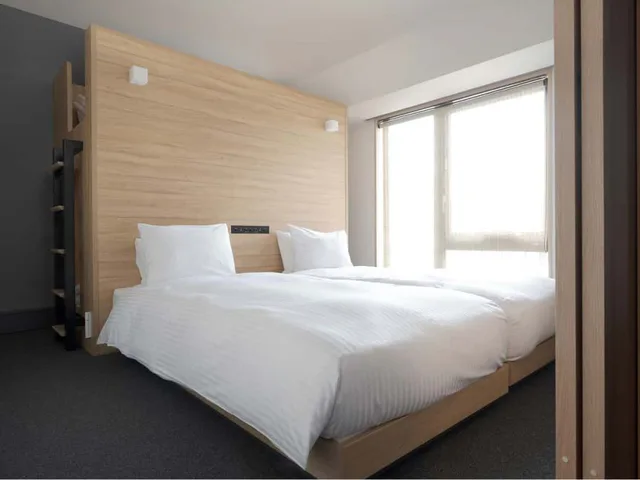
MIMARU Osaka Namba Station shows the difference between room categories. Its current 35 m² Family Apartment has two single beds plus one bunk bed, one basin, one toilet and one bathroom; it does not have an in-room washer-dryer. The current 51 m² Two-Bedroom Japanese Apartment adds two basins, two toilets and an in-room washer-dryer. The 61 m² Two-Bedroom Family Suite adds four single beds plus a bunk bed, two basins, two toilets, a bathroom plus shower room and an in-room washer-dryer.
So “book MIMARU for laundry” is too broad. The correct question is which MIMARU room solves the family bottleneck. A family of four may need the 35 m² room only for beds and kitchen space; six people who all get ready together may get much more value from the two-bedroom geometry.
If you never cook and the children are old enough to manage ordinary hotel routines, the apartment premium can disappear. Use the MIMARU Osaka Namba Station room guide to compare the exact category rather than the brand.
Osaka Station wins when the stroller keeps making the same JR journey
Families often choose Umeda because it is “convenient,” but that label only means something if the trip repeatedly uses Osaka Station. Two or more Kyoto/Kobe/Himeji-style rail days, plus an arrival or departure through JR, can make the station connection valuable several times.
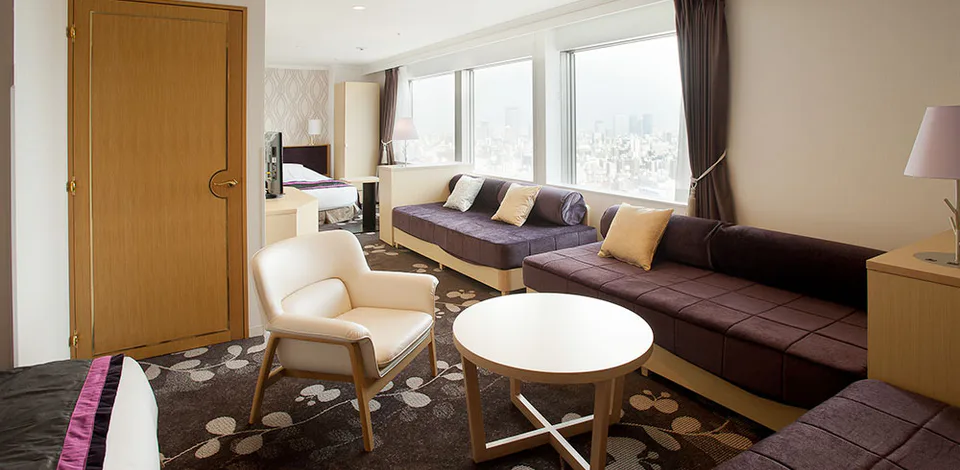
Hotel Granvia Osaka is directly connected to JR Osaka Station. Its current Family 4 is 43 m² for up to four guests. The current Family 7 is 70 m² for four to seven guests and adds living space, a separate bathroom and a separate shower room. For larger families, that is not merely more floor area; it can reduce the queue for washing and changing.
The location premium should be counted the same way. If the stroller crosses Osaka Station three mornings and three evenings, the direct connection is used six times. If there is only one Kyoto day and every other night ends in Namba, paying four nights of Osaka Station premium for two useful station legs is a poor trade.
A stroller changes “five minutes” into a route-quality problem
Walking time is not enough for a family-base comparison. With a stroller, the relevant route is the accessible route: lift location, platform change, crowding, whether the child can remain asleep, rain exposure and how many times the stroller must be folded or lifted.
This is why the same five-minute hotel distance can feel different across Osaka. A direct station connection can beat a geographically closer hotel if the latter requires an awkward exit. Conversely, a slightly longer flat walk around Namba can be easier than navigating a large interchange when the family mostly stays in Minami.
Use the final 500 metres as a veto. If the hotel only looks convenient when everyone is walking quickly with no luggage and no stroller, it is not the same product for your family.
Breakfast should be scored by usable mornings
Park and rail mornings are where prepaid breakfast is easiest to waste. The Park Front currently lists breakfast from 07:00 to 09:30, while USJ warns that admission may begin earlier than the published park opening time on some days. A family paying to sleep beside the gate for an early-start strategy may not want a slow hotel breakfast on that morning.
The same logic applies to an early Kyoto departure from Osaka Station or a flight day. Count how many mornings the family will realistically sit down for breakfast before paying a multi-night breakfast premium. “Includes breakfast” is only value on the mornings you can use it.
Kansai Airport should influence the bookend, not automatically every night
Namba is often attractive on a Kansai Airport arrival because Nankai brings the family into the same side of Osaka as many Namba hotels. Hotel Keihan Namba Grande currently states about a six-minute walk from Nankai Namba, while MIMARU Osaka Namba Station lists about four minutes from Nankai Namba Station.
That first-night simplicity is useful after a flight, but it should not override four days of repeated JR or USJ movement. Split the trip into three parts: arrival, repeated middle days and departure. The middle days deserve the most weight because they repeat.
When I would split hotels with children
I would split only when the second base has a job that is larger than the move itself.
Yes: 2–3 central Osaka nights + 2 Universal City nights around two USJ days.
Yes: Namba arrival nights followed by an Osaka Station base when several JR day trips and the final Shinkansen all move north.
Usually no: move to Universal City for one ordinary USJ day, then move back immediately.
Usually no: move from Namba to Osaka Station only because one Kyoto day appears on the itinerary.
If forwarding or storing the large suitcases removes most of the move friction, the threshold can drop. But luggage logistics should support a sensible base change; they should not be used to justify one that saves almost nothing.
Final decision tree
Two USJ days? Start with Universal City. If the family is relying on a midday hotel nap, verify the ticket first: ordinary Studio Passes currently do not permit re-entry.
One USJ day and three or more central-Osaka days? Keep the main base central unless the late return itself is severe enough to justify one specialist night.
Three to five nights and laundry/reheating will be used repeatedly? Put Hotel Keihan Namba Grande high on the shortlist.
Four to six people and bathroom/bedroom separation is the bottleneck? Compare the exact MIMARU two-bedroom layout, not just the brand.
Two or more JR day trips? Osaka Station/Umeda gets stronger; Hotel Granvia is the cleanest example of paying for repeated station access.
The final choice should survive one question: what family problem will this hotel solve at least twice? If the answer is only a feature you may use once, move that feature down the ranking and choose the base that simplifies the rest of the trip.
Where to Stay in Aomori on Your First Night: Station, Aomoriya, Oirase or Hirosaki
Hotel Royal Classic Osaka: What Does “Connected to Namba Station” Actually Save?
Where to Stay for Kochi Yosakoi: Station, Obiyamachi or Saenbacho
Where to Stay in Takamatsu: Station or Kawaramachi for Ferries, Trains and Evenings?
References
Universal Studios Japan — current re-entry rules · Universal Studios Japan — current operating-hours guidance · The Park Front Hotel — current location · The Park Front Hotel — current Park View / Family room sizes · Hotel Keihan Namba Grande — current Family Room · MIMARU Osaka Namba Station — current room layouts · Hotel Granvia Osaka — current Family 4 / Family 7 rooms. Checked August 25, 2026. Park rules, hotel rooms, child policies and rates can change; verify the exact ticket and room before payment.