
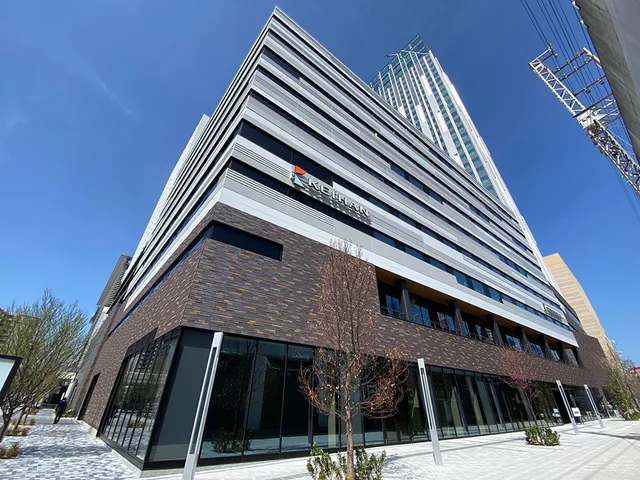
For four or five people staying at least three nights, choose Hotel Keihan Namba Grande’s 44m² Family Room when the group wants one shared space and will repeatedly use the in-room washer-dryer, kitchenette and twin basins. Choose two Connecting Rooms when the recurring problem is shower queues, privacy or two people needing to get ready at the same time. The important choice is not 44m² versus 40m². It is which daily bottleneck you want the room to remove.
The hotel currently lists the Family Room at 44m² for up to five guests, the Twin Room with Japanese Room at 42m² for up to five, and Connecting Rooms as 20m² × 2 for up to six. In 2026 it also introduced first-floor Smart Laundry with three washers and three dryers, available 24 hours. That update matters because in-room laundry is no longer the only workable laundry option.
The 30-second room decision
↔ Scroll table left or right
Group pattern | Start with | Reason |
4 people, 3–5 nights, want one shared room | 44m² Family Room | Four 110cm beds for four guests plus in-room washer-dryer, IH, oven-microwave, 90L refrigerator-freezer and twin basins. |
4 adults with early starts | Connecting Rooms | Two bathrooms and two washbasins increase parallel capacity. |
3–5 travellers comfortable with futons | Twin + Japanese Room | 42m², two beds plus 1–3 futons, with the same core long-stay equipment. |
1–2 nights, little or no laundry | Compare smaller eligible rooms | The large Concept Room features may not repeat enough to justify a premium. |
ValueNavi Family Hotel Logistics Score
This article uses the same family-hotel model as the related Namba comparisons: occupancy and bed fit 25%, parallel morning/evening capacity 20%, arrival and luggage friction 15%, long-stay self-sufficiency 15%, itinerary fit 15%, and likely premium/facility utilisation 10%. Scores are scenario-specific editorial analysis, not hotel quality ratings.
Scenario | Score | Main reason |
|---|---|---|
Family Room, four travellers, four nights, laundry/simple food used | Excellent long-stay self-sufficiency and four ordinary beds, but still one bathroom. | |
Connecting Rooms, four adults, two early-start days | Two bathrooms solve the highest-friction morning constraint. | |
Twin + Japanese Room, family comfortable with futons | Strong shared-space and long-stay setup; score drops if adults dislike floor bedding. | |
Family Room, two travellers, one-night stay | Too much of the room’s functional capacity is unused. |
ValueNavi Bathroom Queue Model: why two 20m² rooms can beat one 44m² room
Floor area does not tell you how fast four people can leave the hotel. The useful morning calculation is parallel capacity. A simple planning model is:
shower window = number of shower users × average shower slot ÷ number of bathrooms
For example, if four adults each need a 15-minute shower, one bathroom creates about a 60-minute shower window. Two bathrooms can reduce the theoretical window to about 30 minutes if the group splits evenly. This is a planning example, not a claim about how long any guest actually showers; it simply shows why two bathrooms can be worth more than four extra square metres.
↔ Scroll table left or right
Assumption | Family Room | Connecting Rooms |
4 people × 15-min shower slot | 1 bathroom → about 60 min sequential window | 2 bathrooms → about 30 min if evenly split |
Face washing / teeth / makeup | 2 basins help | 2 separate washbasins across two rooms |
Different sleep schedules | Everyone shares one room | Two sleeping zones reduce disturbance |
That leads to another ValueNavi formula for same-date rate comparisons:
premium per queue-hour removed = (Connecting Rooms total − Family Room total) ÷ (estimated queue hours saved across the stay)
If Connecting Rooms cost more, this tells you what you are effectively paying to buy back parallel morning/evening time. There is no universal acceptable number; a family with relaxed mornings may assign little value to it, while four adults catching early trains may assign a lot.
The Family Room’s real strength is self-sufficiency, not size
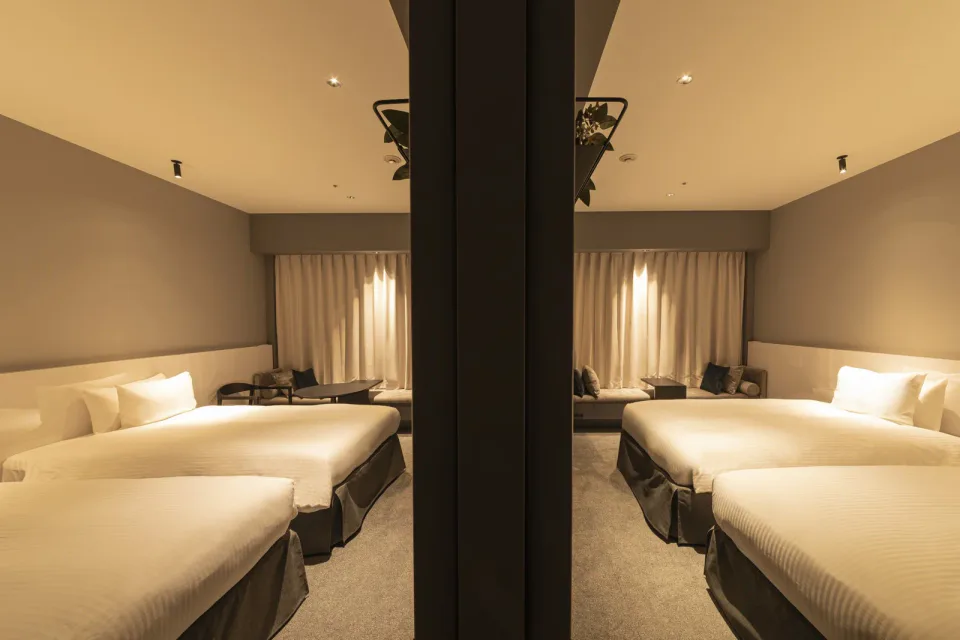
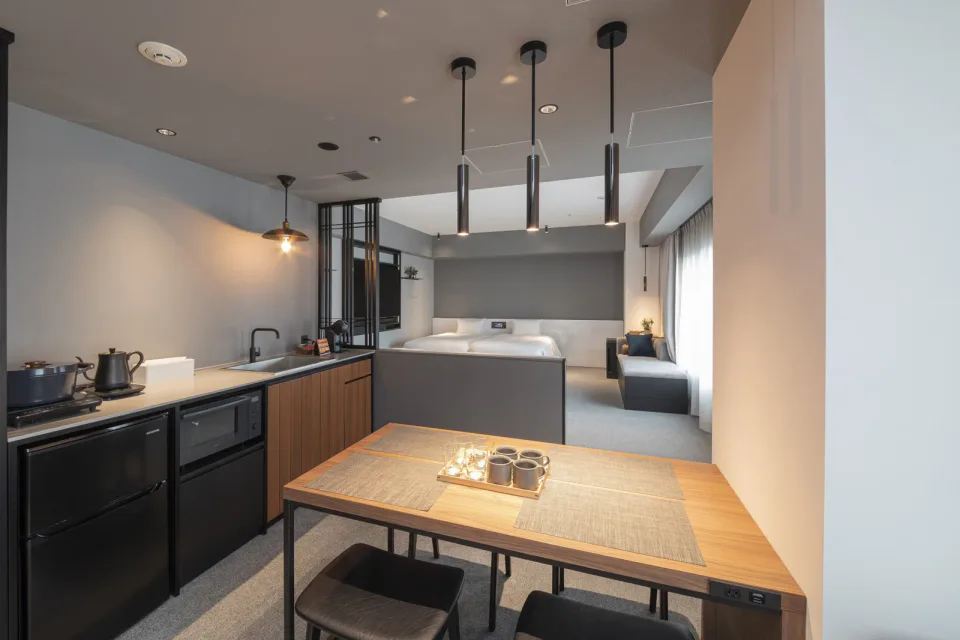
The official Family Room page lists four existing 110cm beds for four guests, with an extra bed for a fifth. It also lists an in-room washer-dryer, IH hob, oven-microwave, 90L refrigerator-freezer, double washbasin and separate washing-area bathroom. These features allow several tasks to overlap inside one room.
One person can start laundry while another prepares a simple breakfast; two people can use the washbasins while someone organises luggage. The hidden limit is that the room still has one bathroom. Twin basins reduce some congestion, but they do not duplicate the shower.
Twin Room with Japanese Room: choose it for the sleeping system, not the 2m² difference
The current 42m² Twin Room with Japanese Room takes up to five guests. Two guests use two 110cm beds; with three to five guests, one to three futon sets are added in the Japanese-style area. It carries the same core Concept Room equipment including washer-dryer, IH hob, oven-microwave, 90L refrigerator-freezer and twin basins.
The decision is therefore cultural and practical rather than numerical. Choose it when the party likes a tatami zone and accepts futon sleeping. Do not choose it because 42m² sounds almost the same as 44m². A traveller who strongly prefers a conventional raised bed may find the Family Room more valuable even though the floor areas are close.
ValueNavi Laundry Cost Threshold: in-room laundry does not automatically pay for the room upgrade
Hotel Keihan’s April 2026 Smart Laundry announcement lists the Namba Grande laundry corner with three washers and three dryers on the first floor, 24 hours. The current charge is ¥600 per wash and ¥100 per 10 minutes of drying, with cashless online payment. Using the 26 August 2026 exchange rate, ¥600 is about US$3.80 and ¥100 is about US$0.63; exchange rates move, so yen remains the booking reference.
That gives a useful threshold calculation. If a hypothetical load needs one wash plus 40 minutes of drying, the shared-laundry cash cost is:
¥600 + (4 × ¥100) = ¥1,000, or about US$6.30.
Three such loads would be ¥3,000, about US$18.90. This does not mean three loads always take 40 minutes to dry; it is a transparent scenario calculation. The point is that laundry fees alone will rarely justify a large multi-night room premium. The Family Room needs to earn the rest through convenience: no trip downstairs, no shared-machine availability risk, kitchenette use, larger refrigerator, twin basins and shared space.
↔ Scroll table left or right
Expected laundry during stay | Shared-laundry cash cost using 40-min dryer example | Decision implication |
0 loads | ¥0 | Do not assign value to the in-room washer-dryer. |
1 load | ¥1,000 ≈ US$6.30 | Convenience, not fee avoidance, must justify most of any room premium. |
3 loads | ¥3,000 ≈ US$18.90 | More meaningful on a longer stay, but still compare against the actual room-rate difference. |
Breakfast: localise the price, but value the schedule
The hotel currently lists breakfast at ¥2,200 per adult, about US$13.80 at the 26 August 2026 exchange rate, from 07:00 to 10:00 with last entry at 09:30 and around 60 seats. Prices can change, so yen is the reference.
The bigger decision for a group is timing. If everybody must sit down together at 07:00 before an early departure, breakfast can become another synchronisation point. The Concept Room kitchenette lets one traveller eat something simple earlier while another sleeps later. That is not automatically cheaper; it is a way to desynchronise the morning.
Namba access: useful from KIX, less magical from every other direction
The hotel currently quotes about six minutes from Nankai Namba’s south gate and about ten minutes from Osaka Metro Namba Exit 3. That distinction matters. A KIX arrival on Nankai fits naturally. A very early Shin-Osaka departure still requires a real walk to the Metro side and should not be planned as though the lobby were attached to the station.
For a trip centred on Namba, Shinsaibashi and Nipponbashi, the hotel’s southern-Osaka location works well. If most days begin in Umeda or Shin-Osaka, the room features need to be used often enough to compensate for the daily direction of travel.
A four-night workflow test
Consider four adults staying four nights with two early-start days. In the Family Room, laundry can run inside the room and two people can use the basins at once, but four showers still pass through one bathroom. In Connecting Rooms, laundry may require a first-floor trip, but two people can shower simultaneously and two separate sleeping zones make different bedtimes easier.
Now change the party to two adults and two children who return early, wash clothes every second night and eat a simple breakfast in the room. The Family Room becomes stronger because its one-room self-sufficiency is used repeatedly, while the second bathroom in Connecting Rooms may be less valuable. Same hotel, same dates, opposite result.
The ValueNavi decision sequence
↔ Scroll table left or right
Step | Question | If yes |
1 | Does the room legally fit the real guest count and preferred bedding? | Continue. If no, remove it before price comparison. |
2 | Will two or more people repeatedly need the shower at the same time? | Put Connecting Rooms high on the shortlist. |
3 | Will the group wash clothes, refrigerate food or use the kitchenette several times? | Give the Concept Family/Japanese room a stronger long-stay score. |
4 | Is the stay only one or two nights? | Reduce the weight of laundry/kitchen features and compare simpler eligible rooms. |
5 | Is the Connecting Room premium high? | Use the premium-per-queue-hour formula before paying for the second bathroom. |
Booking failure mode: OTA room names are not enough
Family Room, Superior Family Room, Twin Room with Japanese Room and Connecting Room are not interchangeable. Before paying, lock the actual guest count, bed plan, breakfast, tax treatment, cancellation deadline and whether the booking page is genuinely selling two internally connected rooms rather than two separate rooms by request. Reconfirm the final hotel confirmation when the layout matters to the trip.
Booking.com — check Hotel Keihan Namba Grande room types
Trip.com — check Hotel Keihan Namba Grande room types
Agoda — check Hotel Keihan Namba Grande room types
Final verdict
I would book the Family Room for four or five people staying at least three nights when laundry, refrigeration, simple food and one shared family space will be used repeatedly. I would compare Connecting Rooms first for four adults, two small family units or any group whose real problem is shower queues and different sleep schedules. I would skip the Concept Room premium for a short sleep-only stay where the kitchenette, washer-dryer and large shared space are mostly unused.
The red-team test is to remove one headline feature. If the washer-dryer disappeared, would the Family Room still win because of the beds, kitchenette, refrigerator, basins and shared space? If the Connecting Rooms lost the extra privacy, would the second bathroom still save meaningful time? If the answer is no, the rate premium is probably being justified by a feature rather than by the group’s actual bottleneck.
FAQ
How many people can the Family Room take?
The current official page lists 44m² and up to five guests. Four guests use four 110cm beds; a fifth uses an additional bed.
Do Connecting Rooms have two bathrooms?
The hotel describes the product as two 20m² rooms connected internally, with a bathroom and washbasin on each side. That duplicated wet-area capacity is the main reason to compare it for four adults.
Does every room have an in-room washer-dryer?
No. The in-room washer-dryer and kitchenette are listed for selected Concept Rooms. Other guests can use the first-floor Smart Laundry.
What does the shared laundry cost?
The current 2026 Smart Laundry announcement lists ¥600 per wash and ¥100 per 10 minutes of drying, cashless online payment only. At the 26 August 2026 exchange rate, those are about US$3.80 and US$0.63 respectively. Reconfirm current pricing before the stay.
What time is breakfast?
Current hotel information lists 07:00–10:00, last entry 09:30, at ¥2,200 per adult (about US$13.80 at the 26 August 2026 exchange rate). Exchange rates and hotel pricing can change.
Namba family hotel comparison | Tokyu Stay Osaka Hommachi: five-night stay | Where to stay for USJ
Mercure Tokyu Stay Osaka Namba: Which Room Actually Has a Washer-Dryer?
Lake Biwa Otsu Prince Hotel: Is the 36.2m² Lake View Worth the Shuttle?
Osaka Solo Travel Hotels: Pay for Less Friction, Not a Bigger Room
HOTEL STRATA NAHA: For Two Nights, Is a Twin Room Worth More Than a Compact Room?
Osaka Hotels for 4–6 Friends: When One Big Room Stops Being the Better Deal

Sources
Hotel Keihan Namba Grande — guest rooms | Family Room | Twin Room with Japanese Room | Connecting Room
Breakfast | 2026 Smart Laundry announcement | Access
USD conversions are approximate using 26 August 2026 exchange rates; JPY remains the booking reference. Room inventory, rates and operating details can change.