
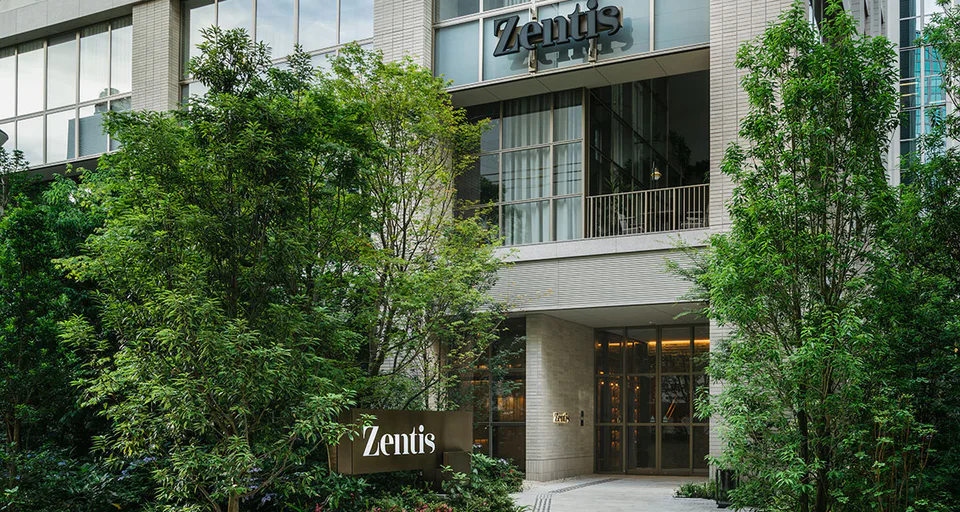
Zentis Osaka sits in Dojimahama, on the southern side of the Umeda area, rather than directly beside the JR Osaka Station gates. Current hotel access information lists about four minutes on foot from JR Kitashinchi Station and about 12 minutes from JR Osaka Station’s Sakurabashi Exit. If you use Osaka Station every morning, that final walk belongs in the itinerary. This guide asks one question: on a three-to-five-night Osaka stay, is it worth paying that walking cost in exchange for a 25 m² Studio, 24-hour Room 001 self-service laundry and shared utility space, plus places outside the room where part of the waiting and organising can happen?
Station distances, room sizes, Room 001, breakfast and service hours below follow the hotel’s current published information. Judgments about whether the stay is worth it, which room makes sense and when the facilities become useful are editorial decisions rather than claims of a personal stay. The easiest mistake is not choosing a “bad” hotel; it is expecting a station-front Umeda hotel when this property is really a Dojima / Kitashinchi long-stay base.
Zentis Osaka: the 30-second answer
I would book it for three to five nights when two travellers expect to do laundry and their dinners or evenings often fall around Dojima, Kitashinchi, Nakanoshima or southern Umeda. The roughly four-minute Kitashinchi walk plus 24-hour Room 001 makes an evening routine of “return, wash clothes, organise, go out again” more convincing than a decision based only on the Osaka Station distance.
I would reconsider it for one night or for a trip in which every morning begins with a longer-distance train from JR Osaka Station. A 12-minute walk from the Sakurabashi side is not extreme, but one overnight rarely gives Room 001, the guest lounge and larger-than-typical room space enough repeated use to compensate for that approach.
I would skip it if the non-negotiable requirement is direct Osaka Station access, on-site parking or the ability for a car to reach the front entrance freely between 22:00 and 01:00. The official access page warns of surrounding vehicle-entry restrictions in that late-night window, and the hotel does not have its own parking. Those are functional constraints that design cannot erase.
Hotel snapshot: conditions that actually change the stay
↔ Scroll table left or right
Item | Current hotel information | Trip impact |
Stations | JR Kitashinchi ~4 min; JR Osaka Sakurabashi Exit ~12 min | Which station you actually use changes the location score |
Studio | 25 m²; 1–2 guests; king; walk-in shower | Baseline room for two people; bathtub users need to look higher |
Corner Studio | 32 m²; 1–3 guests; twin/king; bathtub + shower | Upgrade changes bath, bed flexibility and occupancy, not only floor area |
Room 001 | 24 hours; self-service washers/dryers, iron, microwave and other stay tools | Much more valuable over 3–5 nights than one night |
Guest Lounge | Guest-only, 24 hours; communal work table and sofa seating | A second place to sit when two people share the room |
Breakfast | 07:00–10:00; Japanese, American and vegan choices plus buffet corner | Check actual departure time before bundling breakfast |
Check-in / out | Standard 15:00 / 12:00 | Noon checkout adds useful last-day buffer around Umeda |
Vehicle / parking | No on-site parking; surrounding vehicle restrictions 22:00–01:00 | Self-drive and late taxi arrivals need advance confirmation |
Arrival reality: not station-connected, so count the final walk
From Kansai Airport, current hotel guidance gives two reference routes: HARUKA to JR Osaka Station in about 50 minutes followed by about 12 minutes on foot from the Sakurabashi side, or an airport bus to Herbis Osaka in about 60 minutes followed by roughly a 10-minute walk. Those are reference travel times, not door-to-door guarantees; waiting, station exits, finding the right street and check-in all add time.
With two large suitcases, I would not reject the hotel simply because “Osaka Station is 12 minutes”. Sakurabashi is on the western side of the station and Dojimahama lies in the same broad direction, so this is not a cross-station detour. But rain, summer heat or older companions make an outdoor 12-minute walk a real cost. In those conditions, the Herbis Osaka airport-bus approach deserves comparison too.
The most hotel-specific warning is the late-night vehicle restriction. The official access information notes restrictions around the property from 22:00 to 01:00. If a late flight makes a taxi arrival likely, do not assume the front door is always an available drop-off point; confirm the suitable late-night drop-off before booking. After check-in, the roughly four-minute JR Kitashinchi walk may matter more than Osaka Station if Dojima, Kitashinchi and southern Umeda are the real evening zone.
If this is one base for Osaka, Kobe and Koyasan, put the final walk into the whole route rather than one arrival. The Osaka, Kobe and Koyasan four-day itinerary helps test whether a fixed Osaka base is still efficient. For a larger apartment-style alternative for groups, compare MIMARU Osaka Shinsaibashi Central.
Room decision: Studio and Corner Studio differ by more than seven square metres
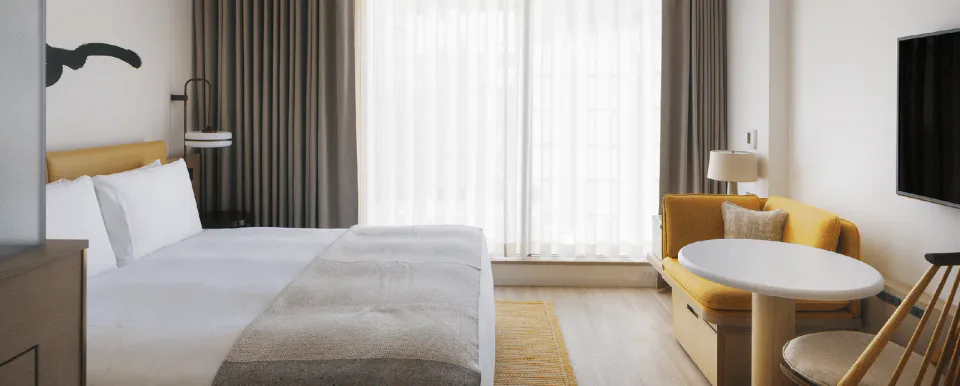
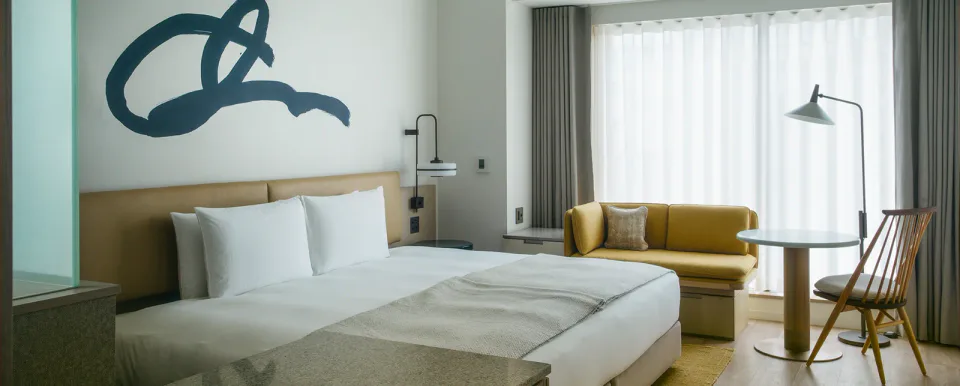
The official Studio is 25 m² for one or two guests with a 1810 × 2030 mm king bed and a walk-in shower, not a bathtub. Corner Studio is 32 m² for one to three guests, can be booked with twin or king configuration, and changes the bathroom to bathtub plus shower. The upgrade therefore changes bathing style, bed flexibility and occupancy as well as floor area.
For two people staying three to five nights, I would price the Studio first rather than upgrade automatically because the Corner Studio is larger. Twenty-five square metres is already a useful urban-room baseline. The real reasons to pay more are a bathtub after long walking days, twin beds, a third guest or additional in-room buffer. If none of those matters, seven extra square metres may not improve the trip enough to justify the rate difference.
Large luggage still needs conservative wording. The hotel publishes room area and photographs but not the precise clear floor rectangle available with every furniture arrangement, so I would not promise that two 28-inch suitcases can always lie fully open at once. Treat 25 m² as more usable allocation space than a very small city room, not as a suitcase-capacity guarantee. The Studio’s walk-in shower is also a concrete trade-off: if soaking in a bath after a high-step day matters, Corner Studio’s bathtub may be a more important reason to upgrade than the room area itself.
↔ Scroll table left or right
Room | Area / guests | Bed | Bathroom | My read |
Studio | 25 m² / 1–2 | King | Walk-in shower | Start here for two people staying 3–5 nights |
Corner Studio | 32 m² / 1–3 | Twin / King | Bathtub + shower | Upgrade when bath, twin beds or a third guest matters |
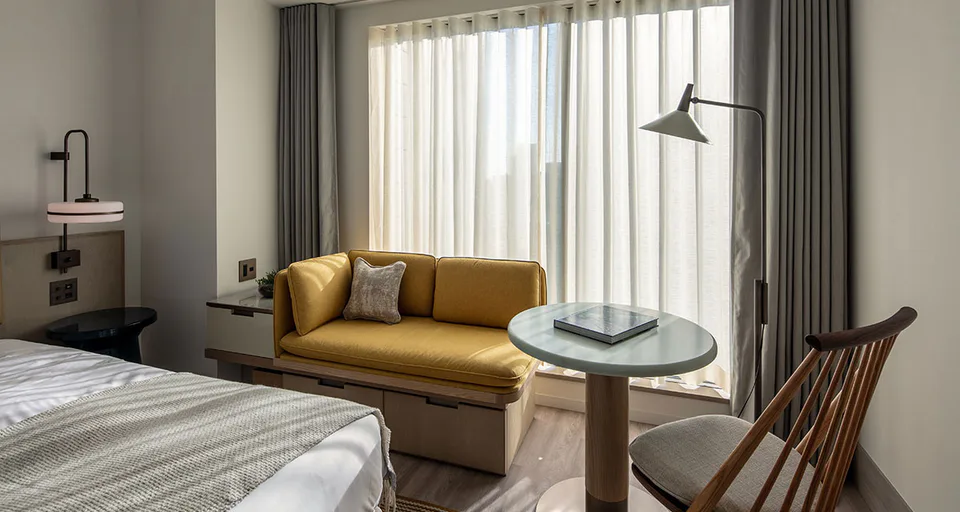
The images above use the same official Zentis Osaka gallery media as the Chinese source. Room and facility labels now match the actual source content rather than treating every image as Room 001.
Room 001: when 24-hour access actually matters over three to five nights
Room 001 is the second major decision point. The hotel describes it as a 24-hour multifunctional space with self-service washers and dryers, dedicated Kimura Soap detergent, irons, an aroma bar, shoe-care service, Nespresso coffee, a microwave and a small library area. Those details are not equally valuable on every stay. They become more relevant after several nights, when laundry and organising are real tasks rather than hypothetical conveniences.
A practical use is to move waiting time outside the room. Imagine returning at 22:00, starting a wash, then having one person work through photos or the next day’s route in Room 001 or the guest lounge while the other showers upstairs. That is an itinerary simulation, not a personal-stay claim, but it tests whether “24 hours” changes the daily rhythm. Travellers intentionally packing light for a four- or five-night stay can extract more value from this than someone who never washes clothes during a trip.
The guest lounge is also open 24 hours for staying guests, with communal work tables and sofa seating. For two people sharing a 25 m² Studio, that creates a second place to sit when one wants to rest and the other still needs to work or plan. It remains shared space, not a guaranteed silent office. If the core requirement is laundry inside the guest room rather than in a shared facility, compare Tokyu Stay Osaka Hommachi by exact room category instead.
If you really stay four nights: test the value with a timeline
I would test a four-night stay like this. Night one: arrive around 20:30, check in and eat dinner; do not force the facilities into the plan. Night two: return from shopping and run the first laundry load. Night three: come back later after USJ or Osaka Castle; this is where 24-hour Room 001 has real value. Night four: organise purchases and decide whether a second wash is useful. The benefit is not evenly distributed across the stay—it becomes very high on one or two specific evenings.
That is also why I would not choose Zentis specifically for a single overnight. You still receive the room design, location and shared spaces, but the “24-hour living tools” have too few repetitions to become the decisive advantage. On a one-night stay, I would move Osaka Station distance, that evening’s destination and the next morning’s transport ahead of Room 001.
Location × itinerary: a Dojimahama base is not an Osaka Station-front base
The roughly four-minute Kitashinchi walk is genuinely useful for Kitashinchi and the southern side of Osaka/Umeda. The roughly 12-minute Osaka Station walk means that if every day uses JR toward Kyoto, Kobe or another city, you repeatedly pay that last section. That does not make the hotel impractical; it means “Umeda area” is not specific enough for a transport decision.
One USJ day does not automatically rule Zentis out. If the park is only one long day inside a broader Osaka stay, you can still return to Dojima and use Room 001 late. If two consecutive days revolve around USJ and the shortest post-event return matters, compare where to stay for USJ Halloween, the USJ Horror Night last-train guide and THE SINGULARI HOTEL at Universal City.
If the stay mixes Kobe, Koyasan, Kyoto or Shinkansen travel, separate the benefit of one fixed Osaka hotel from the cost of travelling outward every morning. For autumn routes, the Osaka autumn leaves guide and the broader Japan autumn trip without changing hotels guide help show when a fixed base is worth the repeated transport.
Breakfast and public space: if you will not use them, do not count them as value
Breakfast at UPSTAIRZ is currently listed from 07:00 to 10:00, with Japanese, American and vegan choices plus a buffet corner for staying guests. I would not make breakfast a core reason to book Zentis because its value depends on when the day starts. A normal city morning has enough flexibility; a very early departure may not. If USJ is the early start, use the USJ Halloween one-day itinerary and the USJ ticket and Express Pass guide before assuming the morning has time for hotel breakfast.
The noon checkout deserves more attention. The current fact book lists standard check-in at 15:00 and checkout at 12:00. If the last day remains around Umeda, two extra hours compared with a 10:00 checkout can be more useful than another breakfast option. This is schedule flexibility, not a promise of free late checkout beyond noon.
What do you give up by staying here?
First, you exchange direct Osaka Station access for the Dojimahama setting and room/shared-space routine. Every JR Osaka departure still includes a last walk. Second, the 25 m² Studio has no bathtub. If soaking is important over four or five nights, the Corner Studio is the more complete product and its actual rate difference matters. Third, self-drive and late-night taxi logistics are less simple because there is no on-site parking and surrounding vehicle restrictions apply from 22:00 to 01:00.
Fourth, these facilities need time to “pay back”. Room 001, the guest lounge, breakfast and noon checkout do not create value simply by existing. If you leave at 07:00, return at 23:00 and never wash clothes, much of the hotel’s distinctive long-stay proposition goes unused. If the trip later leaves Osaka overnight, the Osaka to Beppu overnight ferry guide is one example where luggage handling and checkout-day timing become more important.
Compare three booking platforms without comparing different rooms
Fix the exact room category first. Studio and Corner Studio differ in more than area: bathtub, bed configuration and guest capacity also change. A Studio rate on Booking.com, a Corner Studio on Trip.com and a breakfast-included third option on Agoda are not meaningful price competitors. Align room, bed, breakfast, taxes, payment terms and free-cancellation deadline, then compare the total.
I would not assume any platform is permanently cheapest. The useful question is whether the same-condition rate gap changes the room decision or cancellation flexibility. Inventory moves by date, so this article does not hard-code an OTA price as the conclusion. For navigation and train-day connectivity across Osaka, the Japan eSIM guide for Tokyo, Osaka and Kyoto is a separate practical companion.
Booking.com — compare Zentis Osaka rooms and cancellation terms
Trip.com — compare Zentis Osaka rooms and cancellation terms
Agoda — compare Zentis Osaka rooms and cancellation terms
Final decision: would I book Zentis Osaka?
↔ Scroll table left or right
Decision | When it fits |
I would book | 3–5 nights, two travellers, real laundry needs, and Dojima/Kitashinchi/south Umeda are part of the routine; price the 25 m² Studio first |
I would reconsider | One night, frequent early JR Osaka departures, or a bathtub matters enough that Corner Studio becomes the real comparison |
I would skip | You require station-direct access, on-site parking or unrestricted late-night vehicle drop-off at the entrance |
My final position is simple: Zentis Osaka does not win by being closest to JR Osaka Station. It combines a 25 m² Studio, Room 001 laundry, 24-hour shared space and a noon checkout into a base that becomes more useful the longer you stay. The more you genuinely need laundry, a place to work or organise, and one fixed Osaka hotel, the easier it is to justify the Osaka Station walk. The more the trip is a single overnight or repeated JR departures, the more aggressively I would compare station-front alternatives.
Zentis Osaka FAQ
How long does it take to walk from Osaka Station to Zentis Osaka?
Current official information lists about 12 minutes on foot from JR Osaka Station’s Sakurabashi Exit and about four minutes from JR Kitashinchi Station. Do not collapse both into a vague statement that the hotel is simply “near Umeda”; use the station your itinerary actually relies on.
Does the Zentis Osaka Studio have a bathtub?
The Studio room information lists a walk-in shower. Corner Studio lists a bathtub plus shower. If soaking in a bath is non-negotiable, do not book the Studio only because 25 m² sounds spacious enough.
Does Zentis Osaka have self-service laundry?
Yes. Room 001 includes self-service washers and dryers and current hotel service information lists Room 001 as available 24 hours. This article does not invent machine counts or peak-time queue conditions that the source does not provide.
Can a taxi always reach the hotel entrance late at night?
Do not assume so. The official access page warns of vehicle-entry restrictions in the surrounding area from 22:00 to 01:00. If your arrival falls in that window, confirm the appropriate drop-off point with the hotel before travel.
What are the standard check-in and check-out times?
The current hotel fact book lists standard check-in at 15:00 and check-out at 12:00. Early check-in or a later checkout beyond that depends on the booking and direct hotel confirmation.
How can I reach Zentis Osaka from Kansai Airport?
Official reference routes include HARUKA to JR Osaka Station in about 50 minutes plus the roughly 12-minute walk, or an airport bus to Herbis Osaka in about 60 minutes plus roughly 10 minutes on foot. Add waiting, exit-finding and luggage time to both estimates.
Where to Stay
Centara Grand Hotel Osaka: Is the 40m² Family Room Worth It for Four?
Hotel Hankyu RESPIRE OSAKA: Is a 3-Minute Osaka Station Walk Worth the High-Rise Trade-Off?
Mitsui Garden Hotel Osaka Premier Review: Is Nakanoshima Worth the Trade-off?
Shin Furano Prince Hotel: Is Ski-in Access Worth Being 6 km from Furano Station?
THE LIVELY FUKUOKA HAKATA: Is Nakasu-Kawabata Worth a 12 m² Room?
ONSEN RYOKAN YUEN SAPPORO: Is the Karurusu Hot Spring Worth a 13-Minute Walk?
Sources
Zentis Osaka official Corner Studio
Zentis Osaka official Room 001
Zentis Osaka official services, lounge and dining information