
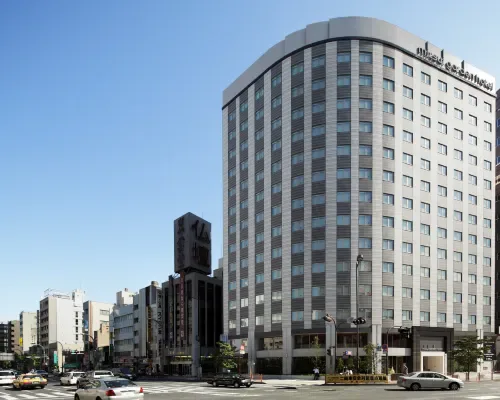
Yes — the official six-minute walk from Keisei Ueno after the Skyliner is usually worth accepting when Narita Airport is only the bookend of the trip and you will reuse JR Ueno or Tokyo Metro Ueno every day. Mitsui Garden Hotel Ueno is officially about two minutes from JR Ueno Asakusa Exit and one minute from Tokyo Metro Ueno Exit 1. That means you pay the longer Keisei walk once on arrival and once on departure, but the shorter JR/Metro walk can be used six, eight or ten times during a multi-night stay.
The answer reverses when the Narita luggage leg is the whole reason you chose Ueno, when two large suitcases make the 18 m² room category a poor fit, or when most sightseeing is in Shinjuku/Shibuya and the “Ueno convenience” is not actually being reused. The decision is therefore not “Is six minutes too far?” It is which station walk repeats most during the stay?
↔ Scroll table left or right
Your trip pattern | Verdict | Why |
Narita in/out + 3–5 nights using JR/Metro from Ueno | Strong fit | Two longer Keisei walks can be outweighed by many 1–2 minute station walks later |
One night only after a late Narita arrival | Conditional | The six-minute luggage walk is now a larger share of the whole stay |
Two adults + two 28-inch suitcases | Do not book the cheapest 18 m² room automatically | Published room area is a space signal, not a two-open-suitcase guarantee |
Most days in Shinjuku / Shibuya / western Tokyo | Reconsider Ueno itself | The airport convenience can create repeated cross-city movement after check-in |
Very early JR / Shinkansen departure | Location gets stronger; breakfast may get weaker | JR Ueno is two minutes away, but hotel breakfast starts at 07:00 |
Stroller, wheelchair or step-free priority | Use the station accessibility map, not only “Exit 1” | The shortest hotel exit and the official elevator route are not necessarily the same path |
The six-minute Skyliner walk is a bookend cost, not a daily cost
The hotel’s current official access page lists three distances: six minutes from Keisei Ueno, two minutes from JR Ueno’s Asakusa Exit and one minute from Tokyo Metro Ueno Exit 1. Keisei currently lists the Skyliner from Narita Airport Terminal 2·3 to Ueno at about 41 minutes and JPY 2,470 one way.
That creates an asymmetry most hotel comparisons miss. If you stay four nights, the Keisei Ueno → hotel walk may happen only twice: airport arrival and airport departure. By contrast, the JR/Metro hotel walk can happen every morning and every evening.
A simple way to judge the hotel is to count station uses:
Narita round trip: 2 Keisei hotel walks.
Three full Tokyo days: potentially 6 JR/Metro hotel walks before adding evening returns or day trips.
One Nikko/Sendai/northbound rail day: another pair of JR Ueno movements where the two-minute station access matters.
This does not mean a six-minute walk is trivial with luggage. It means it should not be given the same weight as a walk repeated every day.
When does the six-minute Narita walk become too expensive?
The official “six minutes” is a walking-distance estimate, not a guarantee that a family with two full-size suitcases will reach the lobby in exactly six minutes. Rain, platform-to-exit navigation, traffic lights, crowds and the effort of rolling luggage can all make the arrival feel longer.
I would raise the cost of that walk when three things stack together: a late flight, multiple large bags and travellers who are already tired or mobility-limited. In that case, a hotel with a simpler Keisei arrival can beat Mitsui Garden even if its everyday JR/Metro access is slightly worse.
But do not over-correct. If the stay is five nights and the whole itinerary is Ueno, Asakusa, Akihabara, Ginza, northbound day trips and Tokyo Metro, choosing a hotel only because it is closer to the Skyliner can move the inconvenience into the next five days.
If the real choice is between this hotel and another Ueno property, use the Mitsui Garden Hotel Ueno vs NOHGA comparison after deciding which station relationship matters more.
JR Ueno and Tokyo Metro are the reason to accept the Narita trade-off
JR Ueno’s Asakusa Exit is officially about two minutes away. That is useful when the trip repeatedly uses the JR network, the Yamanote Line or northbound rail. Tokyo Metro Ueno Exit 1 is officially about one minute away, which is useful for Ginza Line and Hibiya Line trips.
The hidden value is the last walk home. After a long day, a two-minute hotel finish can matter more than saving four minutes once on airport day. This becomes especially useful on a trip where you return to the hotel, rest, then go back out for dinner.
However, “one minute from Exit 1” should not be read as “the one-minute path is the best step-free path.” Tokyo Metro currently confirms elevator routes at Ueno, but the accessible exits are identified separately from the hotel’s shortest Exit 1 instruction. Travellers with a stroller, wheelchair or heavy bags should use the official station accessibility map and accept a slightly longer route if necessary.
The 18 m² room can make a good location feel like the wrong hotel
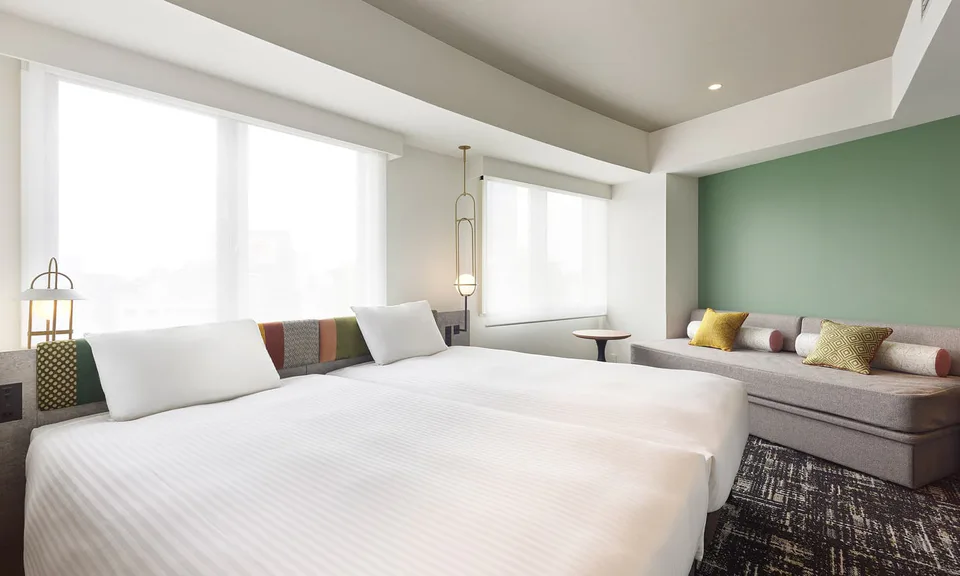
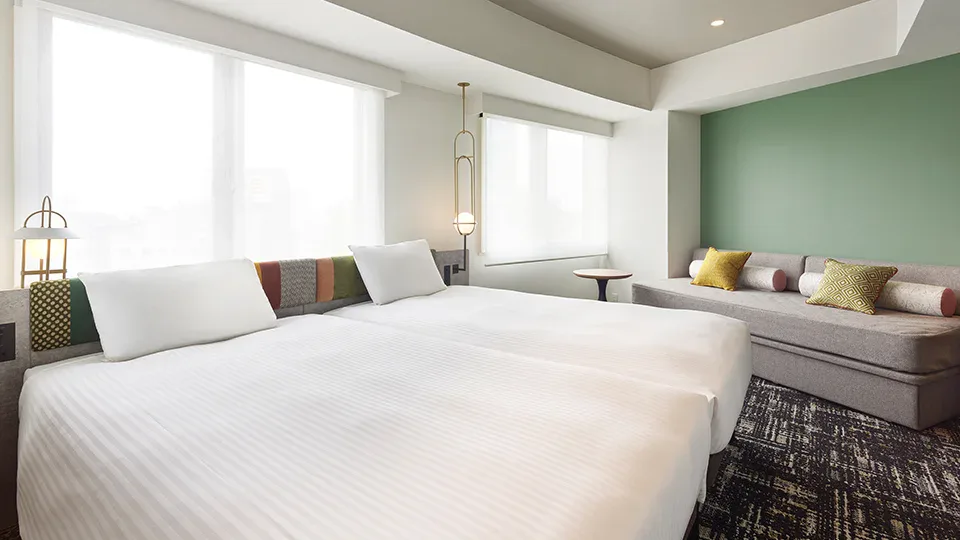
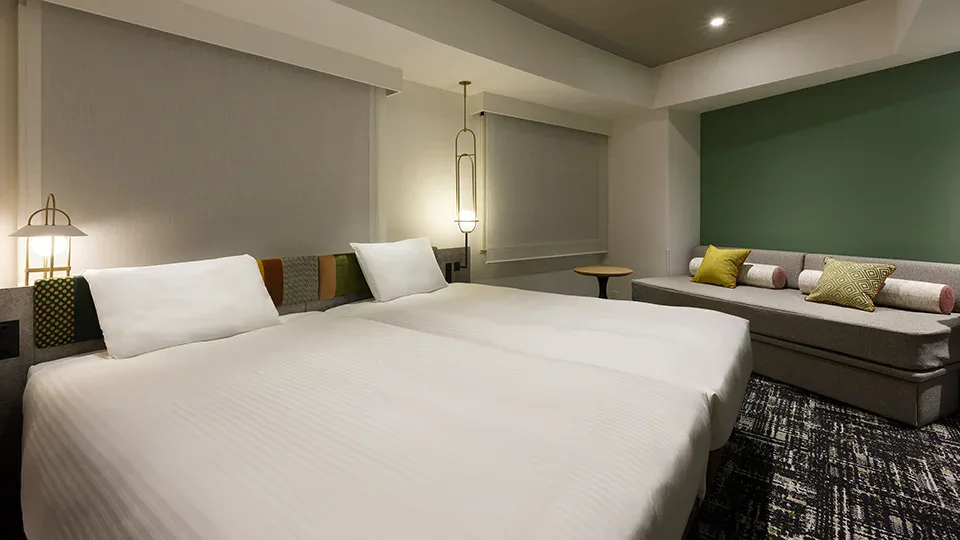
The hotel’s current room list includes standard 18 m² rooms, including a two-bed Hollywood-style room and an 18 m² queen. Those are perfectly plausible for one traveller, a lightly packed couple or a short stay. They are not automatically the right reference product for two people carrying large luggage for a two-week Japan trip.
The original article treated room size as a secondary note. It should be a booking veto. If the stay is four or five nights and both travellers have large cases, price the larger room categories before deciding that the hotel itself is “good value.” A cheaper 18 m² rate can create daily floor-space friction that you then live with much longer than the six-minute airport walk.
The hotel does not publish a test saying that two specific 28-inch suitcases can stay fully open with a clear walkway. Do not invent one. Use the published area and room photos as a signal, then compare the next room tier and the total price difference.
A useful rule is: if the room upgrade needed to make your luggage workable closes most of the price gap to a more spacious Ueno hotel, reopen the hotel comparison instead of automatically upgrading inside Mitsui Garden.
One night and five nights should not use the same verdict
One night after Narita
The six-minute Keisei walk has high weight because it is one of the main movements of the entire stay. If the next morning leaves Tokyo immediately, you may not reuse JR/Metro Ueno enough to recover that cost. For a pure transit night, airport-to-bed simplicity deserves more weight.
Three nights
This is where Mitsui Garden starts to make more sense. Two bookend Keisei walks are balanced against several short JR/Metro walks. If the itinerary includes Ueno, Asakusa, Akihabara, Ginza or one northbound day trip, the location becomes more coherent.
Four to five nights
The daily station geometry matters more than the Narita bookends. At this length, room area and laundry also become more important. The hotel currently has coin laundries on floors 3, 8 and 13 and microwaves on 4, 9 and 14, which makes a longer stay more practical — but only if the room itself still works for the luggage.
Breakfast is useful only when 07:00 fits tomorrow’s first train
Breakfast currently runs 07:00–10:00 with last entry at 09:30 and costs JPY 2,530. The Italian-style buffet can be convenient on a normal Tokyo morning, but Ueno is often chosen specifically for early rail access.
If you are leaving early for a Shinkansen, airport train or a long day trip, the 07:00 opening can make a breakfast-inclusive rate less valuable. Do not pay for breakfast simply because the hotel has a good buffet; check whether you will actually be in the building at 07:00.
This creates another useful location test. A hotel close to JR Ueno may tempt you to book an early train. If that train leaves before the hotel breakfast becomes useful, the transport advantage and the breakfast package can pull in opposite directions.
For a very early day, buy breakfast separately only if the schedule allows it. For a normal sightseeing morning, the hotel breakfast is easier to justify because there is no need to protect a hard departure time.
Late arrival: tell the hotel when the schedule slips
The hotel currently lists check-in from 15:00 and checkout at 11:00. Its current room information also says guests should notify the hotel about late arrival and that a reservation may be cancelled if the guest arrives without notice more than two hours after the scheduled arrival time.
That matters for Narita travellers. A delayed flight plus the Skyliner can push arrival well past the time originally entered on the reservation. The correct response is not to assume that a paid booking guarantees unlimited late check-in; contact the hotel when the schedule changes.
For very late Narita arrivals, use the Narita late-arrival guide first. If the airport-to-Ueno chain itself has become fragile, the hotel comparison should wait until the transport decision is solved.
Panda rooms are an experience upgrade, not a transport upgrade
The hotel currently promotes a dedicated panda-themed concept floor and multiple panda room types. That can be fun for families or travellers visiting Ueno Zoo, but it should be priced as an experience feature.
The panda theme does not improve the six-minute Skyliner walk, enlarge a standard room automatically or make the Metro exit more accessible. If the themed room costs more, compare the premium with what else that money could buy: a larger ordinary room, breakfast, luggage forwarding or a hotel with more floor space.
Theme premium is easiest to justify when the room itself is part of the trip — for example, a child genuinely cares about the panda stay. It is weaker when the room will only be used for sleeping.
Three traveller profiles
Couple, four nights, Narita in/out, one large suitcase each
Good hotel, but price the larger room first. The six-minute Keisei walk happens twice; JR/Metro access repeats every day. The location is strong, but room circulation can become the limiting factor.
Solo traveller, two nights, mostly Asakusa/Ueno/Akihabara
Very strong fit. The 18 m² room is less problematic, the repeated short station walks are useful and the Narita transfer remains simple.
Family with stroller, first Tokyo trip, most days in Shinjuku/Shibuya
Reconsider the base before the hotel. The shortest Metro Exit 1 path should not be assumed step-free, and a Ueno hotel can create repeated cross-city movement if the trip lives in western Tokyo. Use Ueno vs Shinjuku before comparing room rates.
What would make me choose another Ueno hotel?
The stay is only one transit night. Keisei-to-bed simplicity can matter more than repeated JR/Metro access you will never use.
The required room upgrade is expensive. If escaping 18 m² pushes the price close to a larger competitor, compare hotels again.
You need a simpler step-free arrival. The official one-minute Metro exit is not itself proof of the best elevator route.
Your actual Tokyo itinerary is western. Ueno should not be chosen only because Narita is easy.
The Skyliner walk is the defining constraint. Heavy luggage, bad weather and a late arrival can make the bookend cost more important than it is for a typical traveller.
Final verdict
Mitsui Garden Hotel Ueno is worth the six-minute Keisei Ueno walk when you are buying repeated JR and Metro convenience for several days, not when you are buying the easiest possible Narita transit night. The airport walk is paid once at each end of the stay; the two-minute JR and one-minute Metro relationship can be reused every day.
For a solo traveller or lightly packed couple staying three to five nights around eastern/northern Tokyo, I would keep it high on the shortlist. For two large suitcases, I would price the larger room before judging value. For a family needing elevators or a trip centred on Shinjuku/Shibuya, I would solve the base and step-free route first.
The right question is not “Is six minutes far?” It is which six minutes are you paying, and how many times?
Compare Mitsui Garden Hotel Ueno room types
The Naha Terrace: Are 35m² Rooms and 12:00 Check-Out Worth a 15–20 Minute Station Walk?
Vessel Hotel Campana Susukino: Is the 25:00 Public Bath Worth a 4-Minute Walk?
Zentis Osaka: Is Room 001 Worth the Walk from Osaka Station?
ONSEN RYOKAN YUEN SAPPORO: Is the Karurusu Hot Spring Worth a 13-Minute Walk?
Hotel Sosei Sapporo Review: Is a 39 m² Twin-Queen Room Worth a 15-Minute Walk from Sapporo Station?
References
Mitsui Garden Hotel Ueno — official access · official room information · official breakfast information · official facilities · Keisei Skyliner — Ueno access · Tokyo Metro Ueno accessibility. Checked August 25, 2026. Walking times are operator/hotel estimates and do not include every platform, crowd, luggage or weather condition.