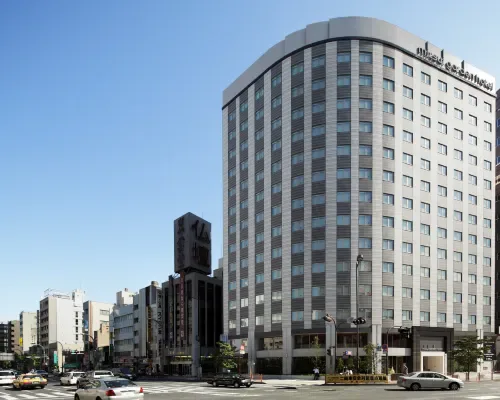
If you will use JR Ueno or Tokyo Metro Ueno repeatedly, I would choose Mitsui Garden Hotel Ueno first. If you are staying four or five nights with large luggage and are actually willing to pay for a 23–26 m² or larger room, NOHGA HOTEL UENO TOKYO becomes the stronger stay. The key point is that NOHGA’s cheapest Double is not larger: both hotels publish an 18 m² entry Double. Its space advantage only exists after you upgrade.
The one-minute difference after the Skyliner should not decide the whole booking. Mitsui Garden is officially about six minutes from Keisei Ueno and NOHGA about seven. What matters more is the friction that repeats after arrival: Mitsui is about two minutes from JR Ueno’s Asakusa Exit and one minute from Tokyo Metro Ueno Exit 1, while NOHGA is about five minutes from JR and three minutes from the Metro but publishes a specific elevator route for travellers with large luggage.
Official access, room-size and facility details were rechecked on August 26, 2026. Hotel rates and room inventory change by date, so this article deliberately compares the parts of the decision that remain useful after a temporary sale disappears.
Mitsui Garden Hotel Ueno vs NOHGA: the decision table
↔ Scroll table left or right
Your actual stay | Choose first | Why | What you give up |
Two or three nights, frequent JR / Metro use | Mitsui Garden | The shorter station walks repeat several times a day | NOHGA has a broader high-end room-size ladder |
Narita arrival only, otherwise similar plans | Almost a tie | Official Keisei Ueno walks differ by about one minute | Choosing on airport arrival alone ignores the rest of the stay |
Booking the cheapest 18 m² Double | Mitsui Garden, narrowly | Room area is tied, so the location advantage becomes more valuable | You are not buying NOHGA’s larger-room advantage |
Four or five nights, two large cases, 23–26 m² upgrade | NOHGA | The upgrade materially changes usable room space and long-stay comfort | Ordinary JR / Metro walks are longer |
Large luggage and anxiety about stairs / exits | NOHGA | Its official Metro directions identify the elevator between exits 2 and 3 | Mitsui remains physically closer for normal walking |
Most days are Shinjuku, Shibuya or Ikebukuro | Recheck Ueno itself | The district choice can cost more daily time than either hotel saves | You lose some of Ueno’s Narita and east-Tokyo convenience |
ValueNavi Hotel Fit Score: why the winner changes after a room upgrade
This is not a review score and it does not rate service, taste or atmosphere. It is a repeatable decision model for hotel comparisons. The score uses five dimensions: daily route fit 30%, luggage friction 25%, room-space fit 20%, long-stay utility 15%, and arrival/departure fit 10%. A higher number means lower travel friction or more useful flexibility for the stated booking.
Because the room you buy changes the result, NOHGA should not receive credit for a 26 or 36 m² room when you are booking its 18 m² Double. The same rule applies to Mitsui Garden.
Booking scenario | Mitsui Garden | NOHGA | Interpretation |
|---|---|---|---|
Base 18 m² Double | Effectively tied; Mitsui’s shorter daily walks and NOHGA’s clearer luggage route cancel much of each other out | ||
Meaningful room upgrade | NOHGA pulls ahead when its larger room tiers are actually purchased |
ValueNavi analysis: the score is an editorial synthesis of verified access, room and facility facts, not an official hotel rating. It should be used to expose trade-offs, not to replace checking the exact room and rate for your dates.
The first hidden cost: a one-minute Skyliner advantage happens once
Ueno is attractive to many international travellers because of Narita access, but airport arrival is only one movement in a multi-night stay. Mitsui Garden’s official access page lists about six minutes from Keisei Ueno; NOHGA lists about seven. That gap is too small to justify a meaningful room-rate premium by itself.
From day two, the geometry changes. Mitsui Garden lists about two minutes from JR Ueno’s Asakusa Exit and one minute from Tokyo Metro Ueno Exit 1. NOHGA lists about five minutes from JR Ueno and three minutes from the Metro. If you leave the hotel in the morning, return before dinner, then go out again, those extra minutes repeat.
A useful way to think about this is frequency × friction. Saving three minutes once is trivial. Saving two or three minutes six to ten times over a short stay can become more valuable than the first walk from the Skyliner.
If the bigger question is whether Ueno should be your Tokyo base at all, compare Ueno vs Shinjuku before optimising one street corner.
Large luggage changes “shortest walk” into “most predictable route”
Mitsui Garden has the shorter published station walks. NOHGA has the clearer large-luggage instruction: from Tokyo Metro Ueno, its official route specifically recommends the elevator between Exit 2 and Exit 3 toward Showa Dori for guests with large bags.
That distinction matters after a long-haul flight. A nominally shorter path can still be annoying if it ends at stairs, the wrong side of a road or an unfamiliar exit. A slightly longer route can be easier when the elevator path is known before you arrive.
My rule is simple: one suitcase each and normal mobility: favour the shorter repeated walk. Two large cases, stroller or limited stair tolerance: give more weight to the documented elevator route. This is a boundary condition, not a universal NOHGA win.
For the full Keisei-to-hotel suitcase chain, use the NOHGA Ueno luggage-route guide.
Both cheapest Doubles are 18 m² — so do not buy a brand image
The easiest mistake in this comparison is assuming that a design-led hotel must have larger entry rooms. Official room pages show an 18 m² Double at both properties.
↔ Scroll table left or right
Room step | Mitsui Garden Hotel Ueno | NOHGA HOTEL UENO TOKYO |
Entry Double | 18 m² | 18 m² |
Small upgrade | 20 m² Superior Queen | 20 m² Superior Double |
Material two-person upgrade | 22 m² Separate-Style Twin | 23 m² Deluxe Double; 24–26 m² Twin |
Larger step | 25 m² Superior Twin (+ extra) | 26 m² Corner Double / Deluxe King; 36 m² Deluxe Twin |
The important number is not the maximum room size on the website. It is the upgrade premium for the room you would genuinely book. If NOHGA’s 23 m² room is ¥8,000 more per night on your dates, that is a different decision from a ¥2,000 gap. This article does not invent a fixed “worth it” threshold because live hotel rates change too much.
For two nights when you are out from breakfast to bedtime, I would usually spend less on space and take Mitsui’s transport efficiency. For five nights with two 28–29 inch suitcases, shopping bags and laundry, I would price NOHGA’s 23–26 m² tiers before deciding.
A room upgrade should be judged by cost per night of reduced friction
Instead of asking whether 5–8 extra square metres sounds large, calculate what the upgrade does to the stay. Two travellers with two big cases may use the extra floor area every morning and every night. A solo traveller who keeps one carry-on closed under a desk may barely notice it.
Use this three-step test:
Compare the exact same dates and cancellation conditions.
Calculate the upgrade premium per night, not just the total stay difference.
Ask what problem the extra area solves: open suitcases, third bed, working space, or simply a nicer-looking room.
If you cannot name the problem, the larger room is an aesthetic upgrade rather than a functional one. That may still be worth buying, but it is a different decision.
Long stays: the facilities matter only if you will use them
Mitsui Garden currently lists coin laundry on floors 3, 8 and 13 and microwaves on floors 4, 9 and 14. NOHGA lists 24-hour access to its laundry area and a microwave in the same facilities section.
NOHGA currently publishes ¥400 per wash (about US$2.50) and ¥100 per 30 minutes of drying (about US$0.60). The Japanese yen remains the primary price because that is what you pay; the US-dollar figures are rounded planning conversions using roughly ¥159 per US$1 in late August 2026 and will move with exchange rates.
The decision value is not the few dollars. It is whether laundry allows you to bring fewer clothes on a long-haul Japan trip. On a four- or five-night stay, that can reduce suitcase pressure enough that a 23–26 m² room feels more useful than the same room would on a weekend.
I would not choose either hotel for laundry on a one- or two-night stay unless you know you need it. A facility you never use should not win the booking.
Which hotel works better for a two-night stay?
Mitsui Garden is my default. On a short stay, there is less time for a bigger room or laundry setup to repay its cost. The shorter JR and Metro walks are easier to use repeatedly, while the Keisei Ueno arrival difference is already negligible.
The answer reverses if the only Mitsui room left is a poor-fit bed configuration while NOHGA has a suitable 23–26 m² room at a small premium. Availability can beat the generic recommendation.
Which hotel works better for four or five nights?
NOHGA gets stronger, but only with the right room. A four-night booking in its 18 m² Double does not magically gain the 26 m² benefit. If you are staying longer because Ueno is the main Tokyo base, compare the real upgrade price to a 23 m² Deluxe Double, 26 m² Corner Double / Deluxe King or 24–26 m² Twin.
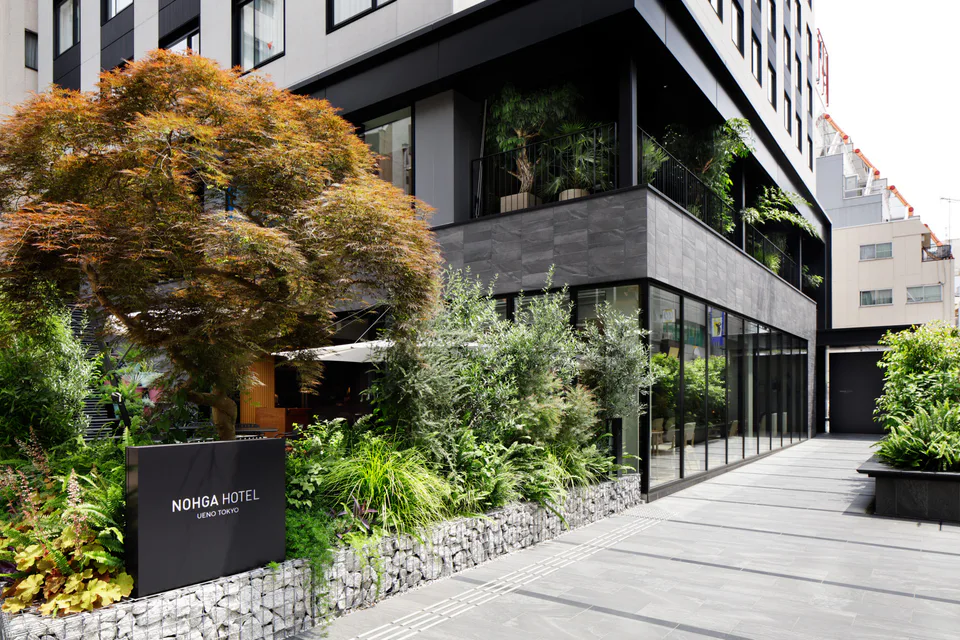
Mitsui still wins for travellers who spend very little time in the room and use JR or Metro constantly. This is why “long stay = NOHGA” is too crude. The real rule is long stay + luggage pressure + actual room upgrade = NOHGA advantage.
Failure modes: how travellers choose the wrong one
Comparing only the Skyliner walk: six versus seven minutes is not enough information for a multi-night hotel choice.
Giving NOHGA credit for a room you did not book: the 18 m² Double should be compared with Mitsui’s 18 m² room, not with NOHGA’s 26 m² marketing image.
Using station minutes as door-to-platform time: Ueno is a major station. A published hotel walk does not include every internal corridor, ticket-gate choice or platform walk.
Ignoring elevator routing with luggage: the shortest stairs-based route may not be your fastest practical route with two cases.
Paying for long-stay facilities you will not use: laundry and microwaves are valuable only when they change packing or meal decisions.
Rates: compare the room, not the hotel name
For either hotel, compare the same dates, occupancy, bed type, breakfast inclusion, taxes and cancellation deadline. A cheaper headline rate is not cheaper if it is the wrong room type or a non-refundable condition you would not otherwise accept.
Mitsui Garden Hotel Ueno
Booking.com — compare Mitsui Garden Hotel Ueno room types
Trip.com — compare Mitsui Garden Hotel Ueno room types
Agoda — compare Mitsui Garden Hotel Ueno room types
NOHGA HOTEL UENO TOKYO
Booking.com — compare NOHGA HOTEL UENO TOKYO room types
Trip.com — compare NOHGA HOTEL UENO TOKYO room types
Agoda — compare NOHGA HOTEL UENO TOKYO room types
Final verdict
Choose Mitsui Garden Hotel Ueno when transport efficiency is the job of the hotel. Its advantage is not the one-minute shorter walk from Keisei Ueno; it is the repeated two-minute JR and one-minute Metro access that can save friction throughout the stay.
Choose NOHGA HOTEL UENO TOKYO when the room upgrade is part of the booking, not an imaginary option. Its 23–26 m² tiers, larger twins, 24-hour laundry area and explicitly documented Metro elevator route make more sense for a longer stay with large luggage.
If you are booking the base 18 m² Double at either property, I would usually break the tie with total price and route, not brand positioning. If most of your itinerary sits in west Tokyo, reconsider Ueno before debating these two hotels at all.
Continue planning
NOHGA HOTEL UENO TOKYO: Which Ueno Route Works with Large Luggage? · NOHGA Ueno vs HOTEL GROOVE SHINJUKU · Tokyu Stay Shinjuku Eastside for a Four-to-Seven-Night Stay