For a first Tokyo stay, choose Ueno when Narita and east-Tokyo mornings reinforce each other; choose Shinjuku when your evenings and onward travel keep pulling west. I would not let one airport ride decide four or five hotel nights. The better base is the one that removes the journey you would otherwise repeat when you are carrying luggage, starting early or coming back tired.
There is also an important 2026 price correction to the usual “Ueno is much cheaper from Narita” argument. Keisei’s current Skyliner discount page lists an online one-way fare of ¥2,310 (US$15 / NT$480 / HK$120) for eligible non-Japanese travellers and an online round trip of ¥4,500 (US$30 / NT$940 / HK$230). JR East’s current N’EX TOKYO Round Trip Ticket is ¥5,200 (US$35 / NT$1,080 / HK$270) for eligible overseas visitors and is valid for a return within 14 days. For a Narita round trip, the ticket-product gap can therefore be only about ¥700 (US$5 / NT$150 / HK$40). Ueno still wins on directness and speed to Keisei-Ueno, but price alone is a much weaker reason to put the whole stay there.
If you are still comparing every major Tokyo base, start with Where to Stay in Tokyo for First-Time Visitors. If you already know western Tokyo is the right half of the city, use Shinjuku vs Shibuya instead.
ValueNavi decision table: which trip actually belongs in Ueno or Shinjuku?
↔ Scroll table left or right
Your actual trip | Start with | Why | What can reverse it |
Narita both ways + Ueno / Asakusa / Akihabara-heavy sightseeing | Ueno | Airport access and repeated east-side days point in the same direction | Three or more important evenings or departures are west of central Tokyo |
Narita arrival only, Haneda departure + Shibuya / Harajuku / Shinjuku-heavy trip | Shinjuku | The one Narita arrival should not outweigh four or five days of west-side movement | Large luggage makes your specific Shinjuku hotel route much harder than the Ueno alternative |
Museums, Ueno Park, Asakusa and Akihabara on several mornings | Ueno | You repeatedly begin on the correct side of the city | Most nights finish west and late-night returns matter more than morning starts |
Late dinners, bars, shopping and nightlife around Shinjuku / Shibuya | Shinjuku | You remove the cross-city ride at the most tiring part of the day | You only have one west-side night and the rest of the itinerary is east-heavy |
Hakone immediately after Tokyo | Shinjuku | Direct Odakyu Romancecar departures can make checkout morning materially simpler | Hakone is only one day in the middle of an otherwise east-heavy Tokyo stay |
Kawaguchiko immediately after Tokyo | Shinjuku | Direct Fuji Excursion services can remove a city transfer | Your date or preferred time does not line up with a useful direct service |
Early Tokaido Shinkansen or several intercity rail mornings | Neither automatically | Tokyo Station or Shinagawa may solve the harder recurring movement | Those intercity journeys happen only once and one of these two areas wins every other day |
Two large suitcases, stroller or older relatives | Decide at hotel level | Exit, elevator and final walk matter more than the district label | A genuinely door-friendly hotel can overturn the area-level result |
ValueNavi Base Score: do not average these unless the category actually matters to your trip
This is an editorial route-fit score, not a claim that one neighbourhood is objectively “better.” A five-star score means the area solves that specific travel problem unusually well. If the problem does not occur in your itinerary, ignore the row instead of averaging it into a fake universal winner.
Decision dimension | Ueno | Shinjuku | What the score is measuring |
|---|---|---|---|
Narita round-trip fit | Direct airport geometry, not just ticket price | ||
East-Tokyo morning efficiency | Repeated starts around Ueno, Asakusa and Akihabara | ||
West-Tokyo evening efficiency | Repeated late finishes around Shinjuku, Shibuya and Harajuku | ||
Hakone / Kawaguchiko onward fit | Ability to start the next overnight leg without crossing Tokyo first | ||
Station simplicity with luggage | Area-level navigation burden; exact hotel side can reverse this | ||
Late-night dining / nightlife breadth | How much of the evening can remain near the hotel |
The score is deliberately conditional. A museum-focused couple arriving and departing Narita may have four relevant Ueno rows and only one relevant Shinjuku row. A nightlife-focused solo traveller leaving for Hakone may have the opposite pattern. That is why “add the stars” is the wrong use of this table.
The three-repeat rule: price the journey you repeat, not the journey that looks dramatic
For a four- or five-night stay, I give more weight to a journey that repeats three times than to a one-off airport leg. GO TOKYO currently gives about 24 minutes between Shinjuku and Ueno on the JR Yamanote Line. Three one-way cross-city returns therefore represent roughly 72 minutes of train time before you add walking, platform access or waiting.
That does not mean every west-side evening costs exactly 24 extra minutes. Shibuya, Harajuku and other districts have different routes. The point is frequency: a modest inconvenience repeated three or four times can exceed a much more visible airport saving that happens once.
Use this test on your itinerary:
mark where each full day starts;
mark where each evening is most likely to end;
mark the airport and the next overnight destination;
circle any direction that appears three or more times;
optimise that repeated pattern before a one-off transfer.
If the map is balanced, airport access becomes a sensible tiebreaker. If it is not balanced, the repeated geography should normally win.
Narita is Ueno’s strongest advantage, but use the fare you can actually buy
Keisei’s current information lists Skyliner travel from Narita Airport Terminal 2·3 to Keisei-Ueno in as little as 41 minutes. The Skyliner is all reserved seating. Keisei’s current discount-ticket page lists the standard one-way product at ¥2,580 (US$17 / NT$540 / HK$130) and the online discount at ¥2,310 (US$15 / NT$480 / HK$120) for eligible non-Japanese travellers. The same page lists an online round trip at ¥4,500 (US$30 / NT$940 / HK$230).
That is a very clean arrival when the hotel is genuinely on the Keisei-Ueno / Ueno side you need. You leave the airport, take one reserved train and arrive inside the accommodation district. This is why Ueno remains my default when Narita is used at both ends and the sightseeing plan is already east-heavy.
Shinjuku is slower from Narita, but the fare comparison needs the right product. JR East currently lists the N’EX TOKYO Round Trip Ticket at ¥5,200 (US$35 / NT$1,080 / HK$270), valid for a return within 14 days for eligible overseas visitors. The normal one-way ordinary-car fare to Shinjuku is currently ¥3,330 (US$22 / NT$690 / HK$170). Current JR East timetables continue to include direct Narita Express services to Shinjuku.
ValueNavi judgment: on a Narita round trip, Ueno’s strongest advantage is now the cleaner direct route and shorter ride, not a huge ticket-price gap. When the online visitor products are available, the published round-trip difference between Skyliner and N’EX is only about ¥700 (US$5 / NT$150 / HK$40). If west Tokyo dominates the stay, I would not trade several repeated journeys for that amount.
Ueno wins when the first half of your day matters more than the last
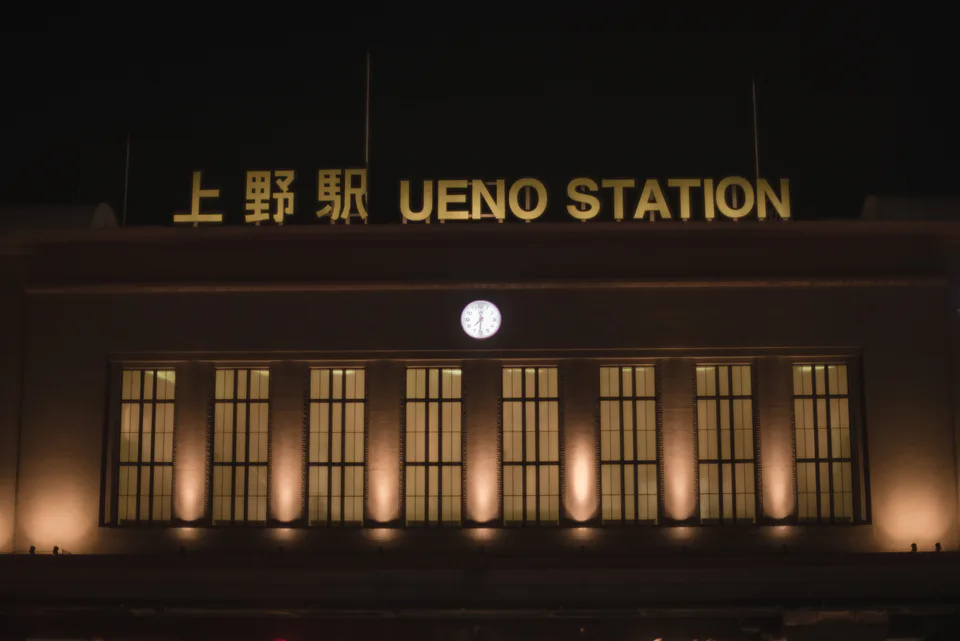
Ueno Park, the Tokyo National Museum, other museums, Ameyoko, Asakusa and Akihabara give Ueno a coherent east-side role. The value is not that every attraction is next door. It is that several different days can begin without first paying a west-to-east positioning journey.
This is especially strong for travellers who like early starts. Museum opening times, temple mornings and market or neighbourhood walks make the first useful hour of the day valuable. If the hotel lets you spend that hour sightseeing rather than crossing Tokyo, the benefit repeats.
The trade-off is the evening. Ueno has plenty of food and activity, but it is not a substitute for choosing Shinjuku when late dinners, bars, Shibuya shopping or Harajuku evenings are central to the trip. If three nights end west, the quieter Ueno return can become the commute you resent most.
The hotel still decides whether Ueno’s theoretical advantage survives contact with luggage. Keisei-Ueno and JR Ueno are separate stations, and “Ueno Station” on a hotel listing can hide a different final walk depending on which railway you just used. If Ueno is winning, compare Mitsui Garden Hotel Ueno vs NOHGA HOTEL UENO TOKYO before paying a premium for a vague “near Ueno” label.
If Akihabara is a core purpose of the trip rather than a side stop, the JR East Hotel Mets Premier Akihabara guide may solve the route more cleanly than forcing Ueno to be the answer to every east-side trip.
Shinjuku wins when the last useful hour of the day keeps happening in western Tokyo
Shinjuku’s biggest advantage is not that it has more train lines. It is that a large amount of shopping, dining and nightlife can happen near the hotel, while Shibuya and Harajuku remain on the same side of the city. That matters after 20:00, when another cross-city ride feels more expensive than it did on the planning spreadsheet.
For one west-side evening, I would not move the whole stay. For three or four, I would. This is the same three-repeat rule applied to the part of the day when fatigue is highest.
The hidden cost is station friction. “Shinjuku” can mean a hotel toward the west side, south side, Kabukicho, Shinjuku-sanchome or another approach. A theoretically excellent base can still require repeated station crossings, the wrong exit or a long luggage walk. If you are travelling with two large cases, a stroller or someone who tires easily, I would value the hotel’s usable entrance more than a small difference in train time.
If Shinjuku wins, compare Hotel Gracery Shinjuku vs HOTEL GROOVE SHINJUKU for Kabukicho-side nightlife and airport-bus trade-offs, or Hotel Gracery vs JR Kyushu Hotel Blossom Shinjuku when JR-side access and luggage movement matter more.
Hakone strengthens Shinjuku when it is the next overnight stop, not merely one item on the list
Odakyu currently advertises the fastest direct Romancecar journey from Shinjuku to Hakone-Yumoto at about 75 minutes. That gives Shinjuku a real checkout-day advantage when Hakone immediately follows Tokyo: you can leave the hotel, reach the Odakyu side of Shinjuku and begin the intercity leg without positioning across Tokyo first.
The recommendation weakens sharply if Hakone is only one day in the middle of five Tokyo nights. In that case you are optimising one morning while the hotel affects every other morning and evening. If four days are east-heavy, I would still keep Ueno and accept the one awkward westbound start.
If Hakone is not yet fixed, compare Hakone vs Kawaguchiko first. If Hakone wins, use the Hakone area guide before deciding whether it deserves a day trip or an overnight stay.
Kawaguchiko gives Shinjuku a similar advantage, but only on services that fit your date
JR East’s current 2026 timetables continue to show direct Fuji Excursion services from Shinjuku through Otsuki to Kawaguchiko. That can make Shinjuku an unusually clean final Tokyo night when Lake Kawaguchi is the next stop.
But the direct train is not a generic promise that every preferred departure time will work. Operating dates and train times need to match the actual travel date. A hotel should not be chosen months in advance solely because one direct service exists on the timetable.
If Kawaguchiko wins, decide how many nights Lake Kawaguchi needs before allowing one checkout morning to dominate the Tokyo base decision.
Haneda changes the weighting, not automatically the winner
Haneda does not give Ueno the same unique direct-airport advantage that Narita gives it through the Skyliner. GO TOKYO currently lists Ueno at around 50 minutes from Haneda by train. Its Shinjuku guidance lists around 55 minutes by limousine bus or train, while another current GO TOKYO access page shows a roughly 30-minute rail example via Shinagawa depending on the service pattern and terminal.
That variation is exactly why I would not choose between Ueno and Shinjuku using one Haneda headline time. The practical question is which route reaches your specific hotel side with the fewest handling events. A direct airport bus to the right hotel can beat a nominally faster train that ends with a difficult station crossing; a predictable rail route can beat a bus when traffic uncertainty matters.
If you arrive very late, treat that as a separate first-night problem. Do not distort four later sightseeing days to solve one midnight transfer.
Open-jaw flights are where the simple “Narita = Ueno” rule most often breaks
A visitor can arrive at Narita, leave Tokyo for Kyoto or Osaka and never return to Narita. Another can arrive at Narita and fly home from Haneda. In both cases, Ueno’s cleanest airport advantage is used once.
Now compare that one event with the rest of the Tokyo block. If three evenings end in Shinjuku, Shibuya or Harajuku and the next overnight stop is Hakone, Shinjuku may solve four recurring movements while Ueno solves one airport movement. I would choose Shinjuku in that pattern even though the arrival day is less elegant.
The reverse is equally important. Narita in and out + two museum mornings + Asakusa + Akihabara is not merely “Ueno is closer to the airport.” It is an airport advantage reinforced by several daily route advantages. That is the pattern where Ueno becomes difficult to beat.
With a family, stroller or older relatives, the final 500 metres can overturn the whole comparison
Area guides flatten stations into dots. Real hotel access includes concourses, exits, elevators, crossings and the final street segment. With one carry-on, a slightly awkward route may be trivial. With two large suitcases, a stroller or someone who tires easily, it can be the most repeated failure point of the stay.
I would therefore run a hotel-level stress test before booking:
↔ Scroll table left or right
Check | Why it can reverse the area winner |
Which station does the airport train actually use? | Keisei-Ueno and JR Ueno are not interchangeable; Shinjuku also has multiple operators and station approaches |
Which exit is closest to the hotel? | A map distance can hide a much longer indoor route |
Is there an elevator on the route you will actually use? | The “shortest” route may be a poor luggage route |
Where do your three latest evenings finish? | The hardest return often matters more than the easiest morning |
Where does the next overnight leg start? | A checkout-day transfer with luggage is more expensive than the same trip as a casual day ride |
If Tokyo is followed by another overnight city, Japan luggage forwarding can remove more friction than changing the Tokyo base purely for one transfer day.
Failure modes: three ways people choose the right area for the wrong reason
1. Comparing airport fares that they will not actually buy
Using the station price for one train and an online visitor discount for the other creates a fake gap. Compare the products you are eligible for and willing to purchase. In 2026, both Keisei and JR East have visitor-oriented Narita products that materially change the round-trip maths.
2. Treating “Shinjuku Station” and “Ueno Station” as single doors
The district-level winner can fail at hotel level. The correct comparison is airport platform → hotel entrance, or evening station → hotel entrance, not pin-to-pin map distance.
3. Optimising a day trip that should not control the hotel
One Hakone or Kawaguchiko departure does not automatically justify Shinjuku. One Narita arrival does not automatically justify Ueno. A one-off movement earns control only when it is unusually hard, luggage-heavy or time-critical.
Choose neither when another repeated constraint is more important
Ueno vs Shinjuku is the wrong comparison when a third base solves the trip better. An early Tokaido Shinkansen can make Tokyo Station or Shinagawa more rational. Two consecutive Disney days can justify moving closer to the parks. A one-night Tokyo stop before a flight can make airport access more important than sightseeing geography.
If intercity rail is the deciding factor, compare Tokyo Station vs Shinjuku. If Disney consumes a major part of the stay, use Stay Near Tokyo Disney or in Tokyo? before forcing either Ueno or Shinjuku to absorb the commute.
Final verdict: Ueno or Shinjuku?
Choose Ueno when Narita is used at both ends and at least two or three meaningful Tokyo days begin east. Choose Shinjuku when at least three meaningful evenings or the next overnight leg point west. If the pattern is balanced, I use Narita access as the tiebreaker and lean Ueno. If the pattern is unbalanced, I optimise the repeated daily geography instead.
The strongest red-team case against Ueno is a Narita-arrival-only trip with several west-side evenings and Hakone or Kawaguchiko immediately after Tokyo. The strongest case against Shinjuku is a Narita round trip with museums, Asakusa and Akihabara doing most of the work. In both cases, the answer is not “which station has more lines?” It is which base removes the most repeated friction from this specific trip?
Sources and what to recheck
Keisei Electric Railway — Ueno access by Skyliner · Keisei Electric Railway — current Skyliner discount ticket prices and eligibility · JR East — Narita Express and N’EX TOKYO Round Trip Ticket · GO TOKYO — Ueno access guidance · GO TOKYO — Shinjuku access guidance · Odakyu — Romancecar Shinjuku–Hakone guidance.
JR East 2026 timetables were also checked for current Narita Express and Fuji Excursion direct services. Facts were rechecked on August 26, 2026. Airport fares, visitor-ticket eligibility, limited-express schedules and operating dates can change, so verify the exact travel date before buying a non-refundable ticket.
MIMARU Osaka Namba Station: Is One 35 m² Apartment Better Than Two Rooms for Four?
NOHGA HOTEL UENO TOKYO vs HOTEL GROOVE SHINJUKU: Which Base Saves More Friction?
Tokyu Stay Shinjuku Eastside: Is It Right for a Four-to-Seven-Night Stay?
Solaria Nishitetsu Hotel Fukuoka vs CROOM Hakata Gion: Better for 4 Adults?
Osaka Hotels for 4–6 Friends: When One Big Room Stops Being the Better Deal