
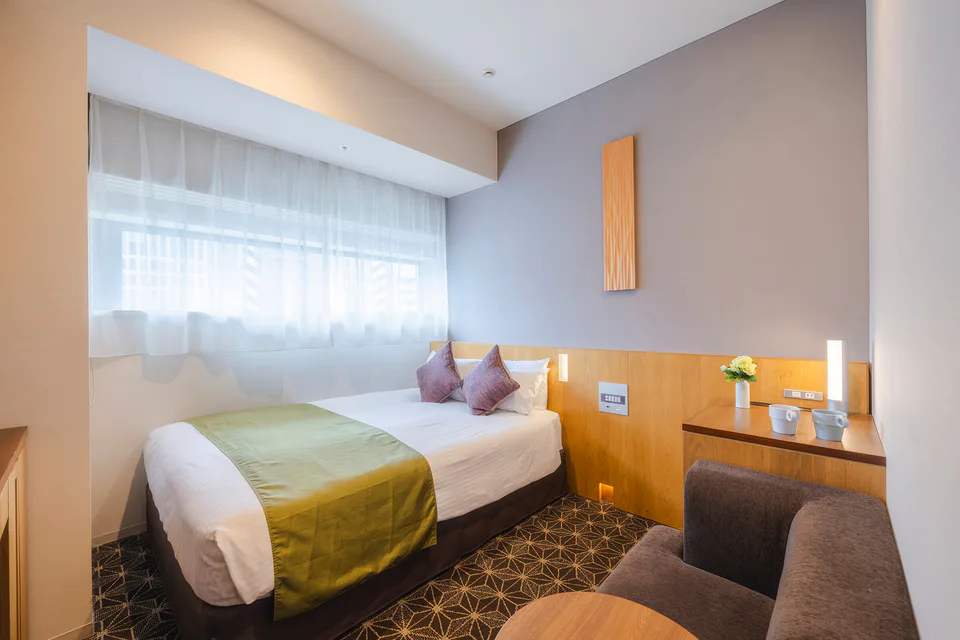
Choose Hotel Gracery Shinjuku when JR Shinjuku East Exit and the lower room-price ladder will pay you back repeatedly. Choose HOTEL GROOVE SHINJUKU when the direct airport-bus stop at Tokyu Kabukicho Tower, one-minute Seibu-Shinjuku access or a larger starting room solves a real constraint. The important correction is that GROOVE's airport-bus advantage is large on arrival and departure day but usually used only twice. Gracery's shorter published JR walk can repeat every day. A four- or five-night stay should therefore not be decided by the airport transfer alone.
Both hotels are in Kabukicho, so this is not a generic “quiet area versus nightlife area” comparison. It is a question of which edge of the stay is expensive for you: the airport hand-off, the repeated station walk, or the room itself.
Hotel Gracery vs HOTEL GROOVE: the 30-second decision
↔ Scroll table left or right
Your real constraint | Start with | Why | What can reverse it |
JR Shinjuku is used every day | Gracery | Official baseline: about 5 minutes from JR East Exit versus about 7 minutes from JR/private-rail Shinjuku for GROOVE | GROOVE's larger room or airport-bus benefit may matter more than two published walking minutes |
Seibu-Shinjuku is a repeated route | GROOVE | Tokyu Hotels lists it at about 1 minute; Gracery lists Seibu-Shinjuku at about 3 minutes | Do not pay for this if you barely use Seibu |
Two large suitcases from Haneda or Narita | GROOVE | The airport coach stops at Tokyu Kabukicho Tower, the same building complex | The bus is traffic-sensitive and schedule-limited; one easy arrival does not automatically justify a multi-night premium |
Two travellers needing more than an entry-level compact room | Compare room-to-room | Gracery's fair luggage comparison is usually its 24 m² Twin, not its 18 m² Double; GROOVE starts around 21 m² and has 25–28 m² Deluxe rooms | The cheaper acceptable room can beat the theoretically better hotel |
Kabukicho evenings every night | Either | Both already solve the late-night neighbourhood problem | Use station, room and airport geometry to break the tie instead of “nightlife” |
The airport-bus advantage is real — and now quantifiable
Tokyu Bus currently operates direct airport coaches between Tokyu Kabukicho Tower and both Haneda and Narita. For Haneda, the current timetable has 12 departures a day from the tower and 11 from the airport. The adult one-way fare is JPY 1,400, and Tokyu Bus gives an approximate journey time of 75 minutes. The earliest tower departure is currently 05:50; the latest Haneda Terminal 3 departure to the tower is 22:05, arriving at 23:00.
Narita is much thinner. The current service has six departures each way per day, costs JPY 3,600 one way for an adult and is listed at roughly 125 minutes. The first tower departure is 06:30, while the latest Narita Terminal 1 departure shown is 19:40, arriving at Tokyu Kabukicho Tower at 21:20.
This changes how the comparison should be used. GROOVE has a genuine luggage advantage when one of those buses matches your flight. But “direct airport bus” is not the same as “airport transport at any hour.” A late Narita arrival can miss the last tower service entirely. A very early departure can also force a different plan.
Gracery is not cut off from the same bus. Its own current FAQ points guests to Tokyu Kabukicho Tower and describes the stop as roughly a two-minute walk away. So the correct distinction is GROOVE = bus-stop building; Gracery = short outdoor final walk from the same bus stop. That is meaningful with two large cases or heavy rain, but smaller than comparing “direct bus” with “no bus.”
Use the two-use versus repeated-use test
The airport bus is normally used once on arrival and once on departure. The JR walk can be used twice a day for four or five days. This creates a simple ValueNavi test:
Airport-heavy stay: two large cases, long-haul flight, airport bus at a good time, limited daily JR use → GROOVE gets stronger.
Rail-heavy stay: repeated JR Shinjuku mornings and returns, light luggage, airport transfer solved another way → Gracery gets stronger.
Mixed stay: calculate the room premium. If GROOVE costs much more across five nights, two easy airport hand-offs may not repay the whole difference.
This is more useful than declaring one hotel “better connected.” They are connected to different things.
JR and Seibu access: published minutes are only the outside segment
Hotel Gracery's official material lists about five minutes from JR Shinjuku East Exit and about three minutes from Seibu-Shinjuku. HOTEL GROOVE's current Tokyu Hotels listing gives about seven minutes from Shinjuku Station on JR/private railway lines, six minutes from Shinjuku West Exit Station and one minute from Seibu-Shinjuku.
Do not turn those numbers into platform-to-pillow guarantees. Shinjuku is a large multi-operator complex; platform walking, finding the correct exit, crowds and vertical movement come before the published outdoor walk. At Gracery, the hotel entrance is on the rear side of the Shinjuku Toho Building and reception is on 8F. At GROOVE, the hotel sits in Tokyu Kabukicho Tower and the guest-room experience begins higher in the same complex.
For a first arrival with luggage, building-entry simplicity matters more than it does on Day 4 when the route is familiar. For repeated commuter-style movement, the shorter station baseline matters more.
Room space can overwhelm the access argument
Do not compare hotel names while silently comparing different products. Gracery's common entry Double is 18 m²; its Standard Twin is 24 m² and Comfort Twin 32 m². GROOVE's room ladder starts around 21–22 m², moves into roughly 25–28 m² Deluxe rooms and then larger Premier categories.
For two people with two 28-inch suitcases, I would not use Gracery's 18 m² Double as the fair reference unless both travellers genuinely accept that compact layout. Compare the 24 m² Twin with the GROOVE room you would actually book. If the rate gap becomes small, the room can decide the stay. If GROOVE is substantially more expensive for five nights, Gracery's larger Twin can be the better total purchase even though GROOVE has the easier airport-bus hand-off.
The useful rule is price the cheapest room you would happily live in, not the cheapest room the hotel sells.
Kabukicho nightlife does not break the tie because both hotels already have it
Both properties are inside the same nightlife-heavy part of Shinjuku. That means “I want Kabukicho at night” is not enough to choose between them. The neighbourhood advantage is already shared.
Instead ask what happens before and after the nightlife. If you return from western Tokyo through JR Shinjuku every evening, Gracery's East Exit geometry matters. If you arrive from Haneda with two large cases and leave for Narita at the end, GROOVE's tower bus stop matters. If you spend long evenings in the room, the larger room ladder matters.
If you are still unsure whether Kabukicho should be the base at all, solve Shinjuku vs Shibuya or the broader first-time Tokyo base decision before comparing these two buildings.
Four- and five-night stays: calculate the premium over the whole stay
A JPY 4,000 nightly difference is JPY 20,000 over five nights. Ask what that JPY 20,000 buys. If it buys two airport hand-offs with no street-level luggage dragging, a room you can actually repack in and a station you use repeatedly, the premium can be rational. If it buys only a nicer arrival on Day 1 while every following day favours Gracery, it is much harder to defend.
The same test works in reverse. Saving JPY 20,000 is not a victory if the cheaper Gracery room is so compact that two suitcases block circulation every day. Move up Gracery's room ladder first, then compare totals again.
Failure modes that should reverse the obvious answer
Late Narita arrival: the final Tokyu Kabukicho Tower coach may be gone. Do not pay a GROOVE premium for a bus you cannot use.
Very early airport departure: check the actual first bus against terminal check-in time; “airport bus hotel” is not a substitute for schedule math.
Daily JR excursions: a one-time airport convenience can lose to repeated station friction.
Large-room requirement: once you upgrade either hotel, reopen the comparison instead of anchoring on its entry rate.
Nightlife is not actually your itinerary: if most days and evenings are east Tokyo, neither Kabukicho hotel may be the best base.
Final verdict
Choose Gracery when JR Shinjuku East Exit and a lower acceptable room tier repeat their value across the stay. Choose GROOVE when the Tokyu Kabukicho Tower airport bus, one-minute Seibu access or a larger room solves a constraint you will actually feel.
For long-haul travellers with two large cases, GROOVE's bus-stop-in-the-building advantage is real, but quantify it correctly: Haneda currently has 12 tower departures and 11 airport departures per day; Narita only six each way. If the flight does not fit the timetable, delete that benefit from the decision. And over four or five nights, compare the total room premium against the number of times each access advantage is actually used.
Keio Plaza Hotel Sapporo: Is a 33.2 m² Twin Worth the Winter Walk?
Tokyo to Kawaguchiko: Fuji Excursion, Highway Bus or Guided Tour?
Hotel Torifito Otaru Canal: Is a 7-Minute Walk from Otaru Station Worth It?
Hotel Gracery Sapporo vs Solaria Nishitetsu: Winter Luggage or a 26 m² Twin?
References
Hotel Gracery Shinjuku — official access and hotel information · Tokyu Hotels — HOTEL GROOVE SHINJUKU access · Tokyu Bus — Tokyu Kabukicho Tower ↔ Haneda Airport · Tokyu Bus — Tokyu Kabukicho Tower ↔ Narita Airport. Checked August 25, 2026. Airport-bus schedules, traffic, room inventory and rates can change; verify the exact travel date.