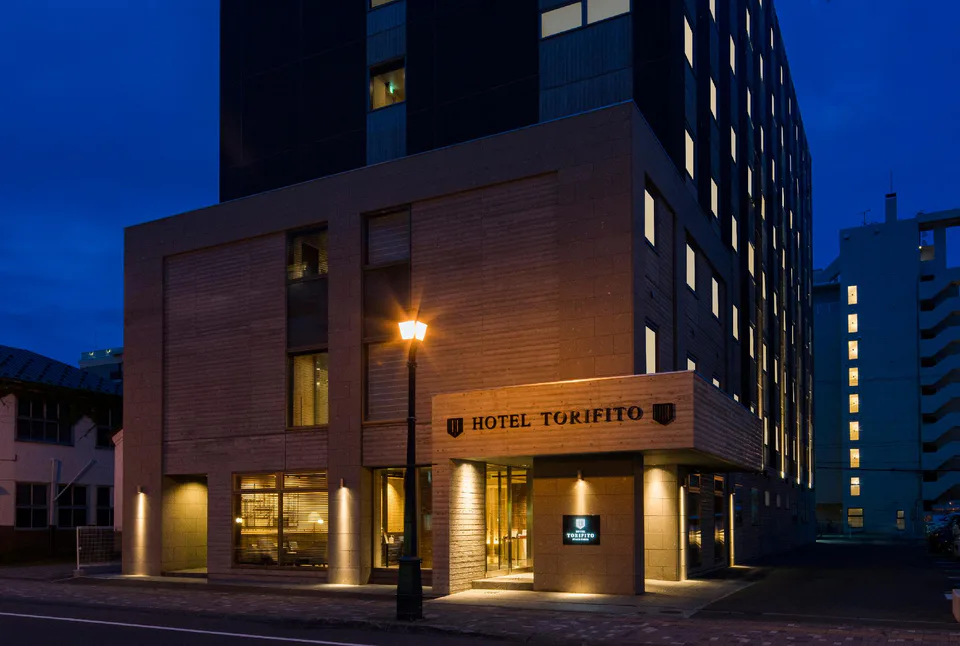
Hotel Torifito Otaru Canal makes the most sense when Otaru is a real overnight rather than a place where you only sleep between two trains. The hotel's current FAQ puts it about seven minutes on foot from JR Otaru Station, while the hotel is roughly three minutes from Otaru Canal. You are therefore paying more suitcase friction on the two transfer edges so that the luggage-free middle of the stay happens closer to the canal and central sightseeing.
That trade works when you arrive early enough to store luggage, spend a real afternoon/evening in Otaru and use at least one public-bath window. It becomes weak for a snowy late arrival followed by an early JR departure: you pay the station walk twice while most of the canal, bath and breakfast value disappears.
ValueNavi decision table: when does Hotel Torifito earn the walk?
↔ Scroll table left or right
Your trip pattern | Start with | Why |
One proper Otaru night with afternoon/evening sightseeing | Hotel Torifito stays on the shortlist | The loaded walk is concentrated on arrival/departure while the useful middle of the stay is canal-side and luggage-free. |
Late winter arrival + early train next morning | Compare a station-front hotel | You keep the suitcase walk but lose most hotel-side payback. |
Two adults, light luggage, one night | 18.2 m² Standard Twin can be rational | Do not buy floor area you barely use. |
Two large hard-shell suitcases | Price Moderate and Superior Twin | 20.4 m² is only about 12% larger than Standard; 24.1 m² is about 32% larger. |
Four travellers | Verify Family Twin sleeping surfaces | Capacity four does not mean four equal regular beds. |
Tattooed traveller choosing the hotel for the bath | Remove bath value from the calculation | Current hotel rules prohibit tattooed guests from the public bath. |
ValueNavi Overnight Payback Score
This score evaluates whether the overnight structure repays the hotel's station-distance cost. The weights are luggage-edge friction 25%, canal/evening route fit 25%, usable hotel time 15%, room/luggage fit 15%, bath/breakfast usability 10%, and departure resilience 10%. Each dimension is 0–10 and weighted.
Scenario | Score | ValueNavi read |
|---|---|---|
13:00 arrival, luggage storage, canal evening, normal 09:00 departure | Strong fit; the luggage-free middle block repays the two loaded walks. | |
22:30 winter arrival, 07:00 train next morning | Weak fit; almost every Torifito-specific benefit is compressed away. | |
Two nights, two large cases, Superior Twin, bath used twice | Station cost is amortised while room and hotel utility repeat. | |
One night, tattooed traveller, no canal evening | The bath is unusable and the location advantage is underused. |
I use 8.5+ as a strong fit, 7.5–8.4 as conditional and below 7.5 as a signal to compare a station-front alternative. This is an editorial planning score, not a hotel quality rating.
ValueNavi Loaded-Walk Tax: the seven-minute walk is not paid equally on every trip
The official hotel FAQ gives roughly seven minutes from JR Otaru Station. The hotel also says ordinary luggage can be stored before check-in and after checkout for same-day collection.
Loaded-Walk Tax = station-to-hotel loaded legs × weather/luggage burden
For a normal one-night stay that means two loaded legs: arrival and departure. The rest of the sightseeing can happen without luggage. For a late-in/early-out winter stay, those two loaded legs become almost the entire hotel experience.
↔ Scroll table left or right
Trip shape | Loaded legs | Payback available? |
Early arrival → store bags → Otaru afternoon/evening → normal departure | 2 | Yes: long luggage-free central block. |
Late arrival → sleep → early train | 2 | Very little: the loaded walks dominate the stay. |
Two-night stay | 2 | Stronger: the same two loaded legs are amortised across more hotel and Otaru time. |
Winter makes the same map distance less predictable because snow, ice and suitcase-wheel behaviour change the effective burden. Seven minutes is therefore a distance reference, not a guaranteed winter door-to-door time.
Standard, Moderate or Superior Twin: use percentage change, not room names
The current official room list gives Standard Twin at 18.2 m², Moderate Twin at 20.4 m² and Superior Twin at 24.1 m². All three list two 110 × 200 cm regular beds.
Standard → Moderate: +2.2 m², about 12.1% more published area.
Standard → Superior: +5.9 m², about 32.4% more.
Moderate → Superior: +3.7 m², about 18.1% more.
Those percentages do not prove open-suitcase clearance, but they do stop an automatic assumption that the next room name up is a meaningful space solution. Moderate is a small step; Superior is materially larger on paper.
↔ Scroll table left or right
Room | Official size / beds | Best fit |
Standard Twin | 18.2 m² / 2 × 110 cm | One night, light luggage. |
Moderate Twin | 20.4 m² / 2 × 110 cm | Small price-sensitive step up. |
Superior Twin | 24.1 m² / 2 × 110 cm, capacity 3 | Two large cases, more room time or a third guest after checking the extra sleeping arrangement. |
Family Twin | 24.1 m² / 2 regular beds, capacity 4 | Families/groups after checking the bunk/sofa configuration. |
ValueNavi Room Upgrade Efficiency
When live rates are available, compare the upgrade with the area it actually buys:
upgrade cost per added m² = room-price difference ÷ additional published floor area
For Standard → Moderate, divide the premium by 2.2 m². For Standard → Superior, divide it by 5.9 m². This does not make square metres the only value; it simply shows whether you are paying a large premium for a very small physical change.
For one night with carry-ons, I would start with Standard. With two large hard-shell cases and a winter repacking night, I would compare Superior before assuming Moderate solves the bottleneck.
“Capacity 4” does not mean four equal beds
The hotel's room page lists Family Twin at 24.1 m² with two regular beds and capacity four. The room concept uses additional bunk/sofa sleeping surfaces for the extra occupants. Four adults, older teenagers or a group that strongly values equal beds should verify the exact sellable configuration rather than relying on the capacity number.
For families, the useful order is: actual ages → sleeping surfaces → luggage floor space → rate. The word “Family” should not override those checks.
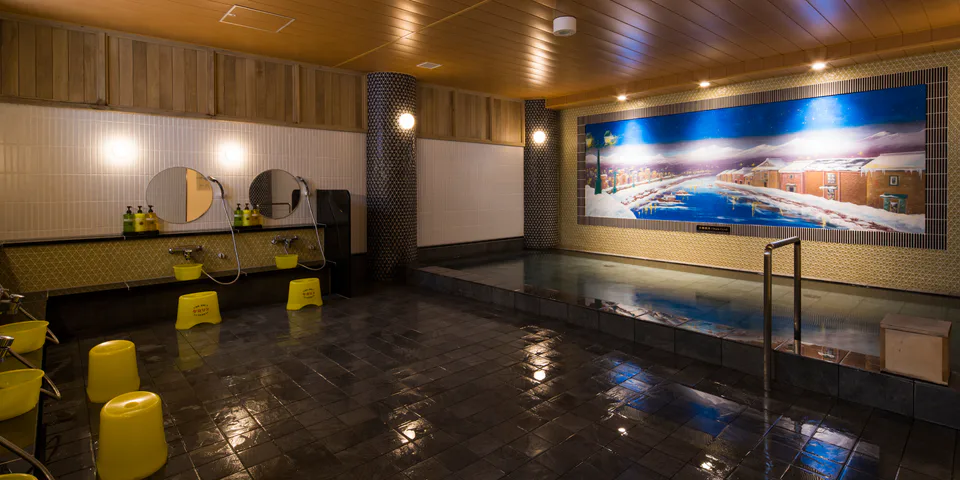
Kumaji-no-Yu public bath at Hotel Torifito Otaru Canal. Official hotel image.
The public bath is valuable by usable sessions, not by the facility icon
Kumaji-no-Yu currently operates 15:00–25:00 and 06:00–10:00. A normal overnight can therefore use an evening or morning session. A 22:30 arrival still leaves one possible late session; a 06:15 departure effectively removes the morning one.
The hotel describes it as a public bath, not a natural hot spring. Current facility rules also prohibit tattooed guests from entering. If either natural spring water or tattoo-compatible bathing is essential, remove the bath from the hotel's value proposition before comparing prices.
ValueNavi Hotel-Use Payback Count
Hotel-Use Payback Count = canal-side evening blocks + usable bath sessions + usable breakfast + laundry/other hotel functions that genuinely repay the station walk
My practical threshold for this one-night hotel is at least two meaningful payback uses. Canal evening + bath is enough. Canal evening + breakfast is enough. If the count is zero, station proximity should dominate the comparison.
Breakfast only counts when the departure leaves a real eating window
The current official breakfast hours are 06:30–10:00, last entry 09:30. Work backward from the actual train and add a winter walking buffer. A prepaid breakfast that leaves only fifteen rushed minutes is not meaningful value.

Breakfast buffet at Hotel Torifito Otaru Canal. Official hotel image.
Parking and laundry are conditional value
The hotel currently lists 41 parking spaces—19 flat and 22 mechanical—on a first-come, first-served basis with no advance reservation. That is not a guaranteed late-arrival parking solution. A winter driver should know the fallback before arrival.
The second-floor coin laundry is almost irrelevant on a one-night standalone Otaru trip but can matter in the middle of a longer Hokkaido route. Amenities should be valued by the problem they remove, not by how long the facility list looks.
When I would choose a station-front hotel instead
I would move Torifito down the list when two or more of these are true: arrival is late, departure is early, two large suitcases make the station walk dominant, Otaru is only a transit night, the public bath cannot be used, or the available room tier creates a space compromise that a station-front competitor does not.
This is the red-team case against the hotel: a good property is still the wrong product when the itinerary removes every feature that was meant to repay its main inconvenience.
When Hotel Torifito earns the walk
I would keep it high on the shortlist when Otaru gets a proper afternoon/evening, luggage can be dropped immediately, the canal and central streets are the main reason for staying, and at least one hotel-side benefit is genuinely used. In that pattern, the seven-minute station walk is the entry price for a better overnight rhythm rather than a repeated daily commute.
If Otaru is one stop in a larger Hokkaido route, solve heavy luggage separately with the Japan luggage-forwarding guide rather than forcing one hotel to solve the entire trip.
Compare the same room and cancellation terms before paying
Freeze the same dates, guest count, exact room category, breakfast, taxes and cancellation deadline before comparing platforms. Standard, Moderate, Superior and Family Twin are different products; comparing their headline minimum rates as if they were identical creates a false saving.
Booking.com — compare Hotel Torifito Otaru Canal rooms
Trip.com — compare Hotel Torifito Otaru Canal rooms
Agoda — compare Hotel Torifito Otaru Canal rooms
Final verdict
I would book Hotel Torifito Otaru Canal for a real Otaru overnight, not for a pure rail stop. Its trade is coherent when you pay the station walk twice, then spend the middle of the stay closer to the canal without luggage and use enough hotel time to repay that cost.
With two large cases, do not assume the 20.4 m² Moderate Twin is automatically enough: it is only about 12% larger than Standard. The 24.1 m² Superior is about 32% larger and deserves the real price comparison when floor space is the constraint.
For a snowy late-in/early-out night, move station distance ahead of the canal and bath. For a proper afternoon/evening overnight, the answer can reverse.
Hotel JAL City Fukuoka Tenjin: Is a 1-Minute Akasaka Walk Worth Choosing Over Tenjin Station?
Dormy Inn PREMIUM Otaru Review: 1 Minute from Otaru Station, but Is a 14m² Double Too Small?
Hotel WBF Grande Asahikawa: Is a 2-Minute Station Walk Worth It for a Northern Hokkaido Base?
Zentis Osaka: Is Room 001 Worth the Walk from Osaka Station?
Mitsui Garden Hotel Ueno: Is the 6-Minute Walk from the Skyliner Worth It?


References
Hotel Torifito Otaru Canal — official FAQ · official room information · official facilities and public-bath hours · official breakfast information · Otaru Tourism Association — station/canal walking reference. Checked August 26, 2026. Room inventory, sleeping configurations, rates and operating conditions can change.