
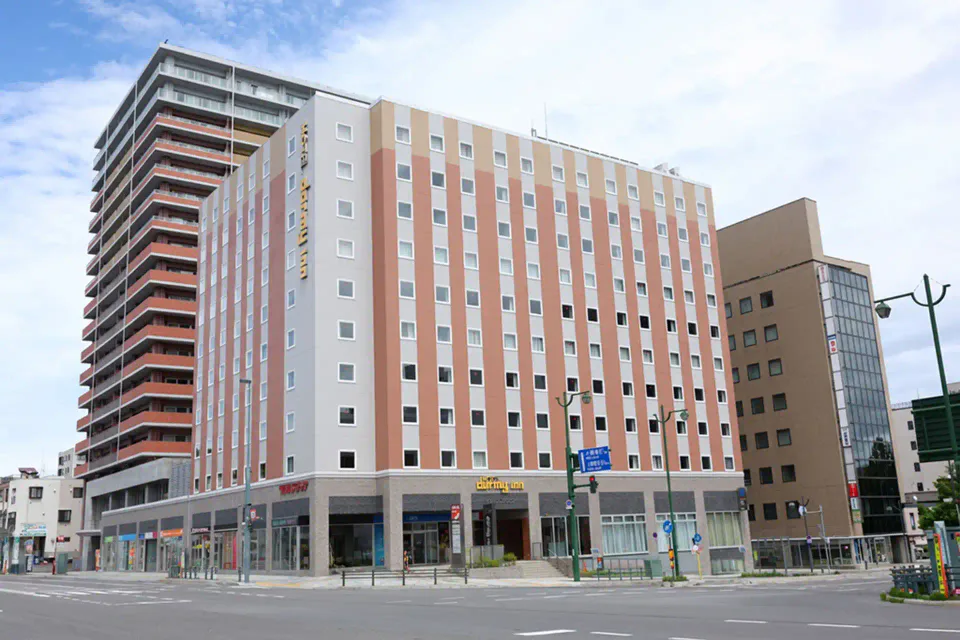

Dormy Inn PREMIUM Otaru is worth choosing when at least two of its three real advantages will be used: the roughly one-minute walk from JR Otaru Station, the natural hot-spring bath from 15:00 to 10:00 the next morning, and the seafood-led breakfast. If you are arriving by JR in winter with luggage and will actually bathe after dinner, the compact-room trade-off can be rational. If you are driving, dislike public baths and only need a bed, the hotel loses much of what makes it distinctive.
The 14.3–15.0 m² Double is not automatically “too small.” It is a short-stay product. For one lightly packed night, it can be the right way to buy station convenience without paying for unused space. For two adults with two large cases or a two- to three-night stay, I would compare the 21.4 m² Queen or Twin first. The room upgrade is buying daily circulation, not status.
↔ Scroll table left or right
Your stay | Start with | Why | What can reverse it |
One night, solo/couple, carry-on or one large case | 14.3–15.0 m² Double | Short stay makes the compact-room cost small while station access still pays back | Two open large cases or lots of shopping |
Two adults, two large suitcases, 2–3 nights | 21.4 m² Queen or Twin | Same station/bath benefits with materially more private floor area | The upgrade premium approaches a larger competing hotel |
Winter JR arrival from Sapporo / New Chitose | Dormy Inn gets stronger | Official station walk is about one minute; JR lists New Chitose→Otaru as fast as 73 minutes | You are driving rather than using JR |
Will use the bath after dinner and again before checkout | Dormy Inn gets stronger | The bath window can create two usable sessions | You do not use communal bathing |
Rental-car trip | Compare again | The one-minute station premium matters less; parking is currently ¥1,400/night and first-come | You still value the bath/breakfast enough to justify the hotel |
The 2026 renovation matters—but it does not turn the hotel into a new build
Dormy Inn PREMIUM Otaru reopened on August 1, 2026 after renovation. The hotel currently confirms redesigned public baths, automatic löyly-style steam systems in both saunas, and updates to guest-room air-conditioning and washbasins. Its Taisho-Romantic room concept remains.
That distinction matters for expectations. “Renovated in 2026” should not be translated into “every room was rebuilt from the structure outward.” The useful upgrade is fresher equipment and a renewed bathing environment. The booking decision still depends on the same core geometry: compact lower room categories, a very short station walk and a long bath window.
The station premium is most valuable on the exact days Otaru is least pleasant to drag luggage through
The hotel officially states about one minute on foot from JR Otaru Station. In winter, the correct interpretation is not “your room is 60 seconds from the platform.” The platform, station exit, snow, ice and hotel check-in remain. What the location does is minimise the outdoor final segment.
JR Hokkaido currently lists New Chitose Airport → Otaru at a fastest 73 minutes, and some Airport services operate through the Sapporo corridor to Otaru. That gives a rail traveller a very clean trip shape: airport train → Otaru Station → very short final walk → hotel. For a couple with large luggage in February, that chain can be worth more than a prettier canal-side hotel that creates a longer snowy suitcase walk.
The value repeats when Otaru is an overnight stop inside a moving Hokkaido itinerary. Arrive by JR, drop bags quickly, walk the city, then return to the station with minimal luggage friction the next morning.
But do not pay this premium blindly. If you are staying four nights and only use the station on arrival and departure, station proximity is used twice. Room size is used every hour you are inside the hotel. Longer stays push the decision toward the better room even if the cheaper Double is technically adequate.
Is the 14.3–15.0 m² Double too small? Use a room-pressure test
The hotel currently publishes these relevant room sizes:
Double: 14.3–15.0 m².
Queen: 21.4 m².
Twin: 21.4 m².
Japanese-style Twin: 21.4 m².
Japanese-Western room: 32.0 m².
Japanese room: 36.3 m².
Accessible room: 31.6 m².
The hotel does not publish a guarantee that two large suitcases can remain fully open in every Double. So do not turn room area into a fake luggage-capacity fact.
Instead, count pressure sources:
two 28–30 inch suitcases;
winter coats and boots;
shopping bags;
two people getting ready at the same time;
more than one night of belongings accumulating in the room.
If you have zero or one pressure source, the Double can be a rational one-night choice. If you have three or four, compare the 21.4 m² rooms immediately. The published area rises by roughly 43–50% versus a 14.3–15.0 m² Double. That is a large enough change to treat as a different daily-use product rather than a cosmetic upgrade.
Queen vs Twin: the room area is matched, so choose by sleeping geometry
The Queen and Twin are both currently listed at 21.4 m². That makes this a clean comparison: you are not buying more published room area by choosing one name over the other.
Choose the Queen when a couple prefers one bed and the price is equal or lower. Choose the Twin for friends, a parent with an older child, or travellers whose sleep quality improves with separate beds. If two large suitcases are the reason you rejected the Double, neither bed label automatically creates more floor area than the other; inspect the exact room layout on the booking page.
For three or four travellers, move to the larger published categories instead of treating maximum occupancy as a comfort target. A room that legally accepts the party is not automatically the best room for winter luggage and different bedtimes.
The natural hot spring should be valued by sessions you will actually use
The hotel’s natural hot-spring public bath is on the second floor and currently operates from 15:00 until 10:00 the next morning. The saunas pause from 01:00 to 05:00.
That long window is unusually useful for a city hotel because it can create two sessions:
Evening session: return from the canal/sushi/dinner, bathe and sleep.
Morning session: bathe again before breakfast or checkout.
If you plan to use both, the facility is doing real work. If you dislike communal bathing or will be out until checkout, remove it completely from the value calculation. “Hotel has onsen” is not value when nobody in the room uses it.
This is also why Dormy Inn should not be compared with an onsen ryokan as though they are substitutes. Dormy Inn is a station hotel with a strong public bath. It does not sell the dinner–private bath–property-time sequence of a ryokan.
Breakfast at ¥3,000 can replace a seafood meal—or become an expensive unused add-on
The hotel currently lists breakfast at JPY 3,000 for adults, JPY 1,500 for children aged three through elementary-school age, and free for children aged two or younger. Service is 06:30–09:30 with last entry at 09:00. The official menu highlights seafood bowls and grilled seafood among the local items.
For an Otaru stay, that creates a useful way to price breakfast: does it replace one seafood meal you already wanted? If yes, JPY 3,000 is not merely a hotel-breakfast surcharge. It may consolidate breakfast and one local-food objective before departure.
If you have an early train, do not count the buffet as a benefit merely because the room rate includes it. Work backward from the train. A breakfast window you cannot use is worth zero to your itinerary.
I would also avoid paying a large breakfast premium if the trip already contains a major sushi/seafood lunch and you prefer a lighter morning. The hotel’s food is a feature, not an obligation.
One night and two nights create different best rooms
One night: the Double becomes much easier to defend. You arrive, leave the bag, spend most waking hours outside, use the bath, sleep and leave. The room has only one night to impose its space cost.
Two nights: belongings accumulate, you may return to the room during the day, and the 21.4 m² upgrade gets used repeatedly. If the premium is modest, I would usually prefer the Queen/Twin for two travellers with full-size luggage.
Three or more nights: reopen the entire Otaru hotel comparison. The question stops being “Can we tolerate 14–15 m²?” and becomes “Is Otaru even the right multi-night base, and does another hotel provide better daily living space?” Use Dormy Inn vs OMO5 vs Hotel Sonia in winter rather than continuing to upgrade blindly inside one property.
Drivers should discount the station benefit before comparing rates
The hotel currently lists 80 parking spaces at JPY 1,400 per night, first-come, with vehicle-size restrictions for the mechanical parking system. Overflow may be directed to nearby partner parking.
If you are driving Hokkaido, the one-minute JR position may contribute little. Your comparison becomes:
room + bath + breakfast + parking + winter-road fit
rather than:
station + bath.
A driver should therefore tolerate a lower competing hotel rate or a larger room farther from JR more readily than a rail traveller. This is a real boundary condition to the usual “Dormy Inn is perfect for Otaru” recommendation.
If the trip is winter self-drive, check Hokkaido Winter Driving Guide before using hotel parking convenience to justify the car.
Three traveller profiles
Couple arriving from New Chitose with two large cases
Choose Dormy Inn, but price the 21.4 m² room first. The JR chain and one-minute outdoor segment are valuable; two large cases make the Double’s space trade-off more likely to repeat.
Solo traveller on one Otaru night
The Double is the cleanest fit. You exploit the station, bath and breakfast while paying less attention to floor area. Upgrading only for prestige wastes the hotel’s strongest value proposition.
Couple with rental car, no interest in public baths
Compare another hotel aggressively. Two of Dormy Inn’s three strongest benefits—JR proximity and public bath—have now been discounted. A larger room, canal-side evening position or cheaper parking elsewhere can reverse the answer.
The premium ceiling: when should you choose another Otaru hotel?
Do not assign a fixed “worth it up to JPY X” figure because hotel rates vary dramatically by winter weekend, festival, room type and cancellation conditions.
Instead, compare the total-stay premium against what Dormy Inn actually removes:
snowy luggage walk from Otaru Station;
the need to find a separate public bath;
one seafood breakfast/meal decision;
possibly a taxi if another hotel’s winter luggage route is poor.
If you will use all three benefits, a moderate premium can make sense. If only one survives, the premium ceiling should fall sharply. The hotel does not become good value simply because the name contains “PREMIUM.”
Final verdict
Dormy Inn PREMIUM Otaru is strongest for rail travellers who want a short winter luggage route and will use the long natural-hot-spring window. The 14.3–15.0 m² Double is a rational one-night product, not a universally bad room. For two adults with large luggage or multiple nights, compare the 21.4 m² Queen/Twin first. If you are driving, will not use the bath or need a larger room for several nights, reopen the Otaru hotel comparison rather than paying indefinitely for station proximity.
Lake Biwa Otsu Prince Hotel: Is the 36.2m² Lake View Worth the Shuttle?
Hotel JAL City Fukuoka Tenjin: Is a 1-Minute Akasaka Walk Worth Choosing Over Tenjin Station?
Oriental Hotel Okinawa Resort & Spa Review: Is the 170m Pool Worth a 7-Minute Beach Walk?
JR Inn Asahikawa: Is a Station-Connected Hotel Worth a Smaller Room?
Sources
Dormy Inn PREMIUM Otaru — official hotel and 2026 renovation information · Official hotel pamphlet — room sizes, bath and breakfast hours · Official breakfast information and current prices · JR Hokkaido — New Chitose/Sapporo/Otaru Airport services. Checked August 25, 2026. Room availability, breakfast prices, parking and rail operations can change.