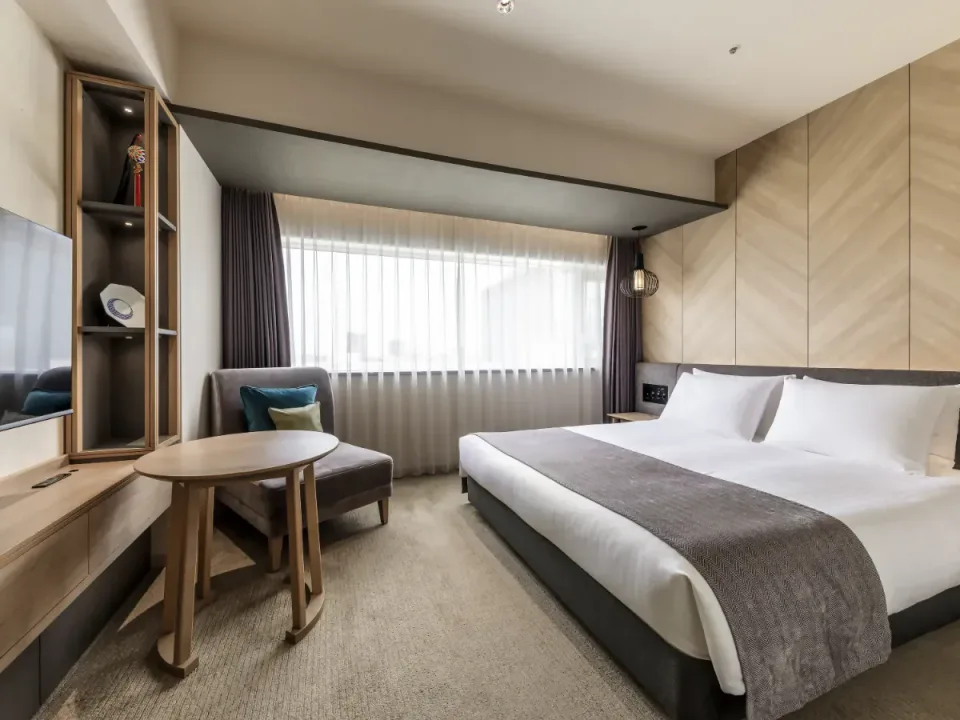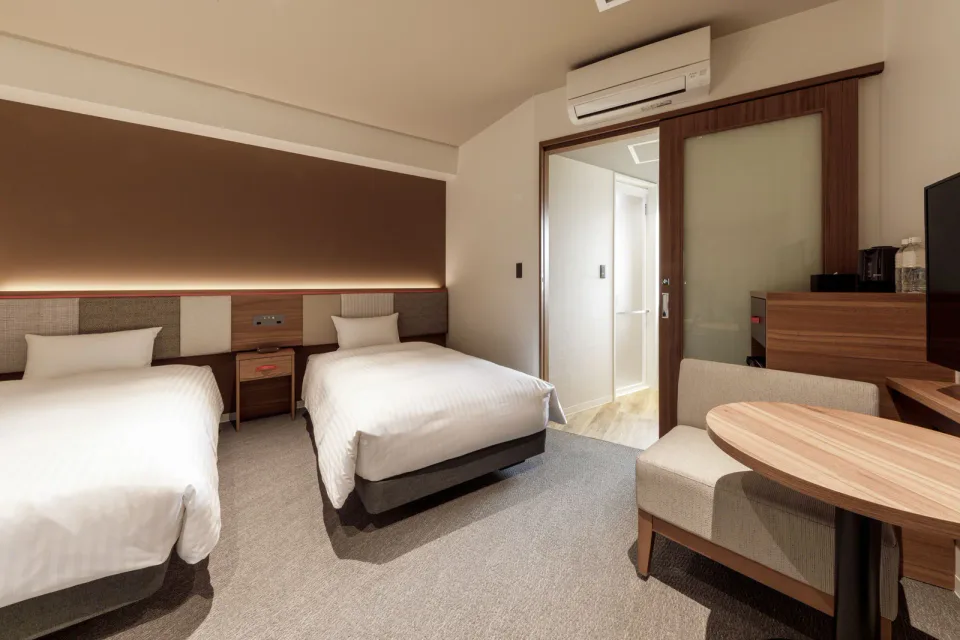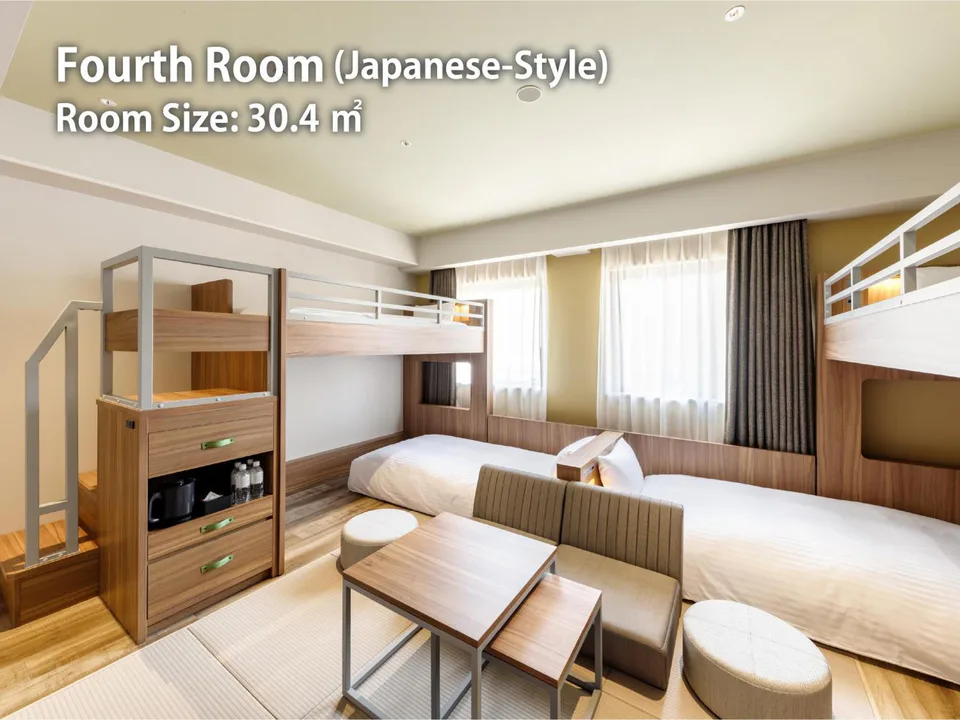
For four adults sharing one room, I would choose Solaria Nishitetsu Hotel Fukuoka when floor space, luggage and Tenjin evenings matter most; I would choose CROOM Hakata Gion when four separate sleeping surfaces, Kushida Shrine/Gion geography and the public bath matter more than generous private-room space. The important correction is that 41.8 m² versus 30.4 m² does not tell the whole story. Solaria gives substantially more room, but its Deluxe Quad is effectively a triple-room layout plus a smaller daybed. CROOM’s standard Fourth gives four single sleeping surfaces, but achieves that inside a much denser room with bunk beds.
For four friends, that bed-layout question can matter more than the star rating. For a family, the answer may reverse again because bunk tolerance, public-bath use and how many large suitcases you carry change the practical value of every square metre.
↔ Scroll table left or right
Your real four-person priority | Choose | Why |
Four large suitcases / 3–5 nights | Solaria | 41.8 m² gives about 37.5% more published room area than 30.4 m² |
Four adults want four separate sleeping surfaces | CROOM standard Fourth | Four single beds are built into the room, including bunk positions |
Everyone wants a conventional same-level bed | Neither automatically | Solaria uses a daybed for the fourth guest; CROOM uses bunk beds |
Tenjin shopping / Dazaifu / late dinner repeats | Solaria | Direct Nishitetsu Fukuoka (Tenjin) connection makes the location work repeatedly |
Canal City / Kushida Shrine / Hakata-side itinerary | CROOM | Kushida Shrine-mae is the hotel’s natural rail anchor |
Four people need to bathe at similar times | CROOM gets stronger | The room already separates bath/toilet/washbasin, and the public bath adds another bathing channel |
Two rooms cost only modestly more | Reopen the whole comparison | Two bathrooms and two private spaces can be worth more than either one-room advantage |
The real space gap is 37.5%—but gross room area is not usable floor space
Solaria’s Deluxe Quad is 41.8 m². CROOM Hakata Gion’s Fourth and Comfort Fourth are 30.4 m². The absolute difference is 11.4 m², which means Solaria publishes about 37.5% more room area than CROOM for these group-room categories.
For four occupants, that works out to 10.45 m² of published gross room area per guest at Solaria versus 7.6 m² at CROOM. This is ValueNavi-derived arithmetic from the published room sizes—not a measurement of free walking space. Bathrooms, walls, furniture and fixed platforms consume part of both totals.
Even with that limitation, the comparison is useful. Four people do not merely add four bodies; they add four bags, four coats, four charging setups and four sets of shopping. The 11.4 m² gap becomes more valuable each night belongings remain unpacked.
For one night with carry-ons, CROOM’s density can be completely rational. For four nights with four checked cases, Solaria’s extra area stops being a luxury specification and becomes daily operating space.
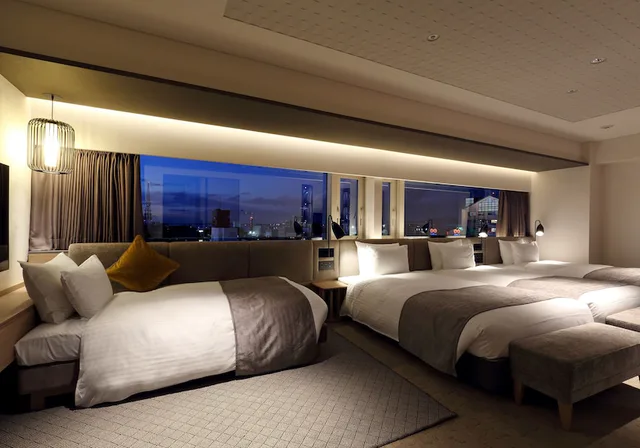
Solaria wins the space comparison, but the fourth bed is not the same product as the first three
Solaria’s current official Deluxe Quad page describes the room as its Deluxe Triple with an added daybed. It lists 41.8 m², capacity for four, regular bed width of 120 cm and a 100 cm × 195 cm daybed.
That creates an important four-adult trade-off. The room is generous, but the fourth guest is not receiving an identical sleeping product. If the group rotates the daybed or nobody cares, this may be trivial. If four adults are splitting the room price equally and bed equality matters, it should be discussed before booking rather than discovered after check-in.
This is why “Solaria is better for four adults because it is bigger” is incomplete. It is better for shared living space and luggage. It does not automatically win on equal-bed fairness.
CROOM’s standard Fourth gives four separate beds—but uses bunk density to achieve it
CROOM Hakata Gion’s standard Fourth is 30.4 m² and is sold for up to four guests. Current hotel-room listings describe four single beds with bunk positions; the published bunk dimensions are about 100 cm × 195 cm. The room also has a separate toilet, wash area and bathroom with washing space.
For four friends, the advantage is obvious: nobody has to share a double bed and there are four separate sleeping surfaces. The trade-off is vertical. At least some guests use the upper bunk positions, and the whole group shares a room that is 11.4 m² smaller than Solaria’s Deluxe Quad.
That makes CROOM a better fit for adults who care more about separate beds than floor area and who are comfortable climbing. It becomes a weaker fit for older travellers, anyone with mobility limits, or a group where nobody wants the upper bunk.
Do not accidentally book Comfort Fourth when what you wanted was four equal individual beds
CROOM also sells a 30.4 m² Comfort Fourth with capacity up to six. That larger capacity does not mean it is automatically the better four-adult room. Current room information shows a different bed arrangement, including 150 cm lower beds and 100 cm upper bunk beds, designed to increase occupancy.
For a four-adult friends trip, the standard Fourth may therefore be the cleaner comparison because its four individual single sleeping surfaces match the actual party. Comfort Fourth becomes more relevant when the group is willing to share wider lower beds, includes children, or needs the higher occupancy limit.
This is a useful booking rule beyond these hotels: compare the exact bed map, not the maximum occupancy number.
CROOM’s public bath is not just an amenity when four people share one room
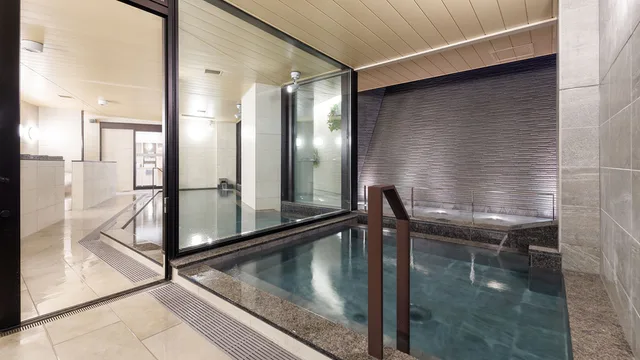
CROOM Hakata Gion’s public bath currently operates 15:00–25:00 and 06:00–09:30 for hotel guests. The group rooms themselves already have a separate bath, toilet and washbasin, so the public bath is not rescuing a unit-bath design. Its real value is parallel capacity.
If two travellers use the public bath while two use the room, the group can finish the evening routine faster. On a four-adult trip, that can be more valuable than the recreational appeal of the bath itself.
The benefit disappears if nobody wants communal bathing, if tattoos make the facility unusable under the property’s current rule, or if the group routinely returns after 01:00. In those cases, remove the public bath from the value calculation rather than treating it as a free bonus.
Location should decide before room size when the same journey repeats every day
Solaria is directly connected to Nishitetsu Fukuoka (Tenjin) Station and is around five minutes on foot from the Airport Line’s Tenjin Station. That is a strong base when Tenjin shopping, Daimyo, late dinners or Nishitetsu trips such as Dazaifu repeat across the stay.
CROOM Hakata Gion sits beside Kushida Shrine-mae Station and around the Canal City/Gion side of central Fukuoka. It is also walkable from Hakata, but “Hakata-side” should not be interpreted as direct JR Hakata Station access. If your group has 07:00 Shinkansen departures on several mornings, a true Hakata Station hotel may be the better third option.
Use the Hakata vs Tenjin guide before paying for either group room. A larger room in the wrong district can make four people commute together twice a day; a compact room in the right district can remove that repeated movement.
Four suitcases create a different decision from four carry-ons
The room-size difference should be tested with the luggage you will have on the final night, not the luggage you imagine on arrival day.
Four carry-ons: CROOM’s 30.4 m² is much easier to justify.
Two large cases + two carry-ons: either can work; location and bed preference can break the tie.
Four large hard-shell cases: Solaria’s extra 11.4 m² becomes materially more valuable.
Shopping-heavy trip: judge the room by night three or four, after new bags and purchases have accumulated.
If the wider Kyushu route lets you send the main cases ahead, the Japan luggage-forwarding guide can change the hotel answer more than a small nightly rate difference.
One room versus two rooms is the comparison both hotels can lose
The strongest red-team against both one-room options is two ordinary twin rooms.
Four adults sharing one room save social separation and may save money, but they also share alarms, lights, conversations and one private bathroom. CROOM’s public bath helps bathing capacity; it does not create another quiet room. Solaria’s 41.8 m² improves circulation; it does not create a second door.
Before paying a large group-room premium, compare:
one Solaria Deluxe Quad;
one CROOM Fourth;
two acceptable twin rooms in the same district.
If two twins cost only modestly more, the extra bathroom, privacy and sleep independence can outweigh staying together in one room. If the group strongly values one-room social time, then the quad comparison remains relevant.
Stay length changes which compromise hurts more
One night: CROOM’s compact density is easiest to accept. You unpack less, the public bath can speed up the evening, and the four-bed layout keeps the group together.
Two or three nights: location becomes the main decision. Choose the hotel that sits inside the repeated itinerary.
Four or five nights: Solaria’s extra room area gains weight because luggage and belongings remain in the room every day. CROOM can still win if its location is clearly better and the group genuinely uses the public bath.
Which would I choose for four adults?
Four friends, equal split, everyone wants their own bed: CROOM Fourth first—provided everyone accepts bunk positions.
Four adults with four large suitcases: Solaria first. The 37.5% larger published room area is likely to matter every day.
Older parents or anyone avoiding bunk ladders: Solaria is safer, but confirm who receives the daybed. Two twin rooms may be better than either.
Shopping-heavy Tenjin trip: Solaria.
Canal City / Kushida Shrine / compact central-city trip: CROOM.
Different sleep schedules: compare two rooms before either quad.
Compare the exact four-person products
Do not compare a two-person teaser price with a four-adult total. Hold the same dates, four adults, breakfast basis, taxes and cancellation terms constant.
Solaria Nishitetsu Hotel Fukuoka
Booking.com — compare the 41.8 m² Deluxe Quad
Trip.com — compare Solaria for four adults
Agoda — compare the same Solaria room and terms
Nishitetsu Hotel CROOM Hakata Gion Kushida Shrine
Booking.com — compare Fourth and Comfort Fourth
Trip.com — compare CROOM for four adults
Agoda — compare the same CROOM room and terms
Final verdict
Solaria is the stronger four-adult room when space and luggage are the first constraint. CROOM Hakata Gion is the stronger one-room solution when four separate beds, the Gion/Canal City location and parallel bathing capacity matter more.
But neither wins automatically for four equal-paying adults. Solaria’s fourth sleeping surface is a smaller daybed; CROOM achieves four separate beds with bunk positions. If nobody wants the daybed and nobody wants the upper bunk, stop comparing quad rooms and price two twins instead.
That is the decision ordinary room-capacity tables miss: the best four-person hotel is not the one that merely accepts four names on the reservation. It is the one where the group agrees on who sleeps where, where four bags go, and how four people get ready at the same time.
Sources and verification date
Solaria Nishitetsu Hotel Fukuoka — Deluxe Quad room specifications · Solaria Nishitetsu Hotel Fukuoka — access and hotel information · Nishitetsu Hotel CROOM Hakata Gion current room listings for Fourth / Comfort Fourth · current hotel public-bath information listing 15:00–25:00 and 06:00–09:30. Checked August 25, 2026. Room inventory, bed assignment, bath rules and rates can change; verify the exact room name and four-adult booking conditions before payment.
Fukuoka Hotels for Day Trips: Choose Hakata or Tenjin by Where Your Mornings Start
Solaria Nishitetsu Hotel Fukuoka vs ONE FUKUOKA HOTEL: Which Tenjin Stay Fits?
Fukuoka Self-Drive Hotels: Choose Your Car Days Before You Choose Hakata, Tenjin or Uminonakamichi
Sapporo Public-Bath Hotel Comparison: Solaria Nishitetsu vs SAPPORO HOTEL by GRANBELL in Winter