
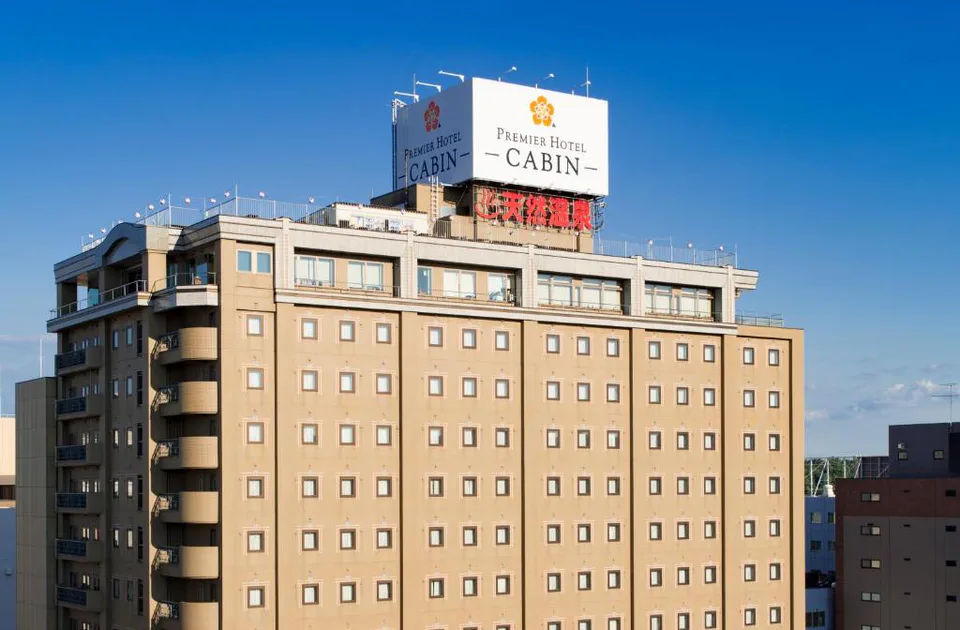
Premier Hotel -CABIN- Asahikawa is worth considering when you want two things at once: a short walk from JR Asahikawa Station and a natural hot spring you can still use after a late northern-Hokkaido day. The hotel’s current guest-room ladder runs from 14 m² Semi-Double to 22 m² Deluxe Twin/Triple, while staying guests can use Kagura-no-Yu from 14:00 until 10:00 the next morning. That overnight bath window is the real differentiator—not simply the fact that an onsen exists.
The trade-off is equally clear. For two travellers with large suitcases, a 14 m² room can become the main source of friction by night three. My default is therefore not “book the cheapest room because the bath is good.” It is: decide how many times the overnight bath will actually be used, then price the 19 m² Twin and 22 m² tier against the compact-room saving. If station connectivity matters more than the bath, compare JR Inn Asahikawa; if you want a different station-area onsen balance, compare Hotel WBF Grande Asahikawa.
The 30-second decision
↔ Scroll table left or right
Trip pattern | My starting point | Why |
1 night, light luggage, definite onsen use | 14–18 m² can be rational | Most of the stay is outside the room and the overnight bath delivers a real benefit. |
2 people, 3–5 nights, large luggage | Price the 19 m² Twin first | Repeated unpacking and winter clothing make room friction compound. |
No public-bath use | Compare another hotel | You are giving up room space without using the property’s strongest differentiator. |
Indoor station route is non-negotiable | Compare JR Inn Asahikawa | Three minutes is close, but Premier Hotel -CABIN- is still an outdoor walk. |
The ValueNavi overnight-onsen payback test
The most useful question is not “Does the hotel have an onsen?” It is “How many times does the overnight operating window rescue a bath I would otherwise miss?”
↔ Scroll table left or right
Expected use | What the 14:00–next 10:00 window changes | Decision effect |
Return before 20:00 every night | Very little; many city hotels can offer an ordinary evening bath window | Do not pay much for the overnight feature. |
One late return after Biei/Furano | You can still bathe instead of racing an early closing time | Useful, especially on a one- or two-night stay. |
Several late returns | The same late-night flexibility repeats | The bath starts to justify a meaningful share of the hotel choice. |
You do not use communal baths | Nothing | The answer reverses: room size and station access should dominate. |
This is the boundary condition that matters most. A feature has value only when the itinerary repeatedly uses it. The hotel states that staying guests may use the bath throughout the night from 14:00 to 10:00 the next morning. On Sundays the men’s and women’s bath areas switch, and the hotel warns that bathing times can change, so recheck the current schedule before building a late-night plan around a specific side.
Three minutes from JR Asahikawa Station is close—not station-connected
The hotel is about three minutes on foot from JR Asahikawa Station. In dry weather with a cabin bag, the distinction between a three-minute walk and an indoor station connection is minor. In snow, wind or ice with two large suitcases, it becomes part of the accommodation product.
I would not exaggerate this into a major winter expedition. The useful point is simply that the final segment remains outdoors. If your priority is removing that segment almost entirely, compare JR Inn Asahikawa. If the larger itinerary is still unsettled, use the Hokkaido itinerary and transport guide before deciding how much a station-area hotel matters at all.
Driving changes the decision again. A central station location loses value when every morning begins at a parking space, while winter-road risk becomes more important. Use the Hokkaido winter-driving guide before letting a station-near hotel determine whether the trip should be self-drive.
14, 18, 19 or 22 m²: choose by stay length and luggage, not room name
The official room list currently shows Semi-Double at 14 m², Double at 18 m², Twin at 19 m² and Deluxe Twin/Triple at 22 m². These are not interchangeable products for a multi-night winter stay.
↔ Scroll table left or right
Room tier | Published area | My use case |
Semi-Double | 14 m² | One night, light luggage, room mainly for sleep. |
Double | 18 m² | Couple wanting one larger bed and a little more margin. |
Twin | 19 m² | My baseline for two travellers with large luggage over several nights. |
Deluxe Twin / Triple | 22 m² | Check when a third guest, winter gear or longer stay raises the space requirement. |
The hotel does not publish enough clear-floor measurements to promise that two specific 28-inch suitcases can remain fully open in every room. Treat the areas as a comparison tool, not a suitcase guarantee. If luggage itself is creating the problem across several Hokkaido stops, the Japan luggage-forwarding guide may remove more friction than paying for larger rooms everywhere.
One night, three nights and five nights produce different answers
One night: the 14 m² Semi-Double can be a deliberate efficiency choice for two light packers. Most belongings stay closed, the bath gets used once, and the room does not have time to accumulate clutter.
Three nights: I move the 19 m² Twin into the baseline comparison for two people with full-size luggage. Coats, shopping, damp gloves and daily repacking start to repeat.
Five nights: I would also price the 22 m² tier if the total premium is modest. The extra area does not guarantee a perfect layout, but the room has to absorb more repeated routines. At this point, saving money on every night by choosing 14 m² can be false economy if the room is frustrating twice a day.
Use a total-stay upgrade calculation
Do not react to one nightly price difference. Compare the total room upgrade over the full stay, then divide by nights and travellers. For example, if moving from the compact tier to a Twin costs JPY 12,000 more over four nights for two people, that equals JPY 1,500 per person per night. This is an illustration only, not a quoted hotel rate.
The right question becomes easier: would I pay that per-person amount each night for more floor tolerance, separate beds and easier luggage handling? If yes, upgrade. If the difference is much larger and the room is mainly for sleep, keep the compact tier and let the onsen be the hotel’s main value.
Breakfast is useful only if the first departure leaves enough buffer
The hotel currently lists breakfast from 06:30 to 10:00, with last entry at 09:30. The staying-guest adult price is JPY 2,200 (about US$13.80 at a recent exchange rate), with the hotel stating the same price whether added at check-in or on the morning. Exchange rates move, so the JPY price should remain the planning reference.
For an ordinary Asahikawa morning, a 06:30 start is easy to use. For an early train, bus or tour, breakfast is only valuable if it does not consume the boarding buffer. I would choose the first fixed departure first, then decide whether the breakfast plan belongs in the rate.
Do not count laundry as a 24-hour advantage without checking
The hotel provides paid laundry facilities, but I would not build the booking decision around an assumed 24-hour operating claim unless the current on-site information confirms it for your stay. This is exactly the kind of small hotel detail that can change during maintenance or operating revisions. The overnight feature that is clearly documented is the hot spring, not an unrestricted laundry schedule.
If laundry is important across a multi-night Hokkaido route, treat it as a convenience to verify rather than a guaranteed late-night workflow. For rural navigation and day trips, the Hokkaido eSIM guide solves a separate practical problem once you leave central Asahikawa.
Asahikawa base or Furano/Biei base?
No room upgrade fixes the wrong city base. If most days are in Furano or Biei and the repeated transfer begins to dominate the trip, use Where to Stay in Furano before paying for a better Asahikawa room. If autumn colour is the reason for travelling north, the Hokkaido autumn-leaves route helps decide whether Asahikawa deserves one night or several.
For a different Asahikawa hotel experience, compare OMO7 Asahikawa. For exact station connectivity, compare JR Inn. For another hot-spring balance near the station, compare Hotel WBF Grande. The correct alternative depends on which friction you are trying to delete.
Compare the same room before choosing a booking platform
Hold dates, guest count, exact room type, breakfast, taxes, payment terms and cancellation deadline constant. A 14 m² Semi-Double and a 19 m² Twin are different products; comparing their headline rates does not tell you which platform is cheaper for the room you actually want.
Booking.com — compare Premier Hotel -CABIN- Asahikawa rooms
Trip.com — compare the same room and rate terms
Agoda — compare the same room and cancellation terms
Final decision
Premier Hotel -CABIN- Asahikawa is strongest for travellers who will genuinely use the 14:00-to-next-10:00 natural hot spring after long days outside. For one night with light luggage, a compact room can be an efficient trade. For two people staying three to five nights with large cases, I would make the 19 m² Twin the baseline comparison. If you will not use the communal bath or need a fully indoor station arrival, the hotel’s main advantage shrinks enough that another property may be the better fit.
Southwest Grand Hotel Okinawa Review: Is a 45 m² Room and Pool Worth the Urban-Resort Premium?
lyf Tenjin Fukuoka Review: Is a 12m² Room Worth the Shared Kitchen and 24-Hour Lounge?
THE LUIGANS Spa & Resort Fukuoka: Is a 33m² Sea-View Room Worth Leaving Hakata for One Night?
Mitsui Garden Hotel Jingugaien Tokyo Premier: Is National Stadium Station Worth the Trade-Off?
voco Osaka Central: Is the Premium Room Worth Leaving Osaka Station?
Sources
Premier Hotel -CABIN- Asahikawa — official English hotel and room information
Premier Hotel -CABIN- Asahikawa — official guest-room information
Premier Hotel -CABIN- Asahikawa — official natural hot-spring information
Premier Hotel -CABIN- Asahikawa — official breakfast information
Room types, rates, operating hours and availability can change. USD equivalents are approximate and exchange rates move. This article may contain affiliate links; ValueNavi may earn a commission from qualifying bookings at no additional cost to you.