
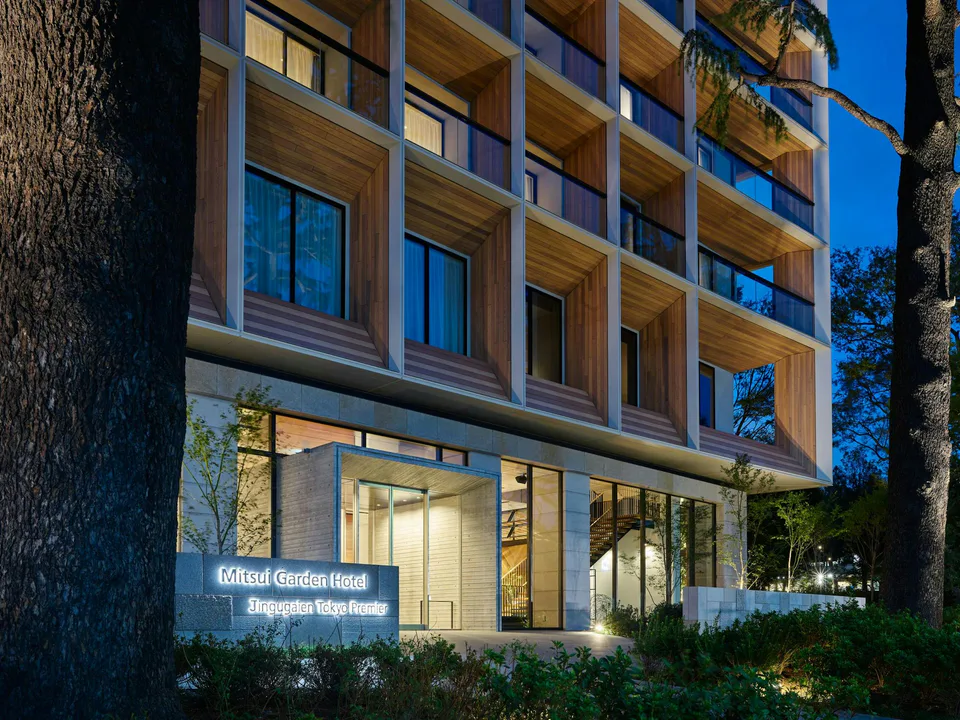
Mitsui Garden Hotel Jingugaien Tokyo Premier is a strong Tokyo hotel when the National Stadium–Sendagaya–Gaien side of the city is part of the trip, not merely when you want to say you stayed “near Shinjuku.” The hotel is about one minute from Kokuritsu-Kyogijo Station, around five minutes from JR Sendagaya and about six minutes from JR Shinanomachi. That makes National Stadium events, Meiji Jingu Gaien, Sendagaya and an Oedo Line connection to Shinjuku unusually easy. It is a weaker all-purpose first-Tokyo base when most days begin at Tokyo Station, Ueno, Disney, or long-distance JR terminals.
The second reason to book it is the hotel itself: every room has a balcony, guest rooms range from 18.5 m² to 50.9 m², and the guest-only public bath is currently free from 15:00–25:00 and 06:00–09:00. But those benefits should be priced separately. A balcony does not guarantee a National Stadium view, a higher room category does not always buy more space, and a public bath has zero value to a traveller who will never use it.
↔ Scroll table left or right
Your trip pattern | Verdict | Why | What reverses it |
National Stadium event + Gaien / Sendagaya time | Strong fit | The hotel removes the post-event rail journey and is roughly one minute from Kokuritsu-Kyogijo Station | The event is only one night inside a long Tokyo stay centred elsewhere |
3–5 nights, mostly Shinjuku / Aoyama / Harajuku side | Good conditional base | Oedo Line and nearby JR stations keep western-central Tokyo practical | Repeated Tokyo Station / Ueno / Disney departures dominate the itinerary |
Solo or couple, short stay, light luggage | 18.5–24.7 m² rooms can work | You can buy the location without automatically paying for a suite | Two large suitcases must stay open for several nights |
Three adults or longer stay | Start at the 30 m² Superior Corner rooms | They sleep three via sofa bed; one version adds a mini-kitchen | Three adults want three equivalent beds rather than a sofa-bed layout |
Public bath is a meaningful daily reset | Hotel gets stronger | The bath is included and has both evening and morning windows | Your actual return/departure times miss those windows |
You are paying mainly for a stadium-facing view | Book by exact room category | Some rooms are explicitly stadium-side, while many lower categories face Shinjuku / railway / expressway | You assumed “balcony” automatically meant stadium view |
The location premium is real—but it is a National Stadium premium, not a generic Shinjuku premium
The hotel’s current official access guide gives three useful station relationships: around one minute on foot from Kokuritsu-Kyogijo Station on the Toei Oedo Line, about five minutes from JR Sendagaya and about six minutes from JR Shinanomachi. The same official material puts the Oedo Line ride between Shinjuku and Kokuritsu-Kyogijo at roughly four minutes.
That makes the hotel geographically different from a normal Shinjuku hotel. It is excellent when the trip repeatedly touches the National Stadium, Tokyo Metropolitan Gymnasium, Meiji Jingu Gaien, Sendagaya, Aoyama or the western side of central Tokyo. It is not at JR Shinjuku Station, and it does not remove the transfer to a Tokaido Shinkansen, Narita Express or most east-Tokyo JR routes.
ValueNavi rule: count how many times the hotel’s exact station geometry is useful. One National Stadium event creates one very strong location win. Two Gaien-side days plus that event can justify several nights. One event inside a five-night itinerary whose other four days are Tokyo Station, Asakusa, Disney and Yokohama is a weaker case.
If the wider base is still undecided, solve where to stay in Tokyo for a first trip first. The hotel should fit the itinerary; the existence of a good hotel should not force the itinerary to fit Jingugaien.
Event night is the hotel’s clearest one-night use case
Stadium nights are the easiest scenario in which I would deliberately pay a location premium here. The hotel is effectively beside the venue, so the crowd-exit problem becomes a walk back to the room instead of a packed post-event rail decision.
But there is a second-order question: does the event justify the whole stay or only one night? A one-night event booking can be very efficient when luggage movement is simple. A four-night booking should be judged on all four days, not on how perfect the location feels between 18:00 and 23:00 on one evening.
I would use a split-stay only when the event night has a clear job and the hotel change does not create more luggage friction than the rail journey it removes. Two adults with carry-ons can make that switch cheaply. A family with several cases may rationally keep one Shinjuku or Tokyo Station hotel and commute once instead.
Every room has a balcony, but balcony is not the same as stadium view
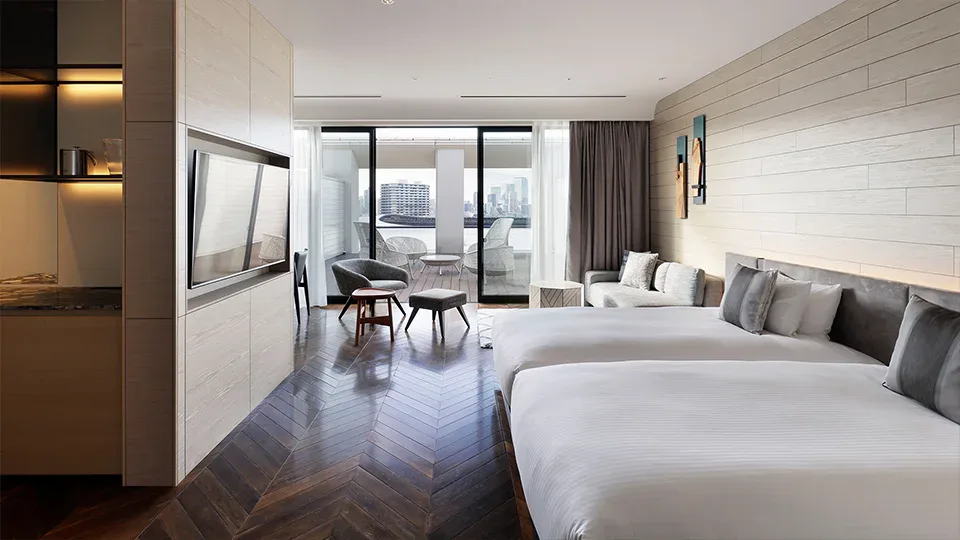
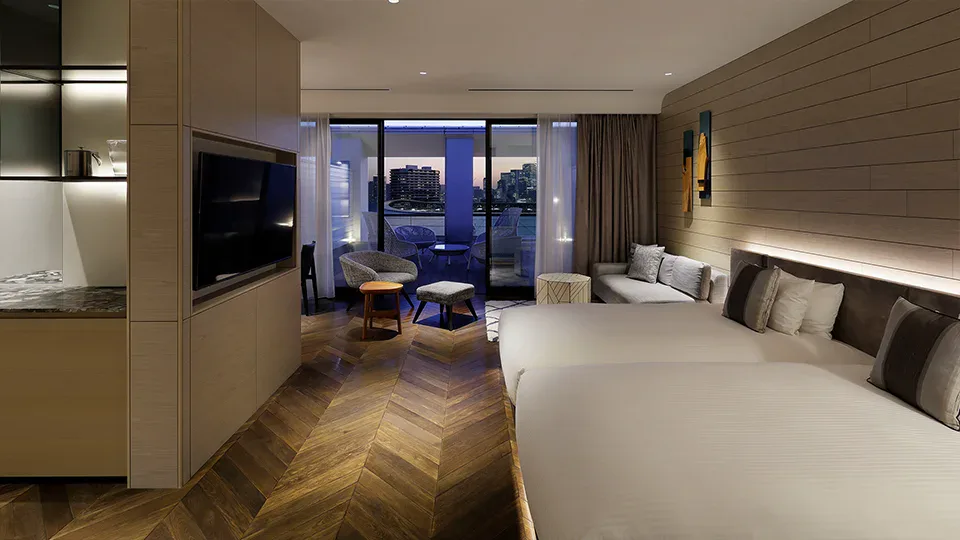
The hotel’s current view page says all rooms have balconies. That is a genuine differentiator in central Tokyo. The mistake is assuming every balcony faces the Japan National Stadium.
The current room list shows the view split more clearly:
Standard Double, 18.5 m²: Shinjuku side, including railway / Metropolitan Expressway orientation.
Standard Queen, 22.0 m²: Shinjuku side, railway / expressway orientation.
Standard Twin, 24.7 m²: view can vary by assigned room.
Superior Corner Twin, 30.0 m²: Shinjuku side; one version includes a mini-kitchen.
Deluxe Twin, 38.0 m²: explicitly listed on the Japan National Stadium side.
Junior Suites, 46.5–50.9 m²: explicitly listed on the Japan National Stadium side.
This creates a useful price-separation rule: first decide whether you want outdoor balcony access, then decide whether you care about the stadium-facing outlook. The first benefit exists throughout the room inventory; the second does not.
If a standard room already gives you the balcony experience you want, do not upgrade simply because you fear losing every view. If the National Stadium view is itself part of the booking, select a room category that explicitly states it instead of relying on a request note.
The room ladder has three separate upgrades: bed, space and function
The current room list makes the cheapest room look like the obvious baseline, but 18.5 m² is not the right reference for every traveller.
↔ Scroll table left or right
Room | Published size / capacity | What changes |
Standard Double | 18.5 m² / 2 | Cheapest compact route into the hotel |
Standard Queen | 22.0 m² / 2 | More floor area + 1,640 mm bed |
Standard Twin | 24.7 m² / 2 | Two 1,230 mm beds and about 34% more published area than the 18.5 m² Double |
Superior Corner Twin | 30.0 m² / 3 | Two regular beds + sofa bed; optional mini-kitchen version |
Deluxe Twin | 38.0 m² / 2 | Large two-person room + stadium-side view |
Junior Suites | 46.5–50.9 m² / 2 | Major space upgrade + stadium-side view |
The most useful jump for two long-haul travellers with luggage may be 18.5 → 24.7 m² rather than 18.5 → suite. The Standard Twin adds 6.2 m², roughly 34% more published area, while preserving a normal two-person bedding layout.
For three adults, the 30 m² Superior is the first room in the current list that explicitly solves legal three-person occupancy. But it does so with a sofa bed. That is a capacity solution, not three equivalent regular beds. If sleep equality matters, compare two rooms or another hotel before treating “sleeps 3” as a complete answer.
The mini-kitchen is a long-stay function, not a luxury badge
There are two 30 m² Superior Corner Twin configurations in the current inventory: one with a mini-kitchen and one without. The mini-kitchen version exists specifically to support longer stays and light food preparation.
That makes it a useful controlled comparison. If both categories are similarly priced on your dates and you are staying four or five nights, travelling with a child, or want breakfast/snacks in the room, the kitchen can create repeated utility. If every meal will be outside, the same square metres without the kitchen may serve the trip just as well.
Do not pay for a kitchenette because “more features” sounds better. Count the number of meals or food-prep moments it will actually replace.
The public bath can be worth more than a room upgrade—if the timing works
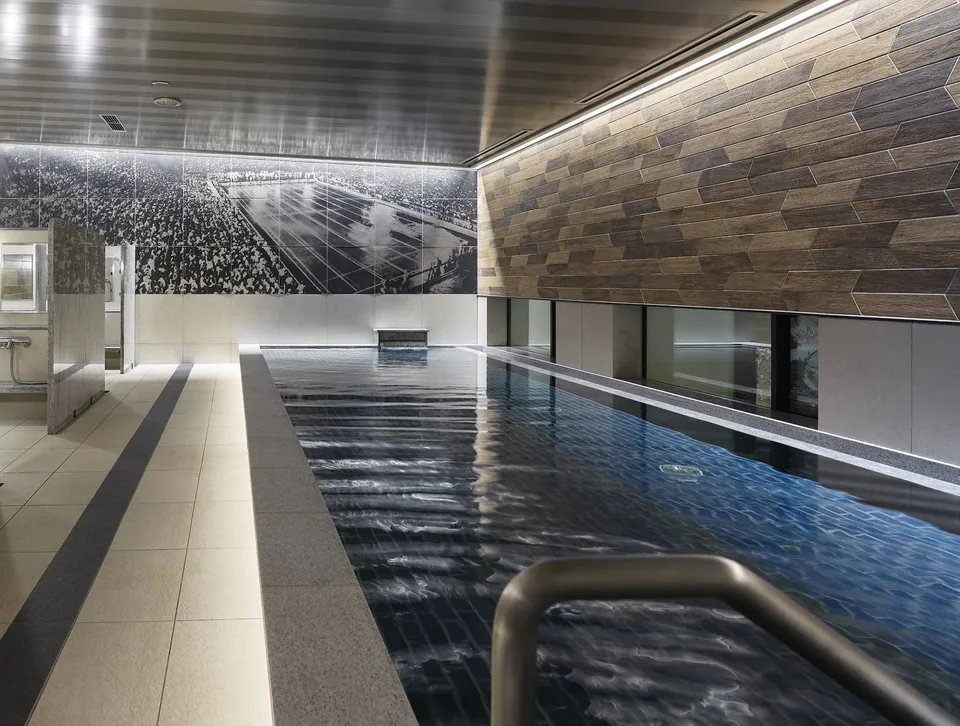
The guest-only public bath on the second floor is currently included in the room rate and opens 15:00–25:00 and 06:00–09:00. This creates two possible bath sessions around a hotel night: after sightseeing/event time and before breakfast or departure.
A major current policy detail is also easy to miss: the hotel states that it has removed restrictions on body art and tattoos for the public bath. That means travellers should use the hotel’s current policy rather than assume the generic “tattoos banned in Japanese public baths” rule automatically applies here.
The bath should be valued by actual sessions:
Late event return before 01:00: one realistic evening use.
Slow hotel morning: a second 06:00–09:00 use is possible.
Leave before 06:00 or return after 01:00: that window has no value.
Traveller who dislikes public bathing: remove the bath entirely from the premium calculation.
This matters because the hotel can look expensive when compared only by room size. For someone who would otherwise pay for a larger in-room bath or separate spa visit, a genuinely used public bath may offset part of that premium. For someone who never enters it, it does not.
Breakfast is a JPY 3,850 decision, not an automatic hotel benefit
The hotel currently serves breakfast at RISTORANTE & BAR E'VOLTA from 07:00–10:30, last entry 10:00. The current staying-guest buffet price is JPY 3,850.
I would add breakfast when the morning is deliberately slow: post-event recovery, a local Gaien morning, or a checkout day without a hard departure. I would not automatically add it before an early Shinkansen, airport transfer or timed attraction simply because the restaurant is in the hotel.
The same opportunity-cost rule used for the public bath applies here. If breakfast forces you to leave later than the itinerary wants, the hotel amenity is working against the reason you chose the location.
Airport access is workable, but this is not an airport-transfer hotel
The hotel’s current access guidance routes Haneda travellers via Daimon and the Oedo Line, and Narita travellers via Shinjuku and the Oedo Line after N'EX or airport bus. Those routes are perfectly usable, but they involve a transfer.
That makes Jingugaien different from a hotel directly aligned with a single airport train or limousine-bus stop. For a late international arrival with several large bags, the final transfer should be included in the room decision. For a daytime arrival with one suitcase, the trade-off is much smaller.
If airport simplicity is one of the trip’s top constraints, decide the Tokyo base first rather than assuming any Shinjuku-ku address is equally convenient.
Large luggage changes which station you should use
Kokuritsu-Kyogijo is the nearest station, but not every journey starts on the Oedo Line. JR Sendagaya and Shinanomachi can be more logical for some rail movements. With two 29-inch suitcases, the correct station is not always the one with the shortest walking distance; it is the one that removes a transfer or an awkward station change.
The hotel accepts luggage sent in advance when the stay date and guest name match its stated requirements, and it has coin-operated laundry on the second floor. Those are useful multi-night functions, but they do not turn the location into a JR hub.
For a three- to five-night stay, I would write down every day’s first major station before booking. If Kokuritsu-Kyogijo / Sendagaya / Shinanomachi repeatedly solve those starts, the location is doing work. If you keep writing “Tokyo Station,” “Ueno” and “Maihama,” it probably is not.
One night, two nights or five nights?
One night: strongest for a National Stadium event or a deliberate Gaien/Sendagaya day. You buy the hotel exactly when its geography is most valuable.
Two nights: strong when the event is paired with Harajuku/Aoyama/Gaien or another western-central Tokyo day. The hotel now solves more than one outing and the public bath/balcony can be used repeatedly.
Three to five nights: require a route audit. The hotel is a good full-stay base only if the western-central geography keeps repeating. If one event is carrying the whole argument, compare the friction of one hotel change against the cost of commuting to the event once.
Longer stay: room selection becomes more important than the hotel brand. The 18.5 m² Double may be a smart one-night room and a frustrating seven-night room. The 30 m² mini-kitchen category can become materially more useful even if the venue access is unchanged.
Who should choose another Tokyo hotel?
JR-heavy first trip: repeated Tokyo Station, Ueno, Yokohama or Disney days usually favour a more JR-aligned base.
Nightlife-first trip: if every night ends in central Shinjuku or Shibuya, staying directly in those districts can remove repeated late returns.
Airport-buffer night: choose by airport route rather than by the National Stadium.
Three adults needing equal beds: the 30 m² three-person room uses a sofa bed; compare two rooms or another property.
View-first booking: if the stadium-facing view is non-negotiable, book an explicitly stadium-side category rather than assuming all balconies are equivalent.
Final verdict
Book Mitsui Garden Hotel Jingugaien Tokyo Premier when the National Stadium–Gaien–Sendagaya side of Tokyo repeats enough to justify the location and you will actually use at least one of the hotel-specific benefits: balcony, public bath, extra room space or kitchenette.
For a one-night event stay, the location can be exceptionally rational. For a multi-night first-Tokyo trip, it is not a generic substitute for Shinjuku or Tokyo Station; the route has to support it. Start with the exact room you need rather than the cheapest teaser rate, and separate three premiums that are easy to confuse: balcony access, stadium-side view and interior space.
The red-team question is simple: if the National Stadium event disappeared from the itinerary, would you still choose this hotel? If the answer is yes because the Gaien geography, room, bath and balcony still fit the stay, the hotel is a strong base. If the answer is no, treat it as an event-night specialist rather than a five-night Tokyo default.
Booking.com — compare Mitsui Garden Hotel Jingugaien Tokyo Premier rooms
Trip.com — compare Mitsui Garden Hotel Jingugaien Tokyo Premier rooms
Agoda — compare Mitsui Garden Hotel Jingugaien Tokyo Premier rooms
Nezu Museum 2026: The Garden Isn’t Free — and That Changes Whether ¥1,400 Is Worth It
SAPPORO STREAM HOTEL: Is Susukino Station Access Worth Upgrading for the 18F Spa?
voco Osaka Central: Is the Premium Room Worth Leaving Osaka Station?
References
Mitsui Garden Hotel Jingugaien Tokyo Premier — official access · official room list · official balcony/view information · official public bath · official breakfast information. Checked August 25, 2026. Room inventory, prices, restaurant fees and operating details can change; verify the exact room and date before payment.