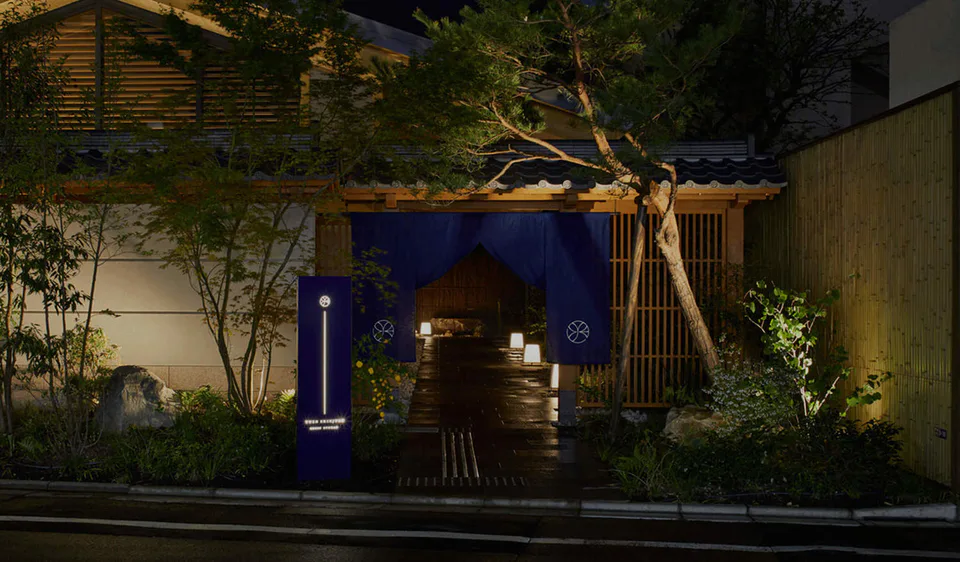
ONSEN RYOKAN YUEN SHINJUKU is worth its location trade-off when the 18th-floor outdoor onsen becomes a repeated evening routine, not merely a feature you admire once. The outdoor bath uses natural hot-spring water transported from Hakone’s Lake Ashi area; the indoor bath is not natural onsen. In return, the hotel is about 16 minutes on foot from JR Shinjuku East Exit, while Shinjuku-gyoemmae and Shinjuku-sanchome are substantially closer approaches.
For an international visitor, that creates a simple test: how many nights will you realistically return early enough to bathe, and how many days will you pay the longer JR walk? If you use the onsen three or four times and naturally travel by Metro, the exchange can be excellent. If you spend every day on early JR or highway-bus departures and come back near midnight, the onsen can turn into an expensive amenity you barely use.
There is also a major 2026 date condition. Renovation work runs through February 28, 2027, with noise and vibration scheduled mainly from 11:00 to 15:00 and workers present between 09:00 and 18:00. KAKATOJO is closed through October 31, 2026, with no on-site meals during that closure. The current 2026 product is therefore much less attractive for red-eye recovery, daytime remote work or a family that needs an afternoon nap.
ValueNavi decision table: when does the onsen earn the location cost?
↔ Scroll table left or right
Your trip pattern | Verdict | Why |
3–5 nights, Metro-heavy Tokyo days, home by about 22:00 most nights | Strong fit | The bath is used repeatedly while the shorter Shinjuku-sanchome / Shinjuku-gyoemmae approaches reduce the JR trade-off |
Several 07:00 departures from JR Shinjuku or the highway-bus terminal | Weak fit | You repeat the longer station walk while the late-evening onsen is harder to use |
Red-eye arrival + planned midday recovery in 2026 | Compare alternatives | The 11:00–15:00 construction-noise window conflicts directly with the reason you need the room |
August–October 2026 and you want a self-contained ryokan evening | Poor fit | There is no on-site meal service during the restaurant closure |
You already have an overnight Hakone ryokan in the same trip | More conditional | YUEN’s bath can still be pleasant, but it is no longer solving your only onsen need |
Two travellers, two large suitcases, 4–5 nights | Price a larger room | The 12–15m² entry rooms may make room space—not the bath—the dominant daily friction |
The ValueNavi onsen-use test: count uses, not amenities
“Hotel has an onsen” is too weak a reason to choose a base. The useful question is how often the feature survives contact with the itinerary. For a four-night stay, imagine three different patterns:
↔ Scroll table left or right
Four-night pattern | Likely onsen value | What may dominate instead |
Back by 21:30 on 3 nights | High | The JR walk matters less if most journeys use nearby Metro stations |
Fuji / Hakone / Nikko-style early days + late returns | Low to medium | Repeated JR/highway-bus access and sleep time |
One bath on the first night, then never again | Low | You are effectively choosing a compact east-Shinjuku hotel for a feature used once |
This is not an official hotel metric; it is a planning test. If you would still choose the property after mentally deleting the onsen from three of your nights, the location and room probably fit independently. If the hotel only wins because you imagine bathing nightly, make sure the actual schedule leaves 40–60 minutes of usable hotel time after you return.
This is an east-Shinjuku hotel, not a JR-Shinjuku-at-the-door hotel
The hotel officially lists about 16 minutes on foot from JR Shinjuku East Exit. Shinjuku-sanchome Exit C7 is about eight minutes, and Shinjuku-gyoemmae is also a much more natural approach for many Metro-based journeys. The word “Shinjuku” can therefore create the wrong mental map for a first-time visitor.
If you are arriving from Tokyo Station, the Marunouchi Line can make Shinjuku-gyoemmae the more logical final approach. If your Tokyo days are built around Ginza, Tokyo Station or other Metro-connected areas, YUEN may feel much better located than the JR walking figure suggests. If every morning starts with the Chuo Line, Yamanote Line or a bus to Hakone/Kawaguchiko, the opposite is true.
ValueNavi rule: count the number of days that genuinely require JR Shinjuku. Do not count every Tokyo day as an “JR Shinjuku day” simply because the hotel name contains Shinjuku.
If west-side departures dominate, compare HOTEL GROOVE SHINJUKU or Hotel Century Southern Tower. If your route is still unsettled, use Ueno vs Shinjuku before making the hotel-level decision.
Large luggage can make the room category more important than the onsen
The current room ladder ranges from a 12m² Semi Double and 15m² Twin to a 20m² Comfort Twin, 25m² Double and 33m² Premium Double. Those are official room areas; they are not evidence that a particular suitcase size will fit in a particular position.
↔ Scroll table left or right
Room | Official area | How I would treat it |
Semi Double | 12m² | Solo short stay first; not my default for two long-haul travellers with large cases |
Twin | 15m² | Can work for a short two-person stay if luggage is controlled |
Comfort Twin | 20m² | My first same-date comparison for two large suitcases over 3–5 nights |
Double | 25m² | Stronger when shopping, repacking or room time matters |
Premium Double | 33m² | Worth pricing when private space is part of the stay, not just sleep |
The hidden mistake is treating the onsen as if it compensates for every room trade-off. It does not. The bath is a shared hotel-level benefit; floor space is a room-level benefit you feel every time you open a suitcase, change clothes or move around the bed. For two people staying several nights, compare the 20m² and 25m² rooms on the same date before deciding that the cheapest room is the best way to access the onsen.
If the real problem is long-stay practicality rather than hot-spring access, Tokyu Stay Shinjuku Eastside solves a different need with its long-stay setup. If room size is the dominant constraint, compare a larger apartment-style option rather than paying for an onsen you will not use.
What the 18th-floor onsen actually is
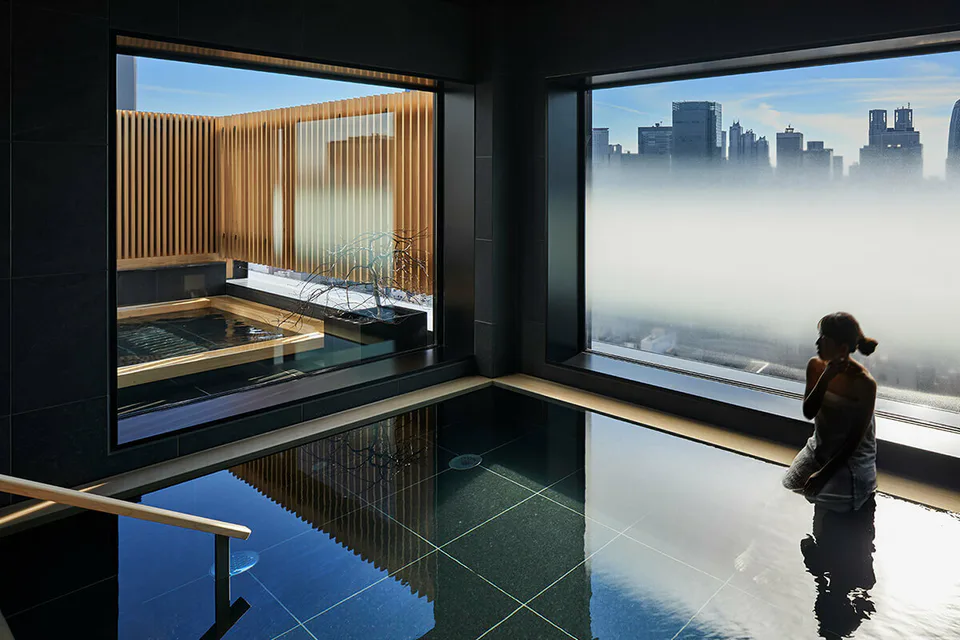
The hotel’s official onsen page is precise: the outdoor bath uses alkaline simple hot-spring water transported from Hakone, Lake Ashi Onsen “Tsutsuji no Yu” at Hotel de Yama. The indoor bath is not hot-spring water. The onsen is for staying guests only and cannot be used before check-in or after checkout.
Through October 2026, the published evening period is 15:00–02:00, with morning bathing from 06:00–10:00. From November 1, 2026, the evening period shortens to 15:00–00:30 while the morning period remains 06:00–10:00. That change matters to late-return travellers: a schedule that works comfortably in September may be much tighter in November.
If you are already staying overnight in Hakone, do not treat the YUEN bath as a substitute for the entire ryokan experience. It solves a different problem: giving a Tokyo city stay a hot-spring finish without adding another journey. If Hakone itself is still undecided, compare Tokyo to Hakone and Hakone ryokan with private onsen before paying twice for the same travel goal.
A realistic evening: when the onsen earns its keep
Imagine a normal Tokyo day that ends at Shinjuku-sanchome around 20:30. You return to the hotel, have dinner nearby if needed, bathe around 22:00 and still have time in the room before sleep. Nothing extra has to be booked and there is no separate spa journey. In that pattern, the onsen is doing real work.
Now reverse the schedule. You leave at 06:30 for a Fuji-area trip, return at 23:30, repack for another early departure and repeat. The bath may still technically be open depending on the date, but using it starts competing with sleep. After two or three days like that, the property’s signature feature matters less than the repeated station and room friction.
This is why the article’s answer is conditional rather than “onsen = worth it.” The feature has value only when the itinerary gives it usable time.
2026 date card: the hotel changes during the renovation period
↔ Scroll table left or right
Travel date | Current official condition | Decision impact |
Now through Oct 31, 2026 | KAKATOJO closed; no on-site meals during the closure | Do not book expecting a self-contained ryokan breakfast/dinner routine |
Through Oct 31, 2026 | Onsen evening hours 15:00–02:00 | Late-return travellers have the longer bathing window |
From Nov 1, 2026 | Onsen evening hours 15:00–00:30 | Late events and nightlife reduce the probability of using the bath |
Through Feb 28, 2027 | Renovation continues; noise/vibration scheduled mainly 11:00–15:00, workers 09:00–18:00 | Daytime naps and remote work remain the clearest risk |
The hotel says guestrooms and the onsen remain open during the renovation period. That should not be translated into “quiet.” A sightseer who is outside from morning to evening may barely care. A jet-lagged traveller who needs to sleep at 13:00 can care a great deal.
For long-haul arrivals, this is one of the strongest localization differences. A traveller arriving in Japan after an overnight flight may value midday recovery more than a domestic visitor or someone moving across Tokyo after a normal night’s sleep. During the current works, that makes YUEN a more conservative recommendation for the first Tokyo night.
New ONSEN Suites are a different product, not an upgrade to the current entry rooms
The hotel has announced new ONSEN Suites with private Hakone-source hot-spring water: 50m² Double and 62m² Twin rooms, for up to four guests, with stays scheduled from November 16, 2026. A new Family Room is planned from March 2027. These should not be used to describe what a current 12–33m² regular-room guest receives.
If your travel date is after the new suites begin and a private in-room onsen is the actual goal, compare that product separately. It changes the value equation because the bath is no longer a shared-only amenity. Before then, regular-room guests should evaluate YUEN as a compact city hotel with access to the shared 18th-floor bath.
Laundry and luggage: the less glamorous long-stay test
The official Q&A lists washer/dryer units on several guest floors. That matters on a four- or five-night stay because it can reduce how much clothing you carry, but it does not solve the first-arrival suitcase route or make a 15m² room larger.
If Tokyo is followed by another overnight destination, luggage forwarding can remove more friction than upgrading the hotel purely to hold bags. This is especially relevant on open-jaw or multi-city itineraries where the large suitcase does not need to follow every overnight stop.
Three ways YUEN becomes the wrong Shinjuku hotel
1. You call every journey an “JR Shinjuku journey.” The hotel makes much more sense when Shinjuku-sanchome or Shinjuku-gyoemmae is the natural station. Repeatedly walking to JR Shinjuku changes the economics.
2. You book the cheapest room because the bath is the main feature. For two long-haul travellers with large luggage, daily room pressure can outweigh a shared amenity used for 40 minutes.
3. You assume the normal ryokan rhythm exists during the 2026 works. Through October 31 there is no on-site meal service, and midday construction can conflict with naps or work. The hotel may still be a good stay; it is simply a different product from the one described by older reviews.
Compare the same room before booking
Fix the same dates, exact room category, bed type, occupancy, taxes and cancellation deadline before comparing prices. Through October 31, 2026, do not treat an old breakfast label as equivalent to current on-site meal availability without reconfirming it.
Booking.com — compare ONSEN RYOKAN YUEN SHINJUKU rooms
Trip.com — compare ONSEN RYOKAN YUEN SHINJUKU rooms
Agoda — compare ONSEN RYOKAN YUEN SHINJUKU rooms
Final verdict: is the Hakone-source onsen worth the trade?
Yes, if you will use it repeatedly and the Metro—not JR Shinjuku—is how the itinerary naturally works. In that case, YUEN gives you a distinctive way to finish Tokyo days without adding another journey, and the longer JR walk is largely a comparison statistic rather than a daily burden.
I would compare alternatives if two large suitcases push you toward a 20–25m² room upgrade, if several mornings require JR Shinjuku or highway buses, or if a late event means the onsen will be used only once. I would be especially cautious during the current renovation if the stay depends on daytime sleep, remote work or on-site meals.
The decisive question is not “Does this hotel have an onsen?” It is: “How many times will I actually use the onsen after paying every other trade-off?” If the answer is three or four times, YUEN can justify its unusual location. If the answer is once, choose the Shinjuku hotel that better solves the rest of the trip.
Nishitetsu Hotel Croom Hakata: Is 14.6 m² Worth a 1-Minute Bus Terminal and Late Onsen?
Hotel Hankyu RESPIRE OSAKA: Is a 3-Minute Osaka Station Walk Worth the High-Rise Trade-Off?
THE BLOSSOM HAKATA Premier: Is the 7-Minute Walk Worth a 30m² Twin and Public Bath?
Hotel JAL City Fukuoka Tenjin: Is a 1-Minute Akasaka Walk Worth Choosing Over Tenjin Station?
Oriental Hotel Okinawa Resort & Spa Review: Is the 170m Pool Worth a 7-Minute Beach Walk?


Sources
ONSEN RYOKAN YUEN SHINJUKU official website
Official onsen information and operating hours
Official Q&A and access information
2026 facility-maintenance notice
Construction dates, facilities, room availability and meal service can change. Recheck the official notices for the exact stay date.