
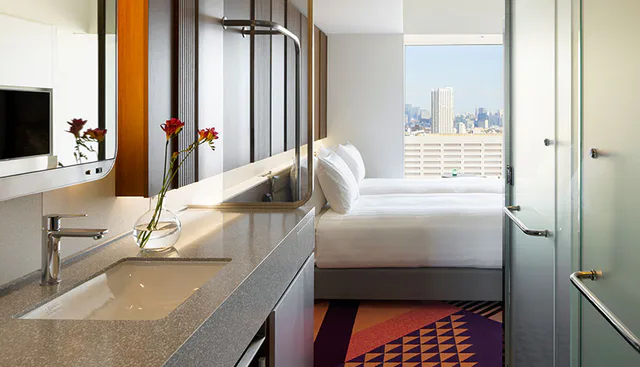
HOTEL GROOVE SHINJUKU is worth its premium when you will repeatedly use what cheaper Kabukicho hotels do not give you in the same combination: a direct connection to the Tokyu Kabukicho Tower experience, a one-minute Seibu-Shinjuku approach, direct airport-limousine-bus access at the tower, and larger high-floor room categories when you are willing to pay above the entry level. It is a weaker buy when every morning starts on JR, every evening ends early, or the rate only gets you a 21–22 m² Superior room while a simpler nearby hotel is materially cheaper.
The useful comparison is not “Is Kabukicho convenient?” It is how many times the hotel’s late-night and arrival advantages pay you back versus how many times you carry the longer JR walk. HOTEL GROOVE’s official access page lists JR Shinjuku at about seven minutes on the standard route, but its elevator-friendly universal-access route from the East Gate is closer to nine minutes. That difference matters more with two large suitcases than it does with a backpack.
↔ Scroll table left or right
Your pattern | Verdict | Why |
Late Shinjuku dinners, bars, shows or Kabukicho nights on 2+ evenings | Strong fit | The hotel remains useful after the sightseeing day instead of becoming somewhere you commute back to |
Haneda/Narita airport bus to Tokyu Kabukicho Tower fits your flight | Strong fit with luggage | You can delete one major-station rail transfer and suitcase hand-off |
JR-heavy mornings on most days, evenings end early | Reconsider | You pay the 7–9 minute JR approach repeatedly while barely using the tower/nightlife advantage |
Two adults, two large cases, 3–5 nights | Price Deluxe before booking | Superior is 21–22 m²; Deluxe is 25–28 m² and is a more credible luggage baseline |
You mainly want the Godzilla/Kabukicho location at the lowest practical price | Compare Hotel Gracery | Gracery is also in Kabukicho, officially about five minutes from JR Shinjuku East Exit, and its basic double is 18 m² |
The real HOTEL GROOVE premium: nightlife, arrival friction and room tier
HOTEL GROOVE sits in Tokyu Kabukicho Tower. The official access page lists Seibu-Shinjuku at about one minute, Shinjuku-nishiguchi at six minutes, JR/Odakyu/Keio/Marunouchi Shinjuku at seven minutes and Shinjuku-sanchome at eight minutes. Those figures make the hotel look simply “close to Shinjuku,” but they describe different transport products.
If your day uses the Seibu line or ends around Kabukicho, the tower location is unusually efficient. If the whole trip is JR day trips and east-Tokyo sightseeing, the seven-minute headline becomes a repeated cost. With luggage, the hotel’s own universal-access map is more revealing: the elevator-friendly route from the East Gate elevator beside LUMINE EST is about nine minutes.
That creates a useful decision rule: do not pay the Kabukicho premium for a trip that uses Kabukicho only as a place to sleep. Pay it when the location removes late-night travel or airport-arrival friction often enough to offset the longer JR approach.
Hotel Gracery is the counterfactual you should price before paying more
Hotel Gracery Shinjuku is the most useful nearby control because it sits in the same broad Kabukicho nightlife zone but solves the stay differently. Gracery’s current official site lists JR Shinjuku East Exit at about five minutes and Seibu-Shinjuku at about three minutes. HOTEL GROOVE lists roughly seven minutes to JR and one minute to Seibu-Shinjuku.
The entry-room geometry also differs. Gracery’s current Standard Double is 18 m². HOTEL GROOVE’s Superior rooms are 21–22 m², Deluxe 25–28 m² and Premier 32–37 m². That means GROOVE can justify a premium through space—but only if you actually book the room tier that creates the difference.
For two light packers staying one or two nights, an 18 m² Gracery room may be a perfectly rational way to keep the Kabukicho location while spending less. For two people with large luggage over four nights, moving from GROOVE Superior to Deluxe can be more valuable than paying for the hotel name while remaining in the smallest tier.
ValueNavi premium test: if GROOVE costs more, identify which benefit the difference buys: direct tower airport bus, one-minute Seibu access, a larger room, high-floor setting, or repeated late-night use. If none of those is specific to your itinerary, the premium is weak.
Seven minutes to JR becomes nine minutes when the elevator route matters
A station walk is not one number. HOTEL GROOVE’s standard access page says about seven minutes from JR Shinjuku. Its universal-access map recommends an elevator route from the East Gate elevator adjacent to LUMINE EST at about nine minutes.
For a solo traveller with a backpack, the difference is almost irrelevant. For two 28-inch suitcases, a stroller or an older traveller, the nine-minute accessible route is the more useful planning number because it is closer to the route you would actually choose.
This is also why a hotel beside a different Shinjuku exit can beat GROOVE for a rail-heavy trip even when both addresses say “Shinjuku.” If the shortest JR relationship matters more than Kabukicho nightlife, compare Hotel Century Southern Tower or the broader Tokyo Station vs Shinjuku base decision instead.
Airport-bus access can be worth more than a two-minute station difference
HOTEL GROOVE’s official access page currently links direct airport-limousine-bus services for both Haneda and Narita at Tokyu Kabukicho Tower. The value is not that a bus is always faster than rail. It is that a correctly timed bus can turn airport → luggage hold → hotel into one continuous transfer without navigating Shinjuku Station.
For a couple with two large cases after a long-haul flight, deleting one station transfer can outweigh a small difference in scheduled travel time. The answer reverses when the bus time does not fit the flight, traffic risk matters, or the rail route to your exact arrival terminal is much more frequent.
Do not let the arrival solution decide the entire Tokyo base by itself. One easy airport transfer is not enough to justify four nights in western Tokyo if the next three days are mostly Ueno, Asakusa and Tokyo Station. Use Where to Stay in Tokyo for First-Time Visitors before paying a location premium for the arrival day alone.
Superior, Deluxe or Premier? Buy the floor space you will actually use
↔ Scroll table left or right
Room tier | Official area | Best use | Main limit |
Superior | 21–22 m² | Short stay, solo traveller or lightly packed couple | Two large open cases can still dominate the usable floor |
Deluxe | 25–28 m² | Two adults with luggage over several nights | Still mainly a shower-room product rather than a large luxury room |
Premier | 32–37 m² | Longer stay, work space or three-person configurations | The premium can become large enough that another hotel should re-enter the comparison |
The biggest room mistake is assuming “HOTEL GROOVE” is one room product. It is not. The jump from 21–22 m² to 25–28 m² changes a multi-night luggage stay more than many soft hotel amenities.
There is another subtle difference: not every room tier has the same bath setup. The official Superior and Deluxe pages emphasize rain showers, while selected Premier King/Twin rooms include bathtubs. If a bathtub is essential, verify the exact room name rather than treating Premier as one uniform category.
Use square metres as a risk filter, not a suitcase guarantee. The hotel does not promise that two particular cases can remain open in every layout.
Nightlife value should be counted in repeated usable evenings
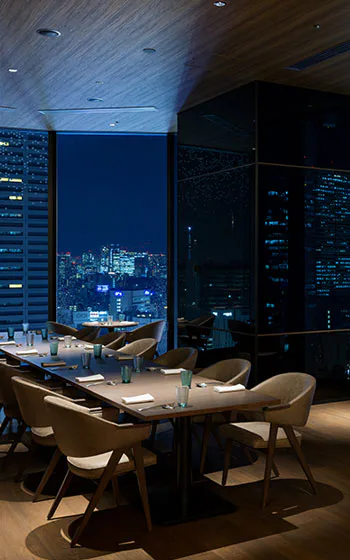
GROOVE earns its location premium most clearly when the hotel remains useful after 22:00. Kabukicho, Golden Gai and the wider Shinjuku night scene are near enough that you can end the night without another rail journey. That benefit compounds if it happens two, three or four times.
Count those evenings. If a four-night stay contains three late Shinjuku nights, the location is doing repeated work. If the same stay has one dinner in Shinjuku and three early nights before day trips, you are paying for a nightlife advantage you barely consume.
This is the same logic as a resort: facilities and location are only benefits during hours you actually use them.
Breakfast is useful only when it does not undermine the reason you chose Shinjuku
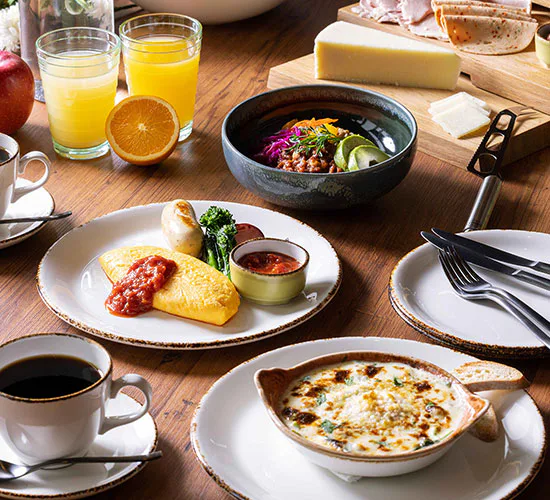
JAM17 DINING currently serves breakfast from 07:00 to 10:00 under the hotel’s published information. That fits a normal Tokyo morning. It is less useful before a very early day trip, airport transfer or an aggressive schedule where you chose Shinjuku specifically to leave early.
Do not add breakfast because the hotel restaurant looks attractive and then rush through it every morning. Compare the breakfast-inclusive premium with how many mornings you can realistically sit down and use it.
Three nights: run the repeated-friction test
For a three-night stay, list the six hotel edges you will actually experience: three morning departures and three evening returns.
If four or five of those edges are Kabukicho / Seibu / late-Shinjuku friendly, GROOVE is a strong base.
If four or five are JR-first departures and early returns, a more JR-adjacent hotel becomes stronger.
If the first edge is an airport-bus arrival and the remaining five are eastern-Tokyo movements, the airport convenience should not outweigh the rest of the stay.
This is more reliable than choosing by neighbourhood reputation. The hotel should fit the movements that repeat.
Who should not book HOTEL GROOVE?
I would choose another hotel when:
every day depends on the shortest possible JR Shinjuku walk;
you want an onsen, gym or hotel spa—the hotel’s current FAQ says these are not offered;
the room rate only buys Superior but a nearby alternative gives materially more usable space or a lower price;
your Tokyo itinerary is mostly Ueno, Asakusa, Tokyo Station and Narita-oriented;
you dislike Kabukicho’s late-night environment enough that the nightlife location becomes a negative rather than a benefit.
If in-room laundry matters more than nightlife for a four-to-seven-night stay, Tokyu Stay Shinjuku Eastside solves a different problem. If a genuine public bath is the priority, compare ONSEN RYOKAN YUEN SHINJUKU.
Final verdict
I would book HOTEL GROOVE SHINJUKU when at least two of these are true: you will use Kabukicho late on multiple nights; a direct airport bus removes an awkward luggage transfer; Seibu-Shinjuku is genuinely useful; or you are willing to pay for Deluxe/Premier space rather than treating the smallest room as the whole hotel product.
I would compare Hotel Gracery first when the goal is simply “sleep in Kabukicho near JR at the lowest sensible premium.” Gracery’s official JR East Exit walk is shorter, while GROOVE’s real advantage is the combination of tower access, direct airport-bus option, one-minute Seibu approach and larger room ladder.
The decisive question is not whether seven minutes is too far. It is whether those seven—or nine elevator-friendly—minutes are paid back by the parts of HOTEL GROOVE that your itinerary actually uses.
Check current HOTEL GROOVE SHINJUKU rooms
The Naha Terrace: Are 35m² Rooms and 12:00 Check-Out Worth a 15–20 Minute Station Walk?
Hotel WBF Grande Asahikawa: Is a 2-Minute Station Walk Worth It for a Northern Hokkaido Base?
Hotel Sonia Otaru: Is a Canal-View Room and Rooftop Onsen Worth the 8-Minute Station Walk?
Hotel Sosei Sapporo Review: Is a 39 m² Twin-Queen Room Worth a 15-Minute Walk from Sapporo Station?


References
HOTEL GROOVE SHINJUKU — official access and universal-access routes · HOTEL GROOVE — Superior rooms · HOTEL GROOVE — Deluxe rooms · HOTEL GROOVE — Premier rooms · Hotel Gracery Shinjuku — official access · Hotel Gracery Shinjuku — official room list. Checked August 25, 2026. Airport-bus timetables, rates and room inventory change; verify the live date before booking.