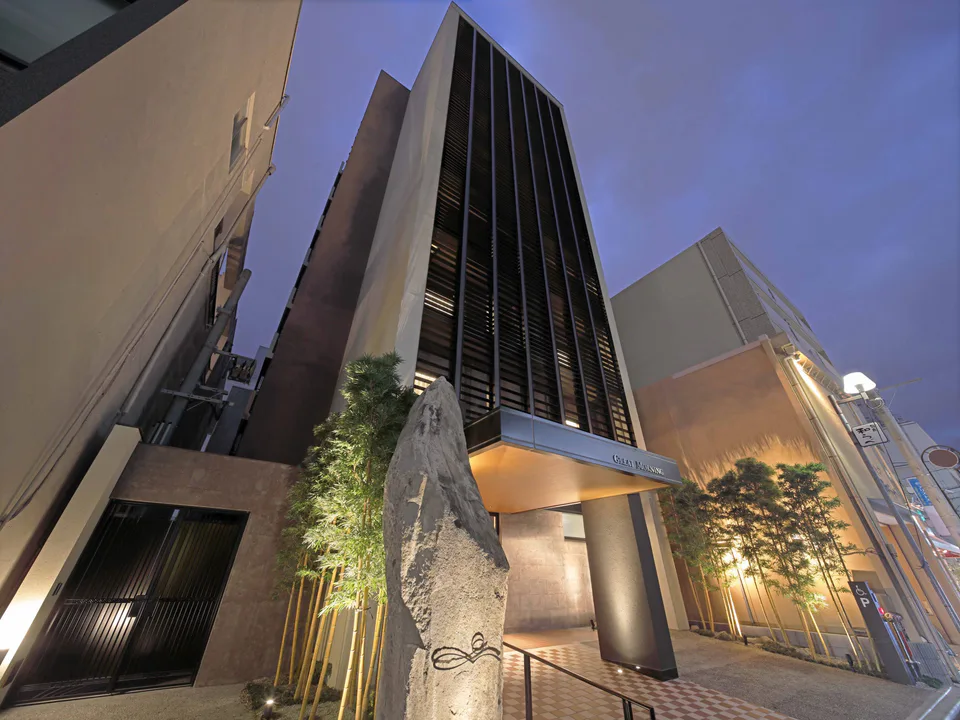
HOTEL GREAT MORNING Fukuoka does not try to win by being the closest hotel to Hakata Station. Its real proposition is different: the main Single, Deluxe Double and Deluxe Twin rooms are all 27m², and the whole property uses F-CON radiant climate control rather than conventional blown-air heating and cooling. The decision is whether you are willing to give up some station-front convenience in exchange for more private-room space and a different in-room environment.
I would not treat the hotel’s sleep-related claims as guaranteed outcomes. The hardware, room sizes, bed widths, floors and access routes can be verified; whether F-CON feels better for your throat, skin or sleep is personal. This guide therefore treats F-CON as a specific product feature with clear use cases, not a medical or universal sleep benefit.
HOTEL GREAT MORNING Fukuoka: the 30-second answer
I would book if private-room comfort is the priority and two travellers want to avoid the 12–18m² room sizes common in central Fukuoka. Because the three main room types are all 27m², the decision is less about buying more floor area and more about choosing bed layout, floor position and how the room will actually be used.
I would compare alternatives if the itinerary uses JR from Hakata Station every morning. The hotel lists roughly 20 minutes on foot from Hakata Station, so a four- or five-night rail-heavy trip repeatedly pays for the extra transfer or walk. Start with Hakata Station hotel comparison if your first priority is reducing arrival and departure friction.
I would skip it if the only objective is to leave the station and enter a room as quickly as possible. HOTEL GREAT MORNING is not a public-bath hotel or a zero-transfer station hotel. Its core value is the private-room environment. If that does not matter to you, there is no reason to pay extra for the concept.
↔ Scroll table left or right
Decision point | Verified detail | Trip impact |
Main room types | Single / Deluxe Double / Deluxe Twin are all 27m² | Choose bed layout and floor before assuming room names imply different sizes |
F-CON | Radiant climate control without conventional blown-air delivery | Most relevant if you dislike direct air flow or spend significant time in the room |
Nakasu-Kawabata | Exit 5 about 5 minutes; Exit 7 recommended by the hotel for escalator access with more luggage | The easiest exit may matter more than the shortest map distance |
Hakata Station | Hotel lists roughly 20 minutes on foot | Daily JR users should count repeated movement back to Hakata |
Check-in / out | 16:00–24:00 / 11:00; luggage storage before and after stay | Late arrivals should still confirm the exact booking conditions |
Breakfast | Officially described as in-room room service with Japanese and Western options | More useful for travellers who want a slower room-based morning |
Arrival reality: choose the exit for your luggage, not just the shortest number
The hotel lists about five minutes on foot from Nakasu-Kawabata Station Exit 5, but the same official access information specifically points travellers with more luggage toward Exit 7 because it has an escalator. That is exactly the kind of detail a map summary loses. With two large suitcases or an older family member, vertical movement inside the station can matter more than saving one or two minutes on the street.
From Fukuoka Airport, the simplest logic is Airport Line to Nakasu-Kawabata followed by the final walk. From Hakata Station, the hotel also lists a direct walk of roughly 20 minutes. In dry weather with a carry-on, that may be acceptable; with rain or heavy luggage, I would treat the subway or another short city transfer as part of the stay cost rather than pretending the walk is free.
The hotel is not remote. Nakasu-Kawabata itself sits inside a useful central Fukuoka zone. If the evening ends around Nakasu, a return to Tenyamachi is more natural than going back to Hakata simply because the Shinkansen station is there. Compare this location logic with THE LIVELY FUKUOKA HAKATA and HOTEL RESOL TRINITY HAKATA if you want to see how different Nakasu-area hotels trade room size against location.
↔ Scroll table left or right
Arrival route | Best fit | Main friction | My view |
Nakasu-Kawabata Exit 5 | Light luggage | Station navigation + final walk | Use the direct official route when baggage is easy to handle |
Nakasu-Kawabata Exit 7 | Large luggage / older travellers | May not be the shortest street route | I would prioritise the escalator over a small walking-time difference |
Walk from Hakata Station | Good weather / light packing | Roughly 20 minutes by hotel guidance | Not my first choice with large luggage or rain |
Pair the hotel decision with your Fukuoka base decision
If you have not decided whether Hakata or the western city centre should be your main base, compare Fukuoka Hakata vs Tenjin Hotels. Tenjin-oriented alternatives such as Solaria Nishitetsu Hotel Fukuoka and ONE FUKUOKA HOTEL solve the same city-base question in very different ways.
Room decision: Single, Double and Twin are all 27m²
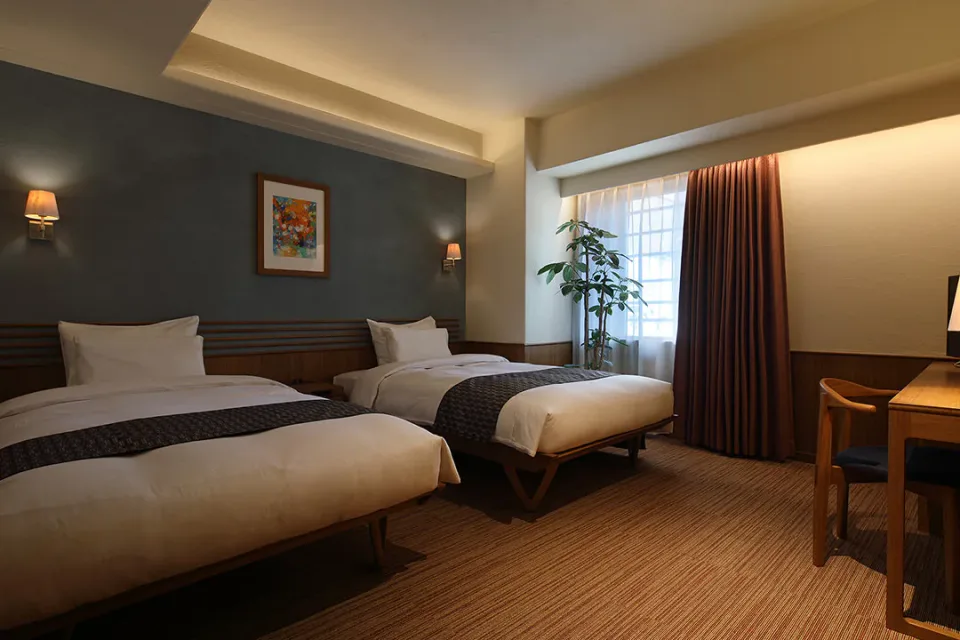
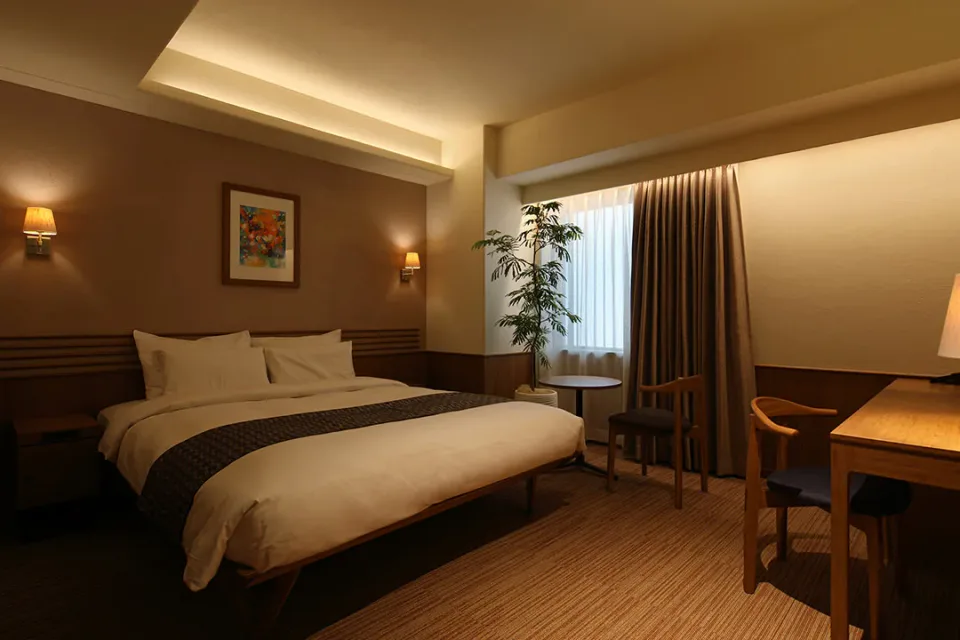
The room names can mislead you here. Deluxe Twin is 27m² with two 120cm beds. Deluxe Double is also 27m² with one 160cm bed. Single remains 27m² with one 140cm bed, but the hotel specifies that Single rooms are on the second floor only. So Single is not a smaller economy box; it is the same published floor area with a different bed and floor condition.
For two people with large luggage, I would compare Twin and Double rather than simply choosing by room name. Twin gives separate sleeping surfaces but uses more fixed floor area for two beds. Double uses one larger bed and may create a different furniture and circulation pattern. The hotel does not publish enough exact measurements to guarantee that two 28-inch cases can always remain fully open, so 27m² should be treated as a larger margin, not a suitcase guarantee.
Solo travel is where the product becomes especially unusual. Many city hotels put solo guests in their smallest room. Here, Single still gets 27m². If you work in the room, organise shopping or stay several nights, that can matter more than having an extra bed. The trade-off is the second-floor restriction. If you want a high floor, Single and Deluxe Double are not equivalent products even though the floor area matches.
The 60m² Suite is a different use case: two 140cm beds, a kitchenette and a personal Mist Spa, with occupancy up to three adults. I would not recommend upgrading for a normal two-night city break just because 60m² sounds impressive. It becomes rational when the kitchenette or a room-centred stay is part of the trip. For another Fukuoka hotel where room category changes the whole product, compare THE BASICS FUKUOKA
↔ Scroll table left or right
Room | Size / bed | Key limitation | Best use |
Single | 27m² / one 140cm bed | Second floor only | Solo, work, multi-night stay |
Deluxe Double | 27m² / one 160cm bed | Two people share one bed | Couples prioritising a larger bed |
Deluxe Twin | 27m² / two 120cm beds | Two beds occupy more fixed floor area | Friends or travellers who need separate beds |
Suite | 60m² / two 140cm beds | Different price and use-case tier | Long stays, kitchenette / Mist Spa use |
Is F-CON worth paying for? Separate the hardware from the promise
F-CON is the hotel’s most distinctive feature. The verifiable point is that the property uses a radiant heating and cooling system rather than relying on conventional blown-air delivery. For travellers who dislike air blowing directly across the bed or the sound and feel of a standard fan-based system, that is a concrete difference they may use every night.
What I would not do is convert the hotel’s broader sleep, dryness or air-quality claims into guaranteed outcomes. Those are product claims and personal comfort varies. The useful decision is simpler: how many waking and sleeping hours will you actually spend in the room, and how sensitive are you to conventional air flow? A traveller out from 08:00 until 23:30 uses this feature less than a family with a child’s afternoon nap, a remote worker or someone staying four nights during very hot or cold weather.
If your trip includes substantial laptop time, compare the space-and-work trade-off with LAMP LIGHT BOOKS HOTEL Fukuoka and Hotel Mei Fukuoka Tenjin. One gives you a 24-hour bookstore environment; the other offers very different room categories. GREAT MORNING’s proposition is the private room itself.
A one-night timeline shows whether the hotel is actually being used
Imagine returning from the city at 18:30 to drop shopping, going back out for dinner at 19:00, returning at 21:30, then showering and organising luggage before breakfast around 07:30. In that pattern, the room is actively used from late evening through the morning. The 27m² floor area, bed layout and F-CON all become recurring parts of the stay rather than brochure features.
Now change the pattern: four nights, two days beginning with JR from Hakata Station, one Tenjin/Nakasu day and one fully local day. The correct comparison is not “five minutes from Nakasu-Kawabata” versus “27m² room.” It is two mornings of extra movement toward Hakata in exchange for four nights of a larger private room. Put repeated transport friction and repeated room use on the same page before deciding.
For a more Hakata-oriented stay that still gives room to breathe, THE BLOSSOM HAKATA Premier and THE BASICS FUKUOKA provide useful counter-examples: one gives public-bath value, the other changes the room-and-lounge mix.
Breakfast and luggage storage change the itinerary more than flashy facilities
The hotel’s official “7 Promises” information describes breakfast as room service with Japanese and Western directions. That suits the same 27m² room-centred proposition: you do not need to go downstairs and queue before starting the day. But service times, inclusion and rate-plan conditions can change, so I would not treat one OTA display as a permanent rule. Confirm whether your exact booking includes breakfast and what the current ordering conditions are.
Luggage storage is more universally practical. The hotel FAQ says baggage can be stored before check-in and after checkout. That means the first city day does not have to begin by dragging large luggage through Nakasu, and the final day does not automatically require an early move to Hakata Station just because checkout has happened. If your flight leaves early, the value is smaller; if departure is late, it can remove a whole block of friction.
For travellers who care more about a lounge or common area than room-service breakfast, compare HOTEL IL PALAZZO Fukuoka or ONE FUKUOKA HOTEL. Those hotels put more value outside the private room; GREAT MORNING does the opposite.
Location × itinerary: which trips fit Tenyamachi better?
If most activity is around Nakasu, Kawabata and the Tenjin side, I would treat HOTEL GREAT MORNING as a central walking-plus-subway base rather than a JR base. The difference changes the last movement of each day: evenings around Nakasu end naturally, while early Shinkansen or limited-express mornings require the Hakata connection to be added back.
If you only have three days and one full day is Yufuin or another JR-heavy excursion, hotel location should not be decided by nightlife alone. A late first-night arrival followed by an early Hakata departure may favour a station hotel. Three days mostly inside Fukuoka city can make Nakasu-Kawabata much more balanced. The Fukuoka 3 Day Itinerary is useful for testing this before choosing the hotel.
For families or travellers with parents, 27m² reduces private-room crowding, but the arrival still has a last walk. This is exactly where the hotel’s Exit 7 escalator note becomes more useful than the shortest-line map. If your evenings revolve around food stalls, the Fukuoka Yatai Guide helps confirm whether Nakasu is truly a repeated destination rather than a one-night visit.
What are you giving up by staying here?
The first sacrifice is Hakata Station immediacy. The hotel does not provide a Hakata shuttle. Travellers using JR every day must handle the subway, local transport or the walk themselves. No amount of 27m² room space can erase that logistical difference.
The second trade-off is paying for an in-room environment only matters if you use it. If the hotel costs meaningfully more than a conventional business hotel on the same dates but you leave early and return near midnight every day, the premium may be buying a feature you barely experience. If you work in the room, stay several nights or simply refuse to live in a 12–15m² space with two suitcases, the room can produce value every day.
The third trade-off is room selection. Single, Double and Twin having the same area does not make them identical. Choose bed type first, then floor needs, then breakfast and cancellation. For a deliberately compact comparison in the same broader city zone, see LAMP LIGHT BOOKS HOTEL Fukuoka; its room-size trade is almost the reverse of GREAT MORNING.
Compare the same room and breakfast conditions before booking
Lock the exact room type, bed layout, guest count, breakfast inclusion, taxes, cancellation deadline and payment timing before comparing platforms. HOTEL GREAT MORNING is especially easy to miscompare because the main room types share the same 27m² area but serve different sleep and floor preferences. Compare like with like before deciding which channel is actually cheaper.
Booking.com: compare HOTEL GREAT MORNING rooms
Trip.com: compare HOTEL GREAT MORNING rooms
Agoda: compare HOTEL GREAT MORNING rooms
Final verdict: would I book HOTEL GREAT MORNING Fukuoka?
↔ Scroll table left or right
Decision | Conditions |
I would book | You value 27m² private-room space, dislike direct conventional air flow, spend evenings around Nakasu / central Fukuoka and are willing to trade some Hakata Station convenience for the room environment. |
I would compare | You use JR every day, arrive late with large luggage, or station-front hotels are materially cheaper on the same dates. Multiply the repeated Hakata transfer before judging value. |
I would skip | You only need a bed, return near midnight every day, do not care about the F-CON air-flow difference and want the shortest possible walk from Hakata Station. |
The positioning is simple: HOTEL GREAT MORNING Fukuoka is not a Hakata-distance hotel. It is a room-environment hotel. You are buying 27m² as the baseline for its main room types and a different climate-control concept, then accepting that JR-heavy days require more movement. The better your itinerary uses the room, the more logical that exchange becomes.
HOTEL GREAT MORNING Fukuoka FAQ
Which subway station is closest, and which exit is better with large luggage?
Nakasu-Kawabata is the closest station. The hotel lists Exit 5 at about five minutes on foot and separately recommends Exit 7, which has an escalator, when carrying more luggage.
Are the Single, Deluxe Double and Deluxe Twin really all 27m²?
Yes. Deluxe Twin, Deluxe Double and Single are all published at 27m². Twin has two 120cm beds, Double one 160cm bed and Single one 140cm bed. Single is on the second floor only.
What is F-CON, and does it guarantee better sleep?
F-CON is the hotel’s radiant climate-control system without conventional blown-air delivery. The equipment and design can be verified. Sleep, dryness and comfort claims are subjective and should not be treated as guaranteed outcomes for every guest.
Is it convenient to walk from Hakata Station?
The hotel lists roughly 20 minutes on foot from Hakata Station. Public transport via Nakasu-Kawabata is another option. If your trip uses JR from Hakata every day, I would count the repeated movement as a real accommodation cost.
What are check-in, checkout and luggage-storage rules?
The hotel FAQ lists check-in from 16:00 to 24:00 and checkout at 11:00. It also says luggage can be stored before check-in and after checkout. Always follow the current conditions for your exact booking date.
Is breakfast served in a restaurant?
The hotel’s official information describes breakfast as in-room room service with Japanese and Western directions. Whether breakfast is included and the current service conditions depend on the rate plan.
Is Oirase Keiryu Hotel Worth It? Rooms, Access, Dining and City-Hotel Alternatives
lyf Tenjin Fukuoka Review: Is a 12m² Room Worth the Shared Kitchen and 24-Hour Lounge?
Lake Kinrin Autumn Leaves Guide: Morning Mist, Fukuoka Access and Yufuin Hotels
voco Osaka Central: Is the Premium Room Worth Leaving Osaka Station?
Fukuoka Nakasu River Cruise: 30 Minutes or Hakata Bay — Which Is Worth It?
Sources
HOTEL GREAT MORNING official access information
HOTEL GREAT MORNING official guest-room information
HOTEL GREAT MORNING official F-CON and breakfast information
HOTEL GREAT MORNING official FAQ
Rakuten Travel HOTEL GREAT MORNING gallery
Room types, rates, availability and cancellation terms can change by date. This article may contain affiliate links; ValueNavi may earn a commission from qualifying bookings at no additional cost to you.