
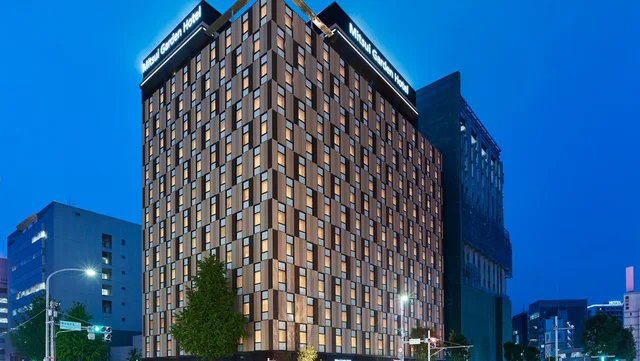
For three adults, I would choose Mitsui Garden Hotel Fukuoka Gion when sleeping equality is the first constraint: its Standard 3 Beds room is 26.6 m² with three fixed 1,110 mm beds. I would choose THE BLOSSOM HAKATA Premier when the group accepts a different third sleeping surface in exchange for more published room area. Its Deluxe Twin is 30–37 m² for up to three guests using an extra bed; its 31–32 m² Comfort Deluxe Twin with TATAMI space uses a futon for the third guest.
The useful comparison is therefore not “which hotel is more luxurious?” Both are around a seven-minute walk from JR Hakata Station. The decision is three equal fixed beds in less space versus two larger fixed beds plus a different third bed in more space. For three friends, three adult siblings or anyone sensitive to the “who gets the extra bed?” problem, that distinction should be decided before breakfast, public bath or hotel branding.
If the group has not narrowed the shortlist to these two properties, use Fukuoka hotels for 3 or 4 adults first. If the wider base is still undecided, settle Hakata vs Tenjin before optimising one room.
The 30-second decision: solve the third sleeper before the hotel
↔ Scroll table left or right
Your hard constraint | Start with | Why | What can reverse it |
All 3 adults want a published fixed bed of the same type | Mitsui Garden | 26.6 m² with three fixed 1,110 mm beds | The group needs materially more floor area than the triple can provide |
Two normal beds + one extra bed is acceptable | THE BLOSSOM Deluxe Twin | 30–37 m² and two 1,200 × 2,000 mm main beds | The third adult will not accept an extra bed whose dimensions are not published on the official room page |
One adult is happy sleeping on a futon | THE BLOSSOM TATAMI room | 31–32 m² plus a defined tatami/futon setup | Getting up from floor level is uncomfortable or the group wants three conventional beds |
3 large suitcases / 3–5 nights | THE BLOSSOM, usually | More published gross room area gives the group more circulation tolerance | Do not assume the 37 m² end of the Deluxe Twin range or three open cases are guaranteed |
Tattoo policy matters for the public bath | Mitsui Garden is the simpler rule | Mitsui says tattoo/body-art restrictions have been removed | THE BLOSSOM may still work for small tattoos that meet its cover-sticker rule; confirm because its official pages currently conflict |
Breakfast before an early but not ultra-early train | THE BLOSSOM | Breakfast currently starts at 06:30 versus 07:00 at Mitsui Garden | If the train is too early for either buffet, remove breakfast from the comparison |
This is almost a controlled location comparison: both are about seven minutes from Hakata Station
Mitsui Garden’s official access page currently gives approximately seven minutes on foot from JR Hakata Station’s Hakata Exit and about five minutes from Gion Station Exit 5. THE BLOSSOM’s official JR Hotel Group page also gives about seven minutes on foot from JR Hakata Station.
That matters because it removes an easy but weak way to manufacture a winner. For a normal Hakata-based stay, the deciding premium should come from the room and the people using it, not a supposed ten-minute location gap that does not exist.
There are still micro-location differences. Mitsui Garden is slightly more naturally aligned with Gion; THE BLOSSOM sits closer to the Kushida Shrine / Canal City side. If three adults plan several late evenings in that direction, the final few blocks can matter. But for a luggage-heavy JR or Shinkansen transfer, both still require a real walk from Hakata rather than a station-connected hand-off.
Mitsui Garden is buying sleep equality, not space
Mitsui Garden publishes the Standard 3 Beds room at 26.6 m² with three beds of 1,110 mm width. The hotel is not converting a sofa or adding a temporary third sleeping surface: the room product itself is a three-bed room.
That makes the advantage unusually easy to define for three adults. Nobody has to volunteer for the extra bed or futon. For three friends splitting the room cost equally, that can be more valuable than several extra square metres because the benefit is distributed equally every night.
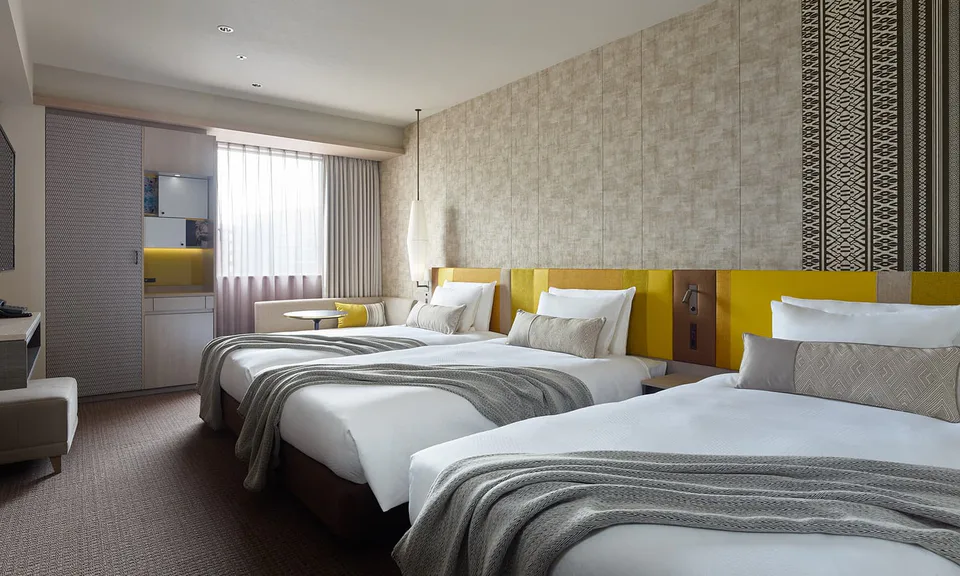
The trade-off is physical. Published room area divided by three guests is about 8.9 m² per guest. That is only a gross planning ratio—it includes beds, furniture and bathroom space and is not a measurement of open floor area—but it helps explain why three fixed beds can make luggage circulation tight.
For one or two nights, I would accept that compromise more readily. For four or five nights with three large cases, shopping bags and repeated repacking, equal sleep can start costing too much living space.
THE BLOSSOM buys more area, but the third sleeper is deliberately different
THE BLOSSOM’s current official room page lists the Deluxe Twin at 30–37 m², capacity two to three, with two 1,200 × 2,000 mm beds. A third guest is accommodated by adding an extra bed. The official page does not publish the extra bed’s dimensions, so it would be wrong to imply that the third adult receives another 1,200 mm bed.
That uncertainty is a real booking boundary. If the third traveler is 190 cm tall, has back problems or simply wants a sleeping surface equal to the other two, “sleeps three” is not enough information. Confirm the extra-bed dimensions directly before payment or choose the Mitsui triple.
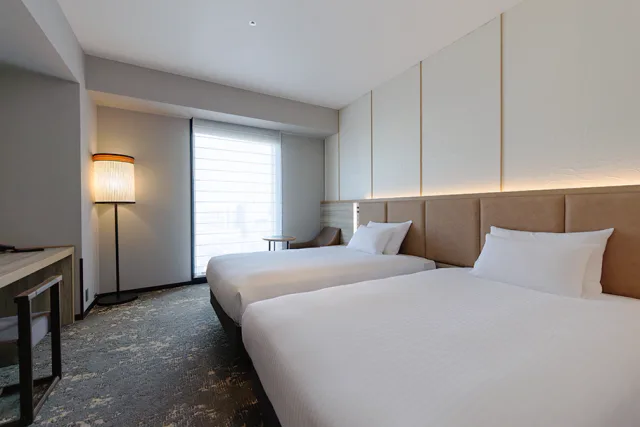
The space advantage is meaningful but should also be described honestly. At three occupants, the published 30–37 m² range equals about 10.0–12.3 m² of gross room area per guest. Compared with Mitsui’s 26.6 m² room, that is roughly 3.4–10.4 m² more total published area.
Do not plan around the top of the range. THE BLOSSOM explicitly says room size and specifications vary by room. Booking “Deluxe Twin” does not guarantee that your assigned room will be 37 m². The safe decision is that the category starts larger than Mitsui’s triple, not that every Deluxe Twin gives you the maximum area.
The tatami room removes the unknown extra bed but creates a different sleep trade-off
THE BLOSSOM’s Comfort Deluxe Twin with TATAMI space is 31–32 m² for up to three guests. The official description is clear: two guests use the two 1,200 × 2,000 mm beds and the third guest uses a futon laid on the tatami area.
For some groups, this is easier to agree on than an unspecified extra bed because everyone knows what the third setup is before arrival. It can also feel more Japanese without booking a full ryokan.
But it is not automatically the “better triple.” The third person sleeps at floor level, and the tatami zone being used as a bed changes how much of that 31–32 m² remains usable at night. Older travelers, anyone with knee or mobility issues, and adults who dislike floor sleeping should treat the futon as a veto rather than a novelty.
The published area works out to about 10.3–10.7 m² per guest, again as a gross comparison rather than open floor space. The room therefore buys more tolerance than Mitsui’s triple, but it does not buy three equal conventional beds.
Three suitcases: count circulation, not the hotel’s legal capacity
Neither hotel publishes a guarantee that three 28- or 29-inch suitcases can remain fully open with a clear path to the bathroom and door. Do not turn square metres into a false luggage promise.
Instead, use a three-stage test:
One-night transfer stay: three fixed beds can be worth more than perfect luggage circulation because the group can open cases in sequence.
Three- to five-night stay: repeated packing, shopping and morning routines make THE BLOSSOM’s extra published area more valuable.
Three very large cases + stroller / mobility equipment / heavy shopping: reopen the search. One larger room may no longer be the best product; two rooms can buy both privacy and floor space.
This is the red-team condition most triple-room comparisons miss: the correct alternative is not always “the other triple room.” If the price premium becomes high enough, compare two smaller rooms before forcing three adults into one room simply because the booking engine allows it.
The public-bath tattoo comparison changed — and THE BLOSSOM’s own pages currently conflict
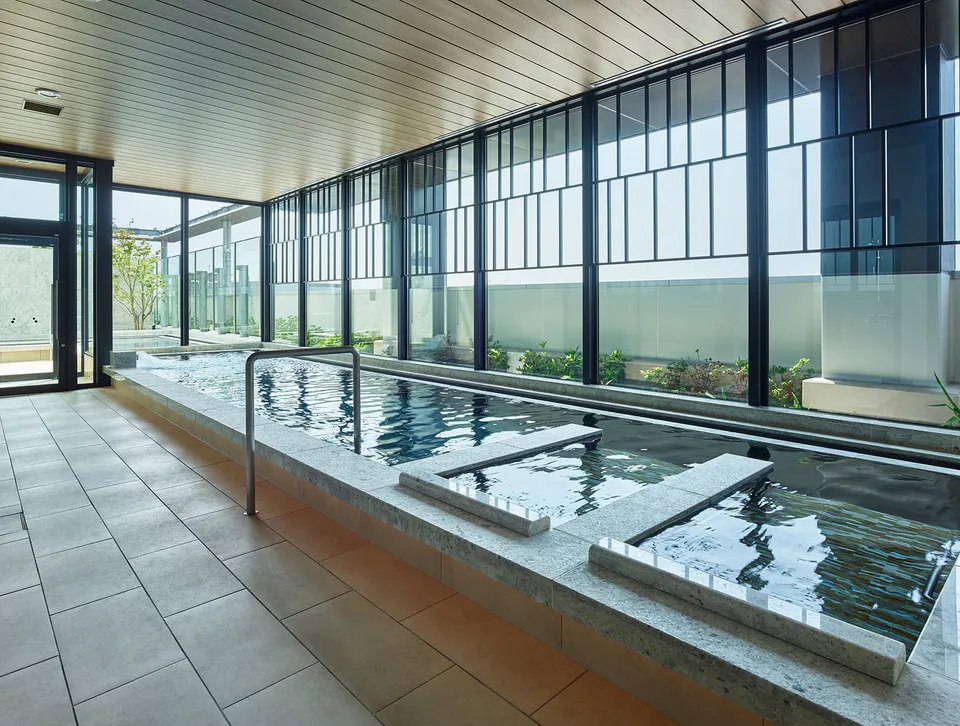
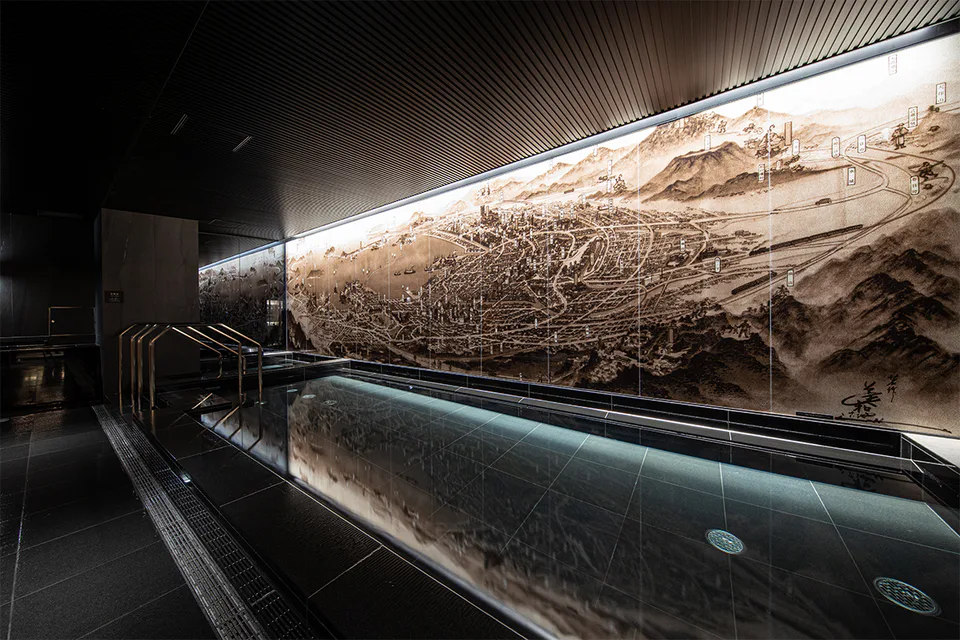
Mitsui Garden’s current public-bath page is straightforward: the hotel says it has removed restrictions regarding body art and tattoos. Its rooftop bath currently operates 15:00–25:00 and 05:00–09:00.
THE BLOSSOM needs more care. Its general facilities page still contains wording that tattooed guests are denied entry. However, the hotel has also published a specific revised-policy notice stating that a guest may use the public bath when each tattoo can be completely covered by a maximum of two approved 10 × 10 cm cover stickers; the hotel provides those stickers free at the front desk.
Those two first-party pages are inconsistent, so this article should not silently choose one and present it as settled. If tattoo access matters, Mitsui Garden currently has the simpler published policy. THE BLOSSOM may be viable for small coverable tattoos, but confirm directly with the hotel before treating the bath as part of the booking value.
Breakfast only matters when the group can actually use the earlier half-hour
THE BLOSSOM currently serves breakfast from 06:30 to 10:00, with last entry at 09:30. Mitsui Garden currently starts at 07:00 and runs until 10:30, with last entry at 10:00.
For three adults catching an early Yufuin, Beppu or Shinkansen departure, that 30-minute difference can matter—but only if the timetable falls in the usable window. If the group needs to leave the hotel before 06:30, neither breakfast wins and the feature should be deleted from the price comparison.
This is why I would not let “BLOSSOM has earlier breakfast” overpower bed equality or luggage space. Breakfast is a scheduled benefit. The bed is used every night.
Stay length changes the value of space, but it does not erase sleep fairness
One or two nights: Mitsui Garden is especially strong for three friends when equal beds matter. The smaller room is easier to tolerate when luggage can be managed sequentially.
Three to five nights: THE BLOSSOM gets stronger because the extra published area is used repeatedly—for changing clothes, opening bags, sitting down and moving around each other. But the recommendation reverses if the third adult strongly dislikes an extra bed or futon.
One transfer night before a very early departure: neither hotel automatically wins. Both are around seven minutes from Hakata Station; compare a genuinely station-connected or closer Hakata hotel if the only job of the room is to protect an early train.
If the larger itinerary is still moving, use the Fukuoka three-day itinerary and how many days in Fukuoka before paying for a room feature that the trip may barely use.
Compare the real three-adult rate, not the two-adult headline
Before booking, set occupancy to exactly three adults and compare the same dates, meal basis, cancellation terms and payment conditions. At THE BLOSSOM, make sure the result is actually the three-person Deluxe Twin or three-person tatami/futon configuration rather than a two-person room page whose headline price looks lower.
Then convert any room premium into a group decision:
extra room cost per night ÷ 3 adults = extra cost per person per nightIf THE BLOSSOM costs JPY 6,000 more for the room, for example, the group is deciding whether the extra area and larger two main beds are worth JPY 2,000 per person per night while one traveler accepts the different third sleeping surface. The calculation does not tell you the answer; it makes the trade explicit.
If the premium for one triple room starts approaching the cost of two rooms, reopen the search. Three adults are not required to solve the trip with one keycard.
Final verdict: choose the compromise the third traveler actually accepts
Choose Mitsui Garden Hotel Fukuoka Gion when three equal fixed beds are the first requirement. The published room is smaller, but the sleeping product is unusually clear: 26.6 m², three 1,110 mm beds, no negotiation over an extra bed.
Choose THE BLOSSOM HAKATA Premier when the group values more published room area enough to accept an unequal third sleeping setup. Pick the Deluxe Twin when an extra bed is acceptable; pick the tatami room when the third adult deliberately prefers or accepts a futon. Do not assume the Deluxe Twin is always 37 m², and do not assume the unpublished extra bed is equivalent to the two 1,200 mm main beds.
For tattooed travelers, Mitsui Garden currently has the cleaner official public-bath rule. THE BLOSSOM’s specific revised-policy notice creates a workable cover-sticker route for some guests, but its own general facilities page still conflicts with that notice, so confirm before paying for the bath as a benefit.
THE BLOSSOM HIBIYA: Are the High-Floor Views Worth Paying More For?
Mitsui Garden Hotel Ueno: Is the 6-Minute Walk from the Skyliner Worth It?
THE LIVELY FUKUOKA HAKATA: Is Nakasu-Kawabata Worth a 12 m² Room?
Nishitetsu Hotel Croom Hakata Gion: Can One 30.4 m² Room Work for Six?
References
Mitsui Garden Hotel Fukuoka Gion — official guest rooms · Mitsui Garden Hotel Fukuoka Gion — official access · Mitsui Garden Hotel Fukuoka Gion — official public bath · THE BLOSSOM HAKATA Premier — official guest rooms · THE BLOSSOM HAKATA Premier — official restaurant · THE BLOSSOM HAKATA Premier — revised tattoo public-bath notice. Checked August 25, 2026. Room allocation, extra-bed specifications, bath policy and breakfast details can change; confirm the exact three-adult room before payment.