
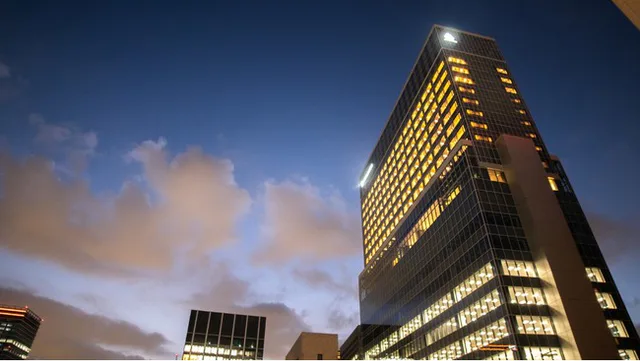
THE BLOSSOM HIBIYA is easy to reduce to a label such as “an upscale business hotel near Shinbashi.” That misses the part travellers are actually paying for. JR Shinbashi Station’s Hibiya Exit is about five minutes away on foot, Uchisaiwaicho Station on the Toei Mita Line is about two minutes away, and Ginza, Hibiya, Yurakucho and Tokyo Station all sit inside a practical central-Tokyo orbit. But the property’s strongest identity begins after you leave street level: the lobby and restaurant are on the 18th floor, the guest lounge and gym are on the 19th, and every guest room is on floors 19–27.
This guide answers one decision for a three- to five-night Tokyo stay: do the high-floor views, 24-hour guest lounge and ability to switch between Shinbashi and Uchisaiwaicho make THE BLOSSOM HIBIYA worth paying more for than a simpler city hotel? My answer depends on whether you will actually use the view and location together. If you leave early every morning, return close to midnight and never use the lounge, a meaningful part of the premium becomes unused product.
The answer in 30 seconds
I would book it when the itinerary repeatedly uses Ginza, Hibiya, Yurakucho, Tokyo Station or Shinagawa and I still want the hotel to feel distinct after I come back at night. That pattern uses the two nearby transport nodes, high-floor room views and 24-hour lounge rather than paying for them only on paper.
I would reconsider if most days are centred on Shinjuku, Shibuya or the western side of Tokyo and the hotel is mostly a place to sleep. JR access still works, but the location advantage becomes less aligned with the trip and the premium increasingly becomes a payment for a prettier hotel rather than a smoother itinerary.
I would skip it for a late-arrival, early-departure one-night transit stay with large luggage when the only priority is the shortest possible station-to-room path. THE BLOSSOM HIBIYA is not station-connected. The final walk from JR Shinbashi is still about five minutes, and the Toei Asakusa Line route from Shinbashi is longer. In that kind of itinerary, buy lower movement friction before buying a view.
THE BLOSSOM HIBIYA quick decision table
↔ Scroll table left or right
Item | Verified setup | Travel impact |
JR Shinbashi | About 5 minutes from Hibiya Exit | Not station-connected; rain and large luggage still make the final segment real |
Uchisaiwaicho | About 2 minutes from A2 / A5 | Useful when the Mita Line matches the day’s route |
Guest rooms | Floors 19–27; 255 rooms | High-floor perspective is part of the whole product, not only a suite feature |
Core rooms | 22 m² Double; 25 m² Twin / King | For two travellers, bed type and view direction matter as much as floor area |
Guest lounge | 19F, 24 hours, coffee / Wi-Fi / power | More useful on a 3–5 night stay or when two travellers keep different rhythms |
Laundry | Coin laundry on 20F and 24F | Long-stay benefit; no published live queue guarantee |
Breakfast | 06:30–10:00, last entry 09:30 | Easy on a slow city morning; early rail days need a time check first |
A five-minute Shinbashi walk is not “station-side”: the real advantage is switching stations
THE BLOSSOM HIBIYA does not win by being the closest hotel to every line. It wins by letting the same room use different stations for different days. The hotel’s access information lists roughly five minutes from JR Shinbashi Hibiya Exit, four minutes from Tokyo Metro Ginza Line Shinbashi Exit 7, eight minutes from Toei Asakusa Line Shinbashi Exit A2, and two minutes from Uchisaiwaicho A2 / A5 on the Toei Mita Line. Those four numbers are more useful than the generic phrase “good transport.”
From Haneda Airport, the hotel uses about 30 minutes by rail as a general reference and lists routes through Hamamatsucho or via Keikyu / the Toei Asakusa Line. The important detail is the final segment. An arrival at JR Shinbashi still leaves about five minutes on foot; the Asakusa Line A2 route is longer. With a 28-inch suitcase, rain or a late arrival, train time is not the same thing as door-to-door time.
The hidden advantage appears on normal sightseeing days. When the Mita Line is useful, Uchisaiwaicho can reduce the street walk. On another day you may simply use JR Shinbashi. Over a three- to five-night stay, the ability to choose the line that matches the itinerary can be worth more than shaving one minute from the first luggage arrival. That is a different type of location value from a hotel built around one station exit.
↔ Scroll table left or right
Transport node | Official walking reference | Most useful when |
JR Shinbashi Hibiya Exit | About 5 minutes | Yamanote / JR trips and general Tokyo movement |
Ginza Line Shinbashi Exit 7 | About 4 minutes | Trips along the Ginza Line |
Toei Asakusa Line Shinbashi A2 | About 8 minutes | A through-service airport route can be useful, but the final walk is longer |
Uchisaiwaicho A2 / A5 | About 2 minutes | Mita Line days make the location feel much closer |
If the Tokyo stay later connects to Fuji or Hakone, build the luggage plan before optimising another minute of hotel walking. The Kawaguchiko and Hakone luggage-forwarding guide is more useful than pretending every transfer can be solved by hotel location alone.
THE BLOSSOM HIBIYA room guide: 22, 25 or 31–34 m²?
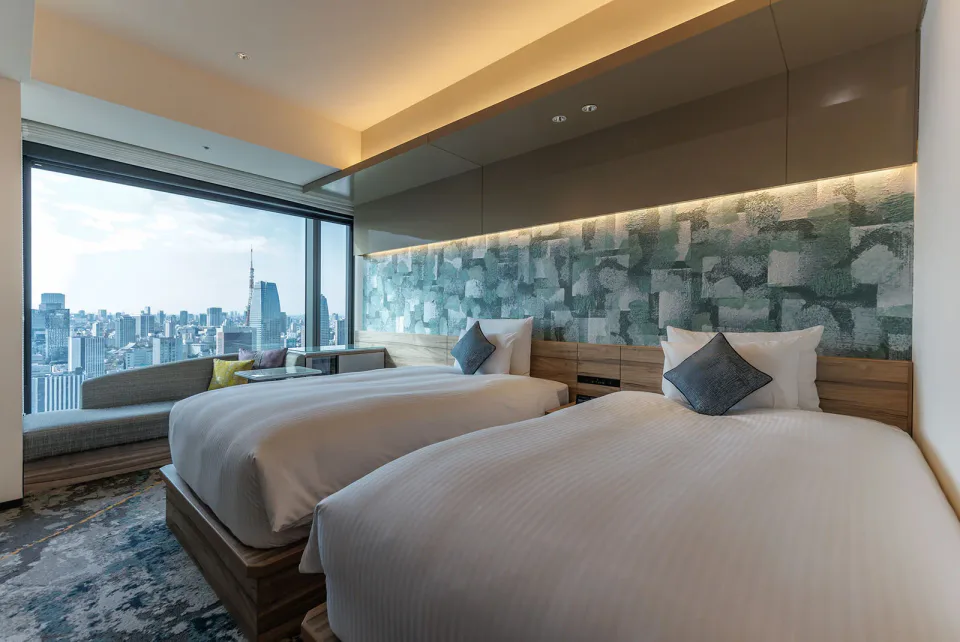
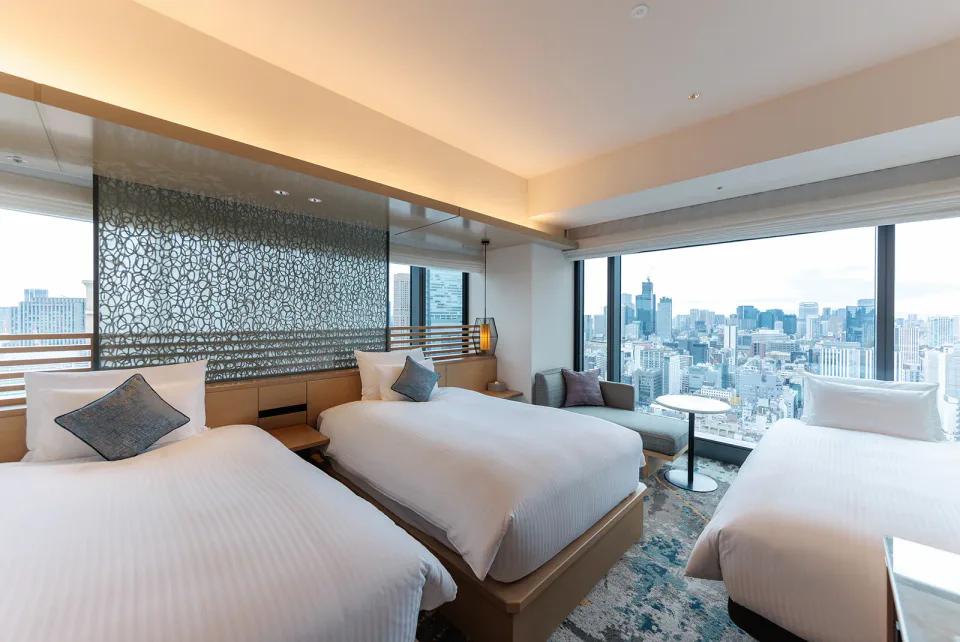
Do not start with the idea that “every room is on the 19th floor or above, so the view is basically the same.” The hotel separates direction clearly. The 22 m² Superior Double faces toward Hibiya on the northeast side. The 25 m² Superior Twin and Superior King face toward Shinbashi on the southwest side and are specifically described with City View. Moving from 22 to 25 m² can therefore change floor space, bed type and the direction of the night view at the same time.
The Superior Double is 22 m² with a 160 cm bed for up to two guests. It can work well for one traveller or a lightly packed couple on a short stay. Two large suitcases introduce less margin, and the hotel does not publish a measurement proving that two 28-inch cases can remain fully open without affecting the walkway. Treat the room size as a planning signal, not a suitcase guarantee.
The 25 m² Superior Twin is the room I would use as the benchmark for two travellers. It provides two 120 cm beds, the Shinbashi-side City View and a large window. It is not a large Tokyo room, but the extra three square metres create more margin for two people across three or four nights. The 25 m² Superior King uses a 180 cm bed and a larger desk, making it the clearer choice for couples who prefer one bed or someone who expects to work from the room.
The corner categories are a more visible upgrade in how the room operates. Deluxe Corner King is 31 m² on the Hibiya side with two-sided windows and a larger luggage rack. Deluxe Corner Twin is 34 m² on the Shinbashi City View side and can take up to three guests. The value is not square metres in isolation: it is corner light, a more forgiving luggage zone and better movement when several people are inside the room. For one night I would not upgrade automatically. For four or five nights—or three travellers—the daily use case becomes stronger.
↔ Scroll table left or right
Room type | Published size / direction | When I would choose it |
Superior Double | 22 m² / Hibiya side, northeast | Solo or short couple stay; lighter luggage; price control first |
Superior Twin | 25 m² / Shinbashi City View | Best two-person benchmark when separate beds and the view both matter |
Superior King | 25 m² / Shinbashi City View | 180 cm bed or a larger desk matters more than twin beds |
Deluxe Corner King | 31 m² / Hibiya side, two-sided windows | Two-person long stay; corner light and more luggage margin |
Deluxe Corner Twin | 34 m² / Shinbashi City View | Two or three people, more luggage, or more time inside the room |
The view is not a free add-on: choose direction before square metres
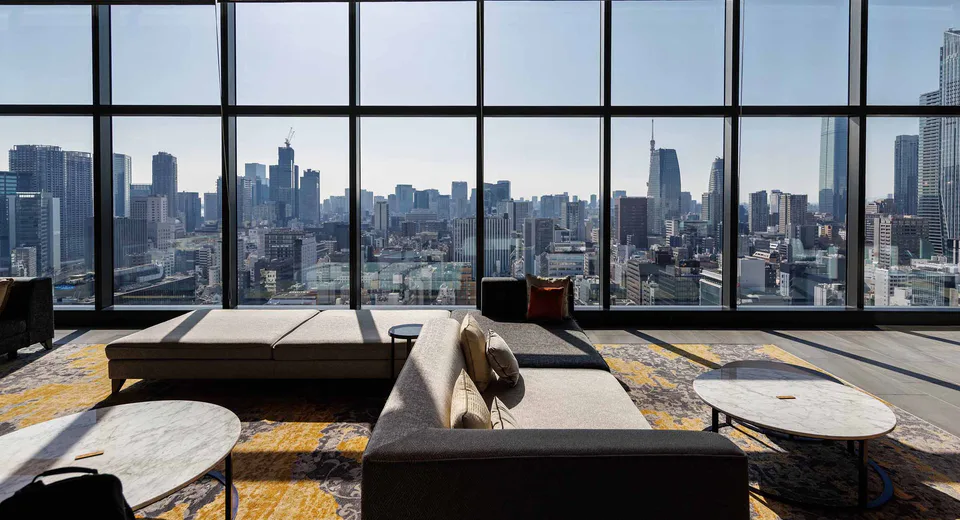
The hotel’s central product is vertical height. Lobby and restaurant functions sit on the 18th floor, the lounge and gym on the 19th, and the rooms continue through the 27th. High-floor perspective is therefore repeated from arrival to waiting, resting and going back to the room. For a traveller who wants a central address without feeling that the hotel experience collapses immediately back onto street level, that vertical separation has real experiential value.
But “high floor” does not mean every room sees the same postcard view. The official room descriptions separate Hibiya-facing and Shinbashi-facing categories, and only some categories explicitly use City View. Book the room name and direction first, then think about floor level. If the view is one of the main reasons for paying more, I would compare Superior Twin / King first and move to a Deluxe Corner category only when the extra room use justifies the price gap.
On a three-night stay, the 24-hour lounge and two laundry floors start to matter
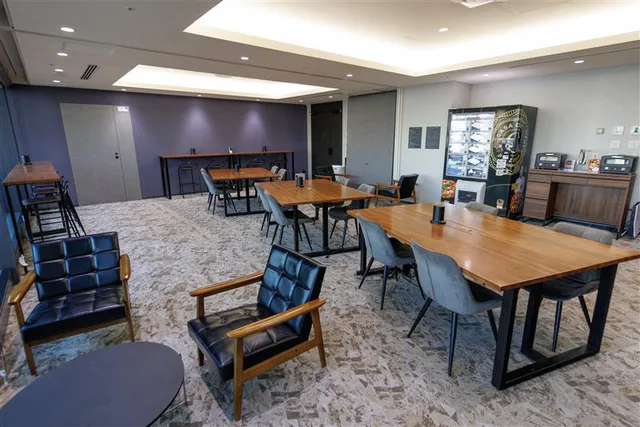
On a real three-night stay, I would expect the 19th-floor Free Lounge to matter more than the gym for most travellers. The hotel lists it as guest-only, open 24 hours, with complimentary coffee, Wi-Fi, power and USB. It is not an executive lounge and it is not a Club Lounge with alcoholic drinks. Its practical role is to stop two people with different routines from having to spend every waiting period inside the same room.
A typical use case is simple: return from Ginza at 18:30, drop shopping in the room, one person handles messages in the lounge while the other reorganises luggage, go back out to Shinbashi for dinner, then return later with one person showering while the other finishes tomorrow’s plan outside the room. That rhythm uses the lounge and the location together. If both travellers leave at 08:00 and come back at 23:30, the lounge becomes a feature list rather than an actual benefit.
Coin laundry is on the 20th and 24th floors. The hotel does not publish a live guarantee that a machine will be immediately available, so I would not describe it as “no waiting.” It is still useful for four- or five-night stays, summer travel or a Tokyo base before continuing to Hakone or Kawaguchiko. The 19th-floor gym is also available 24 hours for staying guests, but the hotel does not provide sports shoes or clothing, so it only has value if exercise is already part of your routine.
↔ Scroll table left or right
Facility | Published information | Decision value |
Free Lounge | 19F; 24 hours; coffee, Wi-Fi, power / USB | Most useful when two guests keep different routines or return to the hotel between outings |
Coin laundry | 20F and 24F | Useful over 4–5 nights or before continuing to another destination |
Gym | 19F; 24 hours for guests | Only valuable when exercise is already part of the trip; bring your own gear |
Breakfast | 18F Sotoroku; 06:30–10:00 | Easy on a slower city morning; early transport needs a schedule check first |
Breakfast at ¥3,850: decide after you know tomorrow’s departure time
Breakfast is served at Sotoroku on the 18th floor. Current hotel information lists 06:30–10:00 with last entry at 09:30, at ¥3,850 for adults and ¥2,750 for children. That is high enough that I would not add it automatically. Start with the next morning’s departure time.
If the day begins after 09:00 around Ginza, Hibiya or Tokyo Station, the 06:30 start is easy to use. If you need to be at Tokyo Station early for a Shinkansen or are leaving for Kawaguchiko or Hakone, protect the packing, checkout and transfer buffer first. A good buffet can still be the wrong purchase if it compresses the morning into an avoidable rush.
For an early side trip, work backward from the actual route: Tokyo to Hakone or the Tokyo–Kawaguchiko–Hakone three-day itinerary before deciding whether breakfast belongs in the booking plan.
Location × itinerary: when this base works best
The strongest fit is the eastern-central Tokyo axis: Ginza, Hibiya, Yurakucho and Tokyo Station. A night that ends in Ginza does not require a cross-city return, and events around Yurakucho still leave you on the same side of the city. This is where the address starts to feel coherent rather than merely central.
A second strong fit is a trip that mixes Haneda access with several city nights. Shinbashi connects naturally into airport-direction rail and the next day can move toward Tokyo Station, Shinagawa or the Yamanote Line. For an extremely late flight and one buffer night, an airport-area hotel may be more rational. For a normal arrival followed by three to five Tokyo nights, THE BLOSSOM HIBIYA has more time to combine airport access with its central location.
It can also work as a base before Hakone or Kawaguchiko, but it does not eliminate every transfer. The morning depends on whether you need Shinjuku, Tokyo Station or another departure point, and large luggage may deserve its own forwarding plan. When the trip itself changes cities, solving the suitcase can reduce more friction than chasing a hotel that is one minute closer to a station.
The fit becomes weaker when most of the trip is Shinjuku, Shibuya and Kichijoji. JR can still take you west, but the daily activity pattern no longer matches the Hibiya / Shinbashi neighbourhood as closely. In that case, a high-floor alternative such as OMO5 Tokyo Gotanda becomes a more useful comparison than assuming every central hotel is equally well located.
↔ Scroll table left or right
Trip focus | Value of staying here | Main friction |
Ginza / Hibiya / Yurakucho | Shorter evening return and several nearby lines | If you only pass through by day, neighbourhood value is lower |
Haneda arrival + Tokyo stay | Shinbashi connects airport-direction travel with central-Tokyo transport | The Asakusa Line Shinbashi route still has about an 8-minute final walk |
Tokyo Station / Shinagawa onward travel | Easy to connect into major JR nodes | Early trains still require hotel-to-departure-station buffer |
Shinjuku / Shibuya heavy trip | JR still makes west-side travel possible | Hotel neighbourhood and daily activity direction are less aligned |
Yurakucho event night | You remain in the same central-eastern zone after the event | Event dates can change room price and pedestrian crowding |
What are you giving up by choosing THE BLOSSOM HIBIYA?
The first trade-off is that high-floor atmosphere can influence price. Lobby, lounge, restaurant and rooms are all part of a deliberately elevated hotel experience. If you do not look out of the window, never sit in the lounge and spend almost no waking time in the hotel, you may be buying a product characteristic you barely use.
The second trade-off is that the core rooms are not universally spacious. Superior Double is 22 m² and Twin / King 25 m². Those are workable central-Tokyo sizes, but they do not make luggage layout irrelevant. A more obvious jump in room margin requires moving to a 31–34 m² corner room. If that price gap is large, return to the actual number of nights and hours you expect to spend inside rather than upgrading because the room name sounds better.
The third trade-off is that multiple lines do not mean zero walking. JR Shinbashi is around five minutes and Toei Asakusa Line Shinbashi about eight minutes according to the hotel. Rain and large luggage create a genuine cost. Uchisaiwaicho’s two-minute figure only helps when the Mita Line matches the itinerary. This hotel suits travellers willing to change lines and stations for flexibility more than travellers who want one exit to solve every day.
The fourth trade-off is that breakfast and facilities only matter when they are used. A ¥3,850 breakfast, 24-hour lounge, gym and in-house laundry all have legitimate purposes, but not every traveller receives equal value from each. I would look for two or three features that fit the real trip rather than saying “there are many facilities, so the hotel is worth it.”
Compare the same room and conditions before choosing a platform
First fix the exact room type, bed configuration, guest count, breakfast, taxes and cancellation deadline. Superior Double and Superior Twin / King do not only differ in area; direction and view labels also differ. Do not compare the cheapest homepage rate on one platform with a different room product on another and call that a price comparison.
Booking.com — check THE BLOSSOM HIBIYA room types
Trip.com — check THE BLOSSOM HIBIYA room types
Agoda — check THE BLOSSOM HIBIYA room types
Final verdict: would I book THE BLOSSOM HIBIYA?
THE BLOSSOM HIBIYA does not win because it is the closest hotel to a station exit. It combines Shinbashi’s multi-line access, high-floor perspective, room direction and a 24-hour public space into one central-city base. Whether it deserves the premium depends on whether those four features appear in your actual travel day.
Legacy Wix block requires review
{"type":"LAYOUT","id":"book-layout","nodes":[{"type":"LAYOUT_CELL","id":"book-cell","nodes":[{"type":"HEADING","id":"book-h","nodes":[{"type":"TEXT","id":"book-h-t","nodes":[],"textData":{"text":"I’d book","decorations":[]}}],"headingData":{"level":3}},{"type":"PARAGRAPH","id":"book-p","nodes":[{"type":"TEXT","id":"book-p-t","nodes":[],"textData":{"text":"Three to five nights, with frequent Ginza, Hibiya, Tokyo Station or Shinagawa plans, plus evenings when I will return to the hotel, rest, and possibly go back out. I would compare the 25 m² Superior Twin / King first, then decide whether a corner room is justified by view and room-use time.","decorations":[]}}],"paragraphData":{}}]}],"layoutData":{"borderRadius":16,"gap":12,"cellPadding":[20,20,20,20],"cellVerticalAlignment":"TOP","responsivenessBehaviour":"STACK","responsivenessBreakpoint":768,"designTarget":"LAYOUT","background":{"type":"COLOR","color":"#FDECEF"}}}Legacy Wix block requires review
{"type":"LAYOUT","id":"reconsider-layout","nodes":[{"type":"LAYOUT_CELL","id":"reconsider-cell","nodes":[{"type":"HEADING","id":"reconsider-h","nodes":[{"type":"TEXT","id":"reconsider-h-t","nodes":[],"textData":{"text":"I’d reconsider","decorations":[]}}],"headingData":{"level":3}},{"type":"PARAGRAPH","id":"reconsider-p","nodes":[{"type":"TEXT","id":"reconsider-p-t","nodes":[],"textData":{"text":"The itinerary is split equally between east and west Tokyo and the rate is clearly above strong alternatives. I would identify whether the view, lounge or multi-line location is the real priority; if two of those three are unlikely to be used, I would rerun the same-date comparison.","decorations":[]}}],"paragraphData":{}}]}],"layoutData":{"borderRadius":16,"gap":12,"cellPadding":[20,20,20,20],"cellVerticalAlignment":"TOP","responsivenessBehaviour":"STACK","responsivenessBreakpoint":768,"designTarget":"LAYOUT","background":{"type":"COLOR","color":"#F3EFEA"}}}Legacy Wix block requires review
{"type":"LAYOUT","id":"skip-layout","nodes":[{"type":"LAYOUT_CELL","id":"skip-cell","nodes":[{"type":"HEADING","id":"skip-h","nodes":[{"type":"TEXT","id":"skip-h-t","nodes":[],"textData":{"text":"I’d skip","decorations":[]}}],"headingData":{"level":3}},{"type":"PARAGRAPH","id":"skip-p","nodes":[{"type":"TEXT","id":"skip-p-t","nodes":[],"textData":{"text":"Late arrival, early departure, one night only, mostly Shinjuku / Shibuya days, or a hard requirement for a much larger room and the shortest possible station walk. Those needs do not use the hotel’s most distinctive value strongly enough.","decorations":[]}}],"paragraphData":{}}]}],"layoutData":{"borderRadius":16,"gap":12,"cellPadding":[20,20,20,20],"cellVerticalAlignment":"TOP","responsivenessBehaviour":"STACK","responsivenessBreakpoint":768,"designTarget":"LAYOUT","background":{"type":"COLOR","color":"#F7F7F7"}}}THE BLOSSOM HIBIYA FAQ
How far is THE BLOSSOM HIBIYA from Shinbashi Station?
Current hotel information lists about five minutes from JR Shinbashi Hibiya Exit, four minutes from Tokyo Metro Ginza Line Exit 7, and eight minutes from Toei Asakusa Line Exit A2. Uchisaiwaicho A2 / A5 on the Toei Mita Line is about two minutes away.
Are all guest rooms on high floors?
Yes. Official information places guest rooms on floors 19–27, with the lobby and restaurant on the 18th floor. Different room types face different directions, so “high floor” does not guarantee the same city view in every room.
Should I choose the 22 m² Double or 25 m² Twin / King?
For a short two-person stay with lighter luggage, the 22 m² Superior Double can be enough. For separate beds or the hotel’s published Shinbashi City View, compare the 25 m² Superior Twin. Choose the 25 m² Superior King when a 180 cm bed or larger desk matters more.
Is the 19th-floor guest lounge really open 24 hours?
Current hotel information lists the guest-only Free Lounge as open 24 hours with complimentary coffee, Wi-Fi, power and USB. Maintenance or special operations can still affect access, so check the current on-site notice during the stay.
What time is breakfast and how much is it?
Current hotel information lists breakfast at 06:30–10:00 with last entry at 09:30, at ¥3,850 for adults and ¥2,750 for children. Whether it is worth adding depends on the departure time and the exact booking plan.
OMO5 Tokyo Gotanda Review: Rooms, Views and Location
Luggage Forwarding for Kawaguchiko and Hakone: What Actually Works
Tokyo to Kawaguchiko: Train, Highway Bus or Guided Tour?
Tokyo to Hakone: Romancecar, JR and Hakone Freepass
Tokyo, Kawaguchiko and Hakone: 3-Day Itinerary
Mitsui Garden Hotel Fukuoka Gion vs THE BLOSSOM HAKATA Premier: Better for 3 Adults?
Kanmon Strait Museum: When the ¥500 Ticket Is Worth It—and When the Free Areas Are Enough
Kawagoe Castle Is Worth Leaving the Old Town For — The ¥100 Honmaru Palace Is the Easy Part
Hotel Hankyu RESPIRE OSAKA: Is a 3-Minute Osaka Station Walk Worth the High-Rise Trade-Off?
Lake Biwa Otsu Prince Hotel: Is the 36.2m² Lake View Worth the Shuttle?
Sources
THE BLOSSOM HIBIYA — official rooms
THE BLOSSOM HIBIYA — official access information
THE BLOSSOM HIBIYA — official facilities
JR Kyushu Hotels & Resorts — THE BLOSSOM HIBIYA official site
JR Kyushu Hotels & Resorts — opening press release and exterior image