
Choose a Sapporo self-drive hotel by what the car must do after you reach the city, not by whether a booking page simply says “parking available.” If the road-trip segment is ending, Hotel Emion Sapporo is the strongest transition back to JR. If you keep driving every day, Vessel Hotel Campana Susukino has the clearest combination of published vehicle dimensions and 24-hour in/out access. SAPPORO STREAM HOTEL works better when the car enters once and then sleeps while you use Susukino on foot. Hotel Sosei Sapporo requires the most caution because its current English and Japanese parking FAQs do not describe the same parking setup.
The bigger decision is sometimes to return the car before choosing any of them. A vehicle that was useful in Furano, Biei or rural Hokkaido can become paid luggage in central Sapporo. Once the trip switches to JR, subway and walking, an extra rental day creates parking cost, winter driving exposure and another return deadline without necessarily buying useful mobility.
Fact-checked August 27, 2026 against current first-party hotel pages. JPY remains the primary price reference. Approximate USD conversions use JPY 1,000 ≈ US$6.27; exchange rates move.
Sapporo self-drive hotels in 30 seconds
↔ Scroll table left or right
Your actual car pattern | Start with | Why | Main failure mode |
Final driving night, then return car and switch to JR | Hotel Emion Sapporo | Adjacent public parking plus roughly 4 minutes on foot from JR Sapporo North Exit | The adjacent Navipark can fill; the hotel does not describe it as guaranteed parking |
Standard vehicle + repeated daily exits | Vessel Hotel Campana Susukino | 80 first-come multi-storey spaces, published dimensions and official 24-hour in/out access | Standard spaces can still fill on a busy return |
Drive once, park, use Susukino on foot | SAPPORO STREAM HOTEL | Several affiliated-lot choices on the current access page and strong nightlife geometry | The access page lists Times while the FAQ names only two affiliated lots; re-entry can also reset parking economics |
Premium hotel + known compact/sedan dimensions | Hotel Sosei Sapporo | Its English FAQ currently lists a lower-cost mechanical option for qualifying cars | The Japanese FAQ currently omits that option; verify the live setup before relying on it |
Only one of four Sapporo days truly needs a car | Return the rental earlier | You avoid solving three nights of parking for a vehicle that no longer has a job | A later rural excursion may genuinely require keeping it |
First decide whether the car should still exist during the Sapporo stay
ValueNavi Parking Friction Model: the nightly fee is only one layer
This article uses a simple decision model:
Parking Friction = base parking cost + vehicle-fit risk + re-entry exposure + space-availability risk + unnecessary city-car days.
That is why two hotels with similar nightly parking prices can produce completely different driving experiences. A JPY 1,500 space that allows easy 24-hour in/out can be more useful than a similarly priced affiliated lot whose discounted stay period effectively assumes the car remains parked. And a JPY 2,000 mechanical space has no value at all if the rental is too tall to enter it.
↔ Scroll table left or right
Hotel | Price clarity | Vehicle-fit clarity | Re-entry resilience | Best transition |
Hotel Emion | Medium: guest discount published, exact rate not stated on the hotel access page | Public-lot rules apply | Depends on Navipark / fallback lot | Car → JR |
Hotel Sosei | Low-to-medium because official language pages currently conflict | High on English FAQ: 1.58 m × 1.85 m × 5.05 m for mechanical parking | Not the strongest reason to choose it | Known vehicle + premium room stay |
SAPPORO STREAM | Medium: the access page publishes three rates, while the FAQ currently names only COCONO SUSUKINO and Jumbo 1000 | Lot-specific | Low-to-medium: leaving can reset the discounted arrangement | Park once → Susukino on foot |
Vessel Campana | High: JPY 1,500/night | High: 5.30 m × 2.05 m × 2.00 m | High: official service page says 24-hour in/out is possible | Repeated driving |
ValueNavi Parking Event Ledger: count how many times the parking system has to work
Three parking nights do not create the same operational risk. A car that enters once and stays put exposes you to one arrival decision. A car that leaves every morning and comes back every evening repeatedly tests availability, re-entry rules and the driver’s willingness to deal with the city again.
For planning, use a second non-monetary measure:
Parking-event exposure = first hotel arrival + every leave-and-return cycle + any fallback search caused by a full or unusable primary lot.
This is a ValueNavi planning metric, not a hotel statistic. Its purpose is to make repetition visible before a low nightly rate distracts you.
↔ Scroll table left or right
Three-night Sapporo pattern | Parking-event exposure | What matters most | Best fit in this shortlist |
Arrive by car, return it the next morning, then use JR | Low: one hotel arrival, no hotel re-entry cycle | Easy transition after the car disappears | Hotel Emion |
Arrive once, leave the car parked for the stay, walk/subway at night | Low: one arrival, no repeat cycle | Overnight window and final exit rule | SAPPORO STREAM |
Drive out on Days 2 and 3, return to the hotel both evenings | Medium-high: one first arrival + two re-entry cycles | 24-hour in/out and repeat-return resilience | Vessel Campana |
Leave for errands, return with bags, then drive out again for dinner | High: several cycles in one day | A dedicated in/out system; affiliated-lot discounts become secondary | Vessel, or redesign the itinerary |
The ledger changes how to read the same price. JPY 1,500 and JPY 1,600 are almost the same cash decision for one quiet overnight, but their rules matter much more once you add repeated exits. If your itinerary creates several parking events purely for convenience-store, shopping-bag or dinner movements, the better fix may be to stop driving inside Sapporo rather than keep optimising the garage.
ValueNavi Parking Fit Score: score the driving pattern, not the hotel brand
For self-drive hotel articles, this score uses six fixed dimensions: route fit 30%, parking certainty 20%, vehicle-fit certainty 15%, re-entry fit 15%, price predictability 10% and winter/fallback resilience 10%. It rates how well a parking setup fits the stated driving pattern. It is not a hotel-quality rating, and the score should be recalculated if the car, season or number of daily exits changes.
↔ Scroll table left or right
Scenario being scored | Best-fit hotel/setup | ValueNavi fit | Why | What can reverse it |
Last driving night, then return the car and use JR | Hotel Emion Sapporo | 7.7/10 | Excellent car-to-rail geometry; parking is only solving one transition night rather than the whole stay. | Navipark is full, or you still need repeated suburban drives after check-in. |
Standard-size rental with repeated exits every day | Vessel Hotel Campana Susukino | 8.6/10 | Published dimensions, JPY 1,500/night (about US$9.41) and 24-hour in/out remove several recurring uncertainties. | Your vehicle exceeds the published limits, or the first-come multi-storey lot is full when you return. |
Enter once, leave the car parked, use Susukino on foot | SAPPORO STREAM HOTEL | 8.1/10 | Its affiliated-lot structure works well when the car behaves like checked luggage, but the current access/FAQ mismatch slightly reduces information certainty. | You need repeated exits, or the lot you planned around is no longer listed on the live page for your stay. |
Known compact/sedan that fits the mechanical limits, after the JPY 2,000 option is confirmed | Hotel Sosei Sapporo | 6.3/10 provisional | The dimensions can work well, but the current English/Japanese FAQ mismatch materially lowers parking certainty. | Direct confirmation resolves the mismatch, or the actual rental requires the JPY 4,000 front space instead. |
The ranking is deliberately scenario-specific. Vessel’s higher repeat-driver score does not make it the better choice after the rental has finished its job; Emion can still be the smarter stay because the correct move is to stop paying for a city car. Likewise, STREAM’s re-entry weakness matters very little if your plan is to park once and walk for the rest of the evening.
Hotel Emion is the cleanest answer when the car is almost finished with its job
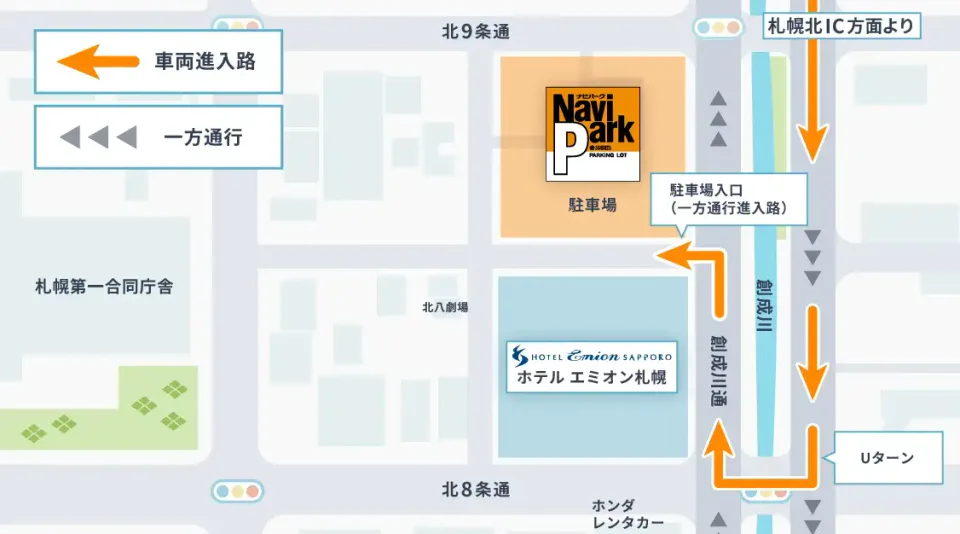
Hotel Emion Sapporo’s current official access page says the adjacent Navipark is used for hotel parking, with a guest discount available when you show the parking ticket at check-in. It also explicitly says that if the lot is full, guests should use nearby coin parking. That is the detail that matters: adjacent is not the same as guaranteed.
The hotel becomes much more persuasive after the vehicle disappears. The same official page puts JR Sapporo Station North Exit at roughly a four-minute walk and the underground route at about five minutes. If your Hokkaido road trip ends on Night 1 of a three-night Sapporo stay, Emion lets that night absorb the car while Nights 2–3 operate as a normal rail-based city stay.
This is a transition advantage, not a claim that Emion has the best parking system in Sapporo. If you are driving out every morning for the next three days, the first-come public-lot setup matters more. If the car is going back tomorrow, JR proximity starts paying rent immediately.
Check Hotel Emion as a car-to-JR transition base
Hotel Sosei has a live first-party mismatch — treat parking as unverified until the hotel confirms it
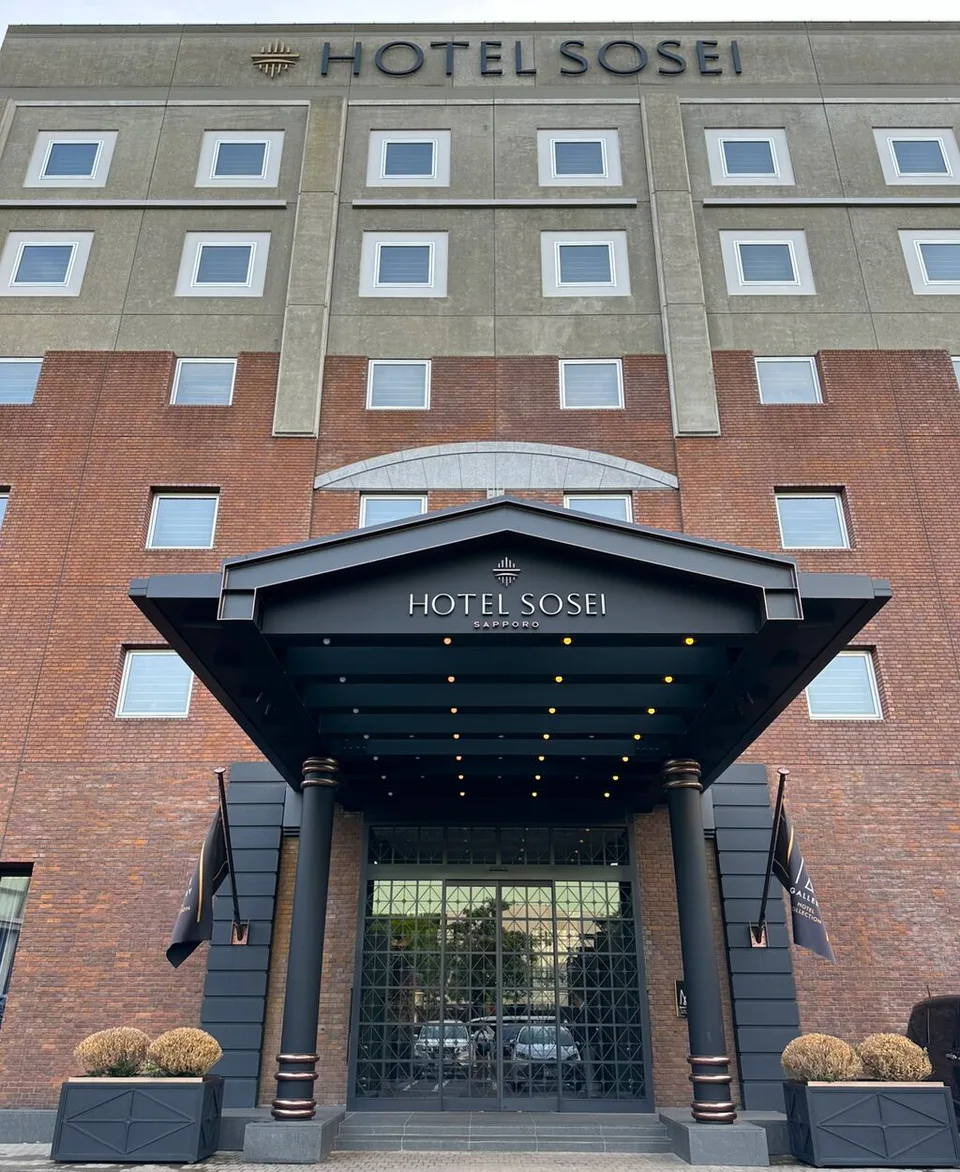
Hotel Sosei Sapporo is the most important correction in this shortlist. Its current English official FAQ lists two parking tiers:
Multi-level parking: first-come, JPY 2,000 per night (about US$12.55), limited to vehicles up to 1.58 m high, 1.85 m wide and 5.05 m long.
Front parking: first-come, JPY 4,000 per night (about US$25.09), intended for vehicles too large for the above limits.
However, the hotel’s current Japanese FAQ only describes front parking at JPY 4,000 per night and says that if hotel parking is full, guests may be directed to Sapporo Factory or nearby coin parking. It does not currently repeat the JPY 2,000 mechanical option.
Do not silently resolve this discrepancy in your own favour. If the JPY 2,000 mechanical price materially affects your booking, contact the hotel with the exact rental model or dimensions before assuming that space and rate will be available on your stay.
If the English mechanical option is confirmed, vehicle height changes the economics sharply. Three nights at JPY 2,000 would be JPY 6,000 (about US$37.64); three nights at JPY 4,000 would be JPY 12,000 (about US$75.28). A taller rental could therefore create a JPY 6,000 (about US$37.64) three-night parking difference before you count the rental upgrade or extra fuel.
That is why “SUV for winter” should not be decided independently from the hotel. The vehicle class can alter both the rental bill and the parking tier. Use the Hotel Sosei Sapporo review only after the parking setup works for the actual car.
Check Hotel Sosei after confirming your exact vehicle and parking tier
SAPPORO STREAM HOTEL is cheapest when the car behaves like checked luggage
SAPPORO STREAM HOTEL has no dedicated hotel car park. Its current official access page lists three non-reservable affiliated options. However, the hotel’s current English FAQ still names only COCONO SUSUKINO and Jumbo 1000. The access page is the more detailed parking source and currently includes Times Station Sapporo Susukino, so the table below follows that page; if Times is the lot that makes your plan work, recheck the live access page before arrival rather than relying on an older FAQ or cached summary.
↔ Scroll table left or right
Lot | Guest rate | Useful window | Re-entry issue |
COCONO SUSUKINO | JPY 2,000/night (about US$12.55) | 15:00–11:00 | Do not assume repeated exits are covered by one overnight fee |
Jumbo 1000 | JPY 1,500/night (about US$9.41) | 14:00–11:00 | Outside the hotel window, normal hourly rates apply |
Times Station Sapporo Susukino | JPY 1,600/night (about US$10.04) | 24 hours from entry | The access page explicitly says re-entry after leaving is charged at the regular rate |
The cheapest-looking rate therefore does not automatically produce the cheapest driving pattern. If you arrive at 17:00, park, walk around Susukino for dinner, sleep and drive away the next morning, the setup is clean. If you repeatedly leave for a suburban meal, come back, drive out for shopping and return again, you are asking an affiliated parking system to behave like a hotel garage.
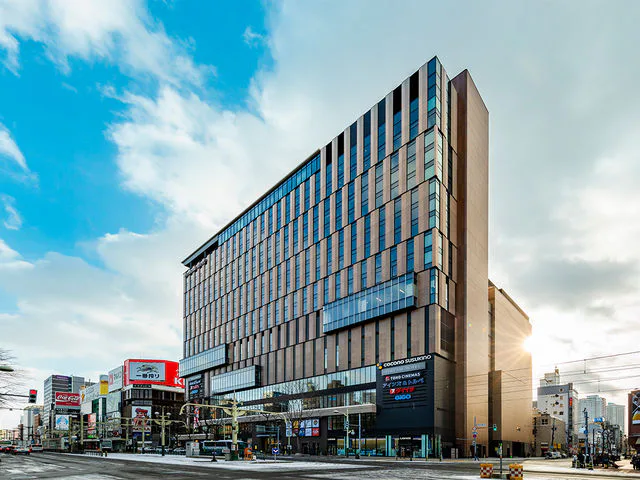
STREAM is therefore strongest when the car sleeps. Park it, use Susukino on foot, and let the hotel’s nightlife location do the transportation work. If you are torn between Susukino and the station, settle Sapporo Station vs Susukino before optimising the affiliated car park.
Use STREAM when Susukino can replace evening car movements
Vessel Campana is the strongest repeat-driver option in this shortlist
Vessel Hotel Campana Susukino currently publishes 80 first-come multi-storey spaces at JPY 1,500 per night (about US$9.41), with maximum dimensions of 5.30 m long, 2.05 m wide and 2.00 m high. Two flat spaces are reservable for vehicles over 2.00 m high or accessibility use, also at JPY 1,500 per night.
The important fact that changes the comparison is on the hotel’s official service page: its dedicated parking supports 24-hour in/out access. That makes Vessel materially more resilient for a stay where the car leaves more than once a day.
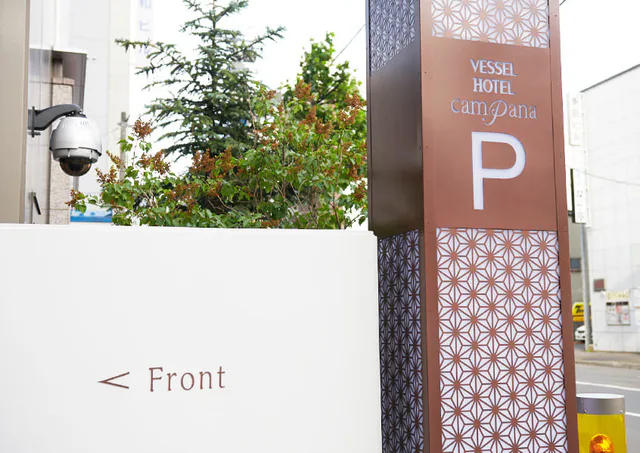
For three nights, the published base parking cost is JPY 4,500 (about US$28.23), assuming you obtain a qualifying hotel space each night. That is not a guarantee: the 80 multi-storey places remain first-come. The hotel says nearby parking may be introduced if its lot is full, but those alternatives are not affiliated and do not receive a hotel discount.
So Vessel wins a specific problem: a normal-height rental, repeated exits, and a driver who wants published rules rather than improvising each return. It does not automatically beat Emion after the car is returned or STREAM when the car never moves.
Check Vessel Campana with your exact rental-car dimensions
Three nights show why the “cheapest parking hotel” question is incomplete
↔ Scroll table left or right
Example | Three-night published base | What the number hides |
Vessel qualifying hotel space | JPY 4,500 (~US$28.23) | First-come availability still matters |
Sosei English-FAQ mechanical tier, if confirmed | JPY 6,000 (~US$37.64) | 1.58 m height limit + current Japanese-page mismatch |
Sosei front parking | JPY 12,000 (~US$75.28) | First-come and double the English mechanical rate |
STREAM | Cannot be compared honestly from one multiplication | Different lots, entry windows, re-entry rules and a current access/FAQ listing mismatch change the certainty of the total |
Emion | Not quoted here | The hotel publishes a guest discount but not the exact amount on its current access page |
This is intentionally not a fake “cheapest-to-most-expensive” ranking. A parking cost is only comparable when the same assumptions survive: same vehicle, same arrival time, same number of exits and a space actually available.
The cheapest parking night can still be the most expensive rental day
Suppose you have four nights in Sapporo but only one day still needs rural driving. Keeping the car for all four nights means paying for three additional rental days and up to three additional parking nights, while also carrying winter-driving risk through central Sapporo.
That is a bad trade when the unused vehicle is only waiting for the airport. Return it when the rural segment ends, then let rail handle the city. Start with full-trip versus partial car rental in Hokkaido; in winter, use the stricter Hokkaido winter rental-car comparison.
The boundary condition is simple: keep the car when a later day still contains a route that is materially worse without it. Do not keep it because “we already rented it.” Sunk-cost logic is especially expensive when every extra day also creates parking.
Return day and flight day should not automatically be the same day
Returning a rental car on the morning of an early flight sounds efficient because it removes one hotel parking night. It can also stack refuelling, rental inspection, winter traffic and airport check-in into one hard chain.
If your last rural drive already returns to Sapporo in the afternoon, consider ending the rental then. You may pay one less parking night and remove the vehicle from departure morning completely. If the next day is an early New Chitose flight, compare this with the Sapporo vs Chitose last-night decision.
The opposite case is a late flight with one useful driving stop still available. Then returning in Sapporo a day early can simply replace one car journey with extra rail. The correct return time is the point where the car stops creating more useful mobility than it costs in parking, risk and deadlines.
Winter makes one unnecessary re-entry more expensive than it looks
In dry weather, leaving a garage for one short errand is mostly a fuel-and-time question. In winter it can add snow clearing, an icy ramp, another drive through central traffic and a second attempt to secure a space. That is why the re-entry distinction between Vessel and STREAM matters more in January than in September.
A hotel garage cannot make winter driving safe by itself. If you are not comfortable on snow and ice, use the Hokkaido winter driving guide before using parking convenience as justification to keep the car.
Seven checks before you pay
Return day: write down when the car genuinely stops being useful.
Vehicle dimensions: check height, width and length for the actual rental model, not just “SUV” or “compact.”
Parking certainty: distinguish dedicated, first-come, affiliated and public parking.
Re-entry: ask whether one overnight fee still applies after leaving and returning.
Fallback: know what happens if the primary lot is full at 21:00 in snow.
Source consistency: if a hotel’s access page and FAQ list different parking options, treat the option you need as unconfirmed until you recheck the live page or ask the hotel.
Departure chain: do not force refuelling + car return + airport check-in into one fragile morning unless the timing genuinely requires it.
Final verdict
Hotel Emion is the best transition choice when the car is ending and JR is starting. Vessel Campana is the strongest repeat-driver choice here when your vehicle fits and you value 24-hour in/out. SAPPORO STREAM HOTEL works best when you park once and let Susukino replace evening driving, but recheck the live affiliated-lot list if Times is central to your plan. Hotel Sosei can still fit a premium self-drive stay, but its current first-party language mismatch means I would verify the parking tier before letting the JPY 2,000 mechanical rate influence the booking.
The most valuable outcome may be choosing none of these for parking reasons. If the car has finished its rural job, return it. A central Sapporo hotel should not be selected around solving a vehicle you no longer need.
Okinawa Trip Cost: 5-Day Budget for Hotels, Car and Activities
Okinawa Self-Drive Hotels: Count Daily Car Trips, Not Free Parking
Nada no Kenka Matsuri 2026: If You Only Go One Day, Choose Oct 15
Naruko Gorge 2 Day Itinerary: 2026 Trains, Trails, Onsen and Hotels
Sources
Hotel Emion Sapporo — official access and parking guidance · Hotel Sosei Sapporo — official English FAQ · Hotel Sosei Sapporo — official Japanese FAQ · SAPPORO STREAM HOTEL — official parking information · SAPPORO STREAM HOTEL — official English FAQ · Vessel Hotel Campana Susukino — official access and parking · Vessel Hotel Campana Susukino — official service page. Checked August 27, 2026.