
For an Okinawa road trip, free parking is a weak hotel filter. The more useful number is how many times you expect to take the car out of the hotel each day. A hotel that charges a small parking fee but lets you walk to dinner can be easier than a hotel with free parking that forces a second drive every evening.
ValueNavi’s default rule is simple: one leave-and-return loop per day is healthy; two loops deserve scrutiny; three loops on consecutive days usually mean the base is fighting the itinerary. The hidden cost is not fuel. It is regrouping everyone, retrieving the car, navigating, finding another space and repeating the parking process after the group has already returned to the hotel.
30-second decision: count car-use density before parking price
↔ Scroll table left or right
Daily pattern | ValueNavi reading | Hotel priority |
Leave after breakfast, return once at night | Low friction | Reliable parking and simple road access |
Return at 4 PM, drive out again for dinner | Medium-high friction | Walkable evening area or useful on-site dining |
Two hotel returns before bedtime | High friction | Re-check whether the base is misplaced |
Drive all day, park in Chatan, walk all evening | Efficient | Paid parking can still be excellent value |
Many short Naha city trips | Question the car itself | Walkability / Yui Rail may matter more than garage convenience |
If you are still deciding whether to rent a car at all, start with Do You Need a Car in Okinawa?. This article starts one level later: the car already exists; now the hotel has to make that car useful.
ValueNavi model: Car-Use Density
Car-Use Density is the number of full hotel car loops per day:
hotel → destination(s) → hotel = one loop.
Returning to the hotel and leaving again creates another loop. The threshold matters because each loop has a fixed startup cost even when the drive itself is short.
That startup cost includes elevators, keys, child seats, bags, route setup, garage access and getting the group moving again. For four adults, young children or older parents, the group-coordination part can be more expensive than the drive.
Parking Friction Tax: “free” solves only one line of the cost
ValueNavi separates parking price from Parking Friction Tax:
walk/shuttle to the car + availability uncertainty + vehicle restrictions + re-entry process + time to regroup + second-trip temptation.
A ¥0 parking charge can therefore be a worse deal than ¥500 if the paid option removes a repeated evening drive. For reference, ¥500 is about US$3.14 at the August 27, 2026 exchange rate.
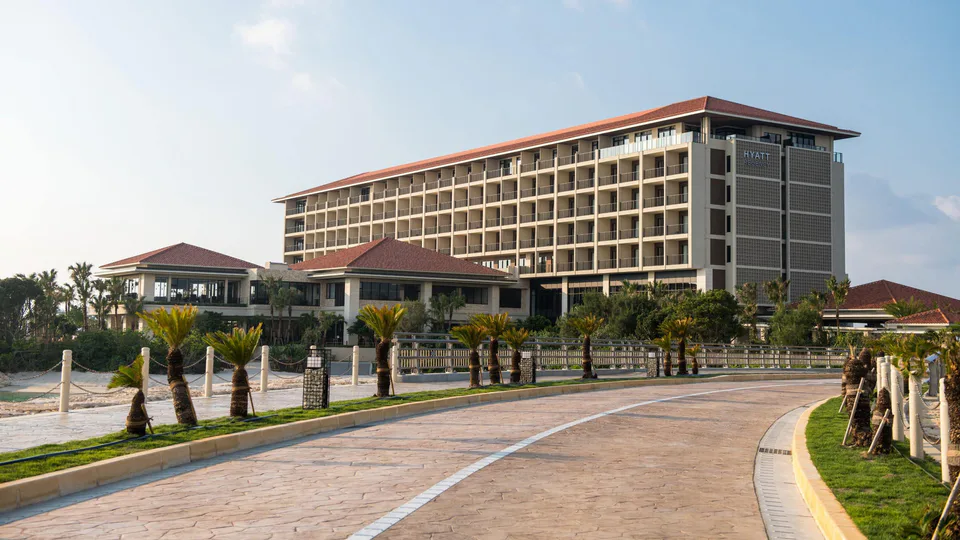
Hyatt Seragaki: parking exists, but it is not room-to-wheel frictionless
At a resort, parking friction stays small when you drive out once and return once. It grows when every evening requires another retrieval cycle.
Hyatt Regency Seragaki Island Okinawa currently says self-parking is on the main island. Guests can drop luggage at the island-side entrance, then use the Beach House shuttle, listed as 7:00 AM–10:30 PM, or walk about five minutes from the garage; hours may vary by season.
For a guest who leaves once in the morning and comes back after dinner, that is a minor operating detail. For a guest who returns at 4 PM, showers, then drives out again at 7 PM, the same five-minute walk or shuttle becomes part of the second loop every day.
This creates the Hotel Exit Cost: how much effort separates “we are in the room” from “everyone is in the car again.” A resort with a higher Hotel Exit Cost can still be excellent when the resort itself is the evening plan.
Chatan: paid parking can win because the car can stop working at night

A small parking fee can be good value when the car stays parked for dinner, shopping and the evening walk.
Hilton Okinawa Chatan Resort currently lists on-site self-parking at ¥500 per day (about US$3.14) with in/out privileges, and Hilton places the hotel in central Chatan next to Mihama American Village.
That is a useful counterexample to “free parking is best.” If the daytime itinerary needs a car but the evening is dinner, shopping and walking around American Village, the ¥500 may buy a more important outcome: zero evening restart.
Use the Chatan hotel comparison to judge what you can do after parking rather than ranking hotels by the garage fee alone.
Zero-Drive Day Test: can the car disappear for an entire day or evening?
For each hotel, ask one question that normal self-drive guides rarely ask:
Can I deliberately create a zero-drive block here?
Examples include:
a full resort afternoon and dinner in Onna;
an American Village evening in Chatan;
a Kokusai Street / central Naha block after the road-trip portion is finished.
The ability to stop driving is not a failure of a self-drive itinerary. It is often the feature that prevents the rental car from becoming another chore.
Naha: short distances do not make every trip worth driving
The urban segment should be judged differently from the north-coast road-trip segment.
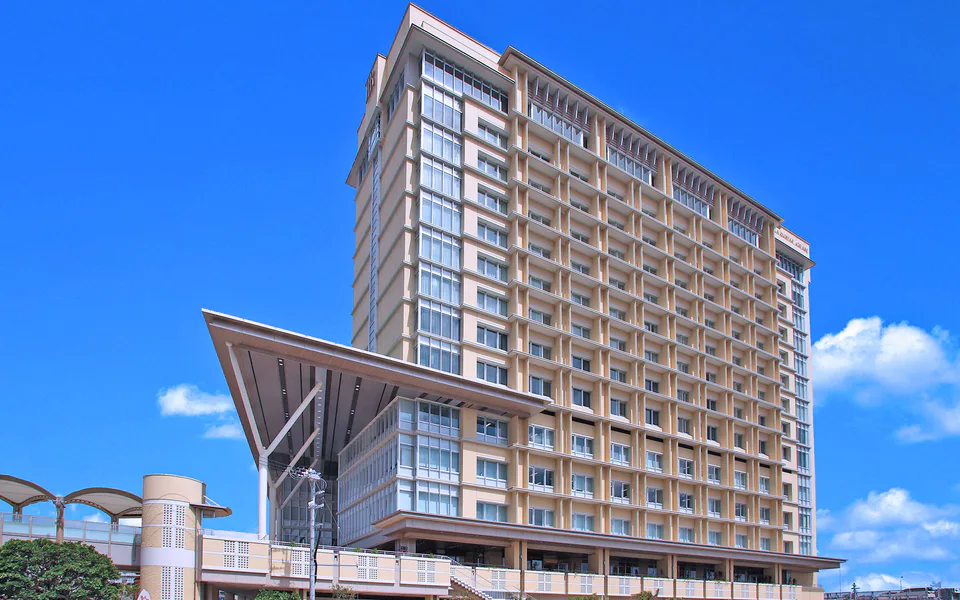
Hyatt Regency Naha currently states that its tower parking is first-come-first-served. Oversized vehicles and guests arriving when it is full must use nearby coin parking at their own expense. Hyatt also notes that every Sunday from noon to 6 PM, part of Kokusai Street is closed to vehicles and opened to pedestrians.
That does not make Naha “bad for cars.” It means the marginal value of the car can collapse once your remaining plans are city walking, dinner and an airport departure.
If you are deciding whether to finish the trip in the north or move back to the city, use Onna vs Naha for the last night. The final night has a different job from the middle of the road trip.
One loop a day: do not over-engineer the garage
If you leave once after breakfast and return once at night, parking only needs to be reliable enough. Confirm:
guest parking availability;
vehicle size / height restrictions;
overnight price;
re-entry rules;
whether the garage is actually beside the hotel.
Then move on. The more important question is whether the hotel points in the same direction as tomorrow’s sightseeing.
Two loops a day: solve dinner before the parking fee
The classic friction pattern is:
sightseeing → hotel → shower/rest → dinner drive → hotel.
The second loop is often not for a major attraction. It is for dinner, groceries or a night walk. That makes it an excellent candidate for elimination.
The three strongest fixes are:
stay where dinner is walkable;
choose a resort where you genuinely want to eat and spend the evening;
eat before the first return to the hotel.
If one of these removes the second loop for three nights, its value repeats three times. A small nightly parking saving usually cannot compete with that.
Three loops a day: stop optimising parking and re-check the hotel area
Morning drive north, hotel return, evening drive south, hotel return, then another short errand is no longer a parking problem. It is a base-design problem.
ValueNavi’s warning threshold is three loops on two consecutive days. At that point, ask whether you are using the hotel as a relay station between places that should have been grouped together.
For families, the penalty is even larger because each extra departure can involve child seats, beach gear, shopping bags, toilet stops and persuading a tired group to leave again.
Build two maps: Daytime Gravity and Evening Gravity
Most Okinawa hotel decisions use only a daytime attraction map. ValueNavi adds a second map.
Daytime Gravity = the direction of the big drives you make after breakfast.
Evening Gravity = where you want to eat, walk, shop or relax after the sightseeing car is parked.
↔ Scroll table left or right
Pattern | Interpretation | Likely move |
Both gravities point north | Base is coherent | Multi-night Onna / northern stay can work well |
Day north, evening Chatan | Repeated evening southbound drive risk | Consider Chatan or eat before returning |
Road-trip days finished, evening Naha | Car value is falling | Consider Naha last night / earlier return of car |
Both gravities change halfway through trip | One hotel is being asked to do two jobs | Split bases may be rational |
Split-Stay Threshold: one hotel move can be cheaper than six extra drives
Hotel changes create their own friction, so splitting the stay is not automatically better. The threshold is reached when one move removes a repeated pattern of long or unnecessary car loops.
A useful test is:
hotel-move friction once < repeated drive + parking friction removed across the remaining days.
This is why Naha for the last night can be rational after several nights in Onna even if you dislike changing hotels. The move may remove an early airport drive, car-return uncertainty and one more morning of group coordination.
Free Parking Trap: three NO-GO cases
NO-GO 1: an isolated hotel wins only because parking is free, but every dinner requires another drive.
NO-GO 2: the parking is free but off-site, shuttle-dependent or awkward, while the itinerary needs two or more loops per day.
NO-GO 3: you keep a northern resort for the final night because parking is easy even though the next morning is dominated by airport and rental-return logistics.
Free parking has value. It simply should not beat a better base when the same movement cost repeats every day.
Three scenario tests
Scenario 1: couple, Onna, one long drive day and resort dinner
Verdict: parking simplicity is enough. One loop per day keeps friction low. Do not overpay just to move the car 30 metres closer to the lobby.
Scenario 2: family, afternoon hotel returns, dinner out every night
Verdict: evening walkability becomes a major hotel feature. A Chatan-style base or a resort evening can remove the second daily start.
Scenario 3: final road-trip night before an early flight
Verdict: re-run the base decision. The last night should reduce the airport / car-return chain, not preserve a northern hotel just because the parking is comfortable.
ValueNavi scorecard
Daily pattern | Car usefulness | Parking friction | Base warning |
|---|---|---|---|
1 loop | Low | Green | |
2 loops | Medium-high | Amber | |
3 loops | High | Red if repeated | |
1 loop + zero-drive evening | Very low | Best balance |
These are editorial decision scores, not official transport ratings.
When this rule becomes wrong
The “reduce daily loops” rule is less important if you genuinely enjoy driving, the hotel garage is exceptionally easy, the group travels light and every second trip serves something you would not want to walk to anyway.
It becomes more important with young children, older parents, large beach loads, frequent hotel rests, difficult parking access or a driver who is already tired from long sightseeing days.
Final verdict
The best Okinawa self-drive hotel is often the hotel that lets the car stop working after sightseeing. With one daily loop, parking just needs to be dependable. With two loops, solve the evening. With three loops on repeated days, re-check the base itself.
Put one number beside every hotel on your shortlist: expected car loops per day — 1, 2 or 3. That number will usually tell you more about the actual road-trip experience than the words “free parking.”
Official hotel references
Parking details checked on August 27, 2026. Re-check the hotel’s current parking rules, vehicle restrictions and access hours for your actual travel dates.