
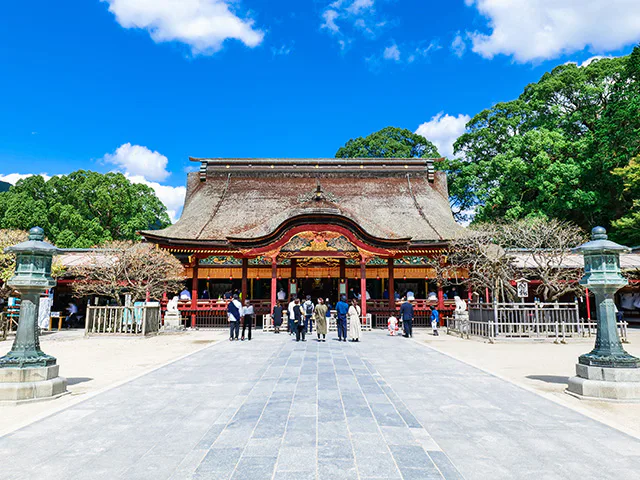
For most first-time visitors with one spare Fukuoka excursion slot, I would choose Dazaifu if I had only half a day, uncertain weather or no appetite for timetable planning. I would choose Itoshima when the coast itself is the day: cafés, sea views and possibly sunset are worth giving up the compactness of Dazaifu. A rental car is the condition most likely to flip the answer toward Itoshima.
The important correction is that these are not two interchangeable “day trips.” Dazaifu is a compressed cultural block that can return you to Fukuoka for the evening. Itoshima is a route-design problem: the more coast you want, and the later you want to stay, the more the return timetable matters. In 2026 that distinction is especially important because the direct West Coast Liner leaves Futamigaura for central Fukuoka much earlier than many travellers expect, while Dazaifu’s museum and shrine both have date-specific operating constraints.
↔ Scroll table left or right
Your actual day | Choose | Why | What can reverse it |
Only 4–6 usable hours | Dazaifu | Shrine, approach street and museum sit in one compact zone | The museum is closed and the shrine is under a temporary access restriction on your date |
Clear full day, coast and cafés are the goal | Itoshima | The day is about moving along the peninsula rather than one attraction | You have no car and the bus timetable forces an early return |
Sunset at Futamigaura without a car | Conditional Itoshima | The experience can be excellent, but return transport must be solved before departure | Sunset is later than your last workable bus; use a taxi, car or overnight instead |
Monday / museum closure day | Recalculate | Dazaifu loses much of its strongest indoor/weather-proof component | The shrine and town alone are still your main interests |
Rental car already booked | Itoshima gets much stronger | Scattered coast stops become one continuous route instead of several bus decisions | Bad visibility, heavy rain or strong wind removes the reason you wanted the coast |
Kyoto and Nara already dominate the wider Japan trip | Itoshima often adds more variety | Coast, cafés and sunset change the rhythm of the trip | You specifically want Kyushu National Museum or Dazaifu Tenmangu |
Dazaifu is the better half-day; Itoshima is the better deliberate full day
The easiest way to decide is to count usable hours rather than attractions.
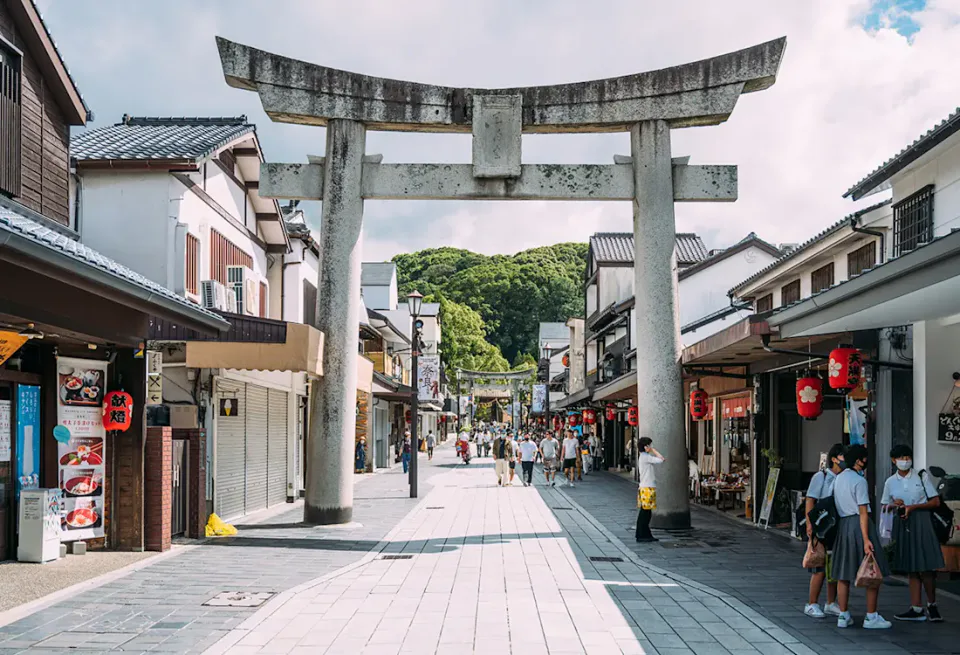
Dazaifu works unusually well when the excursion must fit between breakfast and a Fukuoka evening. Nishitetsu currently lists the Dazaifu Liner Bus “Tabito” at about 40 minutes from Hakata Bus Terminal to Dazaifu under normal traffic, with 28 outbound services on weekdays and 36 on weekends/holidays. Reservations are not required, although a full bus can refuse additional passengers. From Tenjin, the Nishitetsu rail route via Futsukaichi gives you another practical path.
Once you arrive, the shrine approach, Dazaifu Tenmangu and Kyushu National Museum are geographically concentrated. You can build a real 4–6 hour excursion without spending the entire block redesigning transport.
Itoshima is different. Futamigaura can be one anchor, but the peninsula becomes more rewarding when you add cafés, another coastal stop, lunch or a sunset. Every extra stop expands the transport geometry. With a car that can be a feature. Without one, it turns a “day trip” into a timetable you must actively manage.
ValueNavi rule: if you only have a half-day and are still debating, choose Dazaifu. Itoshima should win because you actively want a coastal day, not because somebody said it is a trendy place near Fukuoka.
Dazaifu’s weather advantage depends on the museum actually being open
One reason Dazaifu normally beats Itoshima in mixed weather is Kyushu National Museum. The museum gives the day a substantial indoor component rather than forcing you to spend every hour outside.
The current 2026 museum schedule lists normal opening from 09:30 to 17:00, with later Saturday hours during applicable special-exhibition periods. It is normally closed on Mondays; when Monday is a public holiday, the closure can shift to the following working day. That is not a small footnote in this comparison.
If the forecast is wet and you planned to use the museum as the reason Dazaifu still works, a Monday closure can remove the exact advantage that made Dazaifu the safe choice. The shrine, approach street and food still exist, but you now have a more outdoor-heavy day.
So the weather rule should be written as:
Mixed weather + museum open: Dazaifu is the safer default.
Mixed weather + museum closed: compare what you actually want from the shrine/town before automatically choosing Dazaifu.
Clear day + coast is a priority: Itoshima gets stronger.
This is more useful than calling Dazaifu “all-weather” and Itoshima “good weather only.”
There is a temporary 2026 Dazaifu exception: the main-hall frontage is under construction
Dazaifu Tenmangu completed the major restoration of its historic Main Sanctuary, and the temporary sanctuary used during the work is now being dismantled. That creates a short-term planning exception in late summer 2026.
The shrine’s current notice says paving work in front of the Main Sanctuary begins on August 18, 2026. During the work, visitors cannot enter the area directly in front of the sanctuary; the shrine currently expects frontal worship access to resume around September 20.
This does not mean Dazaifu Tenmangu is “closed.” It means an architecture-focused visitor travelling in that window should not judge the day from pre-construction photos. If the whole reason you chose Dazaifu over Itoshima was to see the restored sanctuary from its normal frontal approach, this temporary restriction can legitimately move a clear-weather day toward Itoshima.
For trips after the restriction ends, remove this temporary factor and return to the normal decision framework.
Itoshima sunset is a transport decision, not just a photography decision
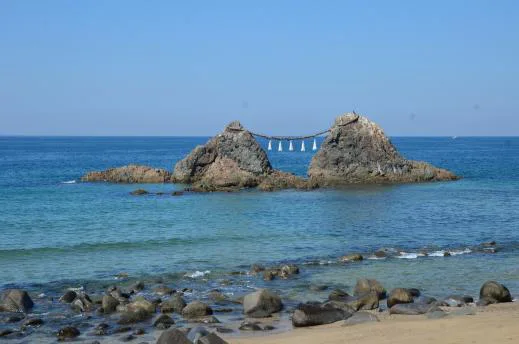
Futamigaura is one of the strongest reasons to choose Itoshima, but “stay for sunset” is often written as if the return to Fukuoka solves itself. It does not.
Under Showa Bus’s current timetable revised April 4, 2026, the direct West Coast Liner from the Futamigaura area toward Tenjin and Hakata leaves the “Futamigaura / Tsuki to Taiyo Itoshima Chabou-mae” stop for the last time at about 17:31 on weekdays and 18:36 on weekends and holidays. Those times can be well before the sunset you actually want on a long summer day.
There is a later local-bus strategy, but it is a different product. The Nishinoura Line can take you from Futamigaura toward Kyudai-Gakkentoshi Station, where you continue by rail. The current timetable shows a last listed Futamigaura departure of about 18:21 on weekdays and about 19:36 on weekends/holidays on the relevant return pattern.
That creates four very different “Itoshima sunset” plans:
Direct bus back to central Fukuoka: simplest, but the current last departure may be too early for sunset.
Local bus to Kyudai-Gakkentoshi + rail: later, but adds a transfer and still has a hard cutoff.
Rental car / taxi: protects sunset and café timing, but changes the cost and driving responsibility.
Overnight in Itoshima: removes the evening return deadline entirely and makes sunrise/quiet-morning time part of the purchase.
Do not leave Fukuoka with “we’ll probably watch sunset” as the plan. Check the actual sunset time for your date against the exact return service first. If the sun sets after the last bus you are willing to use, the day needs a different transport mode or a different ending.

The West Coast Liner is useful, but it does not turn Itoshima into a hop-on coastal network
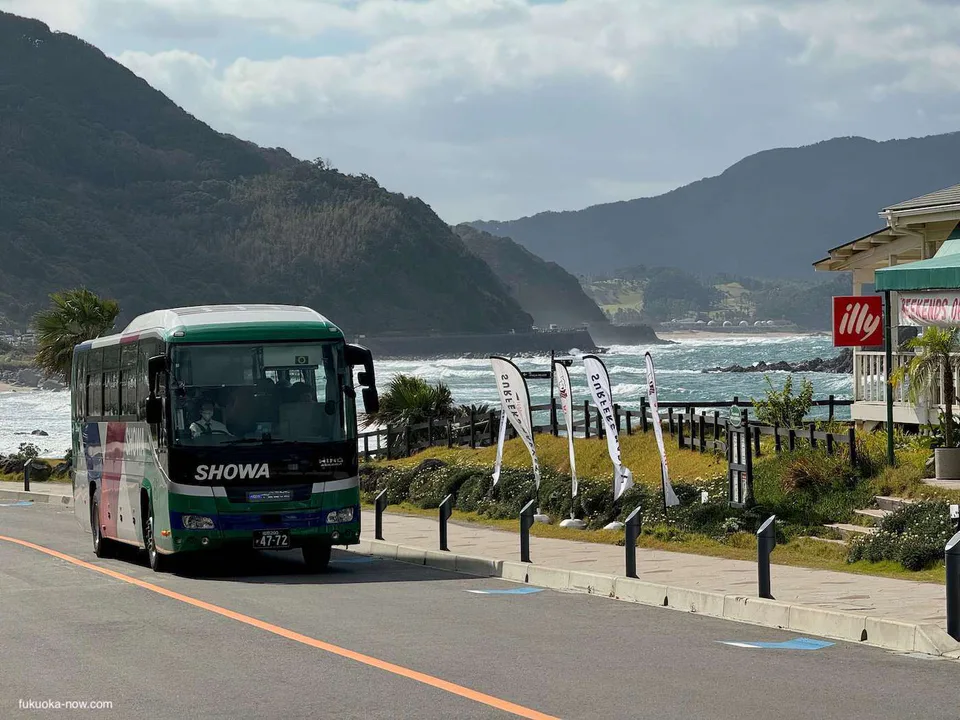
The direct West Coast Liner is excellent when your day matches its geometry: central Fukuoka → Futamigaura area → central Fukuoka. The current timetable also has boarding/alighting restrictions on the coastal section. It is not designed to let tourists casually move between every Itoshima stop as if it were a high-frequency sightseeing loop.
If you want several coastal points, check the Nishinoura / Itoshima local-bus network as well as the West Coast Liner. The more often you need to coordinate a café finish with the next low-frequency bus, the stronger a rental car becomes.
This is the hidden difference between Dazaifu and Itoshima without a car. Dazaifu asks, “How long do you want to stay?” Itoshima often asks, “Which stop must you leave by, and what do you lose if you miss it?”
A rental car changes Itoshima more than it changes Dazaifu
This is the strongest single condition that flips the comparison.
Dazaifu already works well without a car. Driving does not remove the core walk between the station area, shrine and museum, and it adds parking and traffic decisions.
Itoshima, by contrast, is a scattered peninsula. Fukuoka Prefecture’s tourism information describes the Shima Sunset Road as roughly 33 km of coast. With a car, the same geography stops being a sequence of bus cutoffs and becomes a continuous route: lunch, Futamigaura, a café, a beach or another stop can be re-ordered around weather and energy.
A car does not make every Itoshima itinerary good. Weekend traffic, parking, alcohol at cafés/restaurants and poor weather still matter. But if you already have a rental for a wider Kyushu trip, Itoshima deserves to be re-scored from the beginning rather than judged by its public-transport friction.
Choose by what is missing from the wider Japan trip
First-time visitors often make the day-trip decision in isolation. The better question is what the rest of the itinerary already contains.
If the trip already includes Kyoto, Nara, Miyajima and several temples or shrines, Itoshima can add coastline, open space and a slower café day. It is not “better” than Dazaifu; it is less repetitive.
If the wider trip is city-heavy and you have not visited a major Kyushu cultural site or museum, Dazaifu may create more contrast. Kyushu National Museum is not a token add-on: if the exhibitions interest you, it can be the reason Dazaifu deserves most of the day rather than only a shrine stop.
If you still have not decided how many nights Fukuoka deserves, use How Many Days in Fukuoka? before spending one of those scarce days outside the city.
Families and older travellers: count recovery options, not just walking distance
Dazaifu is usually easier to shorten. If somebody gets tired, you can leave the museum or shrine zone and return toward Fukuoka without dismantling an entire coastal route.
Itoshima with public transport has a higher failure cost. A café visit running 25 minutes late can become a missed bus rather than simply a later departure. With a rental car, however, the answer changes again: families can control rest stops, store extra clothing and leave when a child or older traveller is done.
For mobility-sensitive groups, do not reduce the decision to “Dazaifu has less driving.” The exact museum/shrine walking route, stairs and crowd levels still matter. The useful question is which day gives the group more exits when energy drops.
Do not combine Dazaifu and Itoshima just because both start from Fukuoka
They sit in different directions and reward different hours. Dazaifu is strongest as a compact morning-to-afternoon cultural block. Itoshima is strongest when late afternoon remains available for the coast.
Trying to do both usually creates the worst version of each: leave Dazaifu before the museum or town has paid back the journey, then arrive in Itoshima late enough that the return bus becomes the main event.
If you have two excursion days, do one each. If you have one, choose the experience that fills the bigger gap in the wider trip.
Three itineraries that actually match the decision
Option A — Dazaifu half-day + Fukuoka evening
Leave Fukuoka after breakfast, visit Dazaifu Tenmangu, use the approach street for a snack or lunch, then add Kyushu National Museum when it is open. Return to Fukuoka in time for shopping, yatai or a proper dinner. This is the highest-resilience option for a short Fukuoka stay.
Option B — Itoshima by public transport, no sunset dependency
Use the West Coast Liner or rail + local bus to make Futamigaura the anchor, add one café or nearby stop, then return before the last service becomes a constraint. This is the version I would recommend to a first-time no-car traveller who wants the coast but does not want the day to depend on a late bus.
Option C — Itoshima full coastal day with sunset
Use a rental car, a deliberate taxi budget, an overnight stay, or a return timetable that you have already checked against the sunset time for your date. This version buys the experience Itoshima is famous for instead of leaving early merely because the transport plan was never solved.
If the overnight itself is becoming attractive, move to the Itoshima day trip vs overnight decision before booking another Fukuoka hotel night.
Final verdict: Dazaifu is the default because it is easier to complete; Itoshima should win for a specific reason
Choose Dazaifu when you have a half-day, uncertain weather, no car, a family or older traveller who benefits from easy exits, or a wider itinerary that needs a strong Kyushu cultural block. Recheck the museum closure calendar and, for late-summer 2026, the temporary Main Sanctuary frontage restriction before relying on the normal experience.
Choose Itoshima when coast, cafés and sunset create more value than another cultural day and you are willing to solve the return transport before leaving Fukuoka. A rental car makes Itoshima much easier to justify. Without one, the day should be designed around the last workable bus, not around the photograph you hope to take at sunset.
The final test is simple: if you removed the most famous sight from each option, which day would you still enjoy? If the answer is museum, shrine town and a compact return to Fukuoka, pick Dazaifu. If the answer is driving or moving slowly along the coast, eating somewhere with a view and staying late enough for the light, pick Itoshima.
Okinawa Car Rental: OTS vs Toyota vs ORIX — Which Should You Book?
Fukuoka Two-Night Hotels: Do Not Waste a Three-Day Trip Moving Hotels
Nagasaki Day Trip or Overnight from Fukuoka: 4-Day Trip Guide
Kochi Yosakoi Festival 2026: Which Day, Which Venue and Do You Need Paid Seats?
Aso Day Trip or Overnight: Which Fits a 4-Day Kumamoto Trip?
References
Nishitetsu — Dazaifu Liner Bus “Tabito” · Kyushu National Museum — current hours and closure calendar · Dazaifu Tenmangu — 2026 Main Sanctuary frontage paving-work notice · Showa Bus — West Coast Liner timetable revised April 4, 2026 · Showa Bus — Nishinoura / Itoshima local-bus timetable revised April 4, 2026. Checked August 25, 2026. Bus timetables, construction restrictions, museum closures and sunset times can change; verify the exact travel date.